Location: Orkney Scotland Map
Open: Apr- Sept: (9:30am- 5:30pm)
Oct- Mar: 9:30am- 4:30pm
Entrance Fee: Apr- Oct: Adult £6.90, Child £4.10
Nov- Mar: Adult £5.90, Child £3.50
Skara Brae, located on the Bay of Skaill in Orkney, Scotland, is one of the world’s most remarkable prehistoric archaeological sites, often dubbed the “Scottish Pompeii” for its extraordinary preservation. This Neolithic village, inhabited from approximately 3100 BCE to 2500 BCE, offers a rare window into life 5,000 years ago, predating Stonehenge and the Great Pyramids of Giza. Uncovered by a storm in 1850, its stone-built houses, complete with furniture and hearths, reveal a sophisticated, settled community on the edge of the North Atlantic. Now a UNESCO World Heritage Site within the “Heart of Neolithic Orkney,” Skara Brae is managed by Historic Environment Scotland, drawing visitors to explore its ancient homes amid Orkney’s windswept beauty.
Neolithic Origins (3100–2500 BCE)
Skara Brae emerged during the Neolithic period, when farming
revolutionized human life in Britain. Around 3100 BCE, a community of
early farmers settled on the fertile shores of what is now Mainland
Orkney, then a lush, treeless landscape warmed by the Gulf Stream. These
settlers, likely descendants of migrants from mainland Europe or
Scotland, built a village of stone houses, exploiting the abundant local
flagstone due to Orkney’s scarcity of timber.
The village thrived
for about 600 years, supporting perhaps 50–100 people across 10 houses
at its peak. Evidence suggests they grew barley and wheat, kept cattle,
sheep, and pigs, and fished the rich waters of the Bay of Skaill for cod
and shellfish. Skara Brae’s longevity reflects a stable, egalitarian
society, with no clear signs of hierarchy or fortification—unlike later
Bronze Age or Iron Age sites. Around 2500 BCE, it was abandoned,
possibly due to climate cooling, rising seas, or a catastrophic
sandstorm that buried it, preserving it under dunes for millennia.
Burial and Rediscovery (2500 BCE–1850 CE)
After abandonment, Skara Brae vanished beneath sand, its inhabitants
leaving tools, beads, and even a child’s necklace behind. Orkney’s oral
traditions hinted at a “village under the sand,” but no record survived
until 1850. That winter, a fierce storm stripped away the dunes,
exposing stone walls and hearths. Local laird William Watt of Skaill
House began excavating, uncovering four houses by 1868 and sketching
finds like bone tools and pottery. Early antiquarians, including George
Petrie, recognized its antiquity, though its full significance awaited
later study.
In the late 19th century, looting and weathering
damaged the site, prompting protective measures. By 1924, HM Office of
Works took custody, and archaeologist Henry Hakewill cleared encroaching
sand, revealing more structures. The definitive excavation came in
1927–1930 under Vere Gordon Childe, a pioneering prehistorian whose work
dated Skara Brae to the Neolithic and established its global importance.
Childe’s findings—stone beds, dressers, and hearths—painted a vivid
picture of daily life, cementing its nickname, the “Pompeii of the
North.”
Modern Era and UNESCO Status (20th Century–Present)
Post-World War II excavations by David Clarke (1972–1973) refined the
timeline, using radiocarbon dating to confirm occupation from 3100–2500
BCE. In 1999, Skara Brae joined the Heart of Neolithic Orkney UNESCO
World Heritage Site, alongside Maeshowe, the Stones of Stenness, and the
Ring of Brodgar, recognizing its universal value. Historic Environment
Scotland now maintains it, with sea walls built in the 1920s and
reinforced in 2008 protecting it from coastal erosion.
As of
April 11, 2025, Skara Brae remains a living archaeological site, with
ongoing research into its abandonment and artifacts. Climate change
poses new threats—rising seas and storms endanger its low-lying
position—but its preservation continues to captivate scholars and
visitors alike.
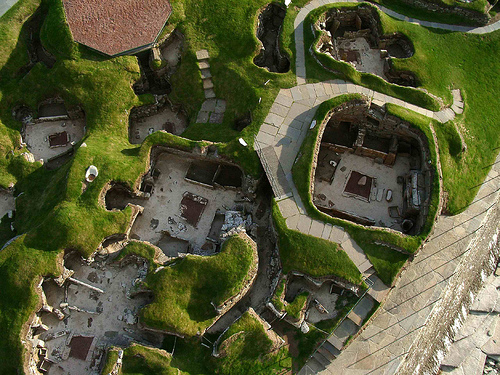
Skara Brae is a cluster of 10 semi-subterranean houses, built into midden (rubbish) heaps and linked by covered passages, showcasing Neolithic ingenuity. Constructed from Orkney’s red and yellow flagstone, its design reflects both practicality and permanence in a treeless environment.
House Structure
Each house, roughly 40 square meters (430 square feet), follows a
standardized layout:
Walls and Foundations: Double-skinned walls,
about 1 meter thick, were built by layering flat stones, with midden and
clay packing for insulation. Houses were dug into the ground, their
roofs level with the surface, sheltered from Orkney’s fierce winds.
Roofs, likely of turf, whalebone, or driftwood, have vanished, leaving
open shells.
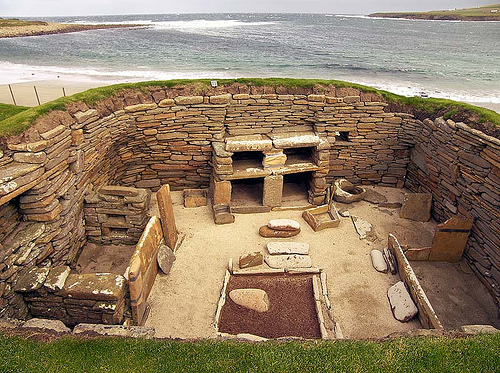
Central Hearth: Every house features a square stone
hearth, 1 x 1 meter, for cooking and heating, fueled by peat, dried
seaweed, or animal dung. Smoke escaped through a roof hole, suggesting a
cozy yet smoky interior.
Stone Furniture: Remarkably preserved, each
house contains:
A dresser, 1–2 meters wide, opposite the entrance,
possibly for displaying tools or food, built of stacked slabs with
shelves.
Two box beds, flanking the hearth, framed by upright stones
and likely padded with heather or straw, some with canopies hinted at by
post holes.
A limpet tank, a waterproof basin sunk into the floor,
used to store live shellfish or soak limpets for bait.
Entrances and
Passages: Low, narrow doorways (1 meter high) lead to passages, some
stone-lined and roofed, connecting houses like a warren. A hinged stone
or hide flap served as a door, with evidence of locking
mechanisms—grooves or bars—suggesting privacy or security.
Village Layout
The village evolved in two phases:
Early Phase (3100–2800 BCE):
Houses 9 and 10, slightly apart, are smaller and cruder, with thicker
walls and no passages, possibly the original settlement.
Later Phase
(2800–2500 BCE): Houses 1–8 form a tighter cluster, linked by passages,
with House 7 standing out for its isolation (locked from outside,
perhaps a workshop or quarantine). House 8, detached and larger, may
have been a communal space or later addition.
A central “street,” now
exposed, winds between homes, its flagstones worn by ancient feet.
Drains beneath suggest sanitation, channeling waste to the sea or midden
heaps.
Preservation and Artifacts
Buried by sand, Skara Brae’s stonework survived intact, unlike
organic roofs or wooden tools. Finds include:
Grooved Ware Pottery:
Flat-bottomed pots with incised patterns, unique to Neolithic Britain,
used for cooking or storage.
Tools: Bone needles, flint knives, and
Skaill knives (sharpened sandstone slabs) reveal crafting skills.
Jewelry: Carved stone balls, whalebone pins, and a child’s necklace of
beads hint at adornment and trade.
The site’s compactness—spanning
just 2,500 square meters (0.6 acres)—and uniformity suggest a
close-knit, cooperative community.
Grounds and Surroundings
Skara Brae’s setting enhances its allure:
Bay of Skaill: The
village hugs a sandy crescent on Orkney’s west coast, facing the
Atlantic. Waves crash against a low sea wall, built in 1924 and raised
in 2008, protecting the site from erosion. Seals and seabirds—skuas,
fulmars—dot the shore.
Landscape: Beyond the bay, rolling fields
stretch to Skaill House and the Loch of Skaill, a freshwater lochan
teeming with trout. Heather and grass cloak dunes, with the Stones of
Stenness visible 5 miles southeast on clear days.
Approach: A visitor
centre, 200 meters inland, marks the entry, with a paved path descending
to the site. The walk offers views of the Neolithic landscape—treeless,
windswept, much as it was 5,000 years ago.
Skaill House: A
17th-century laird’s mansion, 300 meters south, complements the visit,
its rooms displaying Skara Brae artifacts like Watt’s sketches and a
captain’s dinner service from a shipwreck.
The grounds lack formal
gardens, their wildness mirroring the village’s raw simplicity, with
interpretive signs guiding exploration.
Skara Brae is a cornerstone of human heritage:
Neolithic Life: Its
preservation reveals a settled, domestic world—families sleeping by
hearths, crafting tools, sharing meals—challenging views of prehistory
as purely nomadic. The absence of weapons or defenses suggests peace or
isolation, a contrast to later fortified brochs.
Archaeological
Milestone: Childe’s 1920s work revolutionized prehistory, proving
Neolithic Britain had complex societies. Its UNESCO status (1999)
affirms its global impact, linking it to sites like Çatalhöyük or
Pompeii.
Orkney Identity: For Orcadians, Skara Brae is a cultural
anchor, tied to their archipelago’s Neolithic richness—Maeshowe’s tomb,
Brodgar’s stones. Local pride fuels its upkeep, with schools hosting
digs.
Modern Resonance: Its discovery by storm mirrors climate fears
today, while its communal layout inspires sustainable living debates.
Artists and writers, from poet George Mackay Brown to filmmaker Werner
Herzog, draw on its timelessness.
Unlike castles with clan feuds or
royal pomp, Skara Brae’s quiet intimacy speaks of ordinary lives, making
it universally relatable.
Located at KW16 3LR, Skara Brae is 19 miles northwest of Kirkwall,
Orkney’s capital, a 30-minute drive via the A986. Ferries from Scrabster
(90 minutes) or Aberdeen (6 hours) reach Stromness or Kirkwall, with
buses (8A, 30-minute ride) from Kirkwall stopping at the site. Free
parking fits 50 cars, with overflow in summer.
Opening Hours
(2025):
April 1–September 30: Daily, 9:30 AM–5:30 PM (last entry 4:45
PM).
October 1–March 31: Daily, 10:00 AM–4:00 PM (last entry 3:15
PM).
Admission: £10 adults, £6 children (5–15), £8 concessions,
£25 family (2 adults, 3 children), free for Historic Scotland members.
Joint tickets with Skaill House (£12 adults) enhance the visit. Booking
online is advised.
Experience:
Visitor Centre: A modern hub
offers a film, timeline, and replica house with touchable furniture,
ideal for kids and context. The café serves Orkney bere bannocks; the
shop stocks Neolithic-inspired jewelry.
Site Tour: A 200-meter path
leads to the village, with a viewing platform above House 1 and walkways
around the cluster. House 7’s locked door and House 8’s workshop
intrigue, while the replica house (nearby) lets visitors step inside.
Accessibility: Paved paths suit wheelchairs to the platform, but uneven
turf limits closer access. Audio guides (£3) aid all visitors; kids
enjoy scavenger hunts, though parents mind low walls.
Dogs: Allowed
on leads in grounds, not in the replica house.
Highlights include the
dresser in House 1, the hearth’s warmth imagined, and the bay’s wild
beauty. Nearby, the Ring of Brodgar (7 miles) and Maeshowe (5 miles)
complete a Neolithic tour.
Challenges and Preservation
Skara Brae faces ongoing threats:
Coastal Erosion: Just 10 meters
from the sea, it’s vulnerable to storms—2023 waves breached the wall,
prompting £200,000 in repairs (2024). Rising sea levels could submerge
it by 2100 without major defenses.
Tourism Wear: 100,000+ visitors
yearly strain paths; boardwalks and restricted zones mitigate this,
though funding lags.
Climate Impact: Wetter winters soften midden,
risking collapse, while drying summers crack stone. Historic Scotland
monitors this, with plans for a higher sea wall by 2030.
Preservation
since 1924—sand removal, drainage—has saved it, but its fragility
demands vigilance, balancing access with survival.