Location: Randalstown, Antim County Map
Constructed: 1345 by O'Neill clan
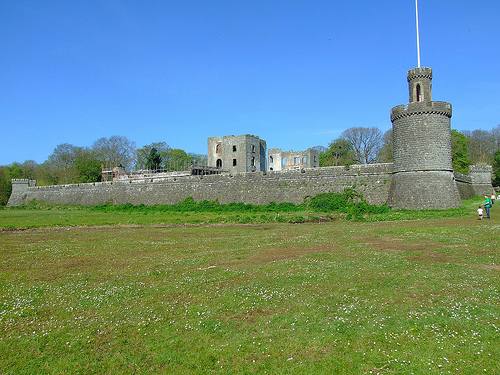
Shane’s Castle, located near Randalstown in County Antrim, Northern Ireland, is a ruined castle steeped in history and mystery, set against the scenic backdrop of Lough Neagh’s northeastern shore. Once the proud seat of the O’Neill dynasty, one of Ireland’s most powerful Gaelic families, the castle’s crumbling walls and sprawling demesne tell a story of medieval might, cultural splendor, and tragic destruction. Unlike the well-preserved Carrickfergus or romantic ruins of Dunluce, Shane’s Castle is a private estate, largely inaccessible except during special events, which adds to its enigmatic allure. Its grounds, blending ancient woodlands and modern farmland, have served as a Game of Thrones filming location, cementing its place in contemporary culture.
Gaelic origins and the first castle
The Clandeboy O’Neills, a
branch of the great Uí Néill dynasty of Ulster, pushed east
across the River Bann in the 14th century. A fortified residence
is traditionally dated to 1345. By the late 15th century the
settlement around it appears in the Annals of Ulster as the town
of Conn O’Neill. A castle on the site was attacked and
demolished in 1490; another structure is recorded under assault
in 1535.
In 1596, during the Nine Years’ War, English
observers described “a runiated pile called Edendow Carreck” on
the edge of Lough Neagh, noting that if made wardable it could
serve as a store for provisioning Blackwater and Coleraine. The
castle changed hands repeatedly in the late Tudor period as
English forces and rival Gaelic lords contested Lower Clandeboy.
Shane McBrian O’Neill and the Plantation settlement
Shane
McBrian McPhelim O’Neill (c. 1550–1616/17), last effective
Gaelic lord of Lower Clandeboy, recaptured the site and Belfast
Castle while allied with Hugh O’Neill, Earl of Tyrone. After the
Flight of the Earls and the subsequent Plantation of Ulster,
King James I settled the castle and a vast estate (later
described as more than 120,000 acres in some accounts) on Shane
McBrian O’Neill in 1607. By 1613 official documents already
address him as “of Shane’s Castle.” The present name is
generally taken from this man, though a later Shane MacBrien
O’Neill (known as “French John”) is also associated with the
1722 family vault inscription.
The early 17th-century house
was a Scottish-style Z-plan fortified residence with a bawn and
a small harbour. Part of that fabric survives in the present
ruins. Shane’s granddaughter Rose O’Neill married Randal
MacDonnell, Marquess of Antrim, in 1653 and remodelled the
house, moving the entrance into one of the smaller towers. After
her death in 1695 the property passed to a cousin, John O’Neill
(“French John”), who in 1722 built the family burial vault in
the adjoining graveyard. The inscription records it as a burial
place “to himself and family of Clanaboy.” The coffins were
later moved to Drummaul Parish Church.
Eighteenth-century
grandeur
Through the 18th century the house grew into a
three-storey castellated mansion over a basement, its main
entrance facing east. A village that had clustered on the
lakeshore was cleared shortly before 1780 so the parkland could
be opened. John O’Neill, created Baron O’Neill of Shane’s Castle
in 1793 and 1st Viscount O’Neill in 1795, lived here until he
was killed at the Battle of Antrim in 1798 during the United
Irishmen rising.
His wife Henrietta was a close friend of the
actress Sarah Siddons. Siddons stayed at the castle in 1783 and
later wrote that she had “no words to describe the beauty and
splendour of this enchanting place.” She recalled carriages and
riders setting out each morning, a table of extraordinary
luxury, silver flagons of claret, a band playing in the
corridors, and dessert plucked from fruit trees in a
conservatory whose foot was washed by the waves of the lough. A
private theatre and a 60-by-30-foot ballroom of painted canvas
sent from London completed the “Arabian Nights” atmosphere.
John Nash and the fire of 1816
Charles Henry O’Neill
succeeded as 2nd Viscount and was created Earl O’Neill in 1800.
Around 1809 he commissioned John Nash, architect of Regent’s
Park, Carlton House Terrace and Buckingham Palace, to rebuild
and reorient the house toward the south and the lough. A terrace
already existed; Nash extended it farther into the water and
designed a new conservatory (an exact copy of the one he built
for himself at East Cowes Castle on the Isle of Wight).
Foundations for a suite of reception rooms were laid and work
began about 1812.
On 15 May 1816, while a large house party
was in residence, fire broke out. The practical explanation is a
jackdaw’s (or rook’s) nest in an unused chimney that ignited and
collapsed into a room below. The blaze consumed the main block,
a valuable library and many pictures. Family papers and plate
were saved. Nash’s terrace and conservatory survived. Work on
the new house was abandoned. The Earl moved into the recently
built stable-yard offices some distance to the north-west.
Local tradition prefers a different cause. The O’Neills kept a
room empty for their family banshee, said to be Kathleen, a
daughter taken by the fairies after an ancestor cut a sacred
thorn to free a white heifer. When impending doom threatened the
family her wail was heard along the shore and the ruined walls.
On the night of the fire every room was occupied. Some guests
later claimed they heard her cry or saw a figure in armour at a
window. A carved “Black Head of the O’Neills” set about 20 feet
up on the east face of the lakeside tower is said to bring the
end of the family if it ever falls.
The American writer John
Neal published the poem “Castle Shane” in The Portico the same
year, commemorating the destruction.
Victorian house and
the 1922 fire
In the 1860s a large Victorian-Gothic mansion
was built on another part of the estate for the 1st Lord O’Neill
(the title had been revived) by Charles Lanyon and William Henry
Lynn of the Belfast firm Lanyon, Lynn and Lanyon. That house
stood until May 1922, when it was burned by the IRA during the
conflict that accompanied the establishment of Northern Ireland.
The family was given time to leave; the ruins were later
cleared. For decades the O’Neills again lived over the stables.
A new classical house was built in the late 1950s and remains
the family residence.
Estate features that survive
Nash’s conservatory, now the Camellia House, contains one of the
finest collections of camellias in the United Kingdom, many more
than a century old. It sits on a vaulted undercroft and has
thirteen arched openings with scalloped glass that pivot for
ventilation. Cannons salvaged from a British man-of-war that
sank in Lough Foyle were brought to the terrace; they were
spiked in 1848 when the government asked to borrow them during
the Young Ireland rising and never collected them. An
underground passage once linked the castle to the graveyard.
The demesne, historically around 2,200–2,600 acres of farmland,
woodland and lough shore, is still a working estate (dairy herd,
sheep flock, hydro-electric scheme using an Archimedes screw
turbine on the River Main). A 3-foot-gauge tourist railway
operated on the grounds from 1971 to 1995.
Modern fame
The ruins and shoreline have been used as Game of Thrones
locations: the Tourney of the Hand lists, dungeon and crypt
interiors, and Lough Neagh standing in for the Summer Sea. The
estate is not generally open as a public visitor attraction,
though it hosts licensed weddings and events and a paintball
operation at the Randalstown end.
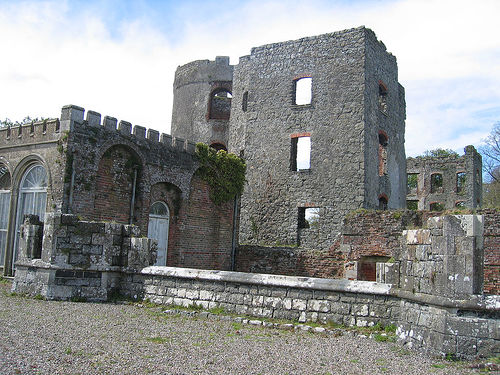
Shane’s Castle is a fragmented ruin, its surviving elements
hinting at past grandeur across multiple eras, set within a
meticulously landscaped demesne.
Medieval Core: The
original 1345 structure was a stone tower house, typical of
Gaelic strongholds, with thick basalt walls to repel attackers.
By the 17th century, it expanded into a Plantation-era castle,
with a three-story main block, battlemented parapet, and curved
bays facing the lough. Little of this survives intact, but
vaults and lower walls, extending to the water’s edge, suggest a
fortified base designed for defense and storage.
18th-Century
Splendor: Pre-1816, the castle was a castellated mansion, with a
grand terrace overlooking Lough Neagh, a conservatory, and
outbuildings. A 1787 account by Rev. Daniel Beaufort describes a
lavish interior: a drawing room with “magnificent mirrors,” a
rotunda coffee room with china-filled recesses, and a 60x30-foot
ballroom “of wood and canvas, painted” from London. A theater
hosted plays, and a conservatory linked to bathing rooms with
painted windows. These features, mostly lost, reflect Georgian
opulence.
Nash’s Vision: John Nash’s 1809–1816 redesign,
halted by the fire, aimed for Gothic drama. Surviving elements
include the extended lakeside terrace, a stone-vaulted
conservatory (modeled on Nash’s East Cowes Castle), and partial
turrets. The conservatory, housing a century-old camellia
collection, is a rare intact feature, its glass and stone
framing views of the lough.
Victorian and Later: The 1860s
Gothic castle, built post-fire, featured pointed arches and
towers but was simpler than Nash’s plan. Its 1922 destruction
left only foundations and stables, now private homes.
Underground tunnels and catacombs, used in Game of Thrones,
remain, accessible only during guided tours. The demesne’s
landscaping—oaks, a Cedar-of-Lebanon (9m girth), and manicured
gardens—preserves 18th-century parkland aesthetics.
Materials
and State: Built from local basalt and sandstone, the ruins
blend with Lough Neagh’s dark shores. Weathering and fires have
reduced the castle to scattered walls, towers, and vaults, with
ivy cloaking much of the stonework. The conservatory and terrace
are maintained, but the main ruins are unrestored, evoking
romantic decay.
Shane’s Castle is a layered symbol of Northern Ireland’s
history, bridging Gaelic heritage, colonial shifts, and modern
reinvention.
O’Neill Legacy: As the Clandeboy O’Neills’
seat, it embodies Ulster’s Gaelic past. The family’s red hand
emblem, tied to a legend of an O’Neill ancestor severing his
hand to claim land, underscores their fierce claim to Ulster.
The castle’s banshee, “Maoveen,” a wailing spirit foretelling
O’Neill deaths, adds folklore, with tales of her wandering the
ruins. A carved stone head, said to signal the clan’s end if it
falls, fuels local myth.
Cultural Hub: In the 18th century,
the castle was a salon for Ireland’s “talent, rank, and beauty,”
per Sarah Siddons. Its theater, printing press, and chessboard
of enemies’ bones (per legend) reflect a blend of refinement and
defiance. The 1816 fire, mourned in poetry, cemented its
romantic tragedy.
Modern Resonance: The estate’s Game of
Thrones role—filming Ned Stark’s tourney and dungeon
scenes—links it to global pop culture, drawing fans to its
atmospheric ruins and tunnels. Its use in festivals, like the
Country & Game Fair (July), celebrates rural Ulster life with
reenactments and crafts. The O’Neills’ continued stewardship,
including hydro-electric projects since 2000, ties the estate to
sustainability.
Community Role: While private, Shane’s Castle
is a point of pride for Antrim locals, evoking shared heritage
over sectarian divides. Its neutrality contrasts with polarized
sites, offering a space for events like steam rallies that unite
families.
The 2,700-acre demesne is a biodiversity gem, designated an Area
of Special Scientific Interest (ASSI) for its parkland.
Woodland: Covering 1,000 acres, the estate boasts ancient oaks,
lime, beech, and a rare Cedar-of-Lebanon, among Ireland’s
largest. These veteran trees host rare fungi (e.g., Milkcap,
Brittlegill), lichens, and invertebrates, unique to Britain and
Ireland.
Farmland: The 800-acre farm supports a 200-head
dairy herd and 1,000 sheep, blending tradition with modern
agriculture. Hedgerows and grasslands nurture pollinators and
birds.
Lough Neagh: The castle’s loughside position offers
views across Ireland’s largest lake, with shallow shores ideal
for wading (knee-deep, per visitors). Bats—Daubenton’s,
Leisler’s, Pipistrelles—roost in ruins and feed over water.
Conservation: The estate’s nature reserve protects red squirrels
and peregrines. Hydro-electric revival (1905 origins, restarted
2000) powers the dairy, cutting carbon. Overgrazing and visitor
trampling are managed via restricted access.
Shane’s Castle is a private estate, not a public site like
Glenariff Forest Park, and access is limited to pre-booked
events, making visits a unique challenge.
Access
Restrictions: The castle is closed to casual tourists, with “No
Entry” signs at the A6 entrance (2 miles west of Antrim,
54.727756, -6.268885). Visitors must book for events via
shanescastle.com or organizers. Tripadvisor reviews note
confusion over access, with some driving far only to be turned
away. Phone inquiries (028 9442 8216) clarify schedules.
Events:
Steam Rally (May Day weekend): A highlight,
showcasing vintage tractors, steam engines, and crafts. Tickets
(~£10 adults, £5 kids) include grounds access, with parking (£5)
and a café (sandwiches, scones). Praised for organization,
though disabled access (e.g., field-based parking) draws
criticism.
Country & Game Fair (July): Features living
history, falconry, and food stalls, drawing 10,000+. Tickets
(~£15) allow ruin exploration.
Weddings and Festivals: The
castle hosts private weddings in the conservatory or vaults, and
music festivals, where ruins enhance ambiance. Game of Thrones
tours, via loughneaghtours.com, include banshee tales and
afternoon tea (£30–50).
Paintball: Escarmouche runs
year-round paintball in Randalstown woods (£20–40), separate
from castle access.
What to See: Event visitors can
explore the ruins—turrets, vaults, conservatory—with Lough Neagh
views. The camellia collection, stone terraces, and dungeons
(used in Game of Thrones) are highlights. Tunnels and catacombs,
dark and winding, are tour-only. The demesne’s oaks, lake wall,
and stable-houses charm walkers, though paths are uneven.
Practical Tips:
Booking: Check shanescastle.com or
discovernorthernireland.com for events (e.g., May 2–3, 2026, for
Steam Rally). Book 2–3 months ahead for festivals; weddings
require direct contact.
Getting There: From Belfast (20
miles, 30 minutes), take the M2 to A6. Park at event-designated
fields; no public transport (nearest bus: Randalstown, 2 miles).
GPS: 54.727756, -6.268885.
Gear: Wear sturdy shoes for muddy
grounds; bring rain gear (Antrim’s wet). Sun cream for summer
events, per rally-goers’ “farmer’s tan” tales. Cameras capture
lough sunsets.
Accessibility: Limited—grassy fields challenge
wheelchairs, and only 5 scooters are available, booked early.
Steps to vaults exclude mobility-impaired visitors.
Safety:
Ruins have loose stones; stick to guided paths. Lough shores are
shallow but slippery. No public facilities outside events;
nearest amenities in Randalstown.
Experience: Reviews
praise the “gorgeous” grounds and “magnificent” ruins, ideal for
picnics or horse rides during events. The café at the old
railway stop serves scones and tea, evoking 19th-century
rituals. However, signage issues (e.g., misdirecting to Antrim
Castle Gardens) frustrate some.
Maintaining Shane’s Castle balances heritage, privacy, and
ecology.
Ruins: Fires left the castle vulnerable to
weathering. The conservatory and vaults are maintained, but
turrets risk collapse without costly repairs (£100,000+
estimated). The O’Neills fund upkeep privately, limiting
restoration.
Access: As a working farm, the estate
prioritizes privacy, frustrating tourists expecting open access
like Carrickfergus. Clearer online info (tripadvisor.com flagged
as vague) could reduce confusion.
Ecology: The ASSI status
protects trees and bats, but events strain grasslands.
Hydro-power and sheep grazing minimize impact, but visitor caps
(5,000/event) prevent overuse.
Community: Locals value the
estate but seek better disabled access and signage. The
O’Neills’ engagement—hosting rallies, supporting charities—earns
goodwill.
Broader Context
Shane’s Castle complements Northern Ireland’s heritage:
Vs.
Carrickfergus: Carrickfergus’s intact Norman keep contrasts
Shane’s ruins, but both tied to O’Neills (Carrickfergus rebuilt
by Neill Mór, 1497). Shane’s is less touristy, more exclusive.
Vs. Dunluce: Dunluce’s cliffside drama outshines Shane’s
loughside calm, but Shane’s Game of Thrones tunnels rival
Dunluce’s Pyke role. Shane’s privacy limits its fame.
Vs.
Glenariff: Glenariff’s public trails and waterfalls offer open
nature, while Shane’s gated demesne feels elite. Both share
Antrim’s basalt geology and Gaelic roots.
Cultural Fit:
Shane’s neutrality aligns with Glenariff’s cross-community
appeal, unlike Belfast’s contested sites. Its O’Neill banshee
echoes Dunluce’s Maeve Roe, tying Ulster’s castles to myth.