Location: Greenhow Hill Rd (B6265) between Wharfedale and Nidderdale, North Yorkshire Map
Tel. 01756 752780
Open: Mar- Nov: daily
Dec- Feb: Sat, Sun & public holidays
Official site
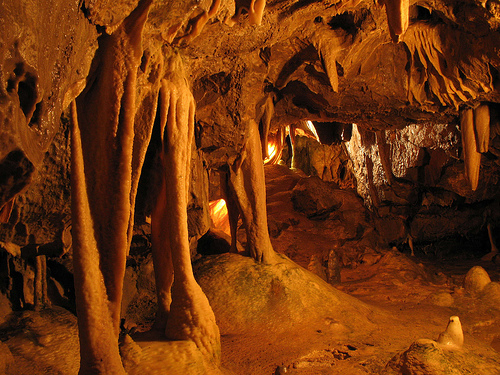
Stump Cross Caverns, located in the Yorkshire Dales near Greenhow Hill, North Yorkshire, England, is a remarkable limestone cave system renowned for its geological wonders, prehistoric significance, and family-friendly appeal. Nestled between the towns of Pateley Bridge and Grassington along the B6265, the caverns lie on the edge of the Yorkshire Dales National Park, offering a subterranean adventure steeped in history and natural beauty. As one of Yorkshire’s premier show caves, alongside Ingleborough and White Scar, Stump Cross provides a glimpse into a world formed millions of years ago, adorned with stalactites, stalagmites, and fossils of Ice Age creatures.
Regional and Stratigraphic Geology
The caves developed within the
Great Scar Limestone, part of the Dinantian (Lower Carboniferous)
succession, deposited approximately 300–350 million years ago in a
warm, shallow tropical sea near the equator. This limestone consists
primarily of calcium carbonate (CaCO₃) from the skeletal remains of
marine organisms, later compacted into a thick, soluble bedrock. In the
Greenhow area, the limestone is heavily faulted and mineralized,
forming a small inlier on the crest of an east-west plunging anticline
immediately north of the North Craven Fault within the broader Craven
Fault Zone.
The structure is key: on the northern limb of the
anticline, the limestone dips north to northeast at 15–30°. Faults,
joints, mineral veins (historically mined for lead ore), and bedding
planes exert strong control on cave morphology. Namurian (Upper
Carboniferous) Grassington Grit caps higher ground to the north and
east, where surface streams sink into the limestone, feeding the cave
system before resurfacing at Timpony Joint in Dry Gill.
Cave
Formation and Morphology
Cave development began millions of years
ago through karst processes: rainwater absorbs atmospheric CO₂, forming
weak carbonic acid (H₂CO₃) that dissolves the limestone along
fractures. Over time (with significant enlargement around 500,000 years
ago), this created an extensive phreatic (sub-water-table) network,
later modified by vadose (air-filled) stream erosion.
The system
features three main passage levels (altitude range ~370–317 m),
reflecting progressive lowering of the water table:
Upper level
(show cave sections): Large phreatic tubes with extensive sediment
fills, collapses, and decorated chambers like Reindeer Cavern and
Wolverine Cave. Passages often end in chokes or mined entrances.
Middle level: Abandoned phreatic network of rifts and tubes along
joints, veins, and bedding; half-filled with fluvioglacial sediments.
Lower level: Active (or flood-activated) constricted streamway canyons
with alternating vadose entrenchments and phreatic loops. Modern
drainage follows the anticline's structure, sweeping around it to the
west.
Passages closely mirror geology: trunk routes follow
bedding strike around the plunging anticline; rifts align with
fractures and mineral veins. Glaciation during the Pleistocene removed
some high-level inlets and resurgences, while mining (early 20th
century) drained parts of the system.
Speleothems and Mineral
Deposits
The caverns are renowned for their decorations, formed when
dripwater degasses CO2, precipitating calcite. Features include:
Stalactites and stalagmites (some colorful due to iron/lead
impurities).
Flowstones and curtains.
Columns and other forms,
especially in upper-level chambers like Keep Chamber.
Uranium-series dating of speleothems reveals intermittent growth over
the last ~170,000 years, primarily during Pleistocene interstadials.
Growth halted during full glacials (due to permafrost freezing) and
interglacials (due to system flooding)—an unusual pattern compared to
most UK sites. Thick flowstones in Wolverine Cave date to ~83 ka. These
records provide high-resolution paleoclimate data via oxygen isotopes
and growth rates.
Pleistocene Glacial and Paleontological Record
The caves preserve evidence of the Late Devensian Ice Age. Cosmogenic
nuclide dating of boulders and bedrock inside the system indicates
glacial ice scoured the area between ~21,000–18,000 years ago, with
complete deglaciation around 18,500 years ago and full thawing of the
region by 16,000–18,000 years ago.
Fossil bone beds (part of the
Banwell Bone Cave Mammal Assemblage Zone) include reindeer (including a
near-complete skeleton with unborn fetus), wolverine (recent jawbone
find during chamber excavation), bison, and other Pleistocene mammals.
These were washed in or fell through fissures and were preserved in
sediments. They document ecosystem shifts from warm- to cold-climate
fauna during glacial cycles.
Scientific and Historical
Significance
Stump Cross Caverns have advanced understanding of:
Karst hydrology (e.g., 14-year drip-rate studies showing non-linear
responses to weather and internal karst processes).
Paleoclimate
reconstruction via speleothems.
Glacial chronology and cave
evolution in glaciated terrains.
Pleistocene faunal records.
Discovered in 1860 during lead mining, the site opened as a show cave
soon after. It remains active for research and tourism, with ongoing
excavations (e.g., new chambers) potentially yielding more data.
Geological Formation and Prehistoric Context (Hundreds of Millions
to Thousands of Years Ago)
The story of Stump Cross Caverns begins
long before human discovery. The limestone bedrock formed around 300
million years ago during the Carboniferous period, when the area was
part of the ancient supercontinent Pangaea. At that time, prehistoric
Britain lay near the equator, submerged under a warm tropical sea where
marine sediments built up into limestone layers. Over eons, tectonic
forces shifted the continents, and the rock was later uplifted.
The
actual cave passages began forming roughly 500,000 years ago through
karst processes—rainwater, slightly acidic from dissolved carbon
dioxide, percolating through cracks in the limestone and slowly
dissolving it over time. This created multi-level passages, chambers,
stalactites, stalagmites, and other formations (some up to 170,000
years old, with growth occurring intermittently). The caves feature
colorful speleothems (mineral deposits) tinted by iron and lead from
the surrounding geology.
During the Pleistocene Ice Age (last major
glaciation), the caverns acted as natural traps or shelters for
animals. Prehistoric bones were washed in or deposited by meltwater
from glaciers. Key fossils include:
Multiple near-complete
reindeer skeletons (including what may be an unborn fetus), giving the
modern "Reindeer Cavern" its name.
Wolverine bones (including a
jawbone dated to around 90,000 years old, discovered in recent
excavations).
Remains of bison and Arctic fox.
These finds
provide valuable data for scientists studying Ice Age paleoecology,
climate, and deglaciation (the area became ice-free around 18,500 years
ago). Many of these bones were found during early digs and are now
displayed or studied at the site.
Discovery by Lead Miners
(1860)
The caverns entered recorded human history in January 1860
(some sources cite 1858) when lead miners William and Mark Newbould,
working for the Yorkshire Mining Company, accidentally broke into the
system while prospecting for lead veins at a depth of about nine
fathoms (around 16.5 m / 54 ft). They sank a shaft near the site of the
old Stump Cross marker and struck a vast underground chamber instead of
ore.
The miners found no commercial lead but discovered the cave's
spectacular formations and the first reindeer fossils. Early accounts
describe "very extensive caverns" with twisting passageways. By 1867,
explorers had mapped about 1,100 yards (1,000 m) of passages, and the
site quickly gained attention as a natural wonder. It opened to the
public around 1863 (or shortly after discovery), making it one of the
earliest show caves in the region, though initially rudimentary without
modern lighting or paths.
Early Development and 1920s
Explorations
In the late 19th and early 20th centuries, the caves
attracted visitors and amateur explorers. A pivotal figure was
Christopher Long, a medical student at Caius College, Cambridge, who
conducted thorough explorations in 1922. Long and fellow students
mapped new sections, discovering vividly colored stalactites
(impregnated with iron and lead) and additional prehistoric bones
(including more reindeer and wolverine remains). He reportedly found an
underground lake but allegedly sealed its entrance after the owners
refused to share tourism revenue with him—a local legend known as
"Long's Lost Lake." His work added around 450 m of new passages.
In
1926, the caves were sold for £400 to Septimus Wray (owner of Heysham
Head Pleasure Gardens). Wray's son-in-law, Harry Deane Hornby, managed
them initially, followed by Wray's grandson George Gill. The family
installed electric lighting, improved access, and actively promoted the
site as a tourist attraction with an information centre, gift shop, and
even a cottage for owners. It remained in the Gill family (later under
Gordon Hanley) until 2003.
World War II and Post-War Caving Boom
(1930s–1960s)
Caving enthusiasm grew in the early 20th century. The
Craven Pothole Club (CPC), founded in 1929, became central to Stump
Cross explorations. Members like Eli Simpson visited as early as the
1900s–1930s, and the club focused efforts here in the 1940s.
During
World War II, the caves were closed to the public. Authorities feared
German paratroopers could seize them as bases, so the entrance was
blocked with rubble. After the war, this rubble was reused to build the
modern cave steps still used today.
Post-war, the CPC and other
groups (including the Angels of the North Cave Diggers, many
overlapping with CPC) conducted systematic digs and surveys from the
1950s onward. They extended passages, mapped connections, and recovered
more fossils. The club’s long association continues today, with major
discoveries credited to its members.
A standout event was in 1963,
when caver Geoffrey (Geoff) Workman spent a record-breaking 105 days in
total isolation underground (June–September). He aimed to study the
effects of prolonged solitude (relevant to Cold War nuclear shelter
ideas) while surveying and photographing passages. Equipped with
camping gear, food, and scientific tools, he endured events like the
Profumo scandal and Great Train Robbery via radio updates but reported
never feeling bored. He celebrated his emergence with a meal of mashed
potato, mushroom soup, and strawberry jelly, toasting "Queen and
country" and fellow speleologists. The stay extended the known cave
network and drew national media attention (including a Pathé newsreel).
Workman’s record stood for decades until broken in 2021–2023 by Beatriz
Flamini (500 days). He advised on the 2010 Chilean miners’ rescue and
returned for a 50th-anniversary recreation in 2013 before his death in
2020.
Late 20th Century to Present: Modern Show Cave and Ongoing
Exploration
The site gained Site of Special Scientific Interest
status for its geological and paleontological value. In 2000, Reindeer
Cavern—first discovered decades earlier—was opened to the public after
further clearing, revealing more Ice Age bones.
In 2003, the caves
were sold for £675,000 to the Bowerman family (who also part-own
Richmond Brewery, which released a Stump Cross ale in 2008). They
remain privately owned and operated as a family-friendly tourist
attraction with UV lighting effects, a café, and educational exhibits.
Annual visitors exceed 60,000.
Exploration continues. The Angels of
the North Cave Diggers and CPC have worked on extensions since the
1950s. As of 2025–2026, volunteers are excavating a major new section
(previously potholer-only) filled with mud and rubble but featuring
spectacular stalactites, stalagmites, and calcite curtains. Over 75
tonnes of material have been removed (with ~300 tonnes left), using
innovative underground engineering like shafts, tracks, conveyors, and
a custom shadoof. The goal is a public opening around 2028, though it
will take as long as needed for safety and quality. Recent finds
include a ~90,000-year-old wolverine jawbone.
Today, Stump Cross
Caverns blends Victorian-era discovery with modern science and
tourism—a living link to deep geological time, Ice Age wildlife,
lead-mining heritage, and the enduring spirit of British caving. It
remains a portal to "a long-forgotten age before humans or dinosaurs
roamed the Earth," as the official site describes it.
Ecology
As an SSSI, Stump Cross Caverns support a delicate ecosystem. The
caves’ stable climate nurtures fungi and bacteria, while bats—likely
pipistrelles—roost in unlit passages, though public areas see fewer due
to disturbance. Fossilized remains dominate the ecological narrative,
with reindeer and wolverine bones offering snapshots of a glacial past.
Above ground, the surrounding moorland hosts curlews, lapwings, and
heather, typical of the Dales’ upland ecology.
Conservation is
paramount. Lighting is designed to minimize algae growth on formations,
and visitor paths protect fragile calcite. The Bowermans’ restoration
efforts, like clearing debris from new passages, ensure the caves
remain a living geological record.
Stump Cross Caverns offer a 40–50-minute self-guided tour through
lit passages, ideal for families and adventurers. Visitors descend 65
steps (no lift), navigating narrow, low-ceilinged tunnels—hard hats are
provided, essential for taller guests. The caves’ 7°C chill demands
warm clothing and sturdy shoes, especially after rain, as floors can be
slippery. Key features include:
Wedding Cake: A calcite column
sparkling under lights.
Sleeping Cat: A whimsical stalactite
formation.
Reindeer Cave: Home to fossil displays and eerie
acoustics.
Curtains and Flowstone: Dripstone sheets glowing with
mineral hues.
A unique Ultraviolet (UV) Experience, available
after 3pm, dims regular lights, providing UV torches to reveal
calcite’s fluorescent glow—an innovative twist praised by visitors,
though some expected fixed UV lighting. Educational signs feature
characters like “Sally Shark Tooth,” while a fairy door trail and
fossil quiz (with prizes like gemstones) delight kids. An audio guide,
downloadable but not always advertised, adds depth.
The visitor
center enhances the day:
Time Café: Serves homemade scones, sausage
rolls, and coffee, though recent menu shifts to fast food have drawn
mixed reviews (e.g., a £11 steak pie criticized as “paste with gravy”).
Prices range from £3 for cakes to £10–15 for meals.
Gift Shop:
Stocks fossils, crystals, jewelry, and local honey, earning praise for
quality over tacky souvenirs.
Cinema Room: Screens a 20-minute film
on cave geology, best viewed before touring, though shown post-tour.
Fossil Dig and Gem Panning: Outdoor activities for kids, weather
permitting.
Tickets cost £15 (adults), £10.50 (children 4–17),
£47.50 (family of four), with free entry for under-4s. Booking online
saves 10%, and York Pass holders get discounts. The site opens 9am–6pm
(7pm Saturdays), with winter hours limited to weekends and holidays. No
wheelchairs or dogs (except guide dogs) are allowed underground due to
65 steps and uneven terrain; the café and shop are accessible.
Motorhome parking (£5/night, max three nights) offers hilltop views but
requires self-contained facilities.
Events include Easter egg
hunts, Dino Days with fossil talks, and school tours (£6/child, one
free teacher per 20 students). Visitors rave about staff
friendliness—guides like Stephen shine—but note busy café tables need
faster clearing. TripAdvisor rates it 4.5/5 from 700+ reviews, with
families loving the “dinosaur egg” anagram trail.
Stump Cross Caverns embody Yorkshire’s rugged charm and geological
legacy. Their discovery by lead miners reflects the Dales’ industrial
past, while fossils evoke a prehistoric wilderness. The 1963 isolation
experiment, though quirky, underscores their role in pushing human
limits. Locally, they’re a point of pride—Nidderdale’s “underground
jewel”—and their Stump Cross Ale ties them to Yorkshire’s brewing
tradition.
Nationally, they join caves like Cheddar Gorge in
showcasing Britain’s subterranean heritage. Educationally, they
inspire, with quizzes and online tours reaching global audiences. Posts
on X highlight their family appeal, citing fossil digs and
cavewoman-guided adventures as 2025 draws.
The caverns face hurdles: no wheelchair access limits inclusivity,
and mobility-impaired visitors may find the 65 steps daunting. Café
quality has dipped since losing a chef, with some calling the menu
“average” compared to nearby Toft Gate Barn. Financially, the
Bowermans’ crowdfunding reveals the struggle to maintain a niche
attraction amid rising costs. Climate change could alter groundwater,
affecting formations, though the caves’ depth offers resilience.
Future plans include expanding educational outreach—virtual reality
tours are mooted—and restoring more passages. The Bowermans aim to keep
prices affordable while enhancing the UV Experience, potentially adding
fixed lighting. Community ties, via local schools and fossil clubs,
ensure Stump Cross remains a Dales staple.