Location: Abbey Lane, North Yorkshire Map
Tel. 01947 603569
Open: Mar- Oct: daily
Nov- Feb: Thu- Mon
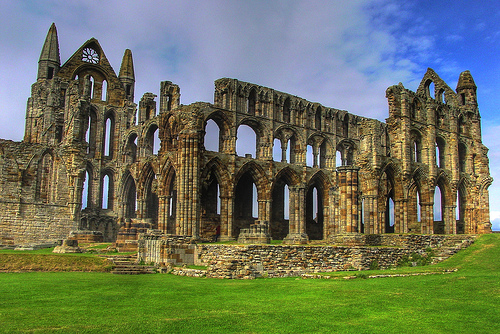
Whitby Abbey, perched dramatically on the cliffs above the North Sea in Whitby, North Yorkshire, is one of England’s most iconic and evocative historic sites. A Scheduled Ancient Monument managed by English Heritage, this ruined Benedictine monastery commands sweeping views over the town, harbor, and coastline, blending spiritual significance, architectural grandeur, and literary fame. Founded in 657 CE by St. Hilda as a double monastery for monks and nuns, it played a pivotal role in early Christianity, notably hosting the Synod of Whitby in 664 CE. Its haunting silhouette, shaped by centuries of prosperity, destruction, and decay, inspired Bram Stoker’s Dracula, cementing its gothic allure.
Geography
Whitby Abbey crowns the East Cliff, a 100-foot-high promontory
overlooking the River Esk’s estuary and the North Sea. The abbey’s
elevated position, reached by climbing the famous 199 steps from
Whitby’s old town, offers panoramic vistas of the red-roofed fishing
port, the harbor’s twin piers, and the rugged Yorkshire coast stretching
toward Sandsend and Robin Hood’s Bay. To the west, the North York Moors
National Park unfurls in rolling heather-clad hills, framing the abbey
in a landscape both wild and serene.
The site’s exposure to
coastal winds and salt spray has weathered its sandstone ruins,
enhancing their stark beauty. Below the abbey lies Church Street, a
cobbled lane lined with Georgian houses, jet shops, and fish-and-chip
eateries, linking the site to Whitby’s maritime heart. The abbey grounds
include St. Mary’s Church, a Norman parish church with a quirky box-pew
interior, and the Cholmley family’s 17th-century manor house, now a
visitor center. The surrounding cliffs, part of the Jurassic Coast, are
fossil-rich, drawing geologists and ammonite hunters to the beaches
below.
Whitby Abbey’s story spans over 1,400 years, intertwining Anglo-Saxon piety, Viking raids, medieval revival, and post-Reformation decline.
Anglo-Saxon Foundation (657–867 CE)
The abbey, originally called Streanæshalch (possibly meaning “beacon
fort”), was founded in 657 CE by St. Hilda, a noblewoman of the
Northumbrian royal house. As a double monastery housing both monks and
nuns, it was a center of learning and spirituality under Hilda’s rule.
Bede’s Ecclesiastical History praises her wisdom, noting that five monks
from her monastery became bishops. The abbey’s most famous moment came
in 664 CE with the Synod of Whitby, a pivotal debate that aligned the
Northumbrian church with Roman practices over Celtic ones, standardizing
Easter’s date and monastic customs across England.
The monastery
thrived as a hub of scholarship, fostering figures like Cædmon,
England’s earliest recorded poet, whose hymn (circa 670 CE) survives in
Bede’s text. Artifacts from this era—stone crosses, inscribed slabs, and
a comb with runic letters—reveal a vibrant community. By the 9th
century, however, Viking raids loomed. In 867 CE, Danish invaders sacked
the monastery, leaving it in ruins for over two centuries.
Norman and Medieval Revival (1078–1539)
After the Norman Conquest, William de Percy, a Norman baron, granted
land to monks from St. Peter’s in York to refound the abbey in 1078.
Relocated slightly from its original site, the new Benedictine monastery
grew under royal and noble patronage. By the 12th century, it housed 40
monks, supported by estates across Yorkshire and fishing rights in
Whitby’s harbor.
The abbey’s wealth funded a grand rebuilding in
the 13th century, creating the Gothic masterpiece whose ruins stand
today. The east end, with its soaring choir and intricate window
tracery, was completed around 1225–50, reflecting Early English Gothic
style. The north transept and nave followed, their scale rivaling
cathedrals like Ripon. Monks lived by Benedictine rules, praying eight
times daily, while lay brothers worked the abbey’s farms and jet mines,
Whitby jet being prized for jewelry.
The abbey’s prosperity
peaked in the 14th century, but challenges arose. The Black Death
(1348–50) halved England’s population, straining monastic life, and
economic shifts reduced endowments. By the 15th century, the abbey
housed only 15–20 monks, though it remained a regional power, electing
MPs for Whitby and hosting pilgrims.
Dissolution and Decline (1539–1640)
The Dissolution of the Monasteries under Henry VIII ended Whitby
Abbey’s monastic era. In 1539, its last abbot, Henry Davell, surrendered
the abbey to the Crown, which stripped its lead roofs, bells, and
treasures. Valued at £437 annually (about £250,000 today), the abbey was
granted to the Cholmley family in 1550, who converted its abbot’s
lodging into a manor house, later expanded in the 1670s with a
banqueting hall.
Neglect and coastal erosion took their toll. By
the 17th century, the nave’s west end collapsed, and storms battered the
exposed ruins. The Cholmleys, ardent Royalists, lost influence after the
Civil War (1642–51), and the abbey grounds passed through various
owners, used for grazing and quarrying.
Modern Rediscovery (18th Century–Present)
The 18th century saw renewed interest in ruins as romantic symbols.
Antiquarians sketched Whitby Abbey, and its gothic aura inspired artists
and writers. In 1830, a storm felled the central tower, reshaping the
skyline, while 1839 saw the choir’s east wall collapse, leaving the
jagged outline seen today.
World War I brought unexpected drama:
on December 16, 1914, German battlecruisers shelled Whitby, hitting the
abbey and damaging its west end. Repairs followed, and in 1920, the
ruins were gifted to the Ministry of Works (now English Heritage) by Sir
Hugh Cholmley. Excavations in the 1920s–30s and 1990s uncovered
Anglo-Saxon artifacts, confirming the site’s early history. Today,
English Heritage maintains the ruins, balancing preservation with public
access.
Whitby Abbey’s ruins showcase Gothic architecture’s evolution,
despite their weathered state. The surviving structures—primarily the
choir, presbytery, north transept, and parts of the nave—are built from
local sandstone, quarried from Sneaton and Aislaby. The east end,
rebuilt circa 1225, is a highlight, with slender lancet windows and
delicate tracery typical of Early English Gothic. The choir’s
triple-tiered design, with arcades, triforium, and clerestory, mirrors
Salisbury Cathedral’s precision, though sea winds have eroded much
detail.
The north transept, with its rose window frame, hints at
later Decorated Gothic influences (circa 1300), while the nave,
partially standing, shows robust piers designed to support a vaulted
roof. The abbot’s house, altered by the Cholmleys, retains medieval
foundations but sports 17th-century domestic features like large
windows. Anglo-Saxon remains—cross fragments and a well—are subtler,
displayed in the visitor center.
The ruins’ silhouette,
especially at dusk, is unforgettable: jagged arches frame the sky, their
decay amplifying their drama. St. Mary’s Church, adjacent, adds Norman
heft, its boxy tower and battlements contrasting the abbey’s elegance.
Cultural Significance
Whitby Abbey’s cultural resonance is profound, rooted in its
spiritual and literary legacy. As the Synod of Whitby’s host, it shaped
England’s Christian identity, aligning it with Rome and influencing
medieval Europe. Cædmon’s poetry, born here, marks the dawn of English
literature, blending oral tradition with Christian themes.
Its
gothic ruin inspired Romanticism, but Bram Stoker’s Dracula (1897)
sealed its fame. Stoker, staying in Whitby in 1890, imagined the
vampire’s shipwreck below the abbey, with Dracula bounding up the 199
steps as a black dog. The abbey’s eerie presence permeates the novel,
drawing Goths and fans to Whitby’s twice-yearly Goth Weekend, where
velvet-clad revelers celebrate its spooky vibe.
The abbey appears
in art—Turner’s watercolors—and modern media, from Robin Hood: Prince of
Thieves to Netflix’s Dracula. Local folklore, like tales of Hilda’s
ammonite fossils as “snake stones,” adds whimsy, tying the abbey to
Whitby’s jet and fishing traditions.
Whitby Abbey is open year-round (10am–5pm, weather permitting), with
seasonal closures from November to February except weekends. Adult
tickets cost £12.80 (£11 online), with discounts for children (£7.70),
families, and English Heritage members (free entry). The visitor center,
housed in the Cholmley manor, offers a museum with interactive
displays—Anglo-Saxon combs, medieval tiles, and a replica Cædmon
cross—plus a café serving hot drinks and cakes. A gift shop sells jet
jewelry, Viking-themed trinkets, and Dracula editions.
The ruins
are explored self-guided, with audio tours (£4) narrating Hilda’s life
and Stoker’s inspiration. Paths are uneven, with steps and grass, but
ramps aid wheelchair users to key areas; the visitor center is fully
accessible, with braille guides and a hearing loop. The 199 steps from
town deter some, but a car park (£5 daily) near the abbey eases access,
with blue badge spaces.
Events enrich visits: Easter quests,
Viking reenactments, and Halloween “Illuminated Abbey” nights, when
floodlights bathe the ruins in eerie glows, draw crowds. Summer
storytelling and medieval craft workshops engage kids, while guided town
walks link the abbey to Whitby’s jet and fishing heritage. St. Mary’s
Church, free to enter, adds quirky charm with its 1818 hearse and pews
carved with donors’ names.
The abbey’s clifftop can be
windy—bring layers—and views are best at sunrise or dusk. Nearby
attractions include the Captain Cook Museum, Whitby Jet Heritage Centre,
and the beach, where fossil hunting is a local rite.
The abbey headland sits on the Cleveland Way National Trail and
within a stretch of coast valued for both geology and wildlife. Herring
gulls, kittiwakes and fulmars nest on the sheer East Cliff faces, while
pipistrelle and other bats use the eaves and voids of Abbey House and
the visitor centre. In summer, thrift and sea campion colour the turf,
and grey seals sometimes haul out on the rocks and beaches below,
especially toward Saltwick Bay. English Heritage manages the site as
both monument and habitat: masonry is consolidated, vegetation is cut
back from nesting ledges, and paths are routed to keep people off
fragile cliff edges.
Erosion is the constant threat. The headland is
Jurassic shale, clay and sandstone; storms and rising seas eat the cliff
from below. Rescue excavations between 1993 and 2008 recorded Anglian
and later remains before they were lost, and rock armour at the foot of
Abbey Cliff helps slow undercutting. Survey work, including LiDAR,
tracks retreat so that further archaeology can be recovered in time.
Climate change sharpens that risk. Stronger winter storms and higher
seas put pressure on the East Cliff’s stability and on the ruined church
itself, already thinned by centuries of salt wind. English Heritage’s
longer conservation programme has focused on drainage, stone repair and
climate-ready work on the visitor centre (originally the 17th-century
Cholmley mansion). Solar panels on that roof now supply a large share of
the building’s daytime power; larger downpipes and lightning protection
deal with heavier rain and more frequent thunderstorms.
Visitor
pressure is the other constraint. The abbey draws on the order of
150,000 people a year. Peak summer days fill the café, shop and headland
car park; grass paths wear quickly. The famous 199 steps from the old
town remain the most atmospheric approach and appear in Dracula, but
they shut out many visitors with limited mobility. Step-free access is
via Abbey Lane and the headland car park; the visitor centre has ramps,
accessible toilets and a modernised lift to the upper exhibition.
Shuttle options from town have been discussed to ease both congestion
and the climb.
Looking ahead, English Heritage continues stone
consolidation and vegetation control while exploring digital
reconstructions of the lost Anglo-Saxon monastery of Streoneshalh. Local
schools and volunteers keep the story of Hilda, Caedmon and the Synod of
Whitby alive on the ground. International interest still rides on
Stoker’s 1897 novel; a festival marking the book’s 130th anniversary in
2027 has been floated as one way to tie literature, Goth culture and the
ruins together without overloading the fragile cliff. The balance
remains the same as on the ground: open the abbey to as many people as
possible, and keep enough of the headland standing for the next century.