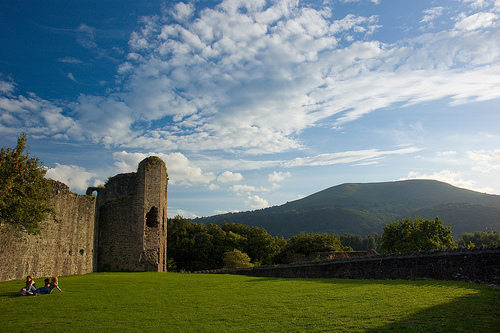
Location: Aberregavenny, Monmouthshire Map
Abergavenny Castle, located in the market town of Abergavenny in Monmouthshire, southeast Wales, is a picturesque medieval ruin that stands as a testament to the region’s turbulent history along the Welsh Marches. Perched on a low ridge overlooking the River Usk, approximately 20 miles (32 kilometers) north of Newport and 15 miles (24 kilometers) west of Monmouth, this 11th-century fortress has evolved from a Norman stronghold into a cultural landmark, now housing the Abergavenny Museum. Managed by Monmouthshire County Council, the castle’s weathered stone walls, towers, and scenic grounds offer visitors a blend of historical intrigue, architectural remnants, and local heritage.
Foundation (Late 11th Century)
The castle was established around
1087–1088 by Hamelin de Ballon, the first Norman Lord of Abergavenny,
shortly after the Norman Conquest of England extended into Wales. De
Ballon, a Norman knight granted lands by William the Conqueror, chose
the site atop a natural spur above the River Usk to secure the valley
route from Welsh incursions and control access between the lowlands and
the hills to the north and west. The location incorporated the ruins of
a Roman fort and civilian settlement known as Gobannium, providing a
strategic vantage. Initially, it was a classic Norman motte-and-bailey
design: an earthen motte (mound) topped with a wooden tower for
oversight, surrounded by a bailey (enclosure) with timber palisades,
dwellings for soldiers and servants, and a dry moat. De Ballon also
founded the nearby Benedictine priory of St Mary in the early 12th
century, further consolidating Norman influence.
Growth and Peak
Period (12th–14th Centuries)
In the 1160s, the castle passed to Henry
Fitzmiles, Earl of Hereford and Lord of Abergavenny, who was killed by
Seisyll ap Dyfnwal, the Welsh Lord of Castell Arnallt (Gwent). Without a
male heir, it transferred through marriage to William de Braose, a
ruthless Marcher lord known for his cruelty. De Braose rebuilt and
extended the castle, adding a timber great hall and a curtain wall,
though it was not his primary residence.
The castle's zenith in
notoriety came in 1175 with the infamous Christmas Day Massacre. De
Braose invited Seisyll, his son Geoffrey, and other Welsh leaders to a
banquet under the guise of reconciliation, only to have them slaughtered
in the great hall as vengeance for Fitzmiles' death. This act, possibly
sanctioned by Henry II, led to sanctions against de Braose, forcing him
to retire and pass the estate to his son. In retaliation, Hywel ap
Iorwerth (Lord of Caerleon) and Seisyll's relatives burned the castle in
1182, capturing much of the garrison but sparing de Braose, who was
absent. During this attack, Welsh archers reportedly penetrated the oak
door of the tower with arrows, as chronicled by Gerald of Wales in 1188.
By 1190, the castle was rebuilt in local red sandstone for enhanced
defense, including five towers along the curtain wall and a new keep.
King John visited in 1215. In the early 13th century, amid Welsh-English
conflicts, it changed hands frequently and was destroyed again in 1233
by Richard Marshal, Earl of Pembroke, and Welsh princes during a revolt
against Henry III. It was rebuilt with a stone keep replacing the wooden
one.
Mid-13th century ownership shifted to William III de Cantilupe
via marriage to Eva de Braose, then to the Hastings family. The
Hastings, particularly John (1st Lord Hastings, d. 1313), expanded it
significantly between 1295–1314, adding two western towers (circular and
polygonal). By 1389, after the last Hastings lord died without heirs, it
passed to the Beauchamp family.
Architectural Developments
Abergavenny's architecture reflects its evolution from a defensive
Norman outpost to a more residential Marcher stronghold. The original
1087 motte-and-bailey featured a timber tower on the motte and a
palisaded bailey. Early 12th-century additions included a stone keep on
the motte and a timber great hall. Under de Braose in the late 12th
century, a curtain wall was added, with surviving stretches to the right
of the gatehouse standing nearly full height.
Post-1233 rebuilding
used local red sandstone, including a cylindrical stone keep on the
motte with a pointed arch entrance, Gothic windows, arrowslits, and a
probable wall-walk. The perimeter wall enclosed an inner ward (c. 20x45
meters) and outer bailey (diagonal c. 60 meters), with the northern wall
thickest (up to 2.3 meters). Hastings expansions (late 13th–early 14th
centuries) added two connected towers in the northwest: cylindrical
(with latrine and fireplace) and quadrilateral (four floors: pantry,
guard room, residential chambers). The great hall (c. 28x8 meters) was
rectangular at first-floor level, with storage below and a separate
kitchen.
In the early 15th century, a quadrilateral gatehouse (8x12
meters) was added, with a drawbridge, guard room, ogival portal, and
portcullis. A barbican was built around 1404 during the Glyndŵr threat.
The north curtain was later landscaped into a rock garden in the late
19th century.
Decline and Challenges (15th–17th Centuries)
From the 15th century, with no permanent lords residing there, major
expansions ceased. In 1402, a riot erupted when the constable attempted
to hang three townsmen; supporters stormed the castle, freed them, and
imprisoned Lady Joan Beauchamp in the keep. During Owain Glyndŵr's
rebellion in 1404, Welsh forces sacked the town but failed to capture
the castle, which was relieved by English forces; by 1405, it had a
garrison of 80 cavalry and 400 archers until the revolt's end in 1415.
By the 17th century, the castle was in disrepair. During the English
Civil War (1640s), as Parliamentary (Roundhead) forces approached, King
Charles I ordered its slighting to prevent enemy use, destroying most
buildings including the keep. Alternatively, some sources suggest
Parliamentary forces slighted it in 1647.
Post-Destruction
History
In the late 18th century, amid Romantic interest in ruins,
the site attracted tourists. In 1818–1819, Henry Nevill, 2nd Earl
(Marquis) of Abergavenny, built a hunting lodge on the motte, altering
the medieval remains. The north curtain was landscaped into a rock
garden in the late 19th century.
Current Status
Abergavenny
Castle is a picturesque ruin and Scheduled Ancient Monument, with
surviving elements including the 15th-century gatehouse, fragments of
the curtain wall, the northwest towers (cylindrical and polygonal), and
the motte with the 19th-century lodge. The lodge houses the Abergavenny
Museum, open to the public, featuring exhibits on local history,
folklore, and artifacts. The inner and outer wards are grassy fields
ideal for picnics, and the site can be explored in a few hours.
Overall Layout and Site Planning
The castle occupies a promontory
on a low hill west of the Gavenny River (flowing into the Usk), with
natural defenses from marshy floodplains to the west and south, and
adjacency to a Benedictine priory to the east. The layout follows a
motte-and-bailey design, with a circular earthen motte (mound) at the
southern end (diameter about 20-25 meters/65-82 feet) and two baileys:
an inner ward (approximately 20 x 45 meters/65 x 148 feet) to the north
of the motte, and a larger outer bailey (diagonal about 60 meters/197
feet). A transverse cross-wall (1.6 meters/5.2 feet thick) divides the
wards, with the northern curtain wall (up to 2.3 meters/7.5 feet thick)
tying into the town's medieval defenses. A dry moat surrounds the site
as an outer defense, with access via a gatehouse on the northern side
leading to a narrow passageway. The design prioritized control over the
Usk Valley, with the motte as the core stronghold and baileys for
residential and service functions.
Key Structures: Gatehouse,
Towers, Halls, and Motte
The gatehouse, added around 1400-1402
(possibly in response to Owain Glyndŵr's threats), is a quadrilateral
structure (8 x 12 meters/26 x 39 feet) protruding slightly from the
curtain wall, with a long vaulted passageway (originally with a
portcullis and drawbridge over the moat), murder holes, and upper
guardrooms heated by fireplaces. It features an ogival (pointed) portal
and a four-sided recess for the drawbridge.
The towers include a
complex in the northwest corner of the inner ward (early 14th century):
a cylindrical tower (with latrine and fireplace) and a polygonal
(quadrilateral) tower (sides about 10 meters/33 feet above plinth, four
floors: basement pantry, guardroom, residential chambers with large
windows and stone seats). A spiral staircase connects them. In the
southeast outer bailey, a four-sided tower (early 15th century) adjoins
a vaulted cellar. The curtain walls enclose the site, with a prominent
eastern stretch (almost full height) featuring a rectangular projecting
tower stub.
The great hall, in the outer bailey (rectangular, 28 x 8
meters/92 x 26 feet), was originally timber (12th century) but rebuilt
in stone, with the first floor for feasts (dais, windows, spiral
staircase to kitchen) and ground level for storage. An underground room
(possible dungeon) lies in the central lawn.
The motte holds the
keep: originally a cylindrical stone tower (c. 1233, with pointed arch
entrance at first-floor level via removable wooden stairs, Gothic
windows, arrowslits, and battlemented parapet). Now topped by the 1819
hunting lodge (Victorian "keep").
Architectural Styles and
Evolution
Abergavenny's architecture evolved from Norman
motte-and-bailey (timber, late 11th century) to stone fortifications
(12th century under de Braose: curtain walls, timber hall). Post-1233
destruction, a cylindrical stone keep was added (Gothic windows, pointed
arches). The Hastings era (late 13th-early 14th centuries) introduced
polygonal and cylindrical towers with residential features (large
windows, fireplaces), reflecting a shift to comfort amid defense. The
15th-century gatehouse features Perpendicular Gothic elements (ogival
arches). Styles blend Norman austerity (thick walls, arrowslits) with
later Gothic domesticity. Evolution halted after the 15th century due to
absentee lords, with Civil War slighting (1640s) causing collapses, and
19th-century additions (hunting lodge) blending Romantic revival.
Materials and Construction Techniques
Primarily local stone
(rubble cores with ashlar facing, dressed surrounds on windows/arches)
for walls, towers, and keep; timber for early structures, ceilings, and
roofs (flat wooden ceilings, possible open trusses). Thick walls (up to
2.3 meters/7.5 feet) provided strength, with battered bases for
stability. Techniques included earthen motte piling, spiral staircases
in wall thickness, vaulted passageways/cellars, removable external
stairs for keep access, and drawbridges with rope mechanisms (no chain
wear). Oak was used for doors (e.g., thick planks penetrated by arrows
in sieges).
Notable Features and Historical Modifications
Key
features: motte with embedded medieval walls in the lodge; northwest
tower complex for defense/residence; hall's dais and lighting;
gatehouse's ogival portal and drawbridge recess; possible tunnels
(unconfirmed). Modifications: 1182 fire/repair; 1233 destruction/stone
keep; 13th-14th century expansions (towers); 1400 gatehouse; 1402 riot
(keep imprisonment); 1404 siege (withstood); 1640s slighting (wall
collapses); 1819 lodge/museum; late 19th-century landscaping (north wall
rock garden). Infamous for 1175 massacre and treachery reputation.
Current State as Ruins
The castle survives as atmospheric ruins,
with substantial curtain wall stretches (east side near full height),
tower outer walls (up to four storeys), gatehouse fragments, hall
foundations, and the motte lodge (now museum, open Tue-Sat 11am-4pm).
Open daily dawn-dusk (free entry), with green spaces, uneven paths, and
views. Preserved as a scheduled monument and public park, it attracts
visitors for history and scenery, though much is reduced from slighting
and decay.
Significance
Abergavenny Castle holds enduring significance as a symbol of Norman conquest and Welsh resistance. Its role in the 1175 massacre marks a grim chapter in Anglo-Welsh relations, fueling Owain Glyndŵr’s later revolt and shaping its reputation as a site of betrayal. Architecturally, it bridges early Norman earthworks with later stone fortifications, offering a rare, unaltered glimpse into medieval Marches castles—its slighting preserved it from modernization. The museum amplifies its cultural value, connecting the castle to Abergavenny’s broader story as a market town, while its park setting reflects a Victorian repurposing of history for public enjoyment.