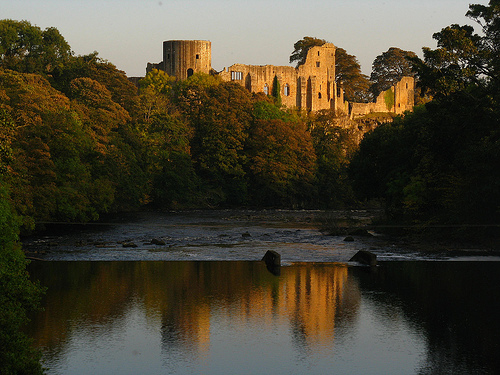
Location: Teesdale, County Durham Map
Constructed: 11th century
Barnard Castle is a ruined medieval fortress located in the market town of the same name in County Durham, northern England. Perched dramatically on a clifftop overlooking the River Tees, it commands a strategic position that has been significant since Roman times, guarding a key ford and ancient road crossing the Pennines. The castle spans about 2.5 hectares (6 acres) and represents one of the largest and most impressive medieval fortifications in northern England, evolving from a simple ringwork to a complex shell keep with multiple wards. Today, it stands as a picturesque ruin, managed by English Heritage, attracting visitors for its historical associations, architectural remnants, and scenic views. The surrounding town, also named Barnard Castle (often called "Barney" locally), developed in the castle's shadow and features Georgian architecture, antique shops, and a vibrant market tradition.
Pre-Norman and Early Norman Origins (Pre-1066 to Early 12th
Century)
Before the Norman Conquest of 1066, the upper
Teesdale area formed part of an Anglo-Norse estate centered on
the ancient village of Gainford, which was mortgaged to the
Earls of Northumberland. The land had been owned by the Church
since at least the 9th century, but in the 11th century the
Earls seized it. After rebellions and the murder of the first
Norman Bishop of Durham (Walcher) in 1080, the region was
devastated.
In 1095, following further unrest, King William
II (Rufus) broke up the large Earldom of Northumberland into
smaller baronies. He granted the Lordship of Gainford to Guy de
Balliol (a Picard knight from Bailleul, near Abbeville, who had
fought for the Normans). Guy built the first fortifications here
around 1093–1125: a simple timber ringwork castle with ditches
and banks on the south and east, protected naturally by steep
cliffs to the north and west above the Tees. It included a stone
gatehouse but was otherwise wooden, designed to control the
river crossing between the Bishop of Durham’s lands and the
Honour of Richmond.
Guy died around 1133 without a direct
heir. His nephew (or possibly son in some accounts), Bernard de
Balliol (Bernard I), inherited and significantly expanded the
site. Bernard rebuilt and extended the castle in stone during
the latter half of the 12th century (c. 1125–1185), giving it
the name Castrum Bernardi (“Bernard’s Castle”). He also founded
the surrounding town on the south and east sides, which quickly
developed as a market settlement. Bernard II (his son or
successor) continued this work, adding the Town Ward and Middle
Ward, including the North Gate, Brackenbury Tower, and Constable
Tower.
The early castle was a powerful feudal stronghold, and
documentary evidence shows Bernard II may have overextended
financially, briefly pledging it to the Bishop of Durham for
debt.
The Balliol Heyday and Scottish Threats (Late
12th–13th Century)
The Balliol family held the castle through
much of the 12th and 13th centuries, building most of what
survives today. Under Hugh de Balliol (who inherited in 1205),
the inner ward’s great hall was rebuilt in stone, with a great
chamber and round tower added at the northern end. These
provided luxurious lodgings—King John even stayed here in
January 1216 during his northern campaigns.
The most famous
early military test came in summer 1216, during the baronial
rebellion against King John. King Alexander II of Scotland
besieged the castle alongside northern rebels, including Eustace
de Vesci. A crossbowman from the garrison killed Vesci with a
bolt as he approached too closely, demoralizing the attackers
and contributing to the siege’s failure. The castle held firm,
and the rebels were later routed in 1217.
The Balliols
maintained strong Anglo-Scottish ties. Notable members included
John Balliol and his wife Devorguilla (who endowed scholars at
Oxford, leading to Balliol College in 1282) and their son John
II, who briefly became King of Scotland (1292–1296) before being
deposed by Edward I. After John II’s fall, the castle was seized
by Bishop Antony Bek of Durham (1306) and then granted by Edward
I to Guy de Beauchamp, 10th Earl of Warwick, around 1307. The
Beauchamps held it for 164 years.
From the Earls of
Warwick to Richard III (14th–15th Century)
In the 14th
century, under Thomas de Beauchamp (who came of age in 1329),
the great hall (already over a century old) was modernized, and
kitchens and service buildings in the inner ward were improved.
A dramatic incident occurred in 1315 when the castle was
temporarily under John le Irreys, who abducted and assaulted
Lady Matilda Clifford here before Edward II intervened.
The
earldom passed in 1446 to Richard Neville (“Warwick the
Kingmaker”) through marriage to Anne Beauchamp. After Neville’s
death at the Battle of Barnet (1471) during the Wars of the
Roses, the estates were divided. His daughter Anne married
Richard, Duke of Gloucester (later King Richard III, 1483–1485).
Richard III made Barnard Castle one of his favorite residences
and carried out repairs, including a projecting oriel window in
the great chamber overlooking the river, carved with his
heraldic boar emblem (a similar boar appears in St Mary’s parish
church). The Brackenbury Tower may commemorate Sir Robert
Brackenbury, Richard’s loyal constable who died with him at
Bosworth in 1485.
After Richard III’s defeat at Bosworth
(1485), the castle passed to Henry VII and was placed under
keepers, notably the Bowes family of nearby Streatlam.
16th Century Sieges and Decline
The castle remained
defensible into the Tudor period. During the Pilgrimage of Grace
(1536), Sir Robert Bowes surrendered it without resistance to
rebels before switching sides back to the king.
Its last
major action was the 11-day siege in December 1569 during the
Rising of the North (a Catholic rebellion by the Earls of
Northumberland and Westmorland in support of Mary, Queen of
Scots). Sir George Bowes (Robert’s nephew) held it loyally for
Elizabeth I with 700–800 men against up to 5,000 rebels. The
outer bailey and Town Ward fell after six days; defenders were
pushed into the inner ward. Water pipes were destroyed, leading
to surrender. The castle was bombarded and never fully repaired.
Bowes was later hailed as one of Elizabeth’s “surest pillars” in
the north.
By the early 17th century the castle was
effectively abandoned. In 1603 James I granted it to Robert
Carr; later, Sir Henry Vane (who bought it and Raby Castle in
1626 for £18,000) plundered its stone to repair and expand Raby.
During the English Civil War it was briefly besieged and taken
by Cromwell’s forces after cannonading.
The Town’s
Development and Later History (17th–19th Centuries)
While the
castle crumbled, the town thrived as a market center with its
maze of cobbled streets (Galgate, Newgate, Thorngate,
Bridgegate), Georgian and Victorian buildings, and the octagonal
Market Cross (also called the Butter Market), which sheltered
dairy sellers and later served as a fire station and courthouse.
Markets are still held weekly.
In the 18th–early 19th
centuries, the town’s economy centered on textiles: hand-loom
wool weaving, followed by flax spinning, dyeing, shoe-thread
manufacture, and some carpet weaving (notably at Thorngate
mills). It was never a heavy industrial hub but prospered
modestly. A railway arrived in 1861, spurring Victorian suburban
growth.
A major cultural landmark is The Bowes Museum, built
in French château style by local landowner John Bowes and his
wife Joséphine (opened 1892). It houses an internationally
renowned art collection (El Greco, Goya, Canaletto, etc.),
decorative arts, and the famous 18th-century Silver Swan
automaton.
Modern Era (20th Century–Present)
In the
20th century the castle passed to the 10th Lord Barnard, who
gifted it to the Ministry of Works in 1952; it is now managed by
English Heritage. The pharmaceutical giant GlaxoSmithKline (GSK)
established a major manufacturing plant on the outskirts,
becoming the town’s largest employer (around 1,000 staff).
Tourism—driven by the castle, museum, and Teesdale’s natural
beauty (including High Force waterfall)—is also vital.
The
town briefly hit national headlines in 2020 when Dominic
Cummings visited during COVID-19 lockdown restrictions, citing
an “eyesight test” at the castle ruins.
The castle is primarily a 12th–13th-century stone structure built on
the site of an earlier late-11th-century timber ringwork. It evolved
through multiple phases of construction and modification by the Balliol
family (and later owners) into a complex multi-ward stronghold that
combined military defenses with increasingly sophisticated domestic
accommodation. Today it survives as substantial but roofless ruins of
coursed squared sandstone with ashlar (finely dressed stone) dressings.
It is a Scheduled Ancient Monument and Grade I listed building in the
care of English Heritage.
Overall Layout and Wards
The castle
occupies a roughly triangular promontory and is divided into four main
wards (baileys), each enclosed by high curtain walls and rock-cut
ditches:
Inner Ward (north-west corner, on the highest clifftop):
The original core ringwork, later strengthened into a shell-keep-like
enclosure. This was the most private and defensively strongest area,
containing the finest domestic buildings.
Middle Ward: A narrow
transitional area south of the Inner Ward, separated by the Great Ditch
(a deep rock-cut feature).
Town Ward: The large eastern courtyard
adjacent to the medieval town, used for everyday access and refuge.
Outer Ward: The southernmost and largest open area, containing the
chapel and more open space.
A surviving plan from J. D.
Mackenzie’s The Castles of England (1897) clearly shows this layout: the
circular Inner Ward with its Round Tower projecting northward over the
river, the rectangular Town Ward with Brackenbury’s Tower and North
Gate, the Middle Ward, and the expansive Outer Ward.
The entire
complex was protected by a continuous high curtain wall (especially
well-preserved on the north side), multiple towers, gates, and a
rock-cut moat/ditch system. Early timber defenses gave way to stone from
the 1130s onward.
Key Defensive and Structural Features
Curtain Walls and Ditches: Built of coursed sandstone rubble with ashlar
quoins and dressings. The north wall follows the cliff edge; elsewhere,
walls incorporate buttresses and lean outward in places due to later
subsidence or erosion of underlying shale layers. The Great Ditch
(between Inner/Middle Wards) was crossed by bridges and contained a C14
sally-port (escape passage) at its west end.
North Gate (principal
entrance into the Town Ward): A substantial gatehouse with chamfered
jambs, plain chamfered abaci, and a double-chamfered round arch. It
originally had flanking walls or a barbican and a first-floor chamber
with rectangular windows.
Towers:
Round Tower (c. 1200, Inner
Ward, north-west corner): The most iconic surviving feature—a tall
cylindrical (drum) tower of high-quality ashlar masonry inserted into
the angle of the curtain walls. It rises through an undercroft (with
domical spiral-laid vault, fireplace, and three arrow slits) plus three
upper storeys. Original details include barrel-vaulted stair landings,
garderobe (latrine) doors, and round-headed doorways. It was later used
as a shot-tower in the 18th century, which removed floors and roof. This
tower combined residential and defensive roles and offers commanding
views over the Tees gorge.
Brackenbury Tower (east wall of Town
Ward): Multi-storey with a barrel-vaulted undercroft containing a
garderobe, fireplace, and cupboards; stone stairs lead to an upper
chamber with further garderobe, fireplace, and arrow slits (one later
converted to a window with seats).
Other towers: Headlam Tower
(fragmentary west wall), Mortham Tower (five storeys, with service rooms
and a C15 garderobe turret), Constable Tower, Prison Tower, and Postern
Tower—all integrated into the curtain walls and showing varying degrees
of vaulting, fireplaces, and defensive slits.
Domestic
Architecture (Inner Ward)
The Inner Ward contains the most refined
surviving domestic buildings, reflecting a shift from pure military use
to lordly comfort in the 13th–14th centuries:
Great Hall (rebuilt C14
by the Beauchamp Earls of Warwick): A large rectangular space with
mullioned-and-transomed windows featuring cusped ogee lights and
quatrefoils (Gothic tracery). Joist holes indicate an upper gallery. It
was served by adjacent kitchens and bakehouse.
Great Chamber
(adjoining the Hall to the north): The lord’s private apartments, with a
projecting oriel window (C15, added or modified under Richard III,
1471–1485) overlooking the river. This bay window is the most
distinctive late-medieval architectural survival; beneath the lintel is
a carved wild boar—the personal emblem of Richard III (then Duke of
Gloucester). The chamber also had re-used interlace carving.
Other Inner Ward structures included a prison, postern, and service
buildings (kitchens, bakehouse). The chapel of St Margaret survives as
ruins in the Outer Ward (Grade II listed).
Construction Phases
and Architectural Evolution
c. 1095–1125 (Guy de Balliol): Initial
timber ringwork with ditches, banks, and a probable stone gatehouse.
1130–1185 (Bernard de Balliol and son): Major stone rebuilding—curtain
walls, Inner Ward enclosure, early towers (Headlam, etc.), and initial
hall/chamber. Norman Romanesque style dominant (round arches, simple
masonry).
Early 13th century (Hugh de Balliol): Addition of the Round
Tower (~1200), further curtain-wall work, and stone rebuilding of
domestic ranges.
14th century (Beauchamps): Defensive upgrades (new
ditch, drawbridge, sally-port) and domestic improvements (rebuilt Great
Hall with Gothic windows).
1471–1485 (Richard III): Minor repairs and
the oriel window with boar emblem.
Post-medieval: The castle declined
after the 1569 Rising of the North. Sir Henry Vane (owner from 1625)
dismantled much stonework for Raby Castle, accelerating ruin. It was
never significantly repaired.
Materials and Construction
Techniques
Almost entirely local sandstone (coursed squared rubble
with ashlar for quoins, dressings, and high-status elements like the
Round Tower). Early vaults used barrel or domical forms; later windows
incorporated Gothic tracery. The geology (sandstone over shale) created
long-term stability issues, with some walls leaning outward.
In
summary, Barnard Castle exemplifies the transition from a simple Norman
ringwork fortress to a sophisticated late-medieval residence. Its
surviving cylindrical tower, oriel window with royal heraldry, vaulted
chambers, and multi-ward layout illustrate both defensive ingenuity
(leveraging the river gorge) and the growing emphasis on comfort and
status in 13th–15th-century English castle design. The ruins remain
impressive and evocative today, especially when viewed from the river or
the town bridge.
Top Things to See and Do
Barnard Castle Ruins (English Heritage):
Dramatic clifftop ruins overlooking the River Tees. Explore the round
tower (great views), Great Hall remains, and outer wards. It's
family-friendly with space to picnic and play. Open daily ~10am–5pm
(last entry earlier); book ahead for 15% discount. Adult tickets around
£8–10.50. Best early to avoid crowds.
The Bowes Museum: Don't miss
this highlight. See masterpieces by Goya, El Greco, Canaletto;
decorative arts; and the Silver Swan (performs daily ~2pm—time your
visit). Beautiful gardens for strolls. Adult ~£21. Open daily 10am–5pm.
Riverside Walks and Views: Walk down to the River Tees for the classic
castle view from the south bank or 16th-century bridge area. Follow
paths to the weir, Deepdale Woods (ancient woodland, peaceful trails),
or Egglestone Abbey (free picturesque ruins ~30-min walk along the
river, English Heritage).
Town Centre and Shopping: Wander the High
Street, Market Cross (Butter Market, 1747), and independent
shops/antique centres. Great for browsing vintage, homewares, books
(e.g., McNab’s), and local produce. Weekly markets add vibrancy.
Nearby Attractions: Raby Castle (deer park, events), High Force
Waterfall, Bowes Castle ruins, Whorlton Suspension Bridge, or Pennine
Way trails. Perfect for extending your trip.
Practical Visiting
Tips
Best Time to Visit: Year-round, but spring/summer (April–August)
for outdoor activities, bluebells, and gardens. Autumn offers lovely
foliage; winter brings cosy pubs and possible snow on the castle. Avoid
peak weekends if you prefer quiet.
Getting There:
By Car: Easy
off the A66 (Scotch Corner from the south) or A688 from Durham (~40
min). Nearest major roads are straightforward.
Public Transport:
Train to Darlington, then Arriva bus X75/X76 (~50 min, frequent).
Limited local buses; a car is ideal for wider Teesdale exploration.
Parking: Generally easy and not a big hassle. Options include
Galgate Car Park, Queen Street (Hole in the Wall), or free 2-hour on the
Cobbles (Market Place—check restrictions, unavailable Wednesdays for
market). Pay-and-display available; some free spots. Town is compact and
walkable once parked.
Accessibility and Practicalities: Compact town
centre; some hilly/cobbled areas and steps at the castle. The Bowes
Museum is more accessible. Toilets, visitor info point, and facilities
available. Dogs welcome at the castle (on leads). Check English Heritage
site for events.
Where to Eat and Drink
Barnard Castle excels
in independent spots:
Cafés: Moments Café (historic building, great
cakes/coffee), Clarendon's, Andalucia (lunch/deli).
Pubs: Three
Horseshoes (renovated, beer garden), Old Well Inn (Bryson mention, cask
ales).
Restaurants: Babul’s (Indian/Bangladeshi), local pubs for
hearty British fare.
Farmers' market on the first Saturday of the
month for local goodies.
Where to Stay
Central: Three
Horseshoes Hotel (historic coaching inn), Commercial Hotel, Coach and
Horses.
Campsites: Teesdale Barnard Castle Caravan Site or others
nearby (good for outdoorsy visitors).
Nearby: Options in Bowes or
further in Teesdale for a rural feel.
In-Depth Tips for a Great
Visit
Pace Yourself: It's small—wander without a rigid plan. Start at
the castle early, then flow into town, museum, and river.
Combine
with Nature: Pair with a Teesdale walk or waterfall trip for variety.
Weather Prep: Bring layers and good shoes—riverside paths can be muddy;
castle exposed.
Families/Kids: Castle has play space; museum is
engaging; riverside fun.
Photography: Golden hour for castle/river
views; museum interiors.
Extend Your Trip: Use as base for Raby
Castle, High Force, or Pennines hiking. Dark skies area for stargazing.
The Castle Ruins: Lady Ann Day and Echoes of Siege
The most famous
haunting is that of Lady Ann (or Anne) Day, a young woman from the 16th
century. Accounts vary slightly: one version says she was murdered and
her body thrown from the castle walls into the River Tees below; another
claims she committed suicide after her lover was beheaded; a third
(rarer) says she died naturally but still appears in spectral form.
Regardless, her ghost is most often described as a woman dressed in
white who is seen falling or toppling from the high walls, accompanied
by piercing, heart-rending screams and cries. Witnesses report that the
apparition and the sound vanish just before “hitting” the water, as if
reliving her fatal plunge. The phenomenon has been reported for
generations by visitors to the ruins.
Inside the castle, the Round
Tower is a particular hotspot. People frequently describe an
overwhelming sense of unease or dread, an urge to leave immediately, and
a feeling of terror that dissipates once outside the structure. Some
link this directly to Lady Ann’s final moments.
Another layer comes
from the 1569 Rising of the North (also called the Northern Rebellion),
when Catholic rebels tried to replace Elizabeth I with Mary Queen of
Scots. The castle was besieged; when it fell, many defenders reportedly
jumped from the walls to escape or in desperation, suffering horrific
injuries or death. On dark nights, locals and visitors have reported
hearing agonised wails and cries echoing from the walls—believed to be
the residual sounds of those doomed men.
A related but lesser-known
spirit is Roger, said to be Lady Ann Day’s husband (or lover in some
tellings). After her death, his ghost reportedly took up residence at
nearby Friar House in the town. Occupants found the “phantom lodger” so
disruptive that priests were called in to banish him.
The Bank:
Grisly Murders, Bone-Thin Ghosts, and Secret Tunnels
Descending the
steep medieval street known as The Bank (running from the castle area
down toward the river) feels like stepping into a concentration of dark
history. Several buildings here have their own hauntings:
Blagraves
House (the oldest house in town, with distinctive 17th-century bay
windows): Granted in 1484 by Richard III to Joan Forest, widow of Miles
Forest (one of the alleged murderers of the Princes in the Tower). It
later became a pub (possibly The Boar’s Head) and hosted Oliver Cromwell
in 1648. His second-floor bedroom is said to be haunted by “a dozen
bone-thin” ghosts. The cellars contain a 36-foot-deep well and rumored
secret tunnels leading to Egglestone Abbey and the castle itself.
No.
34 The Bank (formerly the pub known as the Bucket of Blood, Hat and
Feathers, Turk’s Head, or Shoulder of Mutton): A gruesome accident in
the well turned the name literal—one landlord pulled up a bucket of
blood instead of water. Investigation revealed a drunken regular had
fallen in and drowned. The property is said to be haunted by his
restless spirit.
Steward’s House (also called the Ancient Manor House
or linked to the Punchbowl Inn area): Dates back to the 11th century in
foundations, with a 17th-century rebuild. In the 1550s, Lady
Shuttleworth discovered her husband Sir James’s affair with the maid.
She poisoned the maid, then poisoned Sir James when confronted. Lady
Shuttleworth was hanged for the double murder. Her ghost is still said
to haunt the scene of the crime at the foot of The Bank.
Haunted
Pubs and Inns
Barnard Castle’s historic pubs have their share of
activity:
Old Well Inn (parts dating to the 12th century): A young
boy’s ghost lingers in one of the rooms; his presence has upset guests.
A lady staying overnight once woke to a dark shadowy figure climbing
onto her bed. Some reports also mention the ghost of a monk praying in
the cellar, along with cold breezes and moving shadows. The building was
used as a cholera hospital in 1849 and a WWI billet.
Golden Lion
(dating to 1679): Frequently called one of the most haunted buildings in
town. Reports include multiple spirits (sometimes described as a little
girl or Victorian-era boy), orbs, and other activity that has drawn
ghost-hunting teams. CCTV and personal accounts from investigations are
common.
Churchyard Omens and Other Folklore
In St Mary the
Virgin’s churchyard, the tomb of George Hopper (son of Humphrey)
features a carved figure of Death. Local legend warns that if you see
the scythe move or simply gaze upon it, you or a close family member
will soon die—making it a classic “crisis apparition” or death-omen
haunting.
Broader Teesdale folklore adds atmosphere:
Peg
Powler — a green-haired, long-armed water hag (or nixie-like spirit) who
lurks in the River Tees near the castle. She drags unwary children (or
anyone) into the depths to drown. “Peg Powler’s suds” refers to the
foamy white water on the river after rain—an supposed sign she is
active. This legend is part of a wider tradition of monstrous worms,
goblins, and water spirits in the Durham dales.
Illicit “broomstick
weddings” — In the 18th century, a bogus parson named Cuthbert Hilton
performed quick, unofficial marriage ceremonies in a temporary chapel.
Couples had to jump over a broomstick he held to “seal the knot,” a
pagan-infused tradition. There’s also a related legend of weddings held
in the middle of the bridge over the Tees to avoid falling under the
jurisdiction of two different bishoprics.
Other local tales include
the eccentric 19th-century Hermit of Barnard Castle (Frank Shield), who
lived in the castle’s Round Tower as a tourist attraction, and outlaw
William Gibson hiding in a nearby cave waterfall (though these are more
historical curiosities than active hauntings).
Modern Reports and
Investigations
Paranormal investigators and visitors continue to
report activity: phantom cries of babies, invisible hands tugging at
clothes, orbs, cold spots, and shadowy figures. Ghost hunts at the
castle, pubs, and Egglestone Abbey (just outside town) are popular. Some
claim photographic or video evidence, including white figures near the
castle walls. The town’s narrow wynds, riverbanks, and ancient stones
seem to hold onto these stories, blending real history (murders, sieges,
illicit dealings) with the supernatural.