Location: North Yorkshire Map
Constructed: 1378- 1399 by Richard le Scrope
Tel. 01969 623981
Open: daily 11am- 5pm, 19th Feb- 30th Oct
Closed: 23- 25 Dec
Cost:
Adults- £8.50
Concessions - £7 (O.A.P, students and children)
Family Ticket - £30.00 (2 adults and up to 3 children/concessions, must
include 1 child)
Official site
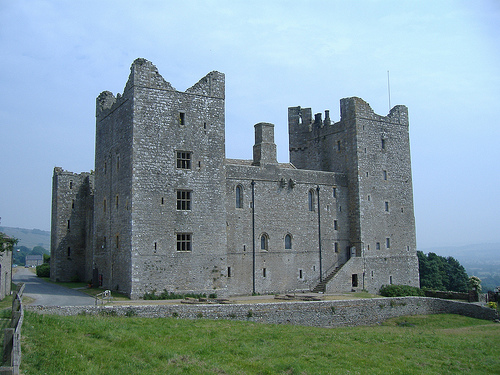
Bolton Castle is a 14th-century castle in Wensleydale, North Yorkshire, England. The nearby village of Castle Bolton was named after the castle. An architectural monument of category I, included in the list of ancient monuments. The castle was damaged and looted during the English Revolution, but most of it survived. Never put up for sale and is still owned by descendants of the Scroop family.
The Scrope Family and the Decision to Build
The Scrope (or le
Scrope) family traced its roots to Norman origins. An early ancestor,
Richard Fitzscrob, constructed Richard’s Castle in Herefordshire around
1050 and was among the Normans who arrived in England with Edward the
Confessor’s nephew before returning with William the Conqueror. By the
14th century, the family had become one of the most powerful in northern
England and along the Anglo-Scottish border.
The castle’s builder was
Sir Richard le Scrope (c. 1327–1403), 1st Baron Scrope of Bolton. A
successful soldier, courtier, and administrator under Edward III and
Richard II, he served as Lord Treasurer of England (1371–1375) and twice
as Lord Chancellor (1378–1380 and 1381–1382). His father, Sir Henry le
Scrope, had laid the groundwork for the family’s wealth and influence as
Chief Justice and a veteran of battles like Crécy (1346). Richard
himself amassed significant land and fortune through military service
(including campaigns with John of Gaunt), wardships, loans secured on
land (often leading to forfeitures), and court fees.
In 1378, while
serving as Chancellor, Richard commissioned the leading military
architect of the day, master mason John Lewyn of Durham, to design and
build a grand new seat to replace an earlier manor house. A contract for
the east range and towers was signed in September 1378. The royal
licence to crenellate (fortify) was formally granted by Richard II in
July 1379. Construction proceeded in stages over two decades and was
completed in 1399, when the chapel was dedicated. The total cost was
reputedly 18,000 marks (equivalent to roughly £90 million in modern
terms), with annual expenditure around 1,000 marks. Richard also spent
another £10,000 to purchase the kingship of the Isle of Man for his son
William.
Architecture and Design
Bolton Castle exemplifies a
quadrangular castle—a rectangular courtyard enclosed by four ranges of
buildings, each three storeys high, with imposing four-storey corner
towers. The design balanced defense (high walls, machicolations for
dropping missiles, portcullises protecting internal doors) with comfort
(private apartments on upper floors of the towers, grand halls, and
innovative engineering). John Leland, the 16th-century antiquary, noted
an astronomical clock in the courtyard and a clever system of tunnels
that conveyed smoke from the hall hearth away through the walls. Sir
Francis Knollys later described the walls as “the highest of any house
he had seen.”
The castle was never intended purely as a military
stronghold but as a statement of wealth and status in the turbulent
northern marches.
The 15th Century: Wars of the Roses
The
castle passed down through the Scrope line. Richard’s son Roger
inherited it, followed by further descendants. By 1459, John, 5th Baron
Scrope of Bolton (only 22 at the time) took possession. A committed
Yorkist, he allied with the powerful Neville family (Earls of Warwick
and Salisbury) and fought at the decisive Battle of Towton in 1461,
where he was injured in the Yorkist victory over Lancastrian forces. The
castle itself saw no major action during the Wars of the Roses, but the
Scropes’ political alignment tied it firmly to the Yorkist cause.
The 16th Century: Rebellion and Royal Imprisonment
In 1536,
during the Pilgrimage of Grace—a major northern uprising against Henry
VIII’s dissolution of the monasteries and religious reforms—John, 8th
Baron Scrope supported the rebels and gave sanctuary at Bolton to Adam
Sedbar, Abbot of nearby Jervaulx Abbey. In retaliation, the king ordered
the castle torched. Extensive damage occurred, but the Scropes repaired
it within a few years, and John regained his seat in Parliament.
The
castle’s most famous episode came in 1568. After her defeat at the
Battle of Langside, Mary, Queen of Scots fled to England seeking
protection from her cousin Elizabeth I. She was first held at Carlisle
Castle under Henry, 9th Baron Scrope (Lord Warden of the West Marches),
but concerns over Carlisle’s security and proximity to the Scottish
border led to her transfer to Bolton on 15 July 1568. She arrived “one
hour after sun setting” with a retinue of about 51 people (knights,
servants, and ladies-in-waiting). Only around 30 men and six ladies
could be accommodated inside; the rest lodged nearby.
Mary resided in
apartments in the south-west tower. Furnishings were borrowed locally
and from Barnard Castle and the royal court (including pewter and a
copper kettle). She brought her own “old cloth of estate” for her
chamber and was accompanied by specialists such as her hairdresser Mary
Seton, an embroiderer, apothecary, physician, surgeon, and goldsmith.
Though technically a prisoner, she enjoyed relative freedom: she
wandered the grounds, hunted, and even learned English from her keeper
Sir Francis Knollys (who jokingly called himself her “Schoolmaster”).
She corresponded, met local Catholics (prompting official reprimands),
and wrote letters in English. After six months, she was moved in January
1569 to Tutbury Castle in Staffordshire, where she spent most of her
remaining years until her execution in 1587.
The 17th Century:
English Civil War and Slighting
During the English Civil War, the
young John Scrope (still a teenager) held Bolton for the Royalists.
Parliamentarian forces besieged it for nearly a year (intensifying from
March 1644). The garrison endured extreme hardship, eventually reduced
to eating their horses before surrendering in November 1645. In 1647,
Parliamentary forces “slighted” the castle—deliberately damaging it to
render it indefensible—by partially demolishing sections. Despite this,
substantial parts survived, especially the south-west tower and west
range.
The castle was largely abandoned as a residence around 1675.
The Scrope male line ended with Emanuel Scrope, 1st Earl of Sunderland,
who died in 1630 without legitimate heirs. The estate passed to his
eldest illegitimate daughter, Mary, who married into the powerful
Powlett (or Paulet) family—specifically Charles Powlett, 6th Marquess of
Winchester and later 1st Duke of Bolton. The castle has remained with
their descendants ever since.
Post-Civil War to the Present
In
1678 the family built a new, more comfortable Bolton Hall about 3 miles
south. The original castle gradually became a romantic ruin but was
never abandoned entirely. Today it is a Grade I listed building and
Scheduled Ancient Monument. Much of the quadrangular core survives as a
standing (if partially ruined) structure, with the west and south ranges
almost complete and the north and east more fragmentary.
It is still
privately owned by Thomas Peter Algar Orde-Powlett, 9th Baron Bolton,
who inherited it in June 2023. Open to the public as a tourist
attraction, it features restored interiors, gardens (including a maze,
herb garden, wildflower meadow, rose garden, and vineyard), falconry
displays, and facilities for weddings and events. An audio app brings
the castle’s turbulent history to life for visitors.
Bolton Castle is a superbly preserved late 14th-century quadrangular
castle in Wensleydale, North Yorkshire, England. It exemplifies the
transition from purely military fortifications to sophisticated
“castle-residences” that balanced defense with high-status domestic
comfort. Commissioned by Richard le Scrope (1st Baron Scrope of Bolton
and Lord Chancellor to Richard II), it was constructed between 1378 and
1399 under master mason John Lewyn. A licence to crenellate was granted
in July 1379, and building took about 18–20 years at a reputed cost of
18,000 marks (roughly £1,000 per year). The result is one of the finest
surviving examples of northern English medieval domestic architecture.
Overall Plan and Dimensions
The castle follows a classic
quadrangular (rectangular courtyard) layout. Four massive rectangular
corner towers (each approximately 10 m × 14 m) are linked by four ranges
(curtain walls) that enclose a central courtyard measuring roughly 28 m
× 17 m. The entire footprint is approximately 55 m east–west by 40 m
north–south. The long axis runs east–west. Towers originally rose to
five storeys plus corner turrets; the linking ranges were generally
three storeys high. A small projecting turret stands at the centre of
both the north and south curtains. The outer defensive works are
modest—there is no wet moat around the core, only an earthwork moat
ditch surviving to the west—but the design relies on height, thick
walls, and controlled access rather than elaborate outworks.
The
single main entrance is a defended passage through the east curtain wall
into the courtyard. From there, five further defended doorways (some
with portcullises) lead into the individual ranges. This “one entrance
only” arrangement was deliberately chosen for security; Sir Francis
Knollys later described the walls as “the highest … of any house he had
seen.”
Materials and Construction
Local limestone, quarried
directly from the hillside immediately north of the site, was used
throughout. The walls employ rubble core with ashlar (finely dressed)
dressings for quoins, window surrounds, and decorative elements.
Ground-floor chambers are barrel-vaulted in stone for strength and fire
resistance. Upper floors use timber joists and floors, with many
fireplaces fitted with integrated chimney flues carried through the
walls (an advanced feature that eliminated open hearths and reduced
smoke). Generous garderobes (latrines) with chutes discharging outside
were provided throughout, reflecting high standards of hygiene for the
period.
Defensive Features
Although built primarily as a
residence, Bolton retains late-medieval defensive thinking:
High,
battlemented walls and corner turrets for archers.
External and
internal portcullises at key doorways.
Machicolations (openings in
the floor of overhanging parapets) above entrances.
The south-east
tower served as a garrison tower overlooking the main gate.
The
courtyard could be sealed off quickly, turning the complex into a
self-contained stronghold.
The design was strong enough to resist
Scottish raiders but never intended as a major siege fortress (no
drawbridge or concentric defences).
Internal Layout and Room
Functions
The castle was planned to accommodate up to eight separate
households of varying status, each with its own suite of hall +
chambers, plus a dozen individual lodgings for retainers and servants—an
unusually sophisticated arrangement for the period. Principal living
rooms are on the first floor and above, entered from the courtyard
galleries; the ground floor is almost entirely service and storage.
Ground Floor (vaulted throughout)
Primarily utilitarian:
Stables,
stores, wine cellar, well chamber.
Workshops: bakehouse, brewhouse,
malting house, armourer’s workshop, horse mill, threshing floor.
South range: mill, brewery, and bakery.
Some basic accommodation
(garrison quarters, servants’ rooms).
Upper Floors (1st–5th)
North Range → The Great Hall (principal ceremonial space) occupies the
upper levels, overlooking the village church to the north. A minstrel
gallery survives in some reconstructions.
West Range → Highest-status
apartments. Includes the Great Chamber (inner hall on the top floor,
accessible only via a private lobby from the Great Hall), Guest Hall
(first floor), State Chamber, and private chambers with garderobes. The
south-west tower contained luxurious suites later used by Mary, Queen of
Scots (imprisoned here 1568–69). The west curtain is the best-preserved
and still roofed/glazed today.
East Range → Domestic and service
wing. Main kitchen in the north-east tower; secondary kitchen in the
south curtain near the gate.
South Range → Chapel occupies the top
floor (roofless today but structurally intact). Administrative heart in
the south-east tower: a hall on the third floor with the Auditor’s
Chamber and two strong-rooms (for estate records and valuables).
Towers provided vertical stacking of chambers; the west towers were the
most private and prestigious. The layout allowed graded privacy—public
halls for feasting, semi-private chambers for family, and secure private
rooms for the lord.
Architectural Innovations and Style
Bolton
is a textbook example of late-14th-century “courtyard castle” design by
John Lewyn (also responsible for similar castles such as Wressle). Key
innovations include:
Integrated chimney flues in every major room
(smoke from the Great Hall hearth was ducted through internal tunnels
rather than roof louvers—an early form of central heating/ventilation).
Multiple self-contained household suites arranged around the courtyard,
allowing the lord to host large retinues while maintaining hierarchy.
Excellent natural lighting and ventilation through large windows on
upper floors (once glazed).
Careful separation of service, garrison,
and noble areas.
It marks the shift toward comfort and display
while retaining enough military character to impress visitors and deter
raiders.
Current Condition and Preservation
The castle was
damaged by fire in 1536 (after the Pilgrimage of Grace) and slighted
(partially demolished) by Parliamentary forces in 1647 during the Civil
War. The north-east tower collapsed in 1761. Nevertheless, the west and
south ranges survive almost to full height and are roofed in places; the
north and east ranges are more ruinous but still stand as impressive
shells. The south-west tower and west curtain are particularly complete
and habitable. It remains in the ownership of the Scrope descendants
(Lord Bolton) and is open to the public, with many rooms furnished to
illustrate medieval life.