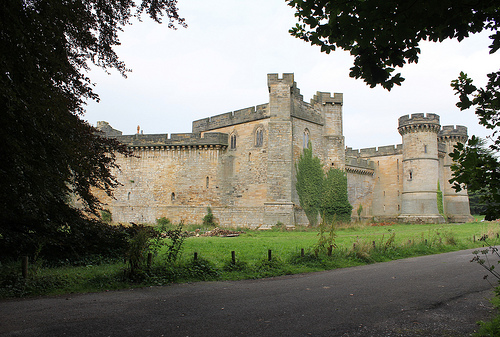
Location: village Brancepeth, 5 miles South- West of the city of Durham Map
Constructed: 14th century
Official website
Brancepeth Castle, located in the village of Brancepeth in County Durham, England (about 5 miles southwest of Durham), is a Grade I listed building that blends medieval fortifications with Regency-era grandeur. It stands on a site occupied since Saxon times and has served as a Norman stronghold, a Neville family power base, a royal grant, a declining estate, a coal magnate’s stately home, a military hospital and headquarters, a research laboratory, and now a private family residence. Its history spans over 900 years, reflecting broader shifts in English politics, warfare, religion, and wealth.
Earliest Origins: Saxon Motte-and-Bailey to Norman Stone Castle
(pre-1176)
The site likely hosted an Anglo-Saxon motte-and-bailey
wooden castle, part of the Honour of Brancepeth granted after the
1066 Norman Conquest to Peter de Humez, a Norman baron. Upon his
death, it passed to his daughter Sybilia, who married Ansketil de
Bulmer (from Sheriff Hutton, Yorkshire). The Bulmers, of Anglo-Saxon
origin but strong Norman supporters (serving as Sheriffs of
Yorkshire), held the estate.
Around 1140, during “the
Anarchy”—the civil war between King Stephen and Empress
Matilda—Bertram de Bulmer (Ansketil and Sybilia’s son) constructed
the first stone castle at Brancepeth. Supporting the victorious King
Stephen, Bertram expanded the Brancepeth estates into one of the
region’s largest. Fragments of this original 12th-century stonework
survive in the curtain wall today. The castle is first documented
around 1216 (though possibly earlier, 1154–77).
Transition to
the Nevilles (1176–1390)
On Bertram’s death, the castle passed to
his daughter Emma (widowed young). Around 1176, she married Geoffrey
de Neville of Ashby (Lincolnshire), a descendant of one of William
the Conqueror’s admirals. Their son Henry de Neville inherited the
estates and witnessed King John’s signing of Magna Carta in 1215;
the following year, he pledged the castle to the king as security
against rebellion. Childless, Henry’s estates went to his sister
Isabel, wife of Robert FitzMeldred of Raby.
Their son Geoffrey
adopted the Neville name (possibly as an inheritance condition or
for courtly prestige, favoring a Norman surname over the Anglo-Saxon
FitzMeldred). This merged the Brancepeth and Raby estates,
establishing the Nevilles as a major northern power. Over six
generations, they amassed wealth and influence.
Neville Seat
of Power and the Palace-Fortress (1390–1569)
In the late 14th
century, under John, 3rd Baron Raby, and especially his son Ralph
Neville, 1st Earl of Westmorland, the family rebuilt Brancepeth as a
grand “palace-fortress” (c. 1398). Most of the surviving medieval
structure—towers named after Neville family branches (Bulmer Tower,
Neville Tower, Westmorland Tower, Constable Tower), curtain walls,
and courtyard—dates to this era. The Baron’s Hall reportedly hosted
planning for the Battle of Neville’s Cross (1346), where Ralph
Neville led English forces to victory against the Scots.
The
Nevilles became one of medieval England’s most powerful families.
Cecily Neville (Ralph’s youngest daughter) married Richard, Duke of
York, and became mother to Kings Edward IV and Richard III, as well
as great-grandmother to Henry VIII. Brancepeth served as a strategic
stronghold during the Wars of the Roses.
The Neville era ended
dramatically in 1569. Charles Neville, 6th Earl of Westmorland, and
Thomas Percy, 7th Earl of Northumberland, used Brancepeth as a
mustering point for the Rising of the North—a Catholic rebellion
against Protestant Queen Elizabeth I aimed at installing Mary, Queen
of Scots. The uprising failed; Charles fled to Flanders and died in
poverty. All Neville estates, including Brancepeth, were forfeited
to the Crown.
Slow Decline and Changing Hands (1569–1796)
The Crown held the castle for about 40 years before granting it to
Robert Carr, 1st Earl of Somerset (early 17th century). It was
swiftly confiscated when Carr was implicated in the poisoning of Sir
Thomas Overbury. In 1633–1636, it passed through commissioners to
Ralph Cole of Newcastle; his grandson Sir Ralph Cole, 2nd Baronet,
sold it in 1701 to Sir Henry Belasyse.
Belasyse’s daughter
Bridget (also called Mary) inherited it mid-18th century. She
famously fell in love with “Bobby” Shafto of Whitworth Hall (across
the River Wear), inspiring the traditional north-country folk song
Bobby Shafto’s Gone to Sea. Shafto married another, and legend says
Bridget died of a broken heart. The castle changed hands repeatedly
over 150+ years, gradually falling into disrepair.
Russell
Family and Regency Remodelling (1796–1925)
In 1796, William
Russell, a Sunderland banker and coal owner, purchased the castle
for £75,000. The Russells became one of the “Grand Allies”—four
leading northern coal-owning families. William’s son Matthew (the
richest commoner in England) began transforming it into a stately
home in the early 19th century, spending £120,000. Architect John
Paterson of Edinburgh designed the sensitive
Regency-Gothic/Neo-Norman remodelling (c. 1818–1821), incorporating
the medieval towers and walls into a grand residence. Matthew died
in 1822; his widow Elizabeth (née Tennyson) and her brother
completed it.
Later, Anthony Salvin made mid-19th-century
improvements for William Russell (1798–1850). The interiors feature
vaulted basements, a grand staircase, Neo-Norman rooms, and a
Gothic-style chapel. The exterior retains medieval curtain walls and
towers, with 19th-century gate towers added.
Matthew and
Elizabeth’s son died unmarried, so the estate passed to their
daughter Emma Maria, who married Gustavus Hamilton, 7th Viscount
Boyne. The family became the Hamilton-Russells.
20th Century:
Wars, Military Use, and Laboratories (1914–1979)
During the First
World War, the 9th Viscount offered the castle as a hospital for
wounded soldiers from Newcastle General Hospital; the family
temporarily moved out.
In 1939, it was leased to the War Office
as headquarters for the Durham Light Infantry (until 1961/62). A
large military camp with over 100 huts was built south of the
village during WWII. The Hamilton-Russells sold the castle and
estates in 1948 to the 2nd Duke of Westminster; parts were broken up
in the 1960s. It was then leased and sold to J.A. Jobling
(Sunderland glassmakers, makers of Pyrex) for research laboratories;
after Jobling’s acquisition by Corning, operations moved to the US.
Dobson Family Era (1979–Present)
After vacancy and decay, the
castle was bought in 1978/1979 by Margaret Dobson (wife of publisher
Dennis Dobson) to house the family’s book warehouse. The Dobsons
restored the fabric (including the lead roof) and interior as funds
allowed. It remains a private family home across generations, with
the publishing business now closed.
Principal rooms are open to
the public via guided tours (bookable year-round; advance booking
for some months). It hosts events, auctions, craft fairs,
Shakespearean plays in the courtyard, and holiday accommodation.
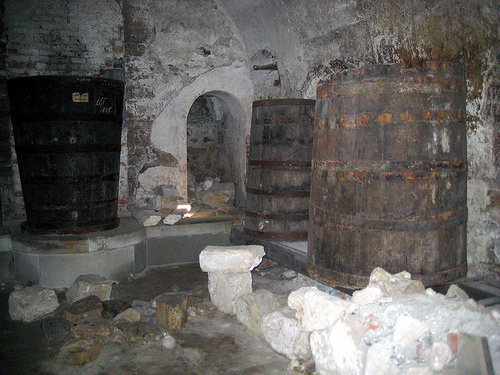
Highlights include the medieval Baron’s Hall, cellars, and archives
featuring original Spike Milligan and Gerard Hoffnung material plus
1968 Paris uprising posters.
Early Origins (11th–13th centuries): The site likely began as an
Anglo-Saxon motte-and-bailey wooden fortification, granted
post-Norman Conquest. The Bulmer family constructed the first stone
castle around 1140 during the Anarchy, with parts of the original
curtain wall surviving in the medieval fabric. It was first
documented in 1216.
Late 14th-Century Rebuild (Neville Era,
c.1398): The powerful Neville family (Earls of Westmorland)
completely rebuilt it as a sophisticated enclosure castle under
Ralph Neville. Master mason John Lewyn of Durham is widely credited
with the design; he also worked on other major northern
fortifications. This phase created the distinctive clustered
accommodation towers and curtain walls that define its medieval
character. It may represent an early, unfinished quadrangular castle
plan.
19th-Century Remodelling (Russell Era): Acquired in 1796 by
the wealthy Russell banking family. Extensive rebuilding occurred
c.1818–1821 under Edinburgh architect John Paterson for Matthew
Russell, who adapted the medieval layout into a grand country house
while retaining the fortress silhouette. Further internal
alterations (1829 and 1864–1875) were carried out by Anthony Salvin
for William Russell (High Sheriff of Durham). These works introduced
Neo-Norman and Gothic Revival elements, new ranges, and lavish
interiors.
Later uses (20th century onward): Served as a WWI
hospital, Durham Light Infantry headquarters, and research facility
before returning to private ownership in 1978. Minor
mid-20th-century additions (e.g., a rendered extension) exist but
are not architecturally significant.
Overall Layout and Plan
The castle encloses a large, irregular (roughly circular or
polygonal) courtyard with ranges of buildings and projecting towers
integrated into a continuous curtain wall. This enclosure-castle
form is typical of 13th-century designs but elevated by the
14th-century Neville towers, which cluster to create a unified,
imposing mass rather than isolated keeps.
Clockwise from the
north-east, the key elements are:
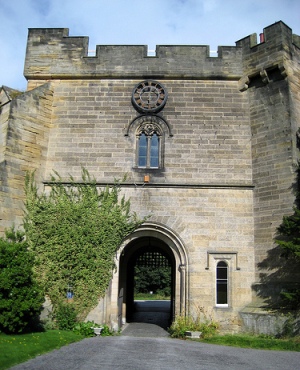
Massive gatehouse (NE).
Westmorland Tower (E).
Constable Tower (SE).
L-plan range (S
and W), incorporating Neville Tower and Bulmer Tower (near SW
corner) plus an unnamed tower in the angle between them.
North
curtain wall with two square-plan watch towers, returning to the
gatehouse.
The irregular courtyard plan, combined with the
clustered towers, gives the impression of a single formidable unit
while providing residential accommodation suited to a noble
household. Evidence suggests an intended quadrangular completion
that was never fully realised.
Exterior Architecture:
Medieval Core
The medieval fabric (primarily dressed sandstone
ashlar masonry from the Neville rebuild) forms the curtain wall and
four principal towers (plus the unnamed SW tower). These are 2–3
storeys high with offset stages, diagonal buttresses topped by
turrets, and restored continuous battlements (some corbelled or
machicolated for defence). Windows are limited and functional in the
medieval sections (e.g., a late-15th-century 2-light window and
17th-century cross window on the unnamed tower).
Curtain
Wall: Substantial sections survive, with a parapet walk on the north
side. It includes two square, battlemented watch towers at angles
(north-west one partly rebuilt in the 19th century). Some original
Bulmer-era walling from the 12th century is embedded.
Westmorland
Tower (East): Lower medieval tower, altered in the 19th century;
houses the chapel.
Constable Tower (South-East): Similar
2–3-storey medieval tower, also lowered and modified.
Neville and
Bulmer Towers (South-West, in L-plan range): The most intact
medieval residential towers. They feature tunnel-vaulted basements
(round-arched and pointed) and groin-vaulted principal chambers
above, indicating sophisticated internal planning for high-status
living.
Unnamed Tower (Angle between Neville/Bulmer): Contains
the late-15th/17th-century windows noted above.
Gatehouse
(North-East): Medieval origins heavily rebuilt in the 19th century
as a massive 3-storey structure with an archway flanked by battered
round towers.
19th-century additions blend seamlessly in
style: an early-19th-century tower on the south (Hamilton Tower on
west), linking 3–4-storey ranges inside the curtain wall, and a tall
narrow Flagstaff Tower (heightened c.1870) above the porte-cochère
facing the gatehouse. All use diagonally-tooled ashlar, round-arched
or hoodmoulded windows, and low-pitched roofs concealed by
battlements. The overall effect is a romantic, picturesque castle
silhouette.
Interior Architecture
The interiors juxtapose
preserved medieval elements with opulent 19th-century Neo-Norman and
Gothic Revival decoration:
Medieval Survivals: Tunnel-vaulted
basements and groin-vaulted chambers in the Neville and Bulmer
Towers.
19th-Century Grand Spaces:
Entrance Hall: Ornate
plasterwork imitating a medieval timber roof.
Semi-Octagonal
Staircase Hall: Dramatic cantilevered staircase (one flight
ascending, returning in two), ribbed domed ceiling with central
skylight.
Armour Gallery (6 bays): Quadripartite rib vaults;
features early 19th-century neo-Norman painted glass depicting
Neville figures and (formerly) the Battle of Neville's Cross.
Chapel (in Westmorland Tower): Reconstructed mid-19th century
(likely by Salvin) in full Gothic style with vaulted wood roof,
elaborate decoration, mosaics, reredos, and a triforium at the west
end.
Main rooms feature Neo-Norman detailing throughout,
with the 19th-century work sensitively integrating the medieval
walls to create a luxurious yet fortress-like residence. The Barons'
Hall (medieval origin) retains historical significance as a planning
space for events like the Rising of the North.
Materials and
Significance
Materials: Predominantly local sandstone (dressed
medieval ashlar + early-19th-century diagonally-tooled ashlar);
lead-sheathed and felted roofs; restored stone battlements.
Architectural Importance: Brancepeth exemplifies the transition from
purely defensive Norman castles to late-medieval residential
strongholds in northern England. Its clustered-tower design,
possible early quadrangular intent, and Lewyn attribution make it
architecturally significant. The 19th-century phase is a fine
example of sympathetic Romantic Gothic/Neo-Norman revival that
preserved the medieval envelope while adding comfort and grandeur.