Location: Ryedale, North Yorkshire Map
Tel. 01347 868614
Open: Apr- Jul & Sep: Thu- Mon; Aug: daily
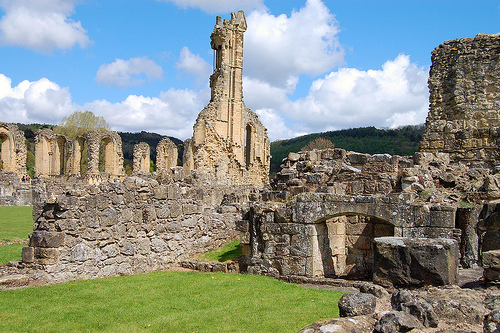
Byland Abbey is a medieval Roman Catholic monastery of Savigniac- Cistercian order situated in the town of Ryedale, North Yorkshire in United Kingdom. Byland Abbey was established in 1155. Monks and laymen alike cleared marshy lands to start a construction of a beautiful cathedral and surrounding buildings. In 1322 it was besieged and taken by the Scottish troops after the battle of Shaws Moor. In 1538 Henry VIII cut all ties with Rome and proclaimed himself as a head of a church thus starting a Reformation in England. He closed monasteries and took away their possessions. Byland Abbey did not escape this fate. It was closed on 30 November, monks were dispersed and remaining structures were used by the local farmers as a source of stone for construction of the new buildings in the area. The land was transferred to Sir William Pickering.
If you decide to walk in the direction of the Rievaulx Abbey you might notice a dry river creek. It was left here after monk of Byland and Rievaulx Abbeys reached an agreement in their dispute over monastery's possessions. River Rye was diverted to become a new border between the two historic religious complexes.
Origins as a Savigniac Foundation (1134–1147)
The community that
became Byland Abbey began not as Cistercian but as Savigniac monks, part
of a reformist order founded at Savigny in Normandy (1112–15) that
emphasized a strict return to the Rule of St Benedict, much like the
Cistercians. In 1128, Savigniac monks established Furness Abbey in
Cumberland (now Cumbria), the first of the order in England. By
1134/1135, Furness was prosperous enough to send out a colony: 12 monks
led by Abbot Gerold (or Gerald) founded a daughter house at Calder,
further up the Cumbrian coast.
Disaster struck in 1138 when a
Scottish army sacked Calder during raids through Cumberland and
Lancashire. The monks returned to Furness seeking refuge, but Abbot
Gerold refused to renounce his rank, and the mother house denied them
re-admission. They appealed for help from Archbishop Thurstan of York
but were aided instead by Gundreda de Gournay (mother of the powerful
Baron Roger de Mowbray), who granted them land at Hood in the North
Riding of Yorkshire, where a former Whitby monk lived as a hermit.
Disputes over jurisdiction with Furness persisted. In 1142, Abbot Gerold
traveled to the Savigniac General Chapter in Normandy, securing
independence for his community. He died on the return journey at York
and was succeeded by Roger (formerly master of novices). The group moved
again in 1143 to Old Byland (near Rievaulx Abbey), a site better suited
to their growing numbers—but the proximity proved problematic, as the
bells of the two abbeys disturbed each other. In 1147 they relocated
once more to Stocking (or Oldstead), on wasteland granted by Roger de
Mowbray, where they built a small stone church and cloister.
That
same year (1147), the entire Savigniac order was absorbed into the
Cistercian family at the invitation of Bernard of Clairvaux. Byland thus
became Cistercian, adopting the white habit and stricter observances.
The community even sent a colony to Fors (later Jervaulx Abbey) in 1150,
which thrived as a daughter house. Jurisdictional claims from Furness
and Calder lingered until 1155, when a Cistercian convocation under
Abbot Aelred of Rievaulx finally confirmed Byland’s independence and
direct protection under Savigny.
The monks had moved five times over
43 years before finding permanence—a remarkably peripatetic early
history for a medieval monastery.
Permanent Settlement and
Construction at Byland (1155–1190s)
In the late 1150s, the Stocking
community acquired marshy land at the final Byland site (near Coxwold),
which they drained to create a stable foundation. Construction began
around 1155–65 with the west range (for lay brothers), one of the oldest
surviving parts. The monks moved into the new monastery in 1177, though
the great church was not fully completed until the early 1190s.
Byland was designed on an enormous scale for about 100 choir monks and
up to 200 lay brothers. The abbey church was cruciform, aisled
throughout, with an unusually elaborate three-storey elevation, wooden
vaults, and a central lantern tower (against early Cistercian custom).
The east end was square with five chapels in an eastern aisle; the
presbytery had four bays; the nave stretched 12 bays. The west
front—still largely intact—is a masterpiece of early Gothic, featuring
three tall lancet windows, a trefoil doorway, and a huge rose window
(its tracery design survives as a mason’s inscription on a flagstone).
This rose window later inspired the south transept window at York
Minster.
The cloister was one of England’s largest at about 44m
(145ft) square, with glazed 15th-century windows replacing earlier open
arches. The south range placed the refectory north–south (an early
English innovation adopted elsewhere around 1170). The west range housed
lay brothers’ dormitory, refectory, and stores; the east range included
the chapter house (with Britain’s only surviving stone lectern base),
library, dormitory, and reredorter (latrine). A separate lay brothers’
cloister was a rare feature.
The abbey’s architecture marked a
turning point in northern English monastic building, blending Cistercian
austerity with emerging Gothic elaboration and influencing sites like
Whitby, Rievaulx, and beyond.
Roger de Mowbray was regarded as the
founder and principal patron; the Mowbray family supported the abbey
into the 14th century. Income derived mainly from sheep farming and wool
exports, with granges (farms) across Yorkshire and Cumberland, iron
mines, urban properties, and fisheries. Abbot Roger (r. 1143–1196) was a
skilled administrator who expanded the estates. His successor, Abbot
Philip, recorded the abbey’s early history in the Historia Fundationis
(1197).
Life, Challenges, and Decline (13th–15th Centuries)
At
its late-12th-century peak, Byland housed around 36 monks and 100 lay
brothers. The lay brothers performed manual labor, allowing choir monks
to focus on liturgy and scholarship. The 13th-century tiled floors in
the south transept and presbytery—among the finest medieval tile
collections in Europe—survive as vivid evidence of the abbey’s wealth
and artistry.
The 14th century brought crises. In 1322, during the
Scottish Wars of Independence, Robert the Bruce’s forces surprised
Edward II’s army near Byland (Battle of Old Byland). The Scots sacked
the abbey, pillaging it alongside Rievaulx and others; Edward fled to
York, abandoning valuables. The Black Death (1348–49) and a decline in
lay brothers further strained operations. By 1391, only 11 monks and
three lay brothers remained. The community shifted to leasing lands to
tenants and hiring servants, with numbers recovering modestly to about
25 monks by the Dissolution. Income in 1535 was valued at around
£238–£240.
Suppression and Aftermath (1538 Onwards)
Like most
English monasteries, Byland fell victim to Henry VIII’s Dissolution.
Following the 1535 Valor Ecclesiasticus survey and the Pilgrimage of
Grace uprising, larger houses were targeted. On 30 November 1538, Abbot
John Ledes (or Alanbridge) and 25 monks signed the deed of surrender.
The monks received pensions; the site was granted to Sir William
Pickering and later passed to the Wombwell family (who still own parts
of the land). Stones were quarried for local buildings, and the roof
lead was stripped, accelerating ruin.
The ruins came under state care
in the 20th century (Office of Works guardianship in 1921) and are now
preserved by English Heritage. Excavations have revealed floor tiles,
architectural fragments (including choir screens and an altar now at
Ampleforth Abbey), and even a 15th-century meat kitchen and abbot’s
lodging. Conservation work, such as on the west front in 2017, continues
to protect the site.
Cultural Legacy
Byland’s influence
extended beyond architecture. Around 1400, an anonymous Byland monk
recorded 12 vivid local Yorkshire ghost stories in Latin on the blank
pages of a 12th-century manuscript (British Library Royal 15 A XX),
intended as sermon exempla. Rediscovered and published in the 20th
century (notably by M.R. James), these are among the earliest and most
detailed medieval English ghost accounts.
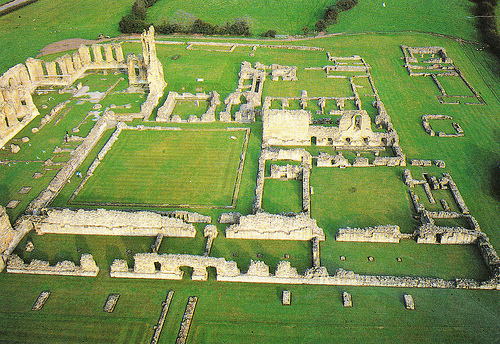
Overall Layout and Monastic Plan
Byland follows the classic
Cistercian plan, with the abbey church forming the northern boundary of
a large rectangular cloister (the “great cloister court”), flanked by
domestic ranges to the south, east, and west. The entire precinct was
enclosed by walls, with outer buildings including an infirmary, abbot’s
lodging, mills, and ponds fed by diverted streams for drainage and
power.
The cloister itself is exceptionally large—approximately 44
metres (145 feet) square, one of the biggest in England—and was
originally open-arched. In the 15th century, the alleys were glazed with
tracery windows for warmth. A distinctive “lane” (a narrow passageway)
separated the monks’ and lay brothers’ areas along the west side,
featuring 35 niche seats for the lay brothers.
The Abbey Church:
A Masterpiece of Early Gothic
The church is the dominant and most
architecturally significant structure. It is cruciform (cross-shaped) in
plan, aisled throughout, and measures roughly 100 metres (328 feet)
long—comparable to many cathedrals and the longest Cistercian nave in
England. It features a 12-bay nave, north and south transepts, a
square-ended presbytery with an eastern aisle containing five chapels,
and a lantern tower over the crossing (a rare departure from strict
Cistercian austerity).
Key architectural features include:
Three-storey elevation: Arcade (ground level with pointed arches on
shafted columns), triforium/gallery, and clerestory. The high central
vessel (nave, transepts, and presbytery) had wooden vaults rather than
stone, though decorative vaulting shafts rise from corbels. This hybrid
approach shows the transition from Romanesque solidity to Gothic
lightness.
Nave: 12 bays long; the easternmost bays housed the monks’
choir stalls, while the western bays were for lay brothers (later
subdivided into chapels as their numbers declined). Internal arcades
were richly detailed with leaf-carved capitals (waterleaf, crocket, and
palmette motifs, later simpler chalice forms often painted).
Transepts and presbytery: The south transept retains the most extensive
surviving 13th-century mosaic floor tiles in northern England—geometric
interlocking patterns and two-colour designs in yellows and greens. The
presbytery had four bays east of the crossing, supported by massive
piers that carried the central tower.
West front: The most iconic
surviving element, standing almost to full height. It features three
tall pointed lancet windows above a trefoil-headed central doorway,
crowned by the shattered lower rim of a magnificent circular rose window
(with two concentric rings of arches on slender shafts). The tracery
design was so influential that it directly inspired York Minster’s south
transept rose window. A template for the rose window was even found
inscribed on a flagstone during excavations.
The church was
originally limewashed inside and out, with lavish painted decoration and
high-quality carved stonework—far more elaborate than the austere ideals
of early Cistercian architecture. Both round and pointed arches appear,
illustrating the mid-12th-century transition to full Gothic.
Cloister and Domestic Range
East range (monks’ side): Included
sacristy/library, a vaulted chapter house (projecting eastward with a
unique surviving stone lectern base), parlour, day stair, and
undercroft. Above lay the dormitory, with a night stair direct to the
church. A reredorter (latrine) projected eastward.
South range:
Warming house (with a huge fireplace), refectory (built north–south
perpendicular to the cloister—an early and influential Cistercian
innovation at Byland around 1170), and kitchen. The refectory had a
vaulted undercroft and high walls with large windows.
West range (lay
brothers’ side): The longest and one of the earliest built (c. 1155–65).
Ground floor housed cellarer’s stores, refectory, and chapter house;
upper floor was a vast open dormitory. It included its own smaller
cloister and reredorter.
Later additions included a 13th-century
detached abbot’s house, a 14th-century meat kitchen, and modifications
reflecting declining numbers of lay brothers and shifts toward more
comfortable living.
Architectural Significance and Innovations
Byland represents a pivotal moment in English Gothic development. It was
the most ambitious Cistercian project of the 12th century—larger and far
more ornate than earlier English Cistercian churches—drawing inspiration
from Ripon Cathedral and York Minster while introducing French/Flemish
Gothic details (pointed arches, lancets, rose windows). Its influence
spread across the north: identical or near-identical details appear at
Jervaulx, Tynemouth, and Whitby. The reorientation of the refectory
became standard in later Cistercian planning.
Construction occurred
in phases (west range first, then cloister ranges, church completed
last), using local limestone. After the Dissolution in 1538, the roof
lead was stripped, and the buildings gradually collapsed or were
quarried, leaving the haunting skeleton we see today—yet enough survives
to reveal its former grandeur.
Today, visitors can walk the full
length of the nave foundations, marvel at the soaring west front against
the Yorkshire hills, and admire the intricate tilework and carved
fragments displayed on site. It remains a Grade I listed ruin and a
testament to the Cistercians’ engineering skill, artistic ambition, and
monastic vision.