Location: Berkshire Map
Constructed: 1386 by Sir Richard Abberbury the Elder
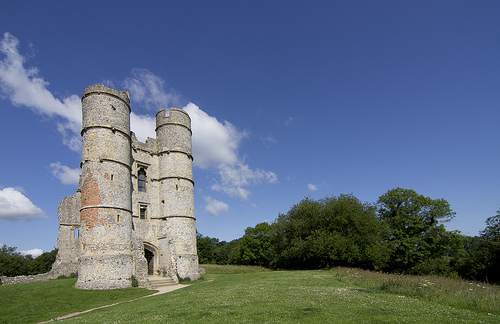
Donnington Castle is a medieval castle situated near village of Donnington, North of town of Newbury in the Berkshire County in England. It was constructed in 1386 by Sir Richard Abberbury the Elder following a crenellation permit issued by King Richard II of England in 1386. Donnington castle was later purchased by Thomas Chaucer, son of the poet Geoffrey Chaucer, as a residence for his daughter Alice de la Pole, future Duchess of Suffolk. It passed it on to the Tudor family, and the building becomes royal property. King Henry VIII lived tere, along with his daughter, future Queen Elizabeth I; the latter even asked to live there in 1554 during her imprisonment by her sister, Marie Ire, but was not allowed to do so.
Donnington Castle, located on a hill overlooking the village of
Donnington near Newbury in Berkshire, England, is a ruined medieval
quadrangular castle renowned for its role in the English Civil War.
Constructed in the late 14th century as a fortified residence, the
castle's most prominent surviving feature is its striking twin-towered
gatehouse, surrounded by impressive 17th-century earthworks and low
walls outlining the original layout. Though largely demolished after the
Civil War, the site offers insights into late medieval architecture,
royal patronage, and wartime resilience. Today, it is a Scheduled
Ancient Monument managed by English Heritage, attracting visitors for
its historical significance and panoramic views of the Lambourn Valley.
Origins and Foundation (13th–14th Centuries)
The manor of
Donnington was held by the Abberbury family from at least 1287, when it
was owned by Sir Richard Abberbury the Elder, a prominent knight and
chamberlain to Anne of Bohemia, wife of Richard II. The family had
acquired the land as early as 1292, and in 1386, Sir Richard obtained a
royal license from Richard II to crenellate (fortify) the site, allowing
him to construct a castle on the hilltop for defense and residence. This
strategic location overlooked a major road junction and the River
Lambourn crossing, providing control over trade routes between Oxford
and Newbury. The castle was built rapidly, likely completed by the early
1390s, reflecting the Abberburys' rising status amid the turbulent
politics of Richard II's reign.
In 1392, Sir Richard purchased
additional rights for 100 shillings and further fortified the structure.
However, financial difficulties led him to sell the castle in 1398 to
Thomas Chaucer, son of the poet Geoffrey Chaucer, for use as a residence
for Thomas's daughter, Alice.
Architectural Developments
Donnington was designed as a quadrangular castle, a style popular in the
late 14th century for combining defense with domestic comfort. The
layout was roughly rectangular, measuring about 67 feet (20 meters)
north to south and 108 feet (33 meters) east to west, enclosed by high
curtain walls. Round towers stood at each corner, with square towers
midway along the east and west walls, and an irregular projection on the
west facade possibly for additional accommodations. The three-storey
gatehouse, the castle's centerpiece, featured twin drum towers flanking
a central entrance, complete with battlements, arrow slits, and
machicolations for defense. Internally, it measured 17.5 by 11.75 feet
(5.3 by 3.6 meters), with upper floors likely serving as living
quarters.
The inner courtyard housed a great hall, kitchens, and
guest chambers, typical of medieval residences. Under the Chaucers and
later the de la Poles, the buildings were enlarged in the 15th century,
adding more luxurious features. No major archaeological excavations have
been noted, but the site's earthworks and surviving masonry provide
evidence of its original scale.
Ownership and Tudor Period
(15th–16th Centuries)
Alice Chaucer married William de la Pole, 1st
Duke of Suffolk, in the early 1430s, and the couple occasionally resided
at Donnington, using it as a base amid their political intrigues.
Suffolk's attainder in 1450 led to the castle's forfeiture to the Crown.
It remained royal property, hosting Henry VIII in 1539, Edward VI in
1552, and Elizabeth I in 1568. By 1535, a survey noted decay, indicating
neglect.
In 1514, it was granted to Charles Brandon, 1st Duke of
Suffolk, but reverted to the Crown. Elizabeth I appointed Elizabeth
Cooke (Lady Russell) as keeper in 1590—the first woman in such a
role—leading to a dispute when Charles Howard, 1st Earl of Nottingham,
received the property in 1600 for his Armada service. It then passed to
the Packer family, including John Packer, a Parliamentarian and
secretary to the Duke of Buckingham.
The English Civil War and
Siege (17th Century)
During the First English Civil War, Donnington
was owned by Parliamentarian John Packer but seized by Royalists after
the First Battle of Newbury in September 1643. Colonel Sir John Boys
garrisoned it with 200 foot soldiers, 25 cavalry, and 4 cannon from Earl
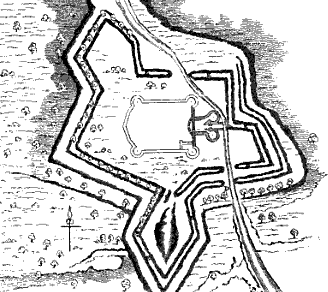
Rivers' regiment. Boys fortified it with star-shaped earthworks for
artillery, surviving up to 1.7 meters high today.
Parliamentarians
under General Middleton besieged it from July/October 1644 for 18–20
months. The garrison repelled assaults, including a sally causing over
100 casualties and a 12-day bombardment in September 1644. During the
Second Battle of Newbury in October 1644, Boys supported Royalist
artillery and was wounded; Charles I relieved the siege briefly and
stayed overnight. Boys famously vowed to defend the ground but not
repair it. The siege ended in April 1646 when Boys surrendered with
honors on the King's orders.
Decline and Destruction
In July
1646, Parliament voted to demolish (slight) the castle, destroying walls
and towers but sparing the gatehouse. Packer regained possession and
resided in a nearby Elizabethan lodge. The Packers held it until the
mid-18th century, passing to the Winchcombe family through marriage,
then to the Hartley family in 1833–1881. In 1924, the estate was sold to
Edward Festus Kelly.
Modern History and Preservation
In 1946,
the castle was placed under state guardianship. External walls were
rebuilt to about 2 feet high in the 20th century to outline the original
plan. It was designated a Grade I listed building on September 9, 1969,
and is now owned by English Heritage as a Scheduled Ancient Monument
(number 1007926). The site is open to the public year-round, free of
charge, with interpretive panels and paths.
Donnington Castle, situated on a hilltop overlooking the Lambourn
Valley and the town of Newbury in Berkshire, England, was
constructed in the late 14th century by Sir Richard Abberbury the
Elder. Built after receiving a royal licence to crenellate from
Richard II in 1386, the castle served primarily as a luxurious
fortified residence rather than a heavily defended fortress. Its
strategic position controlled a major road junction and river
crossing, making it a symbol of prestige for its owners. The site
gained notoriety during the English Civil War, where it endured an
18- to 20-month siege (1644–1646) as a Royalist stronghold under
Colonel Sir John Boys, leading to its partial demolition by
Parliamentarian forces. Today, the ruins are managed by English
Heritage as a scheduled ancient monument, open to the public and
offering panoramic views of the surrounding countryside.
Overall Layout and Site Planning
The castle's original layout was
roughly rectangular (or quadrangular), enclosing a courtyard that
measured approximately 108 feet (33 meters) east-west and 67 feet
(20 meters) north-south, based on the inner dimensions of the
curtain walls. The site occupies a hilltop crest, exploiting natural
defenses with steep slopes on three sides, though it lacked a moat.
The curtain wall formed the perimeter, with an irregular westward
projection on the facade. Corner towers were positioned at each of
the four angles, and mid-wall towers flanked the longer sides. The
main entrance faced southwest through the gatehouse, which was
detached from the main residential blocks. Within the courtyard,
timber-framed buildings—likely including a hall, kitchens, chapel,
guest accommodations, and service areas—were arranged against the
inner walls, rising up to three storeys in places. The design
prioritized domestic comfort over military might, with thin walls
(about 1.5 meters/5 feet thick) and no arrow-loops, reflecting its
role as a country house with castle aesthetics. During the Civil
War, star-shaped earthworks were added around the base of the hill,
forming a larger defensive perimeter with pointed bastions for
artillery.
Key Structures: Gatehouse, Towers, and Courtyard
Buildings
The twin-towered gatehouse is the castle's most
prominent and best-preserved feature, standing three storeys high
and measuring internally about 17.5 by 11.75 feet (5.3 by 3.6
meters). Constructed as a standalone structure, it features two
tall, semi-circular flanking towers with battlements and a central
arched gateway equipped with a portcullis slot and vaulted passage.
The ground floor includes a four-centered archway with a label
molding, while upper floors have square-headed windows with tracery
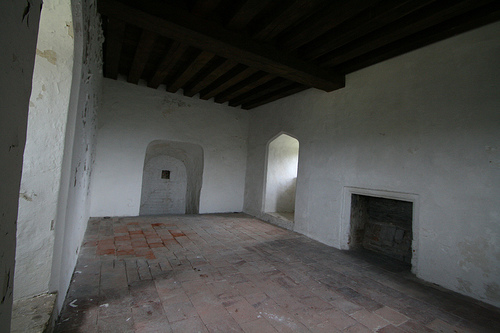
and doorways leading to now-lost attached buildings. A newel
staircase in the southern tower provides access between levels, and
the west wall shows evidence of fireplaces and windows that once
overlooked the courtyard. The towers are adorned with ornamental
string-courses featuring grotesque carved heads, adding decorative
flair.
The curtain walls enclosed the site, with four round
corner towers (each about 12-15 meters/40-50 feet in diameter) and
two square mid-wall towers for added defense and surveillance. These
towers projected outward, allowing for flanking fire, though their
thin construction limited true fortification. The courtyard
buildings, now lost, were timber-framed and multi-storey, including
a great hall possibly on the first floor of a range attached to the
gatehouse, private family rooms, a chapel, kitchens, and storage.
Foundations suggest these were built against the inner curtain
walls, creating a compact residential core.
Architectural
Styles and Evolution
Donnington Castle exemplifies late medieval
architecture, blending elements of fortification with domestic
luxury in the Perpendicular Gothic style prevalent in the 14th
century. The gatehouse's vaulted ceiling, pointed arches, and
decorative moldings reflect influences from royal masons like
William Wynford, who may have contributed despite funding
limitations. Initially built in a single phase (1386–1399), the
design may have shifted mid-construction, as evidenced by the east
wall's priority over the gatehouse. In the 15th century, under
owners like Alice Chaucer, Duchess of Suffolk, the castle was
enlarged with additional residential features. Tudor-period
modifications under royal control included repairs, though by 1535
it was reported in decay. The most significant evolution occurred
during the Civil War (1643–1646), when star-shaped
bastions—characteristic of 17th-century trace italienne
fortifications—were added for artillery defense, rising to about 1.7
meters (5.5 feet) high. Post-siege demolition in 1646 razed most
structures, leaving the gatehouse as the focal point. In the 19th
century, a cottage was temporarily added to the rear but later
removed.
Materials and Construction Techniques
The castle
was built using local materials for economy: flint rubble and chalk
for the core of walls and towers, faced with stone dressings for
finer details like arches and windows. The exterior was rendered and
painted white to enhance its visibility as a landmark. Brick
patches, visible on the gatehouse, were added to repair cannon
damage from the Civil War sieges. Construction involved ashlar
masonry for key features, with the curtain walls laid on shallow
foundations. The gatehouse's vaulting sprang from attached shafts,
demonstrating skilled stonework. Timber was used extensively for
courtyard buildings and roofs (now lost). The earthworks were
constructed from piled soil and turf, revetted for stability.
Notable Features and Historical Modifications
Notable
features include the gatehouse's grotesque carvings and the
star-shaped earthworks, which represent one of the earliest examples
of such defenses in England. The pitting and brick repairs on the
walls testify to intense artillery bombardment during the siege.
Historical modifications include 15th-century enlargements, Civil
War fortifications, and post-1646 slighting. Ownership changes
influenced its use: from Abberbury's residence to royal visits by
Henry VIII (1539), Edward VI (1552), and Elizabeth I (1568). In
1946, the curtain wall foundations were rebuilt to 0.5-0.6 meters
(1.5-2 feet) high to outline the original plan, and a custodian's
hut was added in 1956.
Current State as Ruins
Today,
Donnington Castle survives as atmospheric ruins, with the gatehouse
standing nearly to its full height and the curtain walls reduced to
low foundations. The star-shaped earthworks remain visible but
overgrown, enclosing the site. Managed by English Heritage since
1952 (Grade I listed since 1969), the site is accessible via a
footpath from parking at the base, with no on-site facilities.
Conservation efforts in the 1950s cleared the courtyard to medieval
levels and consolidated masonry, preserving it as a poignant
reminder of medieval architecture and Civil War history.
Notable Features and Legends
The gatehouse stands as the castle's icon, its weathered towers evoking medieval grandeur amid grassy earthworks—depicted in art, album covers (e.g., Tenpole Tudor's 2001 compilation), and media like The Saint (1966) and A Hitch in Time (1978). The star forts, rare survivors of 17th-century fieldwork, highlight tactical evolution. The adjacent 14th-century hospital, rebuilt in 1602, endures as Berkshire's oldest charity. No major legends attach directly, but the 20-month siege romanticizes Sir John Boys as a defiant Royalist hero, with tales of his ingenuity against overwhelming odds. Royal associations—Chaucer lineage, Tudor visits—add literary and dynastic allure.