Location: Durham, England Map
Tel. 0191- 334 3800
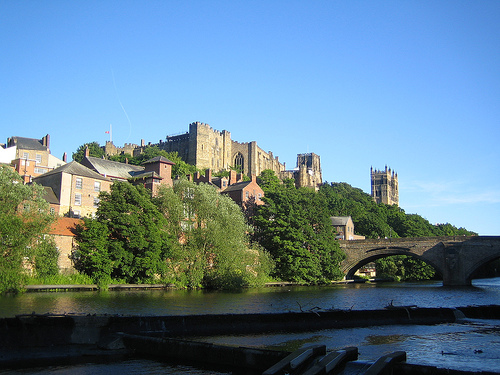
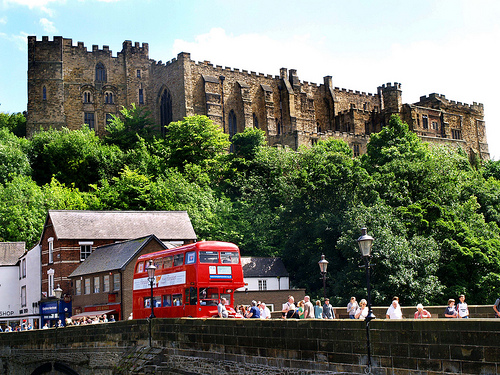
Durham Castle, perched on a dramatic rocky peninsula above the
River Wear in Durham, England, is one of Britain’s most historically
layered fortifications. Standing shoulder-to-shoulder with Durham
Cathedral, it forms the heart of a UNESCO World Heritage Site
(inscribed 1986, with later extensions). Constructed as a Norman
stronghold in 1072, it served for nearly eight centuries as the
fortified palace and administrative seat of the Prince-Bishops of
Durham—ecclesiastical rulers granted near-regal “palatinate” powers
to defend England’s northern frontier.
Today it houses University
College (the founding college of Durham University), making it one
of the few castles in the world still continuously occupied and
lived in by students since the 11th century. Its architecture and
story encapsulate the Norman Conquest, medieval border warfare,
Tudor politics, Civil War upheaval, Restoration grandeur, and the
birth of a modern university.
Pre-Norman Roots and the Strategic Peninsula (Before 1072)
The
site was already important long before the Normans arrived.
Archaeological finds reveal an Anglo-Saxon settlement with evidence of
building, shoemaking, and leatherworking just outside the later moat;
remnants of a pre-Norman defensive wall survive inside the castle. In
995 AD, monks from Lindisfarne brought the relics of St Cuthbert here,
choosing the naturally fortified peninsula as a secure shrine. The
location proved its worth: Durham successfully repelled Scottish
invasions in 1006 and 1039, with grisly displays of enemy heads after
one victory underscoring its defensive value.
Norman Conquest and
Foundation (1072–Late 11th Century)
After the 1066 Battle of
Hastings, northern resistance to William the Conqueror persisted. The
murder of his appointed Earl of Northumbria (Robert de Comines) and 700
men in Durham in 1069 triggered the brutal “Harrying of the North”—a
two-year campaign of destruction that killed or starved an estimated
100,000 people. In 1072, on his return from Scotland, William ordered a
motte-and-bailey castle built to secure the border, suppress local
rebellions, and protect Norman rule. Construction was initially
supervised by the Anglo-Saxon Earl Waltheof, who was executed for
rebellion in 1076. Stone was quarried from the cliffs below and winched
up the slopes.
Bishop Walcher (1071–1080), a Norman appointee,
purchased the Earldom of Northumbria and became the first Prince-Bishop.
He and his successors were granted extraordinary powers: raising armies,
levying taxes, minting coins, holding courts, and administering
justice—essentially ruling a semi-autonomous “state within a state” in
exchange for loyalty and border defense. Early buildings were likely
wooden at first, but stone structures soon followed. The castle featured
a classic motte (mound) with keep, inner and outer baileys, and
defensive walls.
One of the oldest surviving features is the Norman
Chapel (c. 1078–1080), with its distinctive groin-vaulted ceiling and
Anglo-Saxon-influenced stonework (possibly built by forced local labor).
It is the oldest standing building in Durham and one of the finest early
Norman interiors in Britain.
Medieval Peak: From Fortress to
Palace (12th–15th Centuries)
As Norman control solidified, the castle
evolved into a luxurious palace reflecting the bishops’ wealth and
status. Bishop Hugh de Puiset (Pudsey, 1153–1195) added major features,
including the Norman archway linked to the cathedral. In the early 14th
century, Bishop Antony Bek (1284–1311) constructed the Great Hall—one of
the largest in Britain at the time—likely for a royal visit by Edward I.
Bek was a warrior-bishop who commanded forces at the Battle of Falkirk
(1298).
Bishop Thomas Hatfield (1345–1381) rebuilt and enlarged the
keep on its motte and added a wooden minstrels’ gallery to the Great
Hall. The castle hosted numerous monarchs (Edward I, III, Henry III,
Henry VI, and Queen Philippa of Hainault). It also served military,
judicial, and administrative roles across the County Palatine. Bishops
maintained other residences and hunting lodges (Auckland Castle, Norham,
etc.), but Durham remained the ceremonial heart.
Hunting was a key
privilege; Henry I granted the bishops rights over forests between the
Tyne and Tees in 1109. The “Great Chase” in Upper Weardale was an
elaborate ritual hunt for deer, boar, and wolves. Archaeological digs in
the moat (1991) revealed a high-status diet: prime beef, young pigs, and
fine bread—no exotic peacocks or swans.
The castle played roles in
Scottish wars, notably the Battle of Neville’s Cross (1346), where
Bishop Hatfield helped defeat King David II of Scotland just outside
Durham.
Tudor and Reformation Era (16th Century)
The bishops’
secular powers began to wane under the Tudors, but they remained
influential. Bishop Richard Fox (1494–1501) refurbished the Great Hall
and kitchen (his pelican emblem still visible). Bishop Cuthbert Tunstall
(1530–1559), a Renaissance scholar praised by Erasmus, made major
alterations: raising the gatehouse entrance for carriages, adding a new
range, and building Tunstall’s Chapel (with later Cosin modifications).
He navigated the Pilgrimage of Grace (1536) and Reformation upheavals,
providing some defensive features amid turmoil.
Civil War,
Commonwealth, and Restoration (17th Century)
During the Bishops’ Wars
and English Civil War, the castle was occupied by Scottish forces
(1644–1647) but never taken by assault. After the 1649 abolition of the
bishopric, it was sold and used as a makeshift hospital and prison for
Scottish soldiers captured at the Battle of Dunbar (1650); mass graves
of around 1,700 Scots have since been found.
The monarchy’s
restoration in 1660 revived the bishopric. Bishop John Cosin (a former
royal chaplain) found the castle dilapidated and embarked on a major
refurbishment: installing the famous Black Staircase (with ornate
carving and symbolic pineapples), new porch, chimneys, and gardens. The
Black Staircase remains one of the castle’s most striking interiors.
18th–19th Centuries: Decline as Episcopal Seat and University
Founding
By the 18th century, bishops increasingly preferred Auckland
Castle as their main residence. The castle still hosted assizes and
grand events, but its military role had ended. The Durham (County
Palatine) Act 1836 finally stripped the bishops of temporal powers.
Bishop William Van Mildert (last Prince-Bishop, 1826–1836) donated the
castle to the newly founded Durham University. In 1837 it officially
became University College; the keep was converted into student rooms in
the 1840s under architects like Anthony Salvin (with later input from
Bishop Edward Maltby).
University College Era (1837–Present)
The first students arrived in 1833 (pre-formal handover), and the castle
has housed undergraduates ever since—originally under strict rules
including gowns, curfews, and compulsory chapel. Women were admitted in
1987. During the world wars it served practical roles: WWI enlistment
hub and WWII RAF command post in the Norman Chapel (the Great Hall was
used for training). The chapel was later reconsecrated for college
services.
Today the castle blends ancient and modern: students dine
in the Great Hall, worship in the Norman and Tunstall Chapels, and live
amid 1,000 years of history. It remains open for guided tours showcasing
its collections (250+ paintings, arms and armour, social-history
artefacts). Ongoing conservation—such as the Norman Chapel
project—ensures its survival.
Durham Castle has never been
successfully stormed by force, a testament to its impregnable position
and the enduring power of the Prince-Bishops. From a tool of conquest to
a palace of learning, it stands as a living monument to British
history—still very much alive with the footsteps of students echoing
through its ancient halls.
Overall Layout and Norman Origins (1072 onward)
Construction began
in 1072 on the orders of William the Conqueror, supervised initially by
Earl Waltheof and then Bishop Walcher. It followed the classic Norman
motte-and-bailey design: a massive earthen motte (artificial mound)
crowned by a keep (fortified tower), overlooking an inner and outer
bailey (walled or palisaded courtyards). The site exploited the natural
defensibility of the peninsula, with steep slopes and the river
providing natural barriers. Early structures may have included timber
elements (the keep was initially described as wooden in some sources),
but archaeological evidence shows extensive stone building by the late
11th century, using local sandstone quarried from the cliffs below.
Walls were typically of roughly coursed rubble with ashlar (dressed
stone) for arches, quoins, and decorative elements; joints were wide,
and axe-dressed masonry was common.
The castle's Norman layout
remains discernible despite later modifications: a central courtyard
(now Palace Green-facing), with the North Range along one side and the
West Range containing the Great Hall. Defensive features included thick
walls, battlements, and towers, though the castle was never taken by
force. Seventeen elements are Grade I listed, including the keep, north
and west ranges, entrance gatehouse, a bastion, and sections of the
curtain walls.
The Norman Chapel (c. 1078–1080): The Oldest
Surviving Structure
Tucked in the North Range, the Norman Chapel
(also called the Astral or Castle Chapel) is Durham's oldest intact
building and one of Britain's finest surviving examples of early Norman
(Romanesque) ecclesiastical architecture. Built around 1080 under Bishop
William de St Calais, it likely served as the primary castle chapel
rather than a crypt. Its survival is remarkable: Bishop Thomas
Hatfield's 14th-century enlargement of the keep rendered it
inaccessible, shielding it from later stylistic overhauls.
Key
features:
Plan and vaults: A compact, squarish space divided by three
rows of six sturdy sandstone columns supporting 12 groin (cross) vaults
formed by intersecting barrel vaults. These divide the interior into
bays and support the floor above. The vaults are among the earliest and
most atmospheric examples of Norman vaulting in England.
Columns and
capitals: Thick, solid-looking columns with richly carved capitals
featuring an eclectic mix of motifs—some religious/symbolic (e.g., a man
with dogs hunting a stag, interpreted as St Eustace; a Tau cross),
others decorative or whimsical (lions, a snake, a horse, leaf patterns,
and famously an early English mermaid symbolizing temptation).
Backgrounds often use chip-carved stars or geometric diapers. These
carvings mark a turning point in 11th-century Romanesque sculpture.
Arches and windows: Semi-circular arches with geometric decoration
(chevrons, zigzags). Windows are high and narrow, underscoring the
massive wall thickness for defense.
Floor: Originally
herringbone-patterned stone (partially restored).
The chapel's
Anglian influences (possibly from local forced labor) add a hybrid
quality rare in pure Norman work. It is currently conserved for damp
issues but remains used for worship and events.
North Range:
Norman Gallery, Gatehouse, and Later Additions
The North Range
preserves core Norman elements alongside later layers:
Norman Gallery
(early 12th century, under Bishop Ranulf Flambard): Originally the upper
"Constable's Hall" with defensive views. It retains a fine arcade of
triple semi-circular arches decorated with chevrons and zigzags—one of
the best-preserved Norman decorative schemes in the castle. Subdivided
in the 19th century for student rooms.
Gatehouse (late 11th/early
12th century): Features a Romanesque arch (later raised and widened by
Bishop Cuthbert Tunstall in the Tudor period for carriages). Shallow
chevrons, sunken star motifs on the soffit, and scalloped capitals. It
controlled access and processional routes to the cathedral.
Tunstall's Chapel and Gallery (1530s, Bishop Cuthbert Tunstall): Tudor
additions with grand Renaissance-influenced detailing, including a new
chapel and long gallery for display and leisure. These transformed the
castle into a more palatial residence.
West Range: The Great Hall
(Early 14th Century)
Bishop Antony Bek replaced an earlier Norman
hall with a grander Great Hall (c. 1284–1311), later extended south by
Bishop Thomas Hatfield (1345–1381), who added thrones, renewed the
roof/windows, and possibly the trumpeters' galleries (for ceremonial
announcements and music). Bishop Richard Fox shortened it in the late
15th century to its current form: over 30 metres (98 ft) long and nearly
14 metres (46 ft) high. Further 17th- and 19th-century alterations
(including oak panelling, an entrance screen, and a large north
stained-glass window with bishops' and university arms) adapted it for
dining.
Features:
Lofty timber roof with impressive scale.
Tall Gothic-style windows (remodelled 19th century) on east and west
walls.
Two trumpeters' galleries.
Now used for student formal
dinners, retaining its ceremonial character.
The Keep and Later
Modifications
The keep was repeatedly rebuilt: Hatfield enlarged the
motte and gave it an octagonal form in the 14th century. In 1840,
architect Anthony Salvin reconstructed it in Victorian style as student
accommodation—preserving the medieval footprint while adding domestic
comfort.
Other notable features:
Black Stairs (c. 1660–1672,
Bishop John Cosin): A dramatic oak "flying staircase" (originally
unsupported in appearance) nearly 60 feet high, now slightly leaning due
to structural issues. Ornate carvings include pineapples and heraldic
motifs; it leads to upper ranges.
Norman Arch (late 12th century,
Bishop Hugh de Puiset): A magnificent external entrance to the original
North Hall, with concentric layers of geometric carvings (chevrons,
zigzags) and sculptured capitals—one of England's finest surviving
examples.
Materials, Techniques, and Evolution
Local sandstone
dominates, chosen for its durability and marbled texture in columns.
Norman techniques emphasized mass (thick walls, solid columns) and
geometric ornament over figural sculpture initially. Over time, the
castle shifted from purely defensive (post-Harrying of the North) to
palatial: Tudor galleries and gardens under Tunstall, Baroque
restoration under Cosin after the Civil War, and Victorian/educational
adaptations. Fires, sieges, and changing tastes prompted rebuilds, but
the core Norman skeleton endures.
Today, as a working university
college housing over 100 students, Durham Castle remains a living
monument—open for guided tours—its architecture a testament to Norman
innovation, episcopal power, and adaptive reuse. Its proximity to the
Cathedral (with pioneering rib vaults foreshadowing Gothic) amplifies
its cultural significance.