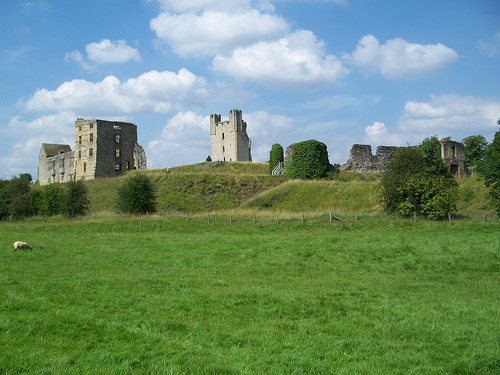
Location: Helmsley, North Yorkshire Map
Constructed: 1186- 1227
Entrance Fee: adult £4.70, children (5- 15
yrs) £2.90
Open: Apr- Sept 10am-6pm Mar & Oct 10am-5pm
Nov- Feb
10am-4pm Thu-Mon
Helmsley Castle is a medieval castle situated in Helmsley, North Yorkshire in United Kingdom. First wooden fortress of Helmsley Castle was constructed in 1120 by Walter Espec, a prominent military leader during reign of Henry I. After his death Helmsley Castle passed to his sister Adelina who married Peter de Roos. Current stone military citadel was constructed in 1186- 1227 by the orders of Robert de Roos replacing earlier wooden structures. The fort remained in the possesion of the family until 1478 when Edmund de Roos sold it to Richard, Duke of Gloucester who became known as Richard III. English king was killed in the Battle of Bossworth (defeated by House of Lancasters on 22 August 1485) and Edmund got his castle back by new king Henry VII. Talking about making a good deal.
Early History and the Timber Castle (11th–12th Centuries)
Following the Norman Conquest in 1066, William the Conqueror’s
half-brother, Robert, Count of Mortain, received the manor of Helmsley
(recorded as Elmeslac in the Domesday Book of 1086). The “Harrying of
the North” (1069–70) had devastated the area, but there is no evidence
Mortain built a castle here. The first fortifications appeared around
1120 under Walter l’Espec (or Espec), a powerful Norman baron, Justiciar
of the North, and founder of nearby Rievaulx Abbey (just 3 km away) and
Kirkham Priory. Walter constructed a timber ringwork castle—unusual for
the period, as it featured double concentric rectangular ditches and
earthwork banks topped with wooden palisades rather than the typical
motte-and-bailey design. The rocky outcrop shaped its rectangular
layout, and it served more as a lordly residence and safe haven than a
strategic border defense. Walter, childless, died in 1154 (or 1153), and
the estate passed through his sister Adelina to her husband, Peter de
Ros (or Roos).
Conversion to Stone and de Ros Expansions (Late
12th–14th Centuries)
The de Ros family transformed Helmsley into a
stone stronghold. Around 1186, Robert de Ros (known as “Fursan”),
Peter’s grandson, began major rebuilding, as recorded in the Rievaulx
Abbey chartulary. He erected a stone curtain wall with rounded corner
towers, a main south gateway under a square tower, an additional north
gatehouse with twin round towers, and two great towers (including the
distinctive D-shaped East Tower, the castle’s most prominent surviving
feature). There was no central keep—defenses relied on the enclosure and
barbicans. Robert divided his estates late in life, leaving Helmsley to
his elder son William.
William (d. 1258) added a chapel in the inner
bailey (replacing one in the East Tower; consecrated 1246). His son
Robert de Ros III (Lord of Helmsley 1258–1285) married Isabel d’Aubigny
(heiress of Belvoir Castle), whose wealth funded further upgrades: a new
hall and kitchen in the southwest inner bailey, strengthening of the
curtain walls, and likely the impressive south barbican (built c.
1227–1285). Robert divided the bailey with an internal wall—the southern
side for the lord’s private family quarters (new hall and East Tower),
the northern for officials and the old hall. His son William de Ros II
(d. 1316) and grandson William de Ros III continued remodeling, adding
domestic buildings, a grand hall, kitchen, and apartments, and
heightening the West Tower (possibly for the royal visit).
In 1334,
King Edward III visited for about five days; the East Tower may have
been raised especially for this. The de Ros family held Helmsley through
the 14th century, using it as a residence, administrative center, and
occasional refuge amid regional instability.
Wars of the Roses,
Royal Connections, and Transition to the Manners Family (15th–Early 16th
Centuries)
The de Ros backed the Lancastrians in the Wars of the
Roses. In 1464, Thomas de Ros III was executed for treason after the
Battle of Hexham; the castle was confiscated by the Yorkists and granted
first to George, Duke of Clarence, then (in 1478) to Clarence’s brother,
Richard, Duke of Gloucester—later Richard III. Richard owned several
northern castles (including Middleham, which he preferred) and made no
changes to Helmsley. After Richard’s defeat at Bosworth Field in 1485,
Henry VII restored the estate to Edmund de Ros (Thomas’s son). Edmund
died childless in 1508, passing Helmsley to his nephew Sir George
Manners of Etal. George’s son Thomas Manners inherited in 1513, became a
Tudor loyalist, and was created 1st Earl of Rutland in 1525. The family
supported Henry VIII, assisting in the 1533 removal of Rievaulx’s abbot
and purchasing the abbey’s estates after the Dissolution of the
Monasteries (c. 1536). They recycled stone from Rievaulx for later works
at Helmsley.
Tudor Mansion Phase (Mid-to-Late 16th Century)
Under the Manners Earls of Rutland, Helmsley shifted from fortress to
comfortable residence. Around 1563, Edward Manners (3rd Earl) demolished
the medieval hall, converted the old hall into a Tudor mansion with new
state apartments and a long gallery, repurposed the 13th-century chapel
as a kitchen (linked by a covered gallery), and adapted the south
barbican into more comfortable lodgings. Work progressed slowly; a 1578
letter notes mason payments and timber for an attic gallery. The Tudor
mansion was largely complete by 1582. Materials from Rievaulx gave it a
grand, recycled elegance. The castle remained a family seat through
Edward’s successors (John, Roger, and Francis Manners, 6th Earl).
Civil War Siege and Slighting (17th Century)
In 1620, Lady
Katherine Manners (daughter of Francis) married George Villiers, 1st
Duke of Buckingham—James I’s famous favorite. On Francis’s death in
1632, Katherine inherited Helmsley, which passed to their son, the 2nd
Duke of Buckingham. During the English Civil War, the castle garrisoned
Royalist troops under constable Sir Jordan Crosland. Parliamentarian
forces under Sir Thomas Fairfax besieged it from September to November
1644 (about three months). The defenders held out heroically but
surrendered due to starvation. Fairfax allowed honorable terms—the
garrison marched out with small arms and some even joined the
Parliamentarians. Parliament ordered the castle “slighted” (deliberately
damaged) to prevent future military use: large sections of walls and
gates were destroyed, and the East Tower was blown up (half still lies
in the ditch where it fell). The Tudor mansion was deliberately spared.
In 1650 the estate went to Fairfax and his heirs. In 1657, the 2nd Duke
of Buckingham recovered it by marrying Fairfax’s daughter Mary.
Buckingham died without heirs in 1687 (or 1689 per some records);
trustees sold the estate in 1695 to settle debts.
Georgian Ruin
and Later History (18th–21st Centuries)
London banker and politician
Charles Duncombe (later Lord Mayor) bought the 40,000-acre estate for
£90,000. On his death in 1711, it passed to his brother-in-law Thomas
Browne (who took the surname Duncombe). The Duncombes built the grand
Duncombe Park house nearby (designed by William Wakefield, a protégé of
Sir John Vanbrugh) and intentionally left Helmsley Castle to decay as a
picturesque romantic ruin and visual backdrop. J.M.W. Turner sketched
it; locals held fêtes, pageants, and agricultural shows there. In the
late 19th century, the vicar of All Saints’ Church hosted events inside
the ruins.
During the Second World War, the castle’s earthworks
formed part of an anti-tank defensive network around Helmsley. In 1923
it entered state guardianship under the Office of Works (Sir Charles
Peers oversaw clearing). It passed to English Heritage in 1984 (some
sources note 1983). The Duncombe family retains ownership of the estate
and castle today.
Helmsley Castle’s layered history—Norman timber
defenses, de Ros stone fortifications, Tudor domestic luxury, Civil War
drama, and deliberate ruination—makes it a microcosm of English medieval
and early modern history. Its surviving features (double ditches,
D-shaped East Tower, south barbican, and partial Tudor mansion)
illustrate centuries of adaptation from warfare to leisure. Visitors can
explore the site daily (managed by English Heritage), with audio guides
and reconstructions bringing its many lives vividly to life.
Early Earthwork Phase (c. 1120–late 12th century)
Walter l’Espec
built the initial castle around 1120 as a timber-and-earth ringwork
fortification. It featured two concentric rectangular earthwork ditches
(inner and outer) surrounding an inner bailey approximately 90m × 65m.
Timber palisades or breastworks topped the banks for defense. This
layout was atypical—no motte (artificial mound) or central keep—and
contrasted with nearby Pickering Castle. The ditches, dug into the rock,
remain one of the castle’s most impressive surviving features:
steep-sided, dry moats that still dominate the site today and provided
formidable passive defense.
Stone Fortification Phase (late
12th–13th centuries, de Ros family)
Major rebuilding began around
1186 under Robert de Ros and continued under his descendants (especially
Robert de Ros III, d. 1285). The timber defenses were replaced with a
stone curtain wall (originally about 4.6m high with a wall-walk and
crenellations for defenders). Rounded corner towers were added for
flanking fire. Key elements include:
East Tower (D-shaped
externally, with faceted internal faces—an innovative late-12th-century
design): The castle’s most prominent “keep-like” structure (though not a
true central keep). Originally two storeys (with a chapel on the upper
floor), it was heightened by a full storey in the 14th century (possibly
for Edward III’s 1334 visit) to three or four storeys with angled corner
turrets and a parapet. Thick walls, vaulted basement, large windows, and
prominent external latrine chutes survive. It overlooks the town and was
partially slighted (blown up) in 1644, leaving dramatic ruins but still
an imposing landmark.
West Tower: Positioned on the western side, it
served domestic purposes with a barrel-vaulted basement and upper floors
(later extended). It formed part of the lord’s private quarters.
Gatehouses and Barbicans: The main southern entrance had a square
gatehouse. In the late 13th century, a massive south barbican was
added—an advanced outer defense with an outer gatehouse flanked by drum
towers, extending curtain walls to open-backed round-fronted towers,
drawbridges, and a postern. A north gatehouse with twin round towers and
its own barbican provided secondary access. These created layered
defenses typical of high-medieval castles.
Internal Division: A
cross-wall (still traceable in footings) split the bailey into northern
(official/steward’s use) and southern (lord’s private) halves.
Domestic Buildings: A 13th–14th-century rectangular hall, kitchen,
pantry, buttery, and well were added in the southwest corner. A chapel
(c. 1246) stood centrally in the bailey.
The design emphasized
enclosure rather than a single dominant tower, with the two great towers
(East and West) and gatehouses providing strongpoints.
Tudor
Mansion Phase (16th century, Manners family)
After the de Ros line
ended, the castle passed to the Manners family (Earls of Rutland).
Around 1563–1587, they converted the northern “old hall” and adjacent
structures into a comfortable Elizabethan mansion (the West Range). Key
changes:
The 13th-century chapel was repurposed as a kitchen, linked
by a covered gallery.
The south barbican was adapted into residential
apartments.
New features included large mullioned windows (signaling
a shift from defense to luxury), ornate oak panelling, finely detailed
plasterwork ceilings and friezes, carved stone fireplaces, and timber
overmantels. The lord’s private apartments in the chamber block were
particularly lavish.
The original medieval new hall was largely
demolished to make way for these updates.
Parts of this range
survive relatively intact (with an on-site exhibition), offering a rare
glimpse of Tudor domestic comfort within castle walls.
Civil War
and Later History (1644 onward)
During the 1644 siege by
Parliamentarian forces under Sir Thomas Fairfax, the Royalist garrison
held out for three months before surrendering. The castle was slighted:
walls, gates, and part of the East Tower were deliberately destroyed to
render it indefensible. The Tudor mansion was spared. It later became a
romantic Georgian ruin in the grounds of Duncombe Park, preserved today
by English Heritage.
Overall Layout and Surviving Features Today
The rectangular inner bailey is enclosed by the (fragmentary) curtain
wall and earthworks. Key visible elements include:
The massive
double ditches/moats.
The ruined but soaring East Tower.
Sections
of the south barbican and gatehouse.
The West Range (Tudor mansion)
with exhibition spaces.
Footings of the chapel, halls, kitchen, well,
and dividing wall.
North gate and barbican traces.
No central
keep existed; defense relied on the perimeter walls, towers, and
ditches. The castle’s atypical ringwork-to-enclosure evolution, combined
with its well-documented phased development (earth → stone fortress →
Tudor mansion), makes it an important example of English castle
architecture.
Helmsley Castle sits right on the edge of the town centre at
Castlegate (postcode YO62 5AB). It’s easy to reach and combines
perfectly with a day exploring Helmsley’s shops, cafés, and the adjacent
Helmsley Walled Garden.
Opening times (as of 2026): Open daily
10am–5pm (last entry 4:30pm). Hours may shorten in winter (e.g., to 4pm
in November–March); always double-check the English Heritage website
before you go.
Tickets: Adult tickets typically range from around
£9–£11 depending on season and day (cheaper midweek/off-peak).
Concessions and children are discounted; family tickets are available.
English Heritage members enter free. Book online in advance for a 15%
discount. Tickets are valid all day.
Parking: Use the large public
pay-and-display long-stay car park right beside the entrance (not
managed by English Heritage, so fees apply even for members). It’s
convenient and serves the nearby Cleveland Way trail too. More parking
is available in the town marketplace.
Public transport: Buses serve
Helmsley; use goodjourney.org.uk for routes. In summer, the Moorsbus
network is handy for exploring the wider area.
Facilities: Toilets,
small shop/gift area, and picnic spots on site (no café, but the town
centre is a 2–5 minute stroll away with plenty of options). Dogs are
welcome on leads. The site is largely accessible with some gravel/grass
paths and ramps; a virtual audio tour covers less-accessible areas.
Plan on 1.5–2.5 hours for a relaxed visit—longer if you linger with
the audio guide or picnic.
A Quick History to Set the Scene
Built around 1120 in timber by Walter l’Espec (who also founded nearby
Rievaulx Abbey), the castle started as an unusual ringwork fortress with
double rectangular ditches rather than the more common motte-and-bailey
design. The de Roos family rebuilt it in stone in the 13th century,
adding the impressive south barbican, D-shaped East Tower, and dividing
the bailey into private and service areas. It hosted royalty (Edward III
visited in 1334) and changed hands during the Wars of the Roses.
In
the Tudor era, the Manners family (Earls of Rutland) transformed the
grim fortress into a luxurious mansion with fine plasterwork, panelling,
and large windows. During the English Civil War in 1644, Royalist forces
held out for three months under siege by Sir Thomas Fairfax’s
Parliamentarians before surrendering; the walls were then “slighted”
(partially demolished) to prevent future military use, leaving the
striking ruins we see today. It later became a romantic backdrop for
Duncombe Park and passed to English Heritage care (while still owned by
the Feversham family).
What to Expect When You Arrive: A
Step-by-Step Visit
You’ll start at the modern visitor area near the
entrance. Pick up the excellent free audio guide (highly recommended by
almost every reviewer—it’s easy to use, full of stories, and far better
than reading boards while walking). There are also information panels
throughout.
The Earthworks and Dry Moat: Begin with a gentle
circuit around the massive banks and ditches—these are the castle’s most
impressive defensive features and feel surprisingly peaceful (not
muddy!). Walk the outer perimeter for dramatic views and a sense of
scale.
Crossing into the Bailey: Head over the bridge and through the
well-preserved late-13th-century south barbican and gates (one of the
highlights). Bronze archer statues stand ready, adding a fun, immersive
touch.
The Ruins and East Tower: Explore the inner bailey’s stone
remnants, including the partially ruined D-shaped East Tower (still tall
and visible for miles, with visible latrine chutes). Climbable sections
offer panoramic views over Helmsley’s rooftops, the River Rye valley,
and the rolling North York Moors.
The Tudor West Range (Mansion
House): This is the most intact part. Step inside the former Elizabethan
mansion for the hands-on exhibition on the ground floor. It covers
social, domestic, and military life with real artefacts like Civil War
cannonballs, arrowheads, swords, early tableware, and even a huge
unexploded bomb. There’s a tactile scale model of the castle (with
Braille and audio descriptions), period furniture recreations, and
displays on plasterwork and panelling remnants. It’s family-friendly and
brings the stories alive.
Final Strolls and Views: Wander the grassy
courtyards, peer into remaining towers, and soak up the atmosphere. On a
clear day, the views are spectacular; on a blustery one, the ruins feel
properly atmospheric.
Visitor Tips and Experiences
Best time:
Sunny weekdays for fewer crowds and peaceful walks. Combine with a short
walk or cycle to Rievaulx Abbey (about 2–4 miles via a scenic route) or
visit the nearby walled garden.
What to wear/bring: Comfortable shoes
for uneven grass and gravel paths. Wind can be strong on the hilltop, so
layer up. Bring a picnic or plan to eat in town afterwards.
Who it’s
for: Excellent for history buffs, families (kids love the archers and
model), couples, and dog walkers. Reviewers call it “dog- and
disabled-friendly,” “far more than you expect from a ruin,” and “a
must-visit” with “wow” views and informative audio.
Hidden gem: Free
guided tours of the nearby Helmsley Archaeology Store are sometimes
available—ask on site.