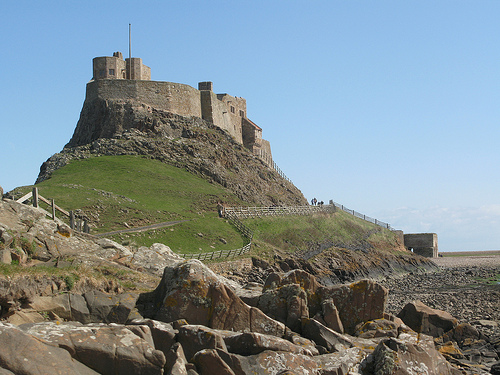
Location: Holy Island, Northumberland Map
Tel. 01289 389244
Constructed: 1550
Entrance Fee: adult
£4.40
Children (5- 15 years) £2.60
Lindisfarne Castle, perched dramatically on a rocky outcrop known as Beblowe Crag (or Beblowe) on Holy Island (Lindisfarne) off the Northumberland coast in northern England, is not a medieval fortress but a 16th-century Tudor artillery fort later transformed into a distinctive Arts and Crafts holiday home. Its history is deeply intertwined with the island’s earlier religious significance, the Anglo-Scottish border conflicts, and evolving military needs, before becoming a celebrated example of early 20th-century domestic architecture. Managed today by the National Trust, the castle remains one of Britain’s most picturesque and atmospheric historic sites.
Early Context: The Island and the Dissolution of the Monasteries
Holy Island’s fame predates the castle by nearly a millennium. The
Lindisfarne Priory was founded in AD 635 by Irish monk St Aidan at the
invitation of King Oswald of Northumbria, becoming a major center of
early English Christianity and home to St Cuthbert (who served as bishop
there). The famous Lindisfarne Gospels were created here around 700–720.
Viking raids, beginning with the notorious attack on 8 June 793,
eventually forced the monks to flee in 875, though a Benedictine priory
was re-established in Norman times (1093) and survived until the
Reformation.
The priory was dissolved in 1537 under Henry VIII as
part of the Dissolution of the Monasteries. Its ruins were initially
used by royal troops as a naval store. The strategic location of Holy
Island—its sheltered harbor made it the last deep-water port before the
Scottish border—prompted Henry to fortify the area against potential
Scottish (and French-allied) invasion. In 1542, Henry ordered Thomas
Manners, 1st Earl of Rutland, to strengthen defenses. By 1547, a small
fort or platform existed under Captain Ralph Cleisbye, armed with guns
including a demi-culverin, brass sakers, and a falcon. A more formal
earthen bulwark and small fort were established around 1548–1549 on
Beblowe Crag, overlooking the harbor.
Construction of the Tudor
Fort (1560s–1570s)
The present structure’s foundations date to the
reign of Elizabeth I. In 1565, military engineer Sir Richard Lee
inspected the site and found only a decayed turf rampart and platform.
Captain William Reed requested funds in April 1569 to complete the
walls. Major works in 1570–1571, costing £1,191, strengthened the fort
with gun platforms suited to evolving artillery. Stone was quarried from
the ruined priory buildings (and possibly other local sources),
explaining why some priory masonry appears in the castle walls.
Construction took roughly two years and created a compact artillery fort
with batteries, a garrison building, and defenses designed to protect
the harbor and deter raids. An additional supporting battery, Fort
Osbourne, was later added in 1675.
The castle was never a grand
medieval stronghold but a practical, functional fort—garrisoned from
nearby Berwick-upon-Tweed—with thick walls, vaults to support gun
platforms, and a commanding position. At its peak, it mounted up to 21
cannons.
Military Role and Limited Action (Late 16th–19th
Centuries)
For over 300 years (from the 1550s until 1893), the castle
remained under government garrison as a border sentinel. Its importance
peaked during the mid-16th-century Scottish Wars but waned after James
VI of Scotland became James I of England in 1603, uniting the crowns and
reducing the border threat. It continued protecting the small
Lindisfarne Harbour and served as a coastguard lookout in later years.
Specific actions were rare but notable:
English Civil Wars
(1640s): The castle was held by Parliamentarian forces. It reportedly
withstood a Royalist siege or standoff; accounts note the garrison
refused bribes or offers from Royalists.
Jacobite Rising of 1715: On
10 October, local Jacobite sympathizers Captain Lancelot Errington and
his nephew Mark seized the lightly defended castle (garrisoned by just
seven men, including a master-gunner who doubled as the local barber).
They overpowered the small force under the pretense of a visit (one
version involves a haircut). The rebels held it briefly as a signal for
uprising but surrendered the next day when no reinforcements arrived.
Recaptured by troops from Berwick, the Erringtons were imprisoned but
escaped after nine days, hiding near Bamburgh Castle before fleeing. The
incident highlighted the fort’s outdated defenses and minimal staffing.
By the 18th–19th centuries, the castle saw little combat. Guns and
garrison were finally removed in 1893, after which it fell into
disrepair and became something of a tourist curiosity.
19th-Century Industrial Context (Associated Features)
Though not part
of the castle proper, the nearby Castle Point Lime Kilns (built 1860 by
William Nicoll) operated until around 1900, producing quicklime and
slaked lime using local limestone. Wagonways, jetties, and a workforce
of up to 35 men supported the operation, which shipped lime by sea.
These industrial remains (now a Scheduled Ancient Monument) sit beside
the castle and reflect the island’s broader 19th-century economy.
20th-Century Transformation into a Holiday Home (1901–1940s)
In
1901, Edward Hudson—founder and owner of Country Life
magazine—discovered the derelict fort while touring Northumberland with
architect Sir Edwin Lutyens. Hudson leased (and later bought the
freehold in 1918) the site, commissioning Lutyens to convert it into a
holiday home. Lutyens (a leading Arts and Crafts figure) worked on the
project from around 1902–1912, dramatically reshaping the interior while
preserving the external Tudor character. He used pink Doddington
sandstone for new elements, added mullioned windows, arches, a
semi-octagonal tower, winding passages, steps, and low doorways for a
playful sense of scale. Furniture was sourced or commissioned to fit the
eccentric layout; original garrison features (like a salt hole, bread
oven, and gun-vaulted ceilings) were retained in places, such as the
dining room.
Garden designer Gertrude Jekyll created the walled
garden (originally the garrison vegetable plot) north of the castle. Her
1911 plan emphasized a vibrant summer flower garden (peaking in August)
with sweet peas and other blooms, sheltered from sea winds. The garden
was restored to her original design in the early 2000s.
Hudson was
deeply attached to the islanders who served as housekeepers: Jack
(“Wheeler”) and Hannah Lilburn (fisherman-turned-caretaker and his
wife), followed by their children George and Linda. The Lilburn family
provided continuity across owners, handling maintenance, guest transport
(by horse and cart or boat at high tide), and daily operations. Hudson
wrote affectionately of their friendship.
Hudson sold the castle in
1922 to stockbroker Oswald Toynbee Falk for around £22,000. Falk sold it
shortly afterward to merchant banker Sir Edward de Stein (also known as
Edward Adolphe Sinauer de Stein). De Stein and his sister Gladys lived
there; he remained a tenant after gifting the castle, garden, and lime
kilns to the National Trust in 1944. The property opened to the public
around 1970 following de Stein’s death in 1965 and Gladys’s in 1968.
Modern Era and Conservation
The National Trust has cared for
Lindisfarne Castle since 1944, preserving Lutyens’ vision with minimal
later changes. A major restoration occurred 2016–2018, after which it
reopened with updated displays. Three upturned herring-buss boat sheds
(designed by Lutyens using disused boats) stand nearby; two were
replaced after arson in 2005.
Today, visitors climb a steep path to
explore the compact interior—entrance hall with stone pillars, kitchen
with large fireplace, music room once used by cellist Guilhermina
Suggia, and galleries echoing Elizabethan and Jacobean styles. The
castle has appeared in films and TV (e.g., Cul-de-sac, The Tragedy of
Macbeth, Cold Feet). It offers panoramic views toward Bamburgh Castle
and embodies layers of history: Tudor military pragmatism, Edwardian
whimsy, and modern preservation.
In summary, Lindisfarne Castle
evolved from a hastily built border fort—born of Reformation upheaval
and Anglo-Scottish tensions—into a quiet sentinel, then a beloved
private retreat, and finally a public treasure. Its story captures
Northumberland’s turbulent past and the creative spirit of the Arts and
Crafts movement, all within one of Britain’s most evocative island
landscapes.
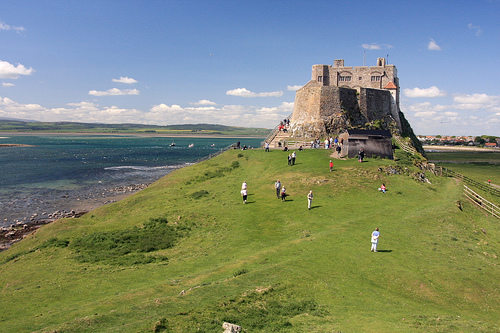
Original Tudor Fort (1540s–1570s)
The castle originated as a
small defensive fortification ordered by Henry VIII in the 1540s
(with major stonework completed under Elizabeth I around 1570–1571)
to protect the harbour—the last deep-water port before the Scottish
border. Stones were quarried from the ruins of the nearby
Lindisfarne Priory after its dissolution.
Constrained by the
irregular shape of the crag, the fort was never a grand geometric
structure like Henry VIII’s south-coast Device Forts. Instead, it
featured:
An irregular polygonal plan rising on three levels
from the rock.
Two main gun batteries (Lower Battery to the
east/south and High Battery to the west) that “rise up out of the
rock face,” with cannon ports piercing the battlements.
A
garrison block sandwiched between them, creating a lower court and
upper court.
Vaulted passages and cellars in the Tudor fabric
(some still visible and functional).
Defensive elements including
an initial earthen bulwark (later replaced in stone), battlements,
and a portcullis at the entrance.
The whole ensemble was
austere and functional, designed purely for artillery defence rather
than residence or display. By the 18th–19th centuries it had become
derelict after losing military importance following the union of the
English and Scottish crowns.
Lutyens’ 1901–1912
Transformation
In 1901, publisher Edward Hudson (founder of
Country Life) bought the ruined fort as a holiday home and
commissioned his friend Edwin Lutyens (then 38 and deeply engaged
with the Arts & Crafts movement) to convert it. Work continued in
phases until around 1912, with Lutyens collaborating on the garden
with Gertrude Jekyll.
Lutyens preserved the castle’s rugged,
windswept silhouette and its intimate relationship with the crag
while turning the military blockhouses into a quirky family retreat.
Key interventions included:
Selective demolition and
rebuilding of older sections.
Insertion of new structural and
decorative elements that blend seamlessly with the Tudor fabric.
Emphasis on “romantic” fortress-like qualities without sacrificing
habitability.
The result is often described as a “castle that
isn’t really a castle” — forbidding outside, cosy and eccentric
inside.
Exterior Architecture
The castle emerges
organically from the rock like a natural outcrop. Its irregular
polygonal footprint follows the contours of Beblowe Crag, giving it
a sculptural, site-specific quality typical of Lutyens’ romantic
works.
Eastern façade (first view from the Lower Battery):
Mostly original Tudor masonry, but Lutyens added distinctive pink
sandstone mullions around (and arches above) new windows, massive
lintels over doors, and an entirely new semi-octagonal tower (two
storeys high, with a lookout cabin and surrounding balcony offering
panoramic island and sea views). The pink Doddington sandstone
(quarried near Wooler on the mainland) contrasts subtly with the
older, weathered local stone.
Entrance: A steep, cobbled ramp
winds around the rocky base (Lutyens deliberately left it
unprotected by rails or fences to heighten the sense of exposure and
drama). It leads to a Tudor-style surround with portcullis and heavy
oak door.
Other features: A former garderobe tower with pyramidal
roof; battlements retained and repaired; upturned herring-buss
(fishing boat) hulls repurposed as garden sheds (one of Lutyens’
whimsical touches).
Below the castle lies Jekyll’s small
walled garden (originally the garrison vegetable plot), reached via
restored steps and featuring her characteristic planting plan.
Interior Architecture and Design Philosophy
Lutyens’ genius
here lies in his playful manipulation of scale, space, and texture
within the tight constraints of the old fort. He created a labyrinth
of small, human-scale rooms connected by winding passages,
unexpected steps (down then up), low doorways opening into
high-ceilinged spaces, and integrated stone cupboards and staircases
that appear to grow from the rock itself.
He “dressed small rooms
with huge pieces of furniture” and used simple, honest
materials—stone, brick, slate, and wood—to evoke a rustic, spartan
yet romantic lifestyle. Many “Tudor” details (fireplaces, panelling,
latched doors, moulded beams) are actually sympathetic mock-Tudor
additions by Lutyens.
Key hallmarks of his style visible
throughout:
Vaulted arches and ceilings (echoing medieval and
Elizabethan forms).
Herringbone-patterned brick floors (a Lutyens
signature).
Contrast of raw stone and whitewashed plaster.
Neo-Gothic and Jacobean-inspired details (traceried windows, exposed
oak beams).
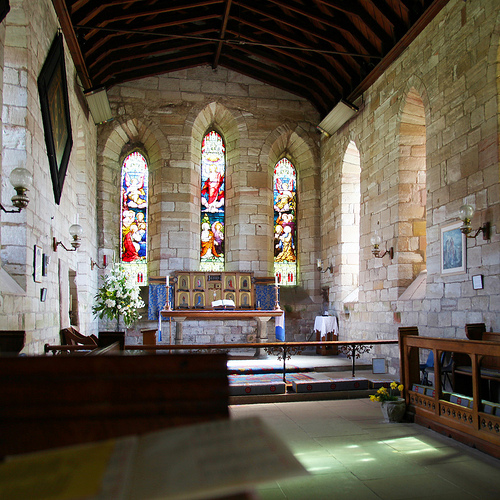
The entrance hall, for example, draws inspiration
from Durham Cathedral: a columned arcade of large stone pillars
(dark reddish-brown local stone) that “sprout” from the rock
beneath, dividing the space like a nave. The arches are
non-load-bearing—purely theatrical for dramatic effect—contrasting
with whitewashed walls and bare stone floors.
Floor plan overview
(based on Lutyens’ designs and later conservation plans): The layout
links two former separate buildings via a long gallery. On the lower
levels are the kitchen/scullery and entry areas; the dining room and
Ship Room occupy the old Tudor kitchen and gun-magazine spaces (with
surviving vaults that once supported the batteries above); upper
levels include bedrooms and the gallery leading to the High Battery.
Signature Rooms and Features
Kitchen: Bare and dominated by a
massive stone fireplace with an old bread-oven; tiny scullery window
and visible portcullis mechanism.
Dining Room: Built within the
Tudor fort remnants; retains low walls and 18th-century vaulted
ceiling (originally to bear the weight of guns); Lutyens added a new
fireplace and signature herringbone red-brick floor, but left the
garrison’s salt hole and bread oven. One wall is painted Prussian
blue; Neo-Gothic traceried windows with swing-out curtains.
Ship
Room (drawing room): Converted from gun magazine and small rooms;
vaulted ceiling from which Lutyens once suspended a model East
Indiaman ship; green walls, dark wood furniture.
Long Gallery:
New linking space in Elizabethan/Jacobean style but on a smaller,
more intimate scale; exposed stone arches, oak beams, herringbone
brick floor.
Bedrooms: Varied in character—the east bedroom is
bright and airy with pull-out pole curtains; others feature
inglenook fireplaces and panelled detailing.
Materials and
Artistic Influences
Stone: Local dark reddish-brown for
structure; pink Doddington sandstone for Lutyens’ new work.
Brick: Herringbone floors; used in vaults and accents.
Other: Oak
beams and panelling, slate, whitewashed plaster; textures
deliberately left raw to celebrate craftsmanship and the building’s
military past.
Influences: Arts & Crafts honesty of materials;
Elizabethan/Jacobean domestic architecture; medieval vaulting; even
Durham Cathedral for spatial drama.
Gardens and Surroundings
The walled garden, once a garrison vegetable plot, was redesigned by Jekyll in 1911 as a summer flower garden, with Lutyens reshaping the walls. Restored 2002–2006 using her plans (now at UC Berkeley), it features vibrant blooms like sweet peas ('Miss Wilmott', 'Queen Alexander'), peaking in August. The lime kilns at Castle Point, with wagonways and jetties, represent 19th-century industry.
Holy Island is only accessible via a 3-mile (5 km) causeway that
floods twice daily with the tide. This is the single most important
planning factor — ignore it at your peril. The sea rushes in fast, and
the causeway can disappear under several feet of water.
Check
safe crossing times in advance on the official Northumberland County
Council site (holyislandcrossingtimes.northumberland.gov.uk) or the NT
website. Times vary daily and seasonally; for example, in spring 2026
they shift earlier each day. Aim to arrive at least 30–60 minutes after
a safe window opens to avoid rush-hour crowds on the island.
By car:
From the A1, follow signs to Holy Island. Park in the main
pay-and-display car park near the village (about 15-minute walk to the
castle through the harbour and village). Disabled/coach parking is
closer (half-mile from the castle). No shuttle bus currently operates.
Public transport/walking: Limited buses from Berwick-upon-Tweed or
Bamburgh; many visitors arrive by car or join boat tours from Seahouses
(which land at high tide for a different perspective).
On foot or
bike: Possible from the mainland at low tide (safer with boots), but
check times carefully.
The drive across the causeway itself is
magical — low tide reveals vast mudflats, seabirds, and the castle
rising like a sentinel ahead.
Practicalities: Tickets,
Facilities, and Timing
Opening: Typically March to late October
(tide-dependent); closed in winter. Exact daily hours align with safe
crossing windows — entrance allowed up to 30 minutes before closing. No
pre-booking required (online system retired). Last entry is flexible but
plan 1–2 hours for the castle itself.
Tickets (approximate 2024–2026
rates; check NT site for exact): Adults £10–13 (Gift Aid option higher),
children £5–6.50, family tickets £25 (2 adults + 2–3 kids) or £15 (1
adult). National Trust members and under-5s enter free. Garden is free
and open anytime.
Facilities: Small ticket office with lockers for
bags. No café inside the castle (picnic on the grassy bank or in the
village). Toilets are at the car park or nearby village. Shop sells NT
gifts and books. Dogs are welcome on surrounding trails and the island
but not inside the castle (guide dogs excepted); there’s a pet station
at the entrance.
Accessibility: Challenging. Steep cobbled ramps,
stone steps, and multiple levels. Blue-badge drop-off possible near the
gate (limited spaces). No disabled toilets on site. A digital guide
helps, and staff are helpful. The walled garden has an uneven path.
Best time: Early morning or late afternoon for fewer crowds and golden
light. Summer (June–August) is ideal for the garden in full bloom;
shoulder seasons offer wilder, emptier vibes and better wildlife
spotting (seals, birds).
A Brief History: From Fort to Holiday
Home
Built in the 1540s as a Tudor artillery fort using stones from
the dissolved Lindisfarne Priory, it defended against Scottish raids. It
had up to 21 cannons and a small, poorly paid garrison. After the 1603
Union of Crowns, it lost military importance and fell into ruin by the
late 1800s.
In 1901, Edward Hudson (founder of Country Life magazine)
leased the ruins and commissioned architect Edwin Lutyens (with garden
designer Gertrude Jekyll) to transform it into a quirky holiday home.
Lutyens (1904–1912) kept the rugged exterior but added Arts & Crafts
details: pink sandstone from local quarries, low doorways, winding
passages, and clever spatial tricks. Jekyll designed the walled garden
(restored 2002–2006 to her original plans). Hudson entertained
celebrities here; later owners preserved it almost unchanged until the
National Trust took over in 1944.
Exploring the Castle: Intimate
and Atmospheric Interiors
The castle is compact (you won’t need more
than 60–90 minutes), but every corner rewards attention. Rooms are
furnished as they were in Hudson’s era — cosy yet eccentric.
Entrance
Hall: Striking symmetry with Lutyens’ columns that seem to “grow” from
the floor (inspired by Durham Cathedral). Look for Hudson’s embossed
initials on the fireplace.
Kitchen & Scullery: Functional 1912 setup
with original features; late-1600s wall paintings above the scullery
door (discovered 2017).
Dining Room: Tudor fireplace with bread oven
and salt hole intact; herringbone floor and a window replaced to
Lutyens’ original design. Imagine champagne-fueled dinners.
Ship Room
(former gunpowder magazine): Drawing room with a model ship overhead —
nautical theme throughout.
Long Gallery & Bedrooms: Added in
1904–1912; low ceilings, uneven steps, and practical luxury.
Upper
Gallery: Once a storeroom and concert space (cellist Madame Suggia
performed here); now features a sound installation of period cello
music.
Upper Battery: The highlight — climb the original staircase
for 360° views over the sea, Farne Islands, Bamburgh Castle, Cheviot
Hills, and navigation beacons. A working wind indicator (installed 1913,
conserved 2006) shows real-time direction.
There are also lime
kilns and historic boat sheds nearby (remnants of the island’s
19th-century industry).
The Walled Garden and Outdoors
A short
walk from the castle (free entry) is Gertrude Jekyll’s restored garden
on the site of the old garrison vegetable plot. In summer it explodes
with colour: sweet peas, delphiniums, poppies, hollyhocks, marigolds,
and herbs. Lutyens lowered the front wall for bench views back to the
castle. It’s a peaceful contrast to the windswept crag — perfect for
picnics or quiet reflection.
Visitor Experience and Tips
Most
visitors describe the castle as “magical,” “stunning,” and “worth every
effort” for the location and views. It feels intimate and lived-in
rather than grand. Crowds can build midday in peak season, but the
end-of-day slot is often quieter. The wind can be fierce — bring layers
and a windproof jacket. Photography is superb from the Upper Battery and
along the coastal paths.
Pro tips:
Combine with Lindisfarne
Priory (English Heritage, separate ticket — NT membership doesn’t cover
it).
Explore the village, harbour, beaches, and bird/seal watching
while waiting for the tide.
Download the NT app or digital guide for
extra stories.
Picnic supplies from the village or bring your own —
the grassy slopes have deck-chair views to die for.
Family-friendly:
free I Spy trail, seal spotting, kite flying, and hide-and-seek in the
lime kilns.