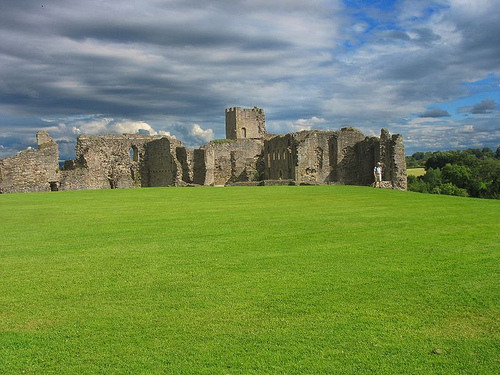
Location: Tower Str, Richmond, North Yorkshire Map
Tel. 01748 822493
Entrance Fee: adults £4.50, children £2.30
Open: Oct- Apr: Thu- Mon
May- Sep: to 4pm daily
Richmond Castle, perched dramatically on a steep cliff above the
River Swale in the market town of Richmond, North Yorkshire,
England, is one of the finest and best-preserved early Norman
castles in Britain. Its honey-coloured sandstone ruins,
including massive curtain walls and a towering 12th-century
keep, have stood since the late 11th century. Originally built
as a statement of Norman power following the 1066 Conquest, it
controlled the strategically important North of England and the
Honour of Richmond—a vast estate spanning parts of eight
counties. Unlike most contemporary motte-and-bailey castles
built of earth and timber, Richmond was constructed primarily in
stone from the outset, making its surviving 11th-century fabric
exceptionally rare and complete.
The castle’s history spans
from its Norman origins through dynastic intrigue tied to the
Duchy of Brittany, periods of royal control, gradual decline
into a romantic ruin, Victorian military use, and its poignant
role in the First World War as a prison for conscientious
objectors. Today it is cared for by English Heritage and draws
visitors for its architecture, sweeping views over the Yorkshire
Dales, and layered stories.
Norman Foundation (late 1070s–1093)
Richmond Castle was
founded in the turbulent aftermath of the Norman Conquest. In
1069–70, William the Conqueror brutally suppressed northern
rebellions through the “Harrying of the North,” which
depopulated large areas. To secure the region and guard against
Scottish incursions (the border then lay farther south), William
granted extensive lands in northern England to his loyal Breton
kinsman, Count Alan Rufus (“the Red”) of Penthièvre. Alan, who
may have commanded the Breton contingent at the Battle of
Hastings, received the borough of Richmond around 1071 and began
building the castle shortly thereafter as his principal seat.
The site chosen was a naturally defensible rocky promontory high
above the River Swale, possibly on the location of an earlier
(but unconfirmed) defensive point. The Domesday Book of 1086
refers to Alan’s holdings as a “castlery”—an estate organized to
support a castle—and names the place Hindrelag (later Riche
Mount, meaning “strong hill”). The earliest surviving
structures, likely built in the 1080s, include long stretches of
the stone curtain wall enclosing a roughly triangular inner
bailey, the great archway now in the keep’s basement (originally
the main gate), and Scolland’s Hall—a rare surviving example of
11th-century domestic architecture named after a later
constable.
12th-Century Expansion and the Keep
After
Alan Rufus died childless in 1093, the castle and Honour passed
to his brothers (Alan the Black and Stephen) and then to his
nephew, another Alan (II), who styled himself Earl of Richmond
by 1136. His son, Conan IV (c.1135–1171), Duke of Brittany from
the 1150s, oversaw the castle’s most significant medieval
expansion. Conan spent considerable time at Richmond in the
1150s–60s and almost certainly built the imposing 100-foot (30
m) keep at the northern apex of the enclosure, replacing the
original gatehouse. Constructed of honey-coloured sandstone with
walls up to 11 feet (3.4 m) thick, the keep served as both a
residence and a powerful symbol of wealth. Recent analysis
suggests its upper chamber may have featured a raised platform
for the duke and officers.
Henry II seized the castle in 1171
after Conan’s death (his young daughter Constance was betrothed
to Henry’s son Geoffrey). Royal records show repairs to the
tower and the “king’s house” (likely Scolland’s Hall) in the
1170s–80s. Henry II or his successors may also have added towers
and a barbican.
Medieval Ownership, Politics, and Minor
Conflicts (13th–14th Centuries)
The castle’s fortunes
remained intertwined with the Duchy of Brittany. Dukes of
Brittany held the Honour of Richmond but owed fealty to both the
English king (for English lands) and the French king (for
Breton/French territories). This impossible balancing act led to
repeated confiscations by the English Crown during Anglo-French
wars. The castle changed hands frequently but saw little major
alteration or conflict.
Notable works included repairs under
Henry III (1250) and more substantial ones by Edward I (after
1294), who likely vaulted the keep’s basement, renovated
Scolland’s Hall, and added residential ranges. Upper apartments
were added to towers like Robin Hood and Gold Hole. A chapel in
the south-west corner (now lost) hosted canons from Egglestone
Abbey in 1278.
Security concerns arose: Scottish raids after
Bannockburn (1314) devastated the area (though the castle was
spared), and in 1340 locals briefly besieged it, injuring the
duke’s servants. By 1341 the castle was described as ruined and
in need of repair. It played a peripheral role in events like
the First Barons’ War (1215–17) and Simon de Montfort’s
rebellion (1265), with no recorded sieges at Richmond itself.
Decline into Ruins (15th–18th Centuries)
By the early
16th century the castle had largely fallen out of use. A 1538
survey described it as derelict; another in 1609 called it
“decayed.” Occasional repairs occurred (e.g., glass for the
chapel in Robin Hood Tower in the 16th century), but it became a
symbolic asset rather than a functioning fortress. In 1462
Edward IV granted it to George, Duke of Clarence (without the
earldom title). Ownership passed to the Dukes of Richmond in
1675. The 3rd Duke repaired the keep in the 1760s, but the site
remained a ruin for nearly 300 years.
Romantic Ruin and
Victorian Military Use (19th Century)
In the late 18th and
early 19th centuries, artists like J.M.W. Turner romanticized
the ruins, boosting tourism in Richmond. The keep was repaired
again in the early 19th century. In 1854–55 the 3rd Duke leased
the site to the North Yorkshire Militia. A barracks block was
built against the west curtain wall; the keep served as a depot,
and a reserve armoury was added near the gate.
In 1908–10 it
became headquarters of the Northern Territorial Army under
Robert Baden-Powell (founder of the Scout Movement). The
historic fabric passed to the Ministry of Works in 1910, though
the army retained some buildings.
First World War: Prison
for Conscientious Objectors
During WWI the castle housed the
Northern Non-Combatant Corps—men granted exemption from combat
who performed support roles. Some “absolutist” conscientious
objectors refused any war-related work and were detained in the
19th-century cell block (formerly the armoury). These tiny cells
still bear over 2,300 examples of graffiti scratched into the
walls by prisoners from the mid-19th century to the 1970s.
In
1916, 16 such men (the “Richmond Sixteen”) were sent to France,
court-martialled for disobedience, and sentenced to death (later
commuted to hard labour). Their story became a landmark in the
history of conscientious objection. The cells’ graffiti—names,
poems, drawings, and messages like one reading “You might just
as well try to dry a floor by throwing water on it, as try to
end this war by fighting”—survive as a unique testament.
20th Century to Present
Post-WWI the barracks briefly became
council housing (1920–28) before demolition in 1931. In WWII the
keep served as an air-raid shelter and observation post. The
cell block held military prisoners again in 1940. English
Heritage has managed the site since 1984, conserving the ruins
and opening them to the public.
Legends and Folklore
Richmond is linked to Arthurian legend. According to local
tales, King Arthur and his knights sleep in a hidden cave
beneath the castle, awaiting England’s hour of need. A potter
named Peter (or Thompson) allegedly stumbled upon the cave, saw
Excalibur and a horn on a tomb, picked up the sword (awakening
the knights), then fled in fear after hearing a voice promising
fortune if he had blown the horn. Another story tells of a
drummer boy lost in a tunnel, whose ghostly drumming is
sometimes heard.
Richmond Castle remains a powerful reminder
of medieval power, dynastic politics, and 20th-century
conscience. Its well-preserved Norman fabric offers a rare
glimpse into early castle design, while its later stories—from
romantic ruins to WWI imprisonment—add depth to its enduring
appeal. Visitors can climb the keep for panoramic views, explore
the cells’ poignant graffiti, and walk the curtain walls that
have witnessed over 900 years of English history.
Richmond Castle, located in North Yorkshire, England, perched
dramatically on a rocky cliff above the River Swale, is one of
the best-preserved early Norman castles in England and a prime
example of 11th- to 14th-century medieval military and domestic
architecture.
Unlike most post-Conquest castles, which began
as earth-and-timber motte-and-bailey structures, Richmond was
built almost entirely in stone from the outset (c. 1071 onward)
by Alan Rufus, a Breton kinsman of William the Conqueror. This
makes it exceptionally rare and significant.
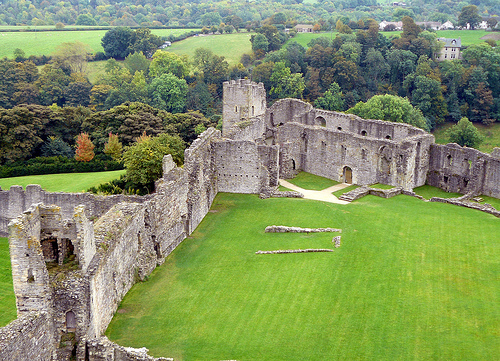
The castle
occupies a naturally defensive triangular site. Its main
enclosure (the "great court") measures approximately 91m
north-south by 137m east-west. The south side relies on the
steep cliff drop to the river for protection, while the north,
east, and west sides are enclosed by a massive 11th-century
curtain wall. To the north lies the keep at the apex; to the
east is an outer barbican court and the "Cockpit" garden area.
Curtain Wall and Defensive Towers (11th Century Core)
The
curtain wall forms the earliest and most complete surviving
example of early Norman fortification in England. Built c.
1071–1100 in coursed ashlar stone (honey-coloured sandstone), it
stands to near-full height in many places, with later
14th-century parapets and wall walks added on the east side. All
major domestic buildings were ranged against its inner face for
efficiency and defense.
East curtain: Features three
projecting square towers. The northernmost is Robin Hood Tower
(late 11th century; name is Victorian romanticism). Its two
lower floors are barrel-vaulted; the ground floor housed the
Chapel of St Nicholas, with traces of medieval red paint still
visible on the altar arch. The middle tower has largely
collapsed. The southernmost is Gold Hole Tower (also called the
garderobe tower), which retains its original height, latrine
pits, and lower 11th-century fabric.
West curtain: Stands
tall and includes an 11th-century sallyport (a small postern
gate for surprise sorties) and a semicircular arch marking the
site of the greater chapel.
North apex: Originally an
11th-century inner gatehouse (principal entrance from the
barbican), later engulfed by the keep.
The Great Keep
(Mid- to Late 12th Century)
Dominating the castle is the
massive square keep, built c. 1150s–1170s (probably begun by
Duke Conan IV of Brittany and completed under Henry II). It
rises ~30m (100ft) high with walls 3.4m (11ft) thick,
constructed of honey-coloured sandstone. It follows the English
tradition of square tower-keeps (comparable to Bamburgh or
Carlisle) but was erected directly over the original
11th-century gatehouse arch, which survives in the basement.
Architectural highlights:
Four corner turrets and shallow
buttresses on each face for structural reinforcement and visual
power.
First-floor level: Three ornate windows facing the
market place below—possibly used as balconies for public
appearances by the lord.
Entrance at first-floor level
(standard for security), accessed via an external stair (no
longer surviving in stone). Inside: a small lobby, then a high
chamber with a central pillar. A straight stair leads to the
second-floor great hall (open to the roof, with a dais under
paired windows). The ground floor was rib-vaulted in the late
13th century (with a well in the central column). A spiral stair
was added then to connect floors. The original roof was steeply
pitched; today a modern flat roof sits within the parapets.
Views from the battlements are panoramic over Richmond and the
Yorkshire Dales.
Domestic and Residential Buildings
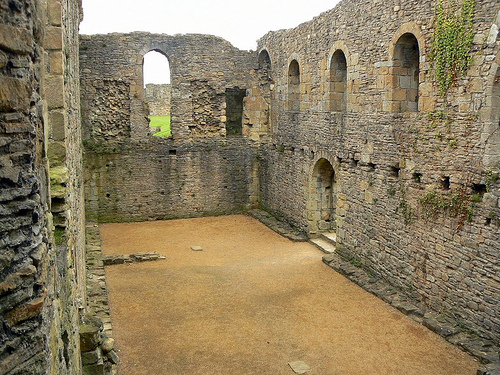
Scolland’s Hall (c. 1080s, against the south curtain wall) is
one of the oldest surviving stone domestic buildings in England
and a textbook example of early Norman/Anglo-Norman hall
architecture. Named after a 12th-century steward, it is a
two-storey rectangular block:
Undercroft (ground floor):
Storage, lit by rectangular south-facing windows.
Upper
floor: Great hall (almost the full length) with large windows on
both long sides for light and status; separated by a stone
partition at the east end is the lord’s private solar
(withdrawing chamber). Evidence exists of an external balcony
overlooking the garden.
Later additions: A 12th-century
kitchen/buttery/pantry range to the west (accessed via three
doors punched through the hall wall, possibly screened). Further
13th/14th-century repairs after fire damage (visible as
heat-discoloured stone) and modifications including a new
doorway and window.
Outer Enclosures and Additional
Features
Barbican (outer court): To the north/east of the
main gate, added or strengthened in the 12th century under Henry
II. It functioned as a secure entry vestibule for checking
visitors. The east wall survives; the outer gatehouse is gone.
Cockpit (second court/garden): East of the curtain wall,
possibly an 11th-century garden (mentioned in 1280 records)
overlooked by a balcony from Scolland’s Hall. Later used for
cockfighting; now a restored garden. Its enclosing wall dates to
the 12th century.
Later Architectural Phases and
Modifications
13th–14th centuries: Vaulting in keep basement,
chapel range, and repairs.
19th century: Victorian barracks
(1855, along west wall; demolished 1931) and armoury/cell block
(c. 1865) for militia use. The latter held conscientious
objectors (“Richmond Sixteen”) in 1916, with surviving graffiti.
The castle fell into ruin by the early 16th century but was
conserved in the 19th–20th centuries for tourism.
Richmond Castle’s architecture is remarkable for its early use
of stone throughout, the integration of domestic halls directly
into the defensive curtain, and the exceptional survival of
11th-century fabric alongside the imposing 12th-century keep. It
blends military strength with early residential sophistication,
offering a near-complete picture of Norman castle evolution in
England.
A typical visit lasts 1–2 hours (or longer if you linger for
views, a picnic, or combine it with the town), and the site
feels spacious and atmospheric rather than crowded. You enter
via the visitor centre area and step into a large, open grassy
bailey (courtyard) enclosed by substantial curtain walls with
towers. The ruins allow free wandering around halls, chapels,
and defensive features, with informative panels explaining the
layout and daily life.
The Keep: The highlight for many
is climbing the tall, square Norman keep (one of the oldest and
most intact parts). It involves around 129 steep, narrow steps,
but the reward is spectacular 360-degree views over Richmond's
rooftops, the River Swale, Culloden Tower, St Mary's Church,
Richmond Falls, and the rolling Dales. The ascent offers
glimpses into the castle's robust construction and defensive
design. Note that the steps make this unsuitable for those with
mobility issues.
Curtain Walls and Towers: Walk along
sections of the walls for elevated perspectives. Features like
the Gold Hole Tower (overlooking the river and Green Bridge)
provide dramatic vantage points.
Cockpit Garden: A tranquil,
landscaped garden area outside the east curtain wall, created in
2000. It's a peaceful spot for reflection, with views down to
the river — perfect for a quiet break or evening events.
Exhibition and Interactive Elements: An engaging interactive
exhibition in the visitor area explores the castle's full
history, from Norman origins through its military phases to the
WWI conscientious objectors. Displays include timelines,
illustrations, artifacts, and a video/virtual tour of the cells
highlighting the prisoners' graffiti. There's also a
museum-style area with information spanning the 11th to 20th
centuries. Free guided tours (when available) from the ticket
office provide deeper insights into architecture and stories.
Atmosphere and Grounds: The vast open spaces invite picnicking,
and the site has a majestic yet approachable feel. On a sunny
day, the light enhances the stonework and views; it can feel
more atmospheric (and quieter) in softer weather. Families
appreciate space for kids to run, while history enthusiasts
delve into the multi-layered narrative.
Dogs are welcome
on leads in outdoor areas (including the grounds), with water
bowls available, but not in the exhibition. The site is
generally well-maintained, though some paths or steps can be
uneven.
Practical Information for Visiting (as of 2026)
Location: Tower Street, Richmond, North Yorkshire, DL10 4QW.
It's right in the heart of the charming market town, making it
easy to combine with a stroll through Richmond's Georgian
architecture, market place, and riverside walks (including the
scenic Castle Walk along the Swale).
Opening Times: Generally
open daily 10am–5pm (last entry 4:30pm) during peak seasons
(e.g., late March to late October). Hours shorten in winter
(often 10am–4pm, with limited days midweek). Always check the
English Heritage website for your exact date, as there can be
seasonal variations or occasional closures.
Tickets and
Prices: Tickets are available on the day (full price) or in
advance online (saving ~15%). Prices vary by season and demand
(super saver, saver, standard periods), but expect roughly
£8–£11 for adults, with concessions for seniors/students and
reduced rates for children (5–17). Family tickets are available.
English Heritage members enter free (with up to 6 children free
per adult member). Tickets are valid all day.
Getting There
and Parking: No on-site parking. Use nearby public car parks in
the market place (some free 2-hour spots for Blue Badge holders)
or options like Fosse Car Park, Yorke Square, or Station Road.
The walk from the market place involves cobbles, so wear sturdy
shoes. The town is compact and walkable.
Facilities: Toilets
(including an accessible unisex one) are available. There's a
small gift shop. No on-site café, but plenty of options in the
town centre (cafés, pubs, and restaurants). Picnic tables on the
grounds.
Accessibility: The site has uneven terrain, steep
steps (especially the keep), and limited flat access, so it's
challenging for wheelchairs or pushchairs in many areas.
However, off-road wheelchairs or assistance may be available —
contact English Heritage in advance. Some disabled parking
exists nearby. The visitor centre and certain paths are more
accessible.
Tips for the Best Visit
Book advance
tickets for the discount and to skip any queues.
Wear
comfortable shoes for climbing and walking on grass/stone.
Visit on a clear day for optimal views; early morning or late
afternoon can be less busy.
Combine with nearby attractions:
Easby Abbey (a short walk or drive), a riverside path to the
falls, or a full town exploration.
Listen to the English
Heritage podcast or watch their video tour beforehand for richer
context, especially on the conscientious objectors.
If
interested in events, look for special tours (e.g., cell block
or garden evenings).