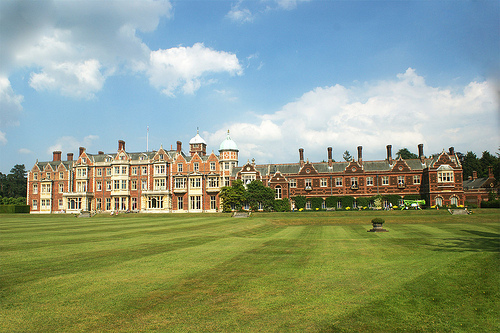
Location: Norfolk Map
Tel. 01553 612908
Open: Easter- Oct: daily
Closed: one week July
Official site
Sandringham House, a private royal residence in Norfolk, England, has served as a beloved country home for four generations of British monarchs. Unlike state-owned palaces such as Buckingham Palace or Windsor Castle, it is personally owned by the sovereign (currently King Charles III). The estate spans approximately 20,000 acres of farmland, woodland, and gardens in the Norfolk countryside, blending centuries of history with royal traditions of shooting, family gatherings, and estate management. Its story begins long before the royals arrived and reflects evolving tastes in architecture, leisure, and land stewardship.
Early History (Pre-1862)
The site of Sandringham is ancient.
It appears in the Domesday Book of 1086 as “Sant Dersingham” (the
sandy part of Dersingham), awarded to the Norman knight Robert
Fitz-Corbun after the Conquest. Evidence of prehistoric activity and
a Roman villa nearby has been found. By the 15th century it was held
by Anthony Woodville, Lord Scales (brother-in-law to Edward IV). In
the Elizabethan period, a manor house stood on the site.
Ownership passed through families including the Cobbes (from 1517)
and the Hostes (from 1686, of Dutch/Huguenot origin). In 1771,
Cornish Henley (married into the Hoste family) demolished the
earlier structure and built a plain Georgian mansion known as
Sandringham Hall—white-stuccoed and relatively modest. Henley died
before completion; his son later sold it.
In 1836 the estate was
purchased at auction by John Motteux, a London merchant of Huguenot
descent. Childless, Motteux bequeathed it in 1843 to his friend
Charles Spencer Cowper (stepson of Prime Minister Lord Palmerston).
Cowper, a diplomat, extended the house with an elaborate porch and
conservatory designed by Samuel Sanders Teulon. However, his
extravagant lifestyle led to heavy mortgages, and by the early 1860s
he was eager to sell.
Royal Acquisition (1862)
In spring
1862, Queen Victoria purchased Sandringham and its then roughly
8,000 acres for £220,000 as a 21st-birthday gift and country home
for her eldest son, Albert Edward, Prince of Wales (later Edward
VII), and his fiancée, Princess Alexandra of Denmark. The idea
originated with Prince Albert, who wanted to steer his son toward a
healthier rural life away from London (where Marlborough House was
his main residence). Victoria proceeded with the purchase shortly
after Albert’s death, following a recommendation from Palmerston.
The Prince and Princess moved in during 1863.
Architectural
Rebuild and Development (1860s–1900s)
The original Georgian house
proved too small for royal entertaining. In 1865 the Prince
commissioned architect A. J. Humbert (favoured by the royal family)
to demolish most of it and create a much larger residence. The new
red-brick house, completed by late 1870 in a style later described
by architectural historian Nikolaus Pevsner as “frenetic Jacobethan”
(a lively Jacobean Revival), retained only Teulon’s conservatory
(converted into a billiard room). A plaque in the entrance hall
reads: “This house was built by Albert Edward Prince of Wales and
Alexandra his wife in the year of our Lord 1870.”
Within a decade
the house was again inadequate. Colonel Robert William Edis designed
major extensions: the Bachelors’ Wing (1883), a new billiard room,
and a ballroom (1884, which delighted Alexandra). A serious fire in
1891 (during preparations for the Prince’s 50th birthday) destroyed
the roof and 13 bedrooms; Edis repaired and enlarged the house,
adding staff bedrooms and using matching brickwork with Ketton stone
and Norfolk Carrstone. The result was a rambling, comfortable
country house with nine clusters of chimneystacks, a porte-cochère
opening directly into the main saloon, and interiors fitted by
Holland & Sons.
The principal rooms include the large saloon
(main reception with Winterhalter portraits of Queen Victoria and
Prince Albert, a minstrels’ gallery, and Edward VII’s famous
weighing machine for guests), the drawing room, oak-panelled dining
room (with Spanish tapestries including works by Goya), and the
ballroom. Corridors display Oriental and Indian arms collected by
Edward VII.
The Saloon at Sandringham House (late 19th-century
view), showing the opulent yet comfortable Victorian interiors
favoured by the Prince and Princess of Wales.
Gardens and
parkland were laid out from the 1860s with advice from William
Broderick Thomas and others. Lakes were created, rockeries built
with Pulhamite stone, and later remodelling by Geoffrey Jellicoe
(post-WWII) and others occurred. The 600-acre gardens and park are
Grade II* listed.
The Edward VII Era (1862–1910): Shooting
Mecca and “Most Comfortable House in England”
Edward VII turned
Sandringham into a premier shooting estate and social hub, hosting
lavish parties for European royalty. Game bags could exceed 20,000
birds in a season; the estate became a “model estate” with
improvements in farming, forestry, and infrastructure. He famously
introduced “Sandringham Time” (clocks set 30 minutes fast,
October–February) to maximise shooting daylight.
Tragedy struck
in 1892 when the Prince’s eldest son, Albert Victor (“Eddy”), Duke
of Clarence, died of pneumonia at the house (commemorated by a
clock-tower inscription). Edward VII died at Buckingham Palace in
1910; the estate passed to his son George V.
Royal family in the
gardens (early 20th century), capturing the house during the
Edwardian/early Georgian V period when it hosted extensive shooting
parties and family life.
George V Era (1910–1936): Deep
Personal Attachment
George V described Sandringham as “dear old
Sandringham, the place I love better than anywhere else in the
world.” He and Queen Mary lived initially at nearby York Cottage.
The first royal Christmas broadcast was made from here in 1932.
During WWI the estate’s Sandringham Company suffered heavy losses at
Gallipoli.
George V died peacefully in his bedroom on 20 January
1936 (doctors reportedly hastened the end for dignity around
midnight). His son Edward VIII briefly owned the house but disliked
its “dullness” and abolished Sandringham Time on the night of his
father’s death. After abdicating in December 1936, he sold the
private estate to his brother George VI for around £300,000 to keep
it in the family.
George VI Era (1936–1952)
George VI
cherished the house: “I have always been happy here and I love the
place.” He and Queen Elizabeth (the Queen Mother) continued
Christmas traditions. He died at Sandringham on 6 February 1952 (in
his sleep, from lung cancer).
Elizabeth II Era (1952–2022):
Christmas Tradition and Public Access
Sandringham became Queen
Elizabeth II’s much-loved winter retreat. The family gathered every
Christmas (gifts exchanged on the 24th), followed by the traditional
walk to St Mary Magdalene Church on the estate. The Queen made her
first televised Christmas message from here in 1957. In 1977, for
her Silver Jubilee, she opened the house and grounds to the public
for the first time—parts remain open seasonally today (typically
spring to autumn).
Modernisations occurred under architects such
as Hugh Casson; earlier 1960s plans to demolish and rebuild were
abandoned. The Queen’s beloved dogs (Labradors and Corgis) were
famously bred here.
Under Charles III (2022–Present)
Upon
the Queen’s death in 2022, Sandringham passed personally to King
Charles III. It remains a private family retreat for Their Majesties
King Charles III and Queen Camilla. The King has focused on
sustainability: organic farming, biodiversity, and garden redesigns,
including a new topiary garden with over 5,000 yews inspired by
Westminster Abbey’s pavement. The estate continues as a working
model farm with a sawmill, shoot, and wildlife sanctuary.
Legacy and Current Status
Sandringham House is not a grand palace
but a comfortable family home—often called “the most comfortable
house in England.” Key features include the Norwich Gates (a wedding
gift), a museum displaying royal cars and memorabilia, and the
adjacent church. Public access supports the estate, while the house
itself retains its private character. It has witnessed births (e.g.,
Princess Diana spent her early years at Park House on the estate),
deaths of two kings, and enduring royal Christmas traditions that
connect the monarchy to the British public.
The house and
600-acre gardens/park are Grade II* listed on the Register of
Historic Parks and Gardens, preserving its layered history from
Georgian origins to contemporary royal stewardship.
The current house largely dates from a comprehensive rebuild between
1866 and 1870 for Albert Edward, Prince of Wales (later King Edward
VII), and his wife, Princess Alexandra of Denmark. The site originally
held a plain Georgian mansion built around 1771 by Cornish Henley, with
a white stucco exterior; this was mostly demolished as it proved too
small for the growing royal family.
Local architect A. J. Humbert
(who had previously worked on royal projects like Osborne House
extensions and the Frogmore mausoleum) designed the new structure.
Construction was executed by the Goggs Brothers of Swaffham, with the
service wing begun in 1866 and the main house completed by 1870–1871.
Humbert retained one element of the earlier house: an elaborate
conservatory by Samuel Sanders Teulon (1830s), which was converted into
a billiard room.
By the 1880s, the house was again deemed inadequate
for large-scale entertaining. Norfolk architect Colonel Robert William
Edis (also known for work on major London stations) was commissioned for
extensions. These included:
The Bachelors’ Wing (1883).
A new
ballroom (1883–1885).
Further rebuilding and additions after a
serious fire in 1891 (which gutted upper bedrooms).
Edis
deliberately harmonized his work with Humbert’s original by using
matching brickwork, Ketton stone, and the Jacobethan vocabulary, though
his contributions introduced livelier detailing. A later two-storey
range was added by W. D. Caroe around 1902–1904. Minor modernizations
occurred in the 1960s (under Hugh Casson), but the house largely retains
its late-Victorian form. A plaque in the entrance hall records the 1870
construction by the Prince and Princess of Wales.
Overall Style
and Influences
The architectural style is Jacobethan (Victorian
revival of early 17th-century Jacobean architecture), often described by
Nikolaus Pevsner as “frenetic Jacobean.” Inspiration came primarily from
nearby Blickling Hall in Norfolk, evident in the gabled silhouettes,
turrets, and ornate detailing. Critics have noted its mid-Victorian
eclecticism—picturesque and opulent but sometimes lacking scholarly
rigor—featuring a mix of gables, cupolas, towers, turrets, tall
chimneys, bay windows, and a porte-cochère. The overall effect is an
irregular, asymmetrical outline typical of Victorian country houses
designed for visual drama rather than strict historical accuracy.
Exterior Architecture and Materials
Sandringham House is a large,
three-storey mansion (plus attics and basement) built on a roughly
rectangular plan with extensions creating a sprawling footprint. The
principal materials are warm red brick with Ketton limestone dressings
(pale ashlar for quoins, window surrounds, and decorative elements) and
Norfolk Carrstone (a brownish local stone) used prominently in Edis’s
later additions, particularly the south-end two-storey range featuring
brick diamond patterns and Dutch gables. The roof is tiled, punctuated
by nine separate clusters of chimneystacks, adding to the skyline’s
vertical emphasis.
Key exterior features include:
East
(entrance) front: A central three-storey, five-bay core with a prominent
porte-cochère (carriage porch) leading directly into the main saloon—an
arrangement later criticized for lacking an ante-room. A domed clock
tower rises on the south return.
West (garden) front: Seven central
bays flanked by three-bay projections to north and south. The south end
features the distinctive Carrstone range with Dutch gables. Bay windows
(some added post-Humbert) and pointed gables over attic wings create a
lively, asymmetrical silhouette. This side overlooks formal gardens and
parkland.
The house’s picturesque irregularity—gables, turrets,
cupolas, and modern-style windows—gives it a “good-looking” yet
quintessentially Victorian character, blending red brick and white
stonework.
Interior Layout and Principal Rooms
The house is
arranged around long corridors connecting a sequence of grand reception
rooms on the ground floor, with private apartments and guest bedrooms
above. It was equipped with cutting-edge Victorian amenities, including
central heating, hot and cold running water, gas lighting from an estate
plant, and later electricity. Decoration was handled by Holland & Sons,
emphasizing plush Victorian opulence with heavy furnishings, painted
ceilings, marble statues, and collections of arms, armor, and art.
Principal rooms include:
Saloon (main reception room): The largest
space and the house’s heart. Guests enter directly beneath the
porte-cochère. It features a minstrels’ gallery, portraits of Queen
Victoria and Prince Albert by Franz Xaver Winterhalter, and a quirky
weighing machine used by Edward VII to monitor guests’ weight gain from
his hospitality. Originally used for dances before the ballroom was
added.
Drawing Room: Described as “the nearest Sandringham gets to
pomp,” with a painted ceiling, two fireplaces, portraits by Edward
Hughes, white marble statues, and lavish late-Victorian decoration
(e.g., rich chenille hangings).
Dining Room: Oak-panelled (later
painted light green under Queen Mary), hung with Spanish tapestries
including works by Goya (a gift from Alfonso XII of Spain). Seats up to
24—a typical number for grand country-house dinners.
Ballroom: Edis’s
1884 addition, designed to relieve pressure on the saloon for large
events and theatrical performances. Queen Alexandra praised its success;
later used by Queen Elizabeth II for cinema screenings and
entertainments.
Other notable spaces: Library (former bowling alley),
billiard room (converted Teulon conservatory), gun room (for shooting
parties), and corridors lined with Oriental and Indian arms and armor
collected by Edward VII. Upper floors contain approximately 29 bedrooms
(exact room count is private, but over 100 rooms total) and family
apartments.
The interiors retain the warm, cluttered charm of a
lived-in Victorian/Edwardian country estate—opulent yet practical for
royal life.
Reception and Context
While beloved by the royal
family (it remains personally owned by the monarch), architectural
critics have been less enthusiastic. John Martin Robinson called it “the
least distinguished architecturally” among royal houses; others likened
it to a “golf-hotel” or noted its “grim, institutional appearance.” The
contrast between Humbert’s and Edis’s sections has drawn particular
comment. Nonetheless, the house and its gardens/park are Grade II*
listed, recognizing its historic and architectural importance within the
estate’s designed landscape.
Opening Times: House and Gardens are open daily from 28 March to 9
October 2026 (last entry typically around 4–4:30 pm; check exact daily
hours closer to your date). Note short closures in summer (e.g.,
mid-July to early August and late August—specific dates are posted on
the official site). The Royal Parkland and church are accessible
year-round when the main areas are open, with gardens reopening for
select dates in February/March.
Tickets: Pre-book online for the best
prices and timed House entry (strongly recommended, especially
weekends).
House & Gardens: ~£26 adult online (£28 on the day);
children under 17 free.
Gardens only: ~£15–17 adult.
Free for
carers (with timed ticket), RHS/Historic Houses/Sandringham members.
Parking: £5 per vehicle if booked in advance (free with afternoon tea
bookings).
How to Get There: Drive via A149/A148 (brown tourist
signs from King’s Lynn or Hunstanton; ~2.5–3 hours from London). Two
main car parks near the courtyard. Public transport: Train to King’s
Lynn (from London King’s Cross ~1.5 hours), then taxi (~£15–20) or
Coastal Explorer bus 35 (stops at the estate entrance). No on-site coach
parking for individuals.
Duration: Allow 3–6 hours (or a full day).
House tour ~45–60 minutes; gardens 1–2 hours; parkland/church/museum
extra 1–2 hours. Many visitors say they underestimate the time needed.
Best Time: Late spring (daffodils, rhododendrons) or early autumn for
gardens. Avoid peak summer weekends if you dislike crowds. Weather in
Norfolk can be breezy—bring layers.
Accessibility & Facilities:
Mostly level paths; free shuttle tram from entrance to house (wheelchair
accessible). Wheelchairs available for hire. Café/restaurant in the
courtyard (book afternoon tea in advance), Stables Café for lighter
bites, gift shops, picnic areas, and toilets. Dogs allowed only in the
Parkland (on lead). No photography inside the House.
Arriving and
Exploring the Grounds
You enter via the visitor courtyard (old
stables area), with shops, cafés, and the Sandringham Museum—a highlight
featuring royal vehicles (from Edward VII’s 1900 Daimler to a half-scale
Aston Martin used by young William and Harry), royal fire brigade
memorabilia, and a display on the Sandringham Company (WWI losses at
Gallipoli). It’s free with your ticket and gives a fascinating glimpse
into estate life.
From here, head to the timed House entry or wander
the Gardens first (60 acres of evolving Edwardian design). Expect
sweeping lawns, two ornamental lakes with rockwork and grottoes, a
veteran oak over 800 years old, Queen Alexandra’s Summerhouse, formal
North Garden with roses/lavender, Stream Walk, and newer features under
King Charles like the Topiary Garden (symbolic patterns for
biodiversity) and Lower Maze. Seasonal highlights include spring bulbs,
summer pollinator plants, and autumn color. Paths are easy, with benches
and peaceful spots—many call it “the finest of the Royal gardens.”
Inside Sandringham House: Eight Ground-Floor Rooms
The House
itself is a “frenetic Jacobean”-style red-brick mansion rebuilt
1870–1900 for comfort and entertaining (no state rooms here). You
self-guide through eight principal ground-floor rooms, each with
knowledgeable stewards ready to share stories—no ropes in some areas,
but mind the (sensitive!) alarms.
Key highlights:
Great Saloon
and Drawing Rooms: Intricate ceilings, tapestries (some recently
replaced with equestrian paintings), porcelain, family photos, and a
cozy, maximalist-yet-welcoming vibe. The White Drawing Room retains
ornate plasterwork and feels intimate.
Dining Room: Where the Royal
Family gathers for Christmas dinner—imagine it set with the changing
annual napkin fold.
Ballroom: Hosts a seasonal exhibition (e.g., RHS
horticultural links or King Charles’s watercolors).
Standouts: The
ongoing puzzle table (a family tradition), semi-precious stone
collections, and personal touches that make it feel lived-in rather than
museum-like. Rooms are largely unchanged since Edwardian times, full of
gifts and portraits.
Photos are prohibited inside for security.
The atmosphere is warm and informative—visitors often rave about the
stewards’ anecdotes (e.g., modern touches like a sound bar used by the
King).
The Church and Parkland
Don’t miss St. Mary Magdalene
Church (16th-century, open during House/Gardens hours; free). The Royals
walk here from the House on Christmas Day. Inside: stunning carved
angels, silver altar/pulpit, 17th-century Spanish cross, Florentine
marble font, and Victorian memorials—far more ornate than a typical
parish church.
The Royal Parkland (600 acres, free once you’re
on-site) offers waymarked trails (2–3 miles), orienteering, and a
children’s playground inspired by the RHS Chelsea Flower Show (rope
swings, slides, treehouses). It’s dog-friendly and perfect for picnics
or longer walks through woods and lakes—ideal for extending your day.
Visitor Experiences and Tips
Reviews consistently praise the
gardens’ beauty and the House’s “cosy, family-home” feel—less stuffy
than other stately homes. Some note the ticket price feels steep for
“just eight rooms,” but the overall estate (plus stewards and parkland)
makes it worthwhile. Allow time for the café (hot meals or cream teas)
and shop.
Pro Tips:
Book House entry early in the day for
quieter crowds.
Combine with nearby attractions like Castle Rising or
Hunstanton beach.
If mobility is an issue, use the tram and request
assistance.
For a deeper dive, consider occasional private or
signature tours (new in 2026, including rarely seen rooms).