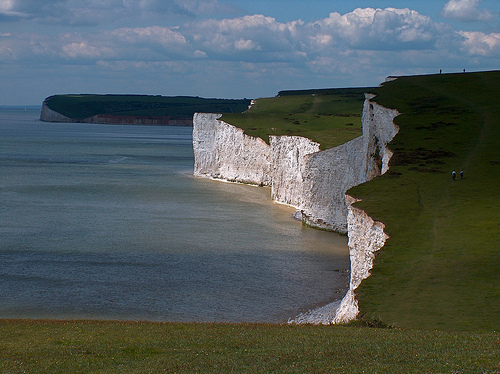
Location: Sussex Map
Age: 60- 130 million years
Height: 253 ft (77 m)
The Seven Sisters are a renowned series of undulating chalk sea cliffs located along the English Channel coast in East Sussex, England, forming part of the South Downs National Park and the Sussex Heritage Coast. Stretching approximately 4 miles (6.4 km) between the towns of Seaford and Eastbourne, these cliffs are characterized by their bright white appearance and dramatic peaks and valleys, reaching heights of up to 162 meters (531 feet). They represent a classic example of coastal erosion shaping a landscape over millennia, often compared to—but distinct from—the nearby White Cliffs of Dover due to their more rugged, undeveloped profile. The site is a popular destination for hikers, photographers, and nature enthusiasts, offering stunning views, diverse wildlife, and a sense of timeless natural beauty. It is managed by the National Trust and attracts visitors for activities like walking the South Downs Way trail, birdwatching, and exploring the adjacent Seven Sisters Country Park.
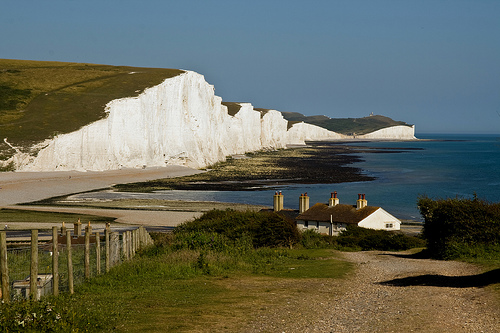
The Seven Sisters cliffs, located along the Sussex Heritage Coast in
East Sussex, England, represent a striking example of coastal geology
shaped by millions of years of sedimentary deposition, tectonic uplift,
and ongoing erosion. These undulating white chalk cliffs stretch
approximately 6 km between Seaford and Eastbourne, reaching heights of
up to 162 meters, and form part of the South Downs National Park.
Geologically, they are remnants of a vast chalk dome formed during the
Late Cretaceous period, offering insights into ancient marine
environments, fossil-rich strata, and dynamic coastal processes. Their
bright white appearance and dramatic profile result from the exposure of
pure chalk layers, making them a key site for studying Cretaceous
geology and modern erosion.
Geological Formation and Age
The
Seven Sisters cliffs originated during the Late Cretaceous epoch,
specifically the Coniacian and Santonian stages, approximately 87–84
million years ago, with broader chalk deposition spanning 100–65 million
years ago. At this time, southern England was submerged under a shallow,
warm tropical sea at around 40°N latitude, with global sea levels over
200 meters higher than today due to greenhouse conditions, active plate
tectonics, and minimal polar ice. This marine environment, far from
land, allowed for the accumulation of fine-grained sediments on the
seafloor.
The chalk formed from the skeletal remains of billions of
microscopic planktonic algae called coccolithophores, which produced
tiny calcified plates (coccoliths) of calcium carbonate. When these
organisms died, their remains sank, forming a soft calcareous ooze that
gradually compacted and lithified over millions of years into dense
chalk layers, up to 500 meters thick in the region. This process created
the White Chalk Subgroup (formerly Upper Chalk), with the cliffs
primarily exposing the Seaford Chalk Formation in the lower sections and
the Newhaven Chalk Formation at the top. The South Downs, including the
Seven Sisters, were part of a larger chalk dome extending across
southeast England, deposited in a shallow sea that covered much of the
area.
Composition and Stratigraphy
The primary rock type is
chalk, a soft, porous, fine-grained limestone composed almost entirely
of calcium carbonate (CaCO₃), giving it a distinctive white color and
crumbly texture. Interbedded within the chalk are bands of flint, a
hard, dark microcrystalline quartz formed from the siliceous remains of
sponges, diatoms, and radiolarians that accumulated and recrystallized
during diagenesis. These flint layers create contrasting horizons,
enhancing structural stability in some areas but contributing to
differential erosion.
Stratigraphically, the cliffs display a
sequence of chalk formations. The Seaford Chalk Formation dominates,
characterized by its purity and fossil content, while the overlying
Newhaven Chalk Formation includes more marly (clay-rich) layers. A
notable marker is the Seven Sisters Flint Band, a prominent dark sheet
flint near the base, visible on the foreshore and forming flint-capped
pedestals due to its resistance to erosion. At Birling Gap, the western
end, the stratigraphy varies slightly, yielding different fossils.
Overlying Quaternary sediments, such as loess from the Devensian stage
(115,000–10,000 years ago), fill dissolution pipes—vertical channels
formed by acidic rainwater dissolving the chalk along joints. The
chalk's porosity acts like a sponge, forming a major aquifer that stores
and filters rainwater, supplying local water sources.
Tectonic
History
The cliffs' current elevation results from tectonic uplift
associated with the Alpine Orogeny, the collision of the African and
Eurasian plates around 50 million years ago during the Eocene epoch.
This event folded and uplifted the chalk dome, exposing it above sea
level. Subsequent tectonic movements and isostatic rebound after the Ice
Ages further elevated the land. The South Downs ridge, including the
Seven Sisters, is an anticline (upward fold) remnant of this dome, with
the chalk dipping gently southward. Natural joints and fractures from
this tectonic stress provide pathways for erosion, contributing to the
cliffs' instability.
Erosion Processes and Landscape Evolution
Erosion has been the dominant force shaping the Seven Sisters since the
end of the last Ice Age (approximately 12,000 years ago), when rising
sea levels flooded low-lying areas and initiated marine transgression.
Wave action undercuts the soft chalk at the base, leading to collapses,
while weathering—physical (freeze-thaw) and chemical (dissolution by
rainwater)—widens cracks and creates overhangs. Heavy rainfall
exacerbates slumping, with thousands of tonnes of material falling
annually. Differential erosion, where softer layers erode faster than
flint bands, forms caves, arches, stacks, and the seven (or eight)
distinct peaks: Haven Brow, Short Brow, Rough Brow, Brass Point,
Flagstaff Point, Flat Hill, Baily's Hill, and Went Hill. The average
retreat rate is about 60 cm per year, faster at softer sections like
Birling Gap. During the Ice Ages, periglacial processes (meltwater and
frost) carved valleys like the Cuckmere, while post-glacial sea-level
rise shifted the coastline inland by up to 7 km. Longshore drift moves
eroded pebbles along the shingle beaches, influencing sediment
distribution.
Fossils and Paleoenvironment
The cliffs preserve
a rich fossil record of the Late Cretaceous marine ecosystem, including
microfossils like coccolithophores and foraminifera, as well as
macrofossils such as echinoids (Micraster, Conulus, Echinocorys),
bivalves (Neithea, inoceramids), sponges, brachiopods, crinoids,
belemnites, ammonites, starfish, and crustacean burrows (Terebella)
lined with fish scales. These indicate a diverse benthic community in a
clear, shallow sea. Fossils are abundant in loose boulders on the
foreshore, especially after storms, but collection is restricted to
loose material due to SSSI status.
Unique Geological Features
Unique aspects include the Seven Sisters Flint Band, dissolution pipes
filled with Ice Age soils, and the cliffs' rapid erosion rate, which
exposes fresh strata and fossils. The adjacent Cuckmere Valley, shaped
by fluvial and glacial erosion, features meanders and sediment deposits,
contrasting the marine cliffs. The chalk's aquifer role supports local
hydrology, a feature shared with the broader South Downs but pronounced
here due to the exposed ridge.
From west to east the named peaks are Haven Brow (the highest, about
77 m / 253 ft), Short Brow, Rough Brow, Brass Point, Flagstaff Point,
Flat Hill, Baily’s Hill and Went Hill Brow. There are seven named
“sisters,” but erosion has created an eighth rise (Flat Hill), so the
skyline is more complex than the name suggests. Just east of Went Hill
Brow is Birling Gap; beyond that lie Belle Tout Lighthouse and Beachy
Head.
Best starting points
Exceat (Seven Sisters Country Park)
is the best all-round base. Postcode BN25 4AD. Larger car park, visitor
centre in an 18th-century barn, café, toilets and easy access to the
Cuckmere meanders and the western end of the ridge. Good for first
visits and families.
Birling Gap (National Trust, BN20 0AB) sits
under the eastern cliffs. Café, toilets, paid parking and steps down to
a shingle beach (tide-dependent). Most people start here because it is
the quickest way onto the first few peaks, so it is also the busiest.
Seaford Head / South Hill Barn gives the iconic profile view of all
seven sisters with fewer crowds than Birling Gap on peak days.
How to get there
By train: Southern services from London Victoria to
Seaford (about 1 hr 25 min) or Eastbourne (about 1 hr 30 min). Off-peak
returns are often in the £20-£35 range. From Seaford station it is a
walk or a short bus ride to Exceat. From Eastbourne the Coaster buses
continue toward Birling Gap and Beachy Head.
By bus: The Brighton &
Hove Coaster 12 / 12X (and seasonal 13X) runs between Brighton, Seaford,
Exceat, East Dean, Birling Gap and Eastbourne. Single fares on this
corridor are typically capped around £3. This is the most practical
car-free option.
By car: A27 then A259. Parking is paid at both main
sites and fills early on sunny weekends and bank holidays. Aim to arrive
before 9-10 am, or after mid-afternoon. Birling Gap often fills first
(sometimes by 9:45 am in summer). Exceat is larger and fills later.
There is no formal coach parking at the Country Park during school
holidays; the nearest is Beachy Head.
Walking the cliffs themselves
is free. You pay only for parking. National Trust members park free at
Birling Gap.
Walking routes
The South Downs Way follows the
ridge. There is no shade and no facilities once you leave Exceat or
Birling Gap, so carry water.
Easy valley walk (Cuckmere Haven): About
3 miles / 5 km return from Exceat along a mostly firm path beside the
river to the beach. Family-friendly and the only reasonably accessible
option. The famous oxbow meanders are the highlight. Beach access
depends on the tide.
Short cliff loop from Birling Gap: 2 km, 45
minutes. Walk west over the first one or two sisters and return. Enough
for the classic cliff-face view if time is short.
Classic ridge:
Exceat / Cuckmere Haven to Birling Gap: Roughly 6-7 km / 4 miles one
way, 2.5-4 hours. This is the walk most people mean by “the Seven
Sisters.” Seven (or eight) steep climbs and descents. Return by bus
12/12X. Starting from Cuckmere is usually quieter and gives the full
sweep of the sisters in one view.
Full traverse Seaford to Eastbourne
(or reverse): About 22 km / 13.6 miles, 6-7 hours. Includes Seaford
Head, all the sisters, Birling Gap, Belle Tout and Beachy Head. Serious
day out with significant cumulative ascent. Many people taxi or bus one
end and walk one way.
Best time to visit
Late spring
(May-June) and early autumn (September-October) are the sweet spots:
milder weather, longer days, wildflowers or migrating birds, and fewer
crowds than July-August. September-October often has the best light on
the chalk.
Avoid summer bank holidays if you can. Car parks fill by 9
am. Midweek is far quieter year-round. A clear winter weekday can be
dramatic and almost empty, but it is windy, cold and the days are short.
Early morning or late afternoon gives better light and fewer people. The
area is an International Dark Sky Reserve, so night visits are possible
if you are prepared, but there is no lighting on the ridge.
Safety and practical tips
Stay at least 5 metres back from the cliff
edge and from the base if you are on the beach. Falls happen without
warning. Paths are sometimes closed after collapses (Hope Gap and the
Birling Gap staircase have both been affected). Check local access
alerts before you go.
The clifftop is several degrees colder and much
windier than the forecast for the towns. Layers and a windproof jacket
matter even on sunny days. There is almost no shade.
Check tide times
if you want the beach at Birling Gap or Cuckmere Haven. The shingle at
Cuckmere is only usable around low tide; a rising tide can cut you off.
Swimming at Birling Gap is possible but the water is cold, currents can
be strong, there are no lifeguards, and the beach vanishes at high tide.
Rocky seabed - water shoes help.
Do not try to cross the mouth of the
Cuckmere. Tides and currents are strong.
Mobile signal is patchy on
the ridge. Download maps (OS Maps offline is useful) before you leave.
Dogs are allowed on most paths year-round but must be on leads near
livestock (April-October) and near the edge. Carry water for them; there
is none on the ridge. Seasonal beach rules apply at Birling Gap.
Drones are banned along the Heritage Coast.
In an emergency on the
cliff path call 999 and ask for the Coastguard. Nearest useful postcode
for Birling Gap is BN20 0AB.
Facilities
Toilets and food exist
only at Exceat and Birling Gap (plus pubs and cafés in nearby villages
such as East Dean). Nothing on the ridge. Use the facilities before you
start the walk.
The Country Park has some accessible parking and
surfaced valley paths. The clifftop itself is steep, uneven and not
suitable for wheelchairs or pushchairs.
What to pack
Sturdy
walking shoes or boots (chalk paths get slippery when wet)
Windproof
layer and extra warmth even in summer
Sun hat, sunscreen and at least
1 litre of water per person
Snacks
Offline map
Cash or card for
parking (some machines are picky)