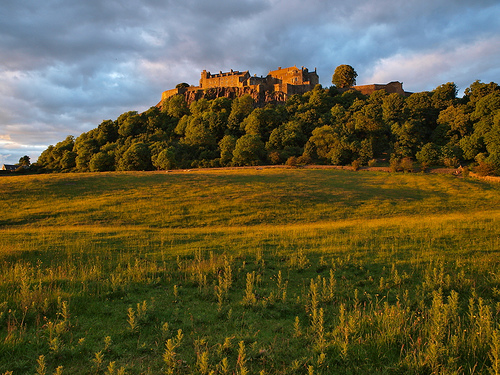
Stirling Castle is a historic castle in the city of Stirling,
Scotland (United Kingdom). It was built on top of the "hill of
the castle" (the castle hill), a peak of volcanic origin, and is
surrounded on three sides by cliffs. The castle of Stirling is
listed as a National Monument, and its management has therefore
been entrusted to the specialized agency Historic Scotland.
Stirling castle also houses the headquarters, as well as the
museum, of a British Army Regiment, the Argyll and Sutherland
Highlanders Regiment, although that regiment no longer has its
base in the Stirling Castle.
Most of the main buildings of the castle date back to the 15th
and 16th centuries, although some buildings are even earlier,
specifically from the 14th century. The exterior defenses of the
castle that face the city, meanwhile, date from the early
eighteenth century. At the beginning of the 14th century
Stirling Castle suffered a siege by the English troops of Edward
I, in the framework of the so-called Scottish Wars of
Independence. Historians indicate that it was during this
assault that Warwolf, the largest siege engine that has ever
been built, was used for the first time, and it was with
devastating effects.
The crenellated wall, which protects the entrance to Stirling
castle proper once its outer defenses have been overcome, was
built by James III of Scotland, originally constituting a part
of the system of fortifications that surrounded and protected
the rocky base. At its two extremities were solid rectangular
casemates and, at its center, framing the entrance to the
fortified enclosure, four large circular towers was covered with
conical roofs. Of this magnificent composition only the casemate
and the southernmost main tower (now attached to the main body
of the building) have survived along with parts of the original
walls, the entrance and the lower part of the internal circular
towers, as well as vestiges of the external and of the casemate
and northern circular towers.
Stirling Castle, perched dramatically atop a volcanic crag in
Stirling, Scotland, is one of the most strategically vital and
historically rich fortresses in the United Kingdom. Its commanding
position—250 feet (75 m) above the surrounding terrain, with steep
cliffs on three sides overlooking the River Forth—made it the literal
“key to Scotland.” It guarded the lowest crossing point of the Forth,
controlling major east-west and north-south routes between the Highlands
and Lowlands. Whoever held it effectively controlled the kingdom.
The
rock itself formed around 350 million years ago from volcanic activity
and was shaped by glaciation into a natural defensive stronghold. While
legends suggest fortifications dating back thousands of years (possibly
a hillfort used by ancient tribes like the Maeatae or even Roman or
Pictish strongholds), the first documented royal activity dates to
around 1110.
Early Medieval Origins and Royal Residence
(12th–13th Centuries)
Stirling Castle emerges into recorded history
during the reign of Alexander I (r. 1107–1124). Around 1110, he endowed
and dedicated a chapel on the site; he died there in 1124. His brother
David I (r. 1124–1153) developed Stirling as a royal burgh and
administrative center.
William I (the Lion) (r. 1165–1214) created a
royal hunting park southwest of the castle in the 1170s. Captured by the
English at Alnwick in 1174, he was forced under the Treaty of Falaise to
surrender key Scottish castles, including Stirling, to Henry II of
England (though it was not occupied). It was returned in 1189 by Richard
I, and William died at Stirling in 1214.
Alexander III (r. 1249–1286)
expanded hunting parks near Bannockburn and undertook building works
(none of which survive today). His death in 1286 without a clear heir
triggered the succession crisis that led to English intervention.
Wars of Scottish Independence: Sieges, Battles, and the Fight for
Control (Late 13th–Early 14th Centuries)
The castle changed hands
repeatedly during the Wars of Scottish Independence (1296–1357),
enduring at least eight sieges overall (and up to 16 attacks in its full
history). It was a prime target for both Scottish and English forces.
1291–1296: Edward I of England assumed control of Scottish royal
castles while arbitrating the succession. The Scots swore fealty to him
at Stirling in 1291; in 1296 the English found it abandoned and occupied
it.
1297: Following William Wallace and Andrew Moray’s stunning
victory at the Battle of Stirling Bridge (fought just below the castle),
the English garrison surrendered.
1298–1299: After the Scottish
defeat at Falkirk, the castle was abandoned to the English again. Robert
the Bruce (among others) successfully besieged it in 1299.
1304:
Edward I’s brutal year-long siege (using 17 siege engines, including the
massive “Warwolf” trebuchet) finally forced surrender on 20 July. It was
the last major Scottish-held castle.
1314: Edward Bruce besieged the
English-held castle. An agreement was struck: it would surrender if not
relieved by midsummer. Edward II’s relief army was crushed at the Battle
of Bannockburn (24 June, two miles south). The castle surrendered; Bruce
immediately slighted (partially destroyed) its defenses to prevent
English reoccupation.
English forces briefly regained it in the
1330s, but Robert Stewart (future Robert II) retook it after a siege in
1342. By the late 14th century, it was firmly back in Scottish hands.
Late Medieval Turmoil and Early Stewart Building (14th–15th
Centuries)
The oldest visible structure today—the North Gate—dates to
around 1380–1381, built during strengthening works under the early
Stewarts.
James II (r. 1437–1460) spent much of his childhood at
Stirling for safety after his father James I’s murder. In a notorious
incident on 22 February 1452, he invited the 8th Earl of Douglas to
dinner and murdered him, stabbing him 26 times before throwing the body
out a window.
James III (r. 1460–1488) added further buildings
(including a now-lost White Tower and chapel rebuilding). His queen,
Margaret of Denmark, died at Stirling in 1486. A rebellion by his son
culminated in the Battle of Sauchieburn (1488), fought near Bannockburn;
James III was killed afterward.
Renaissance Golden Age: The
Stewart Palace (Late 15th–16th Centuries)
Under James IV (r.
1488–1513), Stirling reached its architectural peak. He transformed it
into a Renaissance royal center, commissioning:
The King’s Old
Building (his residence).
The Great Hall (begun ~1500, completed
1504)—the largest secular hall in Scotland at the time.
The Forework
gatehouse with French-inspired military styling (towers, battlements,
and a triumphal-arch-like entrance).
He hosted a cultured court
with artists, poets, and even an alchemist, John Damian, who famously
attempted to fly from the walls with feather wings in 1507 (he crashed
into a dung heap). James IV died at Flodden in 1513.
James V (r.
1513–1542) continued the work. He built the Royal Palace (1530s–1540s),
the first true Renaissance palace in the British Isles, blending French
architecture with elaborate German-style stone carvings (statues of the
king, saints, classical deities, and the Devil). The interior featured
the famous Stirling Heads—carved oak portrait roundels on the ceiling
(56 originally; 38 survive). The palace included royal apartments,
presence chambers, and was completed by his widow, Mary of Guise.
Mary, Queen of Scots was crowned in the Chapel Royal at just nine months
old (9 September 1543) and spent much of her childhood here. Mary of
Guise upgraded defenses with artillery bastions, including the French
Spur.
James VI (r. 1567–1625) was baptized in the Chapel Royal (1566)
with elaborate celebrations. He rebuilt the Chapel Royal in 1594 in
Italianate style for his son Prince Henry’s baptism. The castle hosted
parliaments and royal visits but saw brief seizures by rebels in the
1580s.
Decline as Royal Residence and Rise as Military Stronghold
(17th–19th Centuries)
After the 1603 Union of the Crowns (James VI
becoming James I of England), Stirling lost its role as a primary royal
home. It became a military base and prison. Key events:
1650–1651: Cromwell’s forces under General Monck besieged and captured
it during the English Civil War; significant damage occurred.
1715
and 1745–1746 Jacobite Risings: Government troops held it against
Jacobites. Bonnie Prince Charlie’s forces besieged it unsuccessfully in
1746.
From the 18th century, it served as barracks (War Office
ownership from ~1800). The Great Hall became soldiers’ accommodation,
the Royal Palace an officers’ mess, and new barracks, prisons, and
powder magazines were added. It housed Highland regiments like the
Argyll and Sutherland Highlanders.
Modern Era: Restoration and
National Icon (20th–21st Centuries)
The castle remained in military
use until the 1960s. Major restorations began in the late 20th century:
the Great Hall and Chapel Royal in the 1990s, and the Royal Palace
(2001–2011) returned to its Renaissance splendor with recreated
interiors and Stirling Heads display.
Today, managed by Historic
Environment Scotland as a Scheduled Ancient Monument and major tourist
attraction, it welcomes hundreds of thousands of visitors annually. It
symbolizes Scottish independence and national pride, with its story told
through guided tours, exhibitions, and living history.
Stirling Castle in Stirling, Scotland, is one of the largest and most
architecturally important castles in the United Kingdom. It sits atop a
steep quartz-dolerite volcanic crag (part of the Stirling Sill
geological formation), surrounded on three sides by cliffs that provide
formidable natural defences. This strategic position overlooking the
River Forth and key routes north-south and east-west made it a royal
stronghold and symbol of Scottish power from the early 12th century
onward.
While early fortifications existed from at least the 12th
century (with some 14th-century remnants), the majority of the visible
architecture dates to the late 15th and 16th centuries. This period
reflects the ambitions of the Stewart (Stuart) dynasty under James IV,
James V, and James VI. The castle evolved from a medieval fortress into
a Renaissance palace complex, showing an eclectic mix of English,
French, German, and Italian influences. Later 17th–19th-century
modifications adapted it for military use as a British Army barracks,
adding artillery defences. Major 20th- and 21st-century restorations
have returned key buildings to their historic appearances.
The layout
divides into three main enclosures on the crag: the Outer Defences (with
Forework gateway), the Outer Close (courtyard area with kitchens and
military buildings), and the Inner Close (a quadrangular royal
courtyard). Beyond lies the Nether Bailey at the northern end. Materials
are primarily local stone masonry, often with limewash or distinctive
"Royal Gold" harling (a roughcast render) on exteriors for visual impact
and weatherproofing. Timber elements include massive oak roofs and
carvings; interiors featured elaborate fireplaces, painted ceilings, and
tapestries.
Outer Defences and Forework (Early 16th Century)
The approach features 18th-century artillery fortifications (expanded
after the 1708 Jacobite threat), including double walls, ditches,
caponiers (covered firing galleries), and casemates for guns. An earlier
"French Spur" bastion (ear-shaped orillon from the 1550s under Mary of
Guise) protected gun emplacements with an earth talus ramp.
The
Forework (c. 1500–1506, James IV) serves as the main gateway—a dramatic
curtain wall across Castle Hill with a central gatehouse flanked by
round towers (originally five storeys high, now reduced) featuring
conical roofs, battlements, and a portcullis. It draws on French
military/chivalric architecture (similar to Linlithgow Palace) but
prioritizes show over pure defence, incorporating Classical triumphal
arch elements in its triple passage design. The Prince's Tower (west)
and remnants of the Elphinstone Tower (east) survive. This creates an
imposing, theatrical entrance evoking medieval romance while guarding
the Outer Close.
Inner Close: The Royal Heart of the Castle
The Inner Close forms a quadrangle with the main royal buildings
arranged around it: Great Hall (east), Royal Palace (south), King's Old
Building (west), and Chapel Royal (north). This compact, formal layout
maximized space on the crag while creating a prestigious royal
courtyard.
Great Hall (c. 1497–1503, James IV)
The largest
medieval banqueting hall ever built in Scotland (approximately 42 m ×
14.25 m), this is the grandest secular building of the late Middle Ages
in the country and an early example of Renaissance-influenced royal
architecture. It draws on English designs (comparable to Edward IV’s
hall at Eltham Palace) with medieval proportions but adds Renaissance
details like intersecting tracery on the tall windows. Five fireplaces
heated the space; large windows lit the dais end for the monarchs. The
exterior features "Royal Gold" harling and a restored crenellated
parapet.
The original hammerbeam roof (a complex oak structure) was
removed in the 18th–19th centuries during barracks conversion (when
floors and walls were inserted). It was meticulously reconstructed in
1999 using Scottish oak, restoring the soaring, light-filled interior
for feasts, ceremonies, and displays of power. Limewashing enhances its
striking golden appearance.
Royal Palace (1530s–1540s, James V)
Arguably the architectural highlight and the first true Renaissance
palace in the British Isles, this quadrangular structure (built around a
central paved courtyard known as the Lion's Den) combines French
Renaissance planning with exuberant late-Gothic detailing and German
decorative influences. Commissioned by James V (with French masons under
Master of Works Sir James Hamilton of Finnart) to impress European
courts, it features richly carved stone facades on the north, east, and
south elevations.
Unique elements include full-size statues of James
V, St Michael, Venus, the Devil, planetary deities (arranged by heavenly
quarters), and a south parapet lined with soldier figures—drawing from
German prints by Hans Burgkmair. The west façade remains plainer and
incomplete. Internally, it housed matched royal apartments (king and
queen): each with an Outer Hall (public), Inner Hall (semi-private),
Bedchamber, and closets. Surviving carved stone fireplaces showcase
Renaissance motifs.
The King's Presence Chamber originally had a
magnificent ceiling of ~56 carved oak medallions (the Stirling Heads, c.
74 cm diameter, by sculptor Andrew Mansioun and others), depicting
royals, courtiers, classical/Biblical figures, and mythological
scenes—finest Scottish Renaissance wood-carving, influenced by
French/Italian and German sources (e.g., Wawel Castle in Poland). Many
were brightly painted. A £12 million restoration (completed 2011)
recreated the 1540s interiors with replica Unicorn Hunt tapestries
(hand-woven over 13 years) and returned surviving Heads to display.
King's Old Building (c. 1497, James IV; later modifications)
The
oldest Inner Close range (L-shaped residential block on the west side),
it provided early royal lodgings with principal rooms on the first floor
over cellars and wide western views. A projecting stair tower has an
octagonal upper section. Interiors were heavily altered; the north end
was rebuilt in Scottish Baronial style after a 1855 fire. It now houses
the Argyll and Sutherland Highlanders Regimental Museum.
Chapel
Royal (1594, James VI)
Rebuilt rapidly (in about seven months) by
William Schaw on the north side to replace an earlier collegiate chapel
(site of Mary Queen of Scots' 1543 coronation). It features Italianate
arched windows and served as a Protestant kirk and venue for Prince
Henry's baptism. Interiors included wall paintings (rediscovered 1930s,
restored post-WWII) by Valentine Jenkin. Later used as a military dining
hall, its simple yet elegant design marks one of the last major royal
additions.
Additional Features and Later Adaptations
Kitchens
and Service Areas: Original Great Kitchens (linked to the Hall) in the
North Gate area; later infilled for batteries.
Gardens: Southern
bowling green; the King's Knot below the west wall (16th-century formal
knot garden with earthwork parterres and an octagonal mount).
Military Phase (18th–19th centuries): Barracks conversions, gunpowder
stores, and the Esplanade parade ground. The castle served as a garrison
until 1965.
Stirling Castle's architecture embodies Scotland's
transition from medieval defence to Renaissance cultural display,
showcasing the Stewarts' international outlook through imported styles
and skilled craftsmen. Restorations (Great Hall in 1999; Palace in 2011)
have preserved its grandeur, making it a living monument to Scottish
royal history.
Unlike many castles that feel like a single structure, Stirling is a
complex of buildings, courtyards, and defenses arranged around an Inner
Close (courtyard). Plan on spending 2–3 hours (or more) exploring at a
leisurely pace—there's a lot to see, with excellent interpretive
displays, costumed interpreters, and family-friendly elements. The site
offers panoramic views over the surrounding countryside, the River
Forth, Ochil Hills, and landmarks like the National Wallace Monument.
Key highlights include:
The Royal Palace: One of the standout
features, this 16th-century building has been meticulously restored to
evoke the Renaissance court of James V. Step into recreated royal
apartments with vibrant colors, ornate ceilings, and furniture
reflecting the era's fashions. Costumed interpreters bring the intrigue
and daily life of the time to life. Don't miss the Stirling
Tapestries—seven exquisite hand-woven pieces recreating the medieval
Hunt of the Unicorn series (a multi-year project). The Palace Vault
offers interactive exhibits on 1500s arts, music, and crafts for all
ages.
The Great Hall: Completed in 1503 for James IV, this is
Scotland's largest surviving medieval banqueting hall. Its grand scale,
hammerbeam roof elements (restored), tall windows, and "Royal Gold"
harling (lime render) on the exterior make it impressive. It hosted
feasts and state occasions.
Chapel Royal: Built in 1593–94 by James
VI for his son's baptism, this is one of Scotland's earliest Protestant
royal chapels and the last major royal building added to the castle.
Great Kitchens: Interactive displays show how lavish royal feasts were
prepared, complete with recreated food, utensils, and the hustle of a
busy kitchen serving venison, salmon, pies, and more.
Stirling Heads
Gallery: Features original 16th-century carved oak medallions (about a
meter wide) depicting kings, queens, Roman emperors, biblical figures,
and classical heroes—superb examples of Renaissance artistry.
Castle
Exhibition and Access Gallery: These cover the site's full history from
ancient times, including archaeological finds like medieval burials,
architectural evolution, and hard-to-reach areas with models and
interactives.
Regimental Museum of the Argyll and Sutherland
Highlanders: A fascinating collection of military artifacts, uniforms,
and stories spanning over 200 years of the regiment's service.
Outdoor Areas: Walk the castle walls and battlements for sweeping views.
Explore the Queen Anne Gardens (with a historic beech tree and a Unicorn
Garden family trail) and gaze out toward the King's Knot (a former royal
garden layout visible below). The Forework (grand entrance gate) and
outer defenses add to the fortress feel.
Additional perks include
free guided tours (starting from the Guardroom or well in the Lower
Square—highly recommended for context; they last around an hour and are
engaging), audio guides in multiple languages (small extra fee), and
events like seasonal trails or exhibitions (e.g., Easter activities or
archaeology displays in 2026).
Practical Visitor Information (as
of 2026)
Opening Hours: Open daily. From 1 April to 30 September:
9:30am with last entry at 5pm (closes 6pm). From 1 October to 31 March:
9:30am with last entry at 4pm (closes 5pm). Closed 25–26 December; open
1–2 January (check for exact hours). Note that hours can vary
slightly—always confirm on the official site.
Tickets: Book online in
advance via the Historic Environment Scotland website for the best
prices and to guarantee entry (high demand, especially in peak summer).
Approximate prices: Adults ~£18.50 online / £20.50 walk-up; children
(5–15) ~£11/£12.50; concessions/seniors ~£15/£16.50; family tickets
offer savings (e.g., ~£53–£59.50). Under-5s free. Memberships like the
Explorer Pass or Historic Scotland membership provide free or discounted
entry (including parking in some cases). Guided tours have separate
pricing.
Getting There:
By Train: Easy day trip. From
Edinburgh Waverley: ~45–50 minutes. From Glasgow Queen Street: ~30–40
minutes. Frequent ScotRail services. The train station is in the town
center; from there, it's a steep uphill walk (15–25 minutes) through the
charming Old Town to the castle, or take a short taxi/bus ride. The walk
offers great views and passes sites like the Old Town Jail or Church of
the Holy Rude.
By Car: Stirling is well-signposted off the M9/M80.
Parking at the castle is limited and paid (arrive early); there's a car
park right at the entrance. Alternatives include city-center parking
(e.g., near the train station or Forthside) followed by a walk or the
Castleview Park & Ride service (drops near the Old Town Jail, then a
shorter uphill walk). Watch for residents-only zones to avoid fines.
By Bus: Services to Stirling bus station (near the train station), then
uphill.
Facilities: Café (light meals, drinks), shop (souvenirs,
books, gifts with membership discounts), toilets, and the Regimental
Museum. Limited parking. The Historic Scotland app enhances your visit
with maps and info. Wheelchair accessibility is better than many
historic sites (lifts available in key areas like the main castle, blue
badge parking, free carer tickets), but some cobbled/uneven paths and
older sections may pose challenges—staff are helpful with alternatives.
Tips for Your Visit:
Wear comfortable shoes—the site involves
hills, steps, and some uneven ground; it's windy on the crag, so layers
and a jacket are wise.
Arrive early (or later in the afternoon) to
beat crowds and secure parking. Allow time for the full experience
rather than rushing.
Combine with nearby attractions for a full day:
Walk down through Stirling's Old Town (visit the Church of the Holy Rude
and Old Town Cemetery), head to the National Wallace Monument (short bus
or longer walk), or explore the Battle of Bannockburn Visitor Centre.
Other options include Doune Castle, Cambuskenneth Abbey, or a drive into
the Trossachs.
Families will appreciate kid-friendly interactives,
trails, and the Palace Vault. History buffs will love the depth of
interpretation.
Weather in Scotland is changeable—check forecasts.
Photography is excellent from the walls and esplanade.