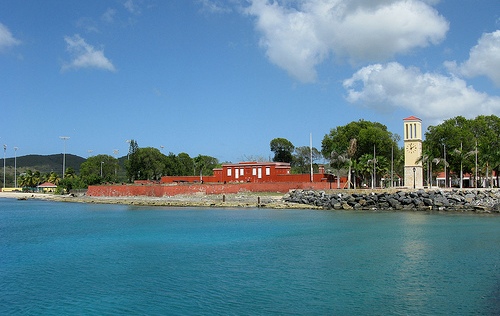
Location: 12 mi (19 km) Southwest of Christiansted, Saint Croix
Tel. (340) 772 0357
Fort Frederik, commonly referred to as Fort Frederiksted or Frederiksfort, is a historic mid-18th-century Danish colonial fortification located at the north end of Frederiksted town on the western end of St. Croix in the United States Virgin Islands. Overlooking a deep-water bay with turquoise Caribbean waters, this striking red-painted structure stands as a testament to colonial-era defense strategies, slavery, emancipation, and labor struggles in the region.
The fort's origins trace back to the Danish acquisition of St. Croix
in 1733 from the French, with formal possession taken in 1734. Prior to
Danish control, the site had seen earlier fortifications by French,
English, and Dutch colonists, including a small gun battery to deter
pirates and privateers from using it as a landing point for attacks on
inland settlements. In 1751, Danish surveyors cleared and laid out the
area for a new town named Frederiksted in honor of King Frederik V, and
construction on the fort—also named after the king—began in May 1752,
completing in 1760. Its primary purposes were multifaceted: to protect
Danish colonial interests against other European powers, prevent
smuggling (such as sugar shipments to nearby Dutch islands), safeguard
shipping in the Frederiksted harbor from pirates and privateers, and
maintain order among the island's enslaved population.
The fort
became a focal point for several pivotal events. During the American
Revolutionary War, on October 25, 1776, it reportedly fired the first
salute by a foreign government to a United States ship, honoring the
American flag on a brigantine in the harbor—despite this violating
Denmark-Norway's neutrality laws. This act symbolized early
international recognition of the fledgling United States and highlighted
the Virgin Islands' supportive ties to the American colonies.
Perhaps
its most profound role came during the era of slavery and emancipation.
St. Croix's economy relied heavily on sugar plantations worked by
enslaved Africans, with over 17,000 slaves and 5,000 free Blacks on the
island by the mid-19th century. Harsh slave codes and conditions led to
unrest, culminating in the Emancipation Revolt of July 3, 1848. Led by
figures like John Gottliff (also known as Moses Gottlieb or General
Buddhoe), approximately 8,000 enslaved people marched on Frederiksted,
besieging the fort and sacking parts of the town. In response, Danish
Governor-General Peter von Scholten proclaimed the emancipation of all
slaves from the fort's south wall roof, effectively ending slavery in
the Danish West Indies three months ahead of schedule. Trials and
executions of revolt leaders followed at the fort, underscoring its role
in both liberation and suppression.
Three decades later,
post-emancipation labor tensions erupted in the 1878 Labor Riot and
Fireburn on October 1—Contract Day—triggered by police brutality and
exploitative annual labor contracts that resembled serfdom. Rioters
again besieged the fort, burning much of Frederiksted and 53 plantations
across the island. Danish troops quelled the uprising, executing six
leaders at the fort. This event led to the 1879 Labor Act, which
abolished the contract system and marked the end of plantation-based
serfdom, though it accelerated economic decline and emigration.
The
fort also played a ceremonial role in the 1917 transfer of the Virgin
Islands from Denmark to the United States. On March 31, 1917, U.S.
Marines raised the American flag at the fort, which briefly served as
their headquarters. In the 20th century, it adapted to modern uses as a
police station, jail, court, fire department, public library, and
telephone exchange until 1973.
Fort Frederik exemplifies Danish colonial military architecture,
built primarily from rubble masonry with limestone foundations and
walls, and brick used for roofs, vaults, and arches. The structure is
slightly trapezoidal in plan, covering about 2 acres, with
diamond-shaped bastions at the southwest and northwest corners for
defensive firing angles, and a triangular projecting salient on the east
side that housed the powder magazine. The curtain walls enclose an inner
brick-paved courtyard, off which open single-story rooms serving as
officers' and men's quarters, kitchens, and detention cells.
The
only two-story section is the Commandant's Quarters, located above the
main west-facing entrance (seaward side), accessible via exterior stairs
and featuring a parlor, dining room, bedroom, pantry, and bath with
tongue-and-groove pine floors and wood tray ceilings. Entrances include
a quoined sally port with wooden gates and a vaulted south passageway.
Windows are barred with double-board storm shutters and interior
jalousies; second-floor windows have pedimented heads and 12-light
sashes. Roofs are flat brick on wood beams or vaulted, and interiors
have plastered walls, paneled doors with molded casings, and wrought
iron hardware.
A three-pointed masonry sea battery extends from the
west side, armed with cannons overlooking the ocean, while the north
side features enclosed masonry stables. The fort's distinctive red
plaster exterior with white trim contrasts with the yellow-and-white
Fort Christiansværn on the island's east end. A 1974-1976 restoration
removed 20th-century additions, such as a hipped roof on the
Commandant's Quarters, repointed masonry, and replastered surfaces to
match its 1778-1780 configuration, preserving high historical integrity.
The fort influenced Frederiksted's broader vernacular architecture,
which blends Danish colonial neoclassical elements with local
adaptations. The town's buildings, many rebuilt after an 1878 fire,
feature fine craftsmanship from the Danish era, including masonry
construction suited to the tropical climate.
Fort Frederik holds national significance for its associations with Danish colonial exploration, settlement, and the ethnic heritage of both Europeans and Africans in the Americas. It embodies the brutal realities of slavery and plantation life, as well as the transformative struggles for freedom and labor rights that reshaped the Danish West Indies. Designated a contributing property to the Frederiksted Historic District (listed on the National Register of Historic Places in 1976), it was individually added to the NRHP on October 8, 1996, and declared a U.S. National Historic Landmark on September 25, 1997.
Today, Fort Frederik functions as a museum and art gallery managed by the Fort Frederick Museum, offering insights into local history through exhibits on slavery, emancipation, and Danish colonial life. It is open weekdays from 8:30 a.m. to 4 p.m. and Saturdays from 1 p.m. to 4 p.m., with a modest admission fee (around $3 as of recent records). The site overlooks Emancipation Park, a waterfront area with paths, a gazebo, statues (including one of General Buddhoe), and events like monthly jazz concerts. Preservation efforts continue to maintain its structural integrity amid the island's tropical environment, making it a key attraction for cultural tourism and education about the Virgin Islands' complex past.