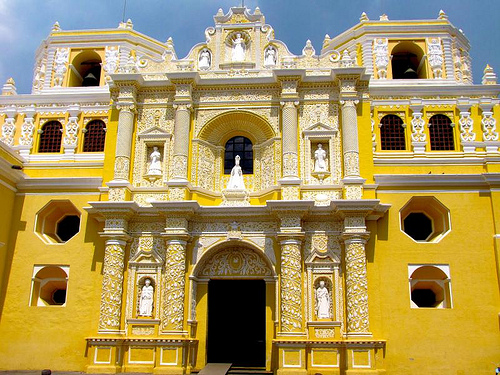
La Merced Church (Iglesia de La Merced) in Antigua, Guatemala, is one of the most iconic and well-preserved examples of colonial Baroque architecture in Central America. Located at the northern end of 5a Avenida Norte, near the famous Santa Catalina Arch, it is a cultural, historical, and architectural landmark that draws visitors for its striking beauty and historical significance.
La Merced Church was constructed as part of a Mercedarian convent,
established by the Order of the Blessed Virgin Mary of Mercy, which
arrived in Guatemala in the 16th century. The church’s construction
began in the mid-18th century, with the architect Juan de Dios Estrada
overseeing the project. It was completed in 1767, just a few years
before the devastating Santa Marta earthquakes of 1773, which heavily
damaged much of Antigua, then the colonial capital of Guatemala.
Unlike many other structures in Antigua, La Merced was designed with
earthquake-resistant features, such as thick walls and a low, sturdy
structure. This allowed it to survive the 1773 earthquakes with
relatively minor damage, making it one of the few colonial churches in
Antigua to remain largely intact. After the earthquakes, many of the
church’s treasures, including artworks and religious artifacts, were
transferred to La Merced in Guatemala City for safekeeping, but the
Antigua church has since been restored and remains a vibrant place of
worship and tourism.
The church and its adjacent convent have
played a significant role in Antigua’s religious and cultural life,
particularly during Holy Week (Semana Santa), when it serves as a focal
point for elaborate processions and religious ceremonies.
La Merced Church is renowned for its distinctive Baroque
architecture, characterized by ornate details, dramatic flourishes, and
a harmonious blend of Spanish and indigenous influences. The following
are its key architectural elements:
Façade
The church’s façade
is one of the most photographed in Antigua, celebrated for its vibrant
yellow color and intricate white stucco work, which creates a striking
contrast. The façade is a prime example of Moorish Baroque or Antigüeño
Baroque, a regional style that incorporates elaborate, lace-like plaster
designs. These designs include floral motifs, scrolls, and geometric
patterns, giving the façade a delicate yet grandiose appearance.
At the center of the façade is a statue of Saint Peter Nolasco, the
founder of the Mercedarian Order, set within a niche. Flanking the
statue are ornamental stucco elements that resemble Solomonic columns
(twisted columns characteristic of Spanish Baroque architecture). The
façade is divided into three sections, with the central portal framed by
pilasters and topped by a triangular pediment.
The bell tower,
visible from the front, is relatively simple but complements the ornate
façade. A stone cross, often included in photographs, stands in the
courtyard in front of the church, adding to its historical ambiance.
Structure and Layout
The church’s design prioritizes earthquake
resistance, with thick walls and a low profile compared to other
colonial churches. The structure includes a single nave with a
barrel-vaulted ceiling, supported by robust arches. The adjacent
convent, though partially in ruins, features a large courtyard with a
famous Fuente de Pescados (Fountain of the Fish), one of the largest
colonial fountains in Central America. The fountain, surrounded by
arcaded corridors, is adorned with fish-shaped spouts, reflecting the
Mercedarian Order’s association with water and mercy.
Dome and
Roof
The church’s dome, visible from certain angles, is decorated
with ceramic tiles and features small ceramic lion figures at its base,
a whimsical touch that adds to the building’s charm. The dome’s design
draws from Spanish Baroque influences, with its curves and decorative
elements echoing the exuberance of the era.
Interior
The
interior of La Merced Church is equally impressive, though less ornate
than the façade due to the loss of some original artworks after the 1773
earthquakes. Key features include:
Main Altar: The grand main
altar is a focal point, adorned with intricate woodwork and gilded
details. It houses religious statues, including representations of the
Virgin Mary and Saint Peter Nolasco.
Altarpieces and Artwork: The
church contains several ornate altarpieces, some of which date back to
the colonial period. While many original paintings were moved to
Guatemala City, the remaining artworks include depictions of biblical
scenes and saints, rendered in the dramatic style typical of Baroque
religious art. One notable painting is a well-known work of Jesus of
Nazareth, celebrated for its emotional intensity.
Ceiling and Walls:
The barrel-vaulted ceiling features subtle decorative elements,
including frescoes and stucco work. The walls are adorned with religious
iconography, though some areas show signs of restoration due to
earthquake damage.
Chapels and Niches: Smaller side chapels contain
additional altars and statues, often dedicated to specific saints or
aspects of the Mercedarian devotion, such as the Virgin of Mercy.
The
interior exudes a sense of reverence and history, with its warm lighting
and carefully preserved colonial elements creating an atmosphere of
spiritual reflection.
The adjacent Mercedarian convent, though partially ruined, is a
significant part of the La Merced complex. Visitors can explore its
remains, which include cloisters, arches, and the iconic Fuente de
Pescados. This large, octagonal fountain, built in the 18th century, is
surrounded by a courtyard with arcaded walkways. The fountain’s
fish-shaped spouts are both functional and symbolic, representing
abundance and the Mercedarian mission of charity. The convent’s ruins
provide a glimpse into the daily life of the Mercedarian monks, with
remnants of cells, kitchens, and communal spaces still visible.
Cultural and Religious Significance
La Merced Church is a cornerstone
of Antigua’s cultural and religious identity. It is particularly
prominent during Semana Santa, when the church hosts some of the city’s
most elaborate Holy Week processions. These processions feature massive
andas (floats) carried by hundreds of devotees, adorned with statues of
Christ and the Virgin Mary, accompanied by somber music and intricate
alfombras (carpets of colored sawdust and flowers) laid out on the
streets. The church’s courtyard and surrounding streets become a hub of
activity during this time, drawing thousands of locals and tourists.
Beyond Holy Week, La Merced remains an active Catholic church,
hosting regular masses and community events. Its central location and
photogenic appearance make it a must-visit for tourists exploring
Antigua’s colonial heritage.
Location: 1a Calle Poniente and 6a Avenida Norte, Antigua Guatemala.
Hours: The church is generally open daily from 8:00 AM to 6:00 PM,
though hours may vary for religious services or special events. The
convent ruins and fountain are accessible for a small entrance fee.
Duration: A visit to the church and convent typically takes about 1
hour.
Tips: Wear respectful clothing (covering shoulders and knees)
when entering the church, as it is an active place of worship.
Photography is allowed, but avoid flash during services. The best time
to visit is early morning or late afternoon to avoid crowds and capture
the façade in soft light.
Yellow Façade: The vibrant yellow color of the façade is a modern
restoration choice, but it has become synonymous with La Merced’s
identity.
Earthquake Resilience: The church’s survival of multiple
earthquakes is a testament to the ingenuity of colonial architects like
Juan de Dios Estrada.
Fuente de Pescados: The fountain is one of the
largest of its kind in Central America and a rare surviving example of
colonial hydraulic engineering.
Moorish Influence: The stucco work on
the façade reflects Moorish influences brought to the Americas by
Spanish architects, blending with local artistic traditions.