Location: Panama city Map
Tel. 225 4419
Panamá Viejo, also known as Panamá la Vieja or Old Panama, represents the ruins of the original Panama City, the first permanent European settlement established on the Pacific coast of the Americas. Founded in 1519, this archaeological site spans approximately 32 hectares in the eastern suburbs of modern Panama City and serves as a testament to early Spanish colonial expansion in the New World. Its strategic location made it a crucial hub for trade, particularly the transshipment of gold and silver from South America to Spain, intertwining its history with the broader narrative of European conquest and commerce. Today, it is part of a UNESCO World Heritage Site, recognized for its cultural and historical significance under criteria ii and iv, highlighting its role in urban planning and architectural evolution during the colonial era.
Founding and Early Development (1519–1520s)
The history of
Panamá Viejo begins on August 15, 1519, when Spanish
conquistador Pedro Arias Dávila (also known as Pedrarias Dávila)
founded the settlement as Nuestra Señora de la Asunción de
Panamá. This occurred with around 100 inhabitants, replacing
earlier Spanish outposts like Santa María la Antigua del Darién
(founded in 1510) and Acla. The location was chosen for its
strategic position on the Pacific side of the isthmus, near
indigenous fishing villages and providing access to the Camino
Real (Royal Road), a mule trail that connected the Pacific to
the Caribbean for overland transport of goods.
In 1521, a
royal decree from Emperor Charles V elevated the settlement to
city status, granting it a coat of arms and establishing a
cabildo (municipal council). This formalized its role in the
Spanish colonial system. The city quickly became a launchpad for
expeditions southward, including those led by Francisco Pizarro
to conquer the Inca Empire in Peru. Gold and silver extracted
from South America were unloaded at Panamá Viejo, transported
across the isthmus, and shipped to Spain from the Caribbean port
of Nombre de Dios (later Portobelo).
By the 1520s, Genoese
merchants, under a concession from the Spanish crown, dominated
Pacific commerce from the city, leveraging ties to the Republic
of Genoa. This period marked the beginning of Panamá Viejo's
economic boom, with the population including Spaniards, enslaved
Africans, indigenous people, and a small number of foreigners
(e.g., 53 foreigners by 1587, including 18 Italians).
Growth and Importance (1530s–1660s)
Throughout the 16th and
17th centuries, Panamá Viejo flourished as a vital node in the
global trade network. By 1610, it had grown to approximately
5,000 residents, with 500 houses, several convents (including
those of the Dominicans, Franciscans, and Jesuits), chapels, a
hospital, and a cathedral dedicated to Our Lady of the
Assumption. The city's layout followed the classic Hispanic grid
pattern, featuring straight streets and a central plaza, which
was typical of Spanish colonial towns.
The wealth flowing
through Panamá Viejo was immense, primarily from Peruvian mines.
Mule trains carried treasures across the isthmus, making the
city a target for envy and attack. Despite this prosperity, the
population faced hardships: the tropical climate brought
diseases, and the city's wooden structures were vulnerable to
fires. Major fires ravaged parts of the city in 1539 and 1563,
but reconstruction efforts continued, often incorporating more
durable stone materials.
By the early 17th century, the
population had swelled to around 8,000. An earthquake on May 2,
1620, caused significant damage, and the "Great Fire" of
February 21, 1644, destroyed 83 religious buildings, including
the cathedral. Rebuilding ensued, and by 1670, the city boasted
about 10,000 inhabitants, making it one of the most important
urban centers in the Spanish Americas.
Challenges and
Early Attacks (1600s)
Panamá Viejo's wealth attracted threats
from pirates, privateers, and indigenous groups. In the early
1600s, it endured raids from Darién indigenous peoples and
European pirates operating in the Pacific and Caribbean. Notable
figures like Francis Drake had eyed the isthmus in the late 16th
century, but direct attacks on Panamá Viejo were limited until
the mid-17th century due to its inland location and defenses.
The city's militia and fortifications provided some protection,
but vulnerabilities persisted, especially during treasure
shipment seasons when galleons arrived from Peru.
The
Sack by Henry Morgan and Destruction (1671)
The city's
downfall came in 1671 at the hands of Welsh privateer Henry
Morgan. Leading about 1,400–1,500 buccaneers, Morgan crossed the
isthmus from the Caribbean coast in a grueling nine-day march
through dense jungle, surprising the defenders. On January 28,
despite being outnumbered by Spanish forces equipped with heavy
artillery and cavalry, Morgan's men defeated the militia in
battle.
The pirates then sacked the city, committing
atrocities and looting what they could. A massive fire broke
out, consuming much of Panamá Viejo by midnight. Accounts vary
on the fire's origin: some suggest Morgan's forces ignited it,
while others, including contemporary reports from Spanish
viceroy Don Juan Pérez de Guzmán and Morgan himself, indicate
that the inhabitants or Captain General Juan Pérez de Guzmán y
Gonzaga (possibly a typo or variant for Emanuel Gonzalez
Revilla) ordered the explosion of gunpowder magazines to deny
the pirates spoils. Morgan reported only 400 Spanish casualties,
but thousands overall perished in the chaos and fire.
Unbeknownst to Morgan, the Treaty of Madrid (1670) had ended
Anglo-Spanish hostilities, leading to his arrest upon return to
England. He was later released and knighted after proving
ignorance of the treaty.
Relocation and Aftermath
(1671–19th Century)
Following the devastation, the Spanish
authorities deemed the original site too vulnerable and ordered
the city's relocation. In 1673, a new Panama City was
established about 8 kilometers southwest, on a more defensible
peninsula now known as Casco Antiguo or the Historic District of
Panamá. This new location featured stronger fortifications and
continued the transisthmian trade role.
The old site fell
into ruin, overgrown by jungle, and was largely forgotten until
the 19th century when interest in its history revived amid
Panama's independence from Spain (1821) and later from Colombia
(1903).
Modern Status and Archaeological Significance
In the 20th century, excavations began, revealing the site's
importance. Panamá Viejo was declared a National Historic
Monument in 1976 and inscribed as a UNESCO World Heritage Site
in 1997 (expanded in 2003 to include the Historic District of
Panamá) under criteria (ii) and (iv). It exemplifies the
interchange of human values in colonial urban development and
outstanding examples of architecture and town planning.
Today, the site is managed by the Panamá Viejo Patronato,
featuring a museum with artifacts like pottery, coins, and
religious items. Archaeological work continues, uncovering
details about daily life, including Christian burials that
confirm the site's continuity from 1519 to 1671. It attracts
tourists and scholars, highlighting the colonial era's global
impact.
The ruins preserve a rudimentary grid layout with irregularly sized
blocks, reflecting early colonial town planning without later overlays
since the site was never rebuilt. Structures were primarily stone and
masonry for elite, religious, and administrative buildings, while
residential areas featured wooden foundations. Prominent remnants
include:
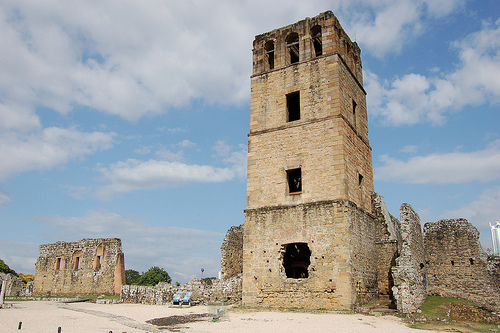
Old Panama Cathedral (Catedral de Nuestra Señora de la
Asunción): The most iconic feature, with its surviving bell tower—once
the city's "skyscraper"—offering panoramic views of the modern skyline.
Originally built in the 16th century, it was damaged multiple times
before the final destruction.
Casa de los Genoveses (House of the
Genoans): A structure tied to Italian merchants, showcasing commercial
influences.
Convents and Public Buildings: Ruins of institutions like
the Convent of San Francisco, Cabildo offices, and Casas Terrín, with
features such as arched façades, brick floors, and stone steps.
Archaeological research at Panamá Viejo, led by the Patronato Panamá
Viejo since 1995, has uncovered layers of Colonial and Precolumbian
history across the 28-hectare core site (originally estimated at 70
hectares). Excavations around the Plaza Mayor have revealed house
foundations, streets like Calle de la Empedrada, rubbish dumps with
16th- and 17th-century artifacts (e.g., majolicas, porcelain, coins, and
botijas peruleras ceramics), and a 6-meter-deep well. Systematic grid
surveys have identified Precolumbian burials (primary extended or flexed
with offerings, secondary in urns) and middens with ceramics and shells,
linking the site to Cueva-language chiefdoms predating European arrival.
These findings illuminate daily life, material culture evolution, and
the integration of indigenous and colonial elements, challenging
narratives that downplay Precolumbian sophistication. Artifacts are
processed in on-site labs, contributing to a reference collection for
ongoing study.
Designated a UNESCO World Heritage Site in 1997 (expanded in 2003), Panamá Viejo is managed as an archaeological park, with preservation guided by the Venice Charter, focusing on anastylosis (reassembling original elements) rather than reconstruction. Efforts include exposing original floors, removing modern intrusions (e.g., 1950s park features), and protecting against natural erosion and vandalism. A Master Plan supports excavation, conservation, publication, and tourism infrastructure, led by Panamanian experts to promote local heritage and economic benefits through jobs in guiding and maintenance. Educational programs, tours, and exhibitions aim to foster public appreciation and decolonize historical interpretations.
As a tourist destination, Panamá Viejo is easily accessible—a 10-minute drive or 30-minute bus ride from central Panama City. Visitors can wander the ruins, climb the bell tower for views, and explore an artisan market for local crafts and souvenirs. The site's unaltered layout allows for an immersive historical experience. Tips include wearing comfortable shoes for uneven terrain, visiting during cooler morning hours, and checking for guided tours to gain deeper insights into the excavations.