Location: Cayo District Map
Baking Pot is a major Maya archaeological site in the Belize River Valley, known for its extensive urban settlement, monumental architecture, and long occupational history spanning from the Preclassic to Postclassic periods (approximately 600 BC to AD 1000). Located in the Cayo District, it is one of the largest Maya centers in the region, alongside sites like Xunantunich and Cahal Pech. Despite its historical importance, Baking Pot remains less visited than Belize’s more famous ruins, offering a quieter, more authentic experience for archaeology enthusiasts, researchers, and adventurous travelers. Its name, possibly derived from a colonial-era term for a riverside clay deposit or a local landmark, reflects its setting along the Belize River.
Baking Pot's architecture highlights Maya engineering and ritual
landscapes:
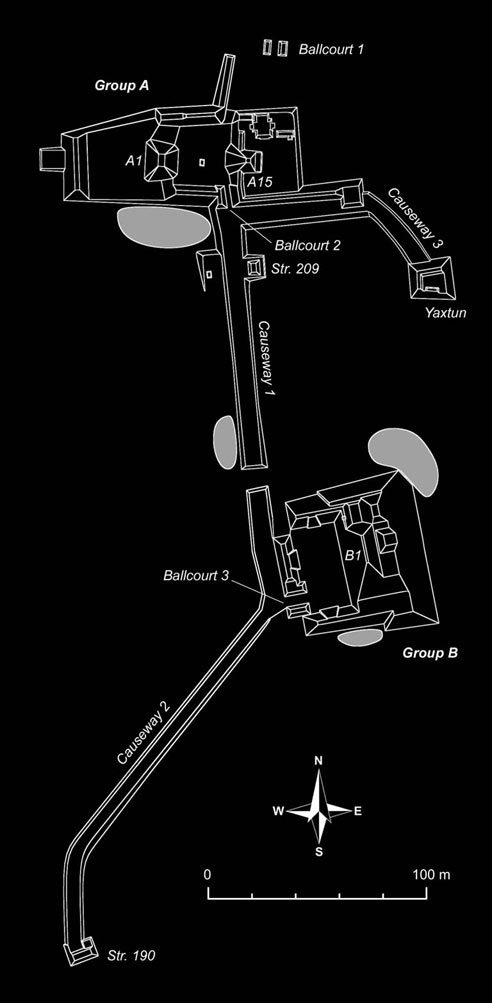
Group A and Group B: These are the primary monumental
complexes. Group B features the tallest structure, while a sacbe links
the two, facilitating ceremonial processions. A secondary causeway
extends south and west from Group B to Mound 190, a terminus structure
used for rituals. Mound 190 yielded deposits with human finger bones, an
altar, intact miniature ceramic vessels speckled with jade, and hundreds
of broken vessels at its base—likely from a termination ritual.
Water
Management Features: The site includes aguadas (reservoirs), seasonal
streams, and drains in the palace complex to channel water from southern
foothills into the river, demonstrating advanced hydraulic engineering
for agriculture and daily needs.
Bedran Group: A residential cluster
near the core, where excavations uncovered Early Classic burials with
painted ceramic vessels (cacao drinking cups) inscribed with a primary
standard sequence. Initially interpreted as a placename ("Four Water
Place"), it's now seen as a royal title.
Other Elements: No carved
monuments exist, but uncarved stelae and altars are present. Over 110
grooved stones were found, whose function remains enigmatic, possibly
related to tools or rituals. Finger bowl caches, similar to those at
Caracol and Cahal Pech, suggest shared cultural practices.
Baking Pot is an ancient Maya archaeological site situated in the
upper Belize River Valley, within the Cayo District of western Belize.
It lies on the southern bank of the Belize River, approximately 6
kilometers (3.7 miles) downstream from the sites of Barton Ramie and
Lower Dover, and northeast of the modern town of San Ignacio. The site's
coordinates place it in the eastern Maya Lowlands, part of a broader
region where multiple environmental zones converge around the Mopan,
Macal, and Belize Rivers. The monumental core and surrounding settlement
cover an estimated area of about 9 square kilometers, though geospatial
analyses suggest the associated polity (political territory) extended to
between 110 and 118 square kilometers during the Late Classic period
(around 600–900 CE). This territory exhibited low-density urbanism, with
settlements dispersed across the landscape and bounded by natural
features such as rivers, foothills, and possibly minor outlying
communities.
The upper Belize River Valley itself spans roughly 125
square kilometers, stretching eastward from the Guatemala-Belize border
near Xunantunich for about 30 kilometers downstream to sites like
Blackman Eddy. Baking Pot's position in this valley made it a key node
in the Maya world, facilitating interactions with nearby polities such
as Cahal Pech, Lower Dover, and Yaxox. Its proximity to the Belize
River—one of the major riverine arteries in the Maya Lowlands—provided
essential access to water for transportation, irrigation, and daily
life, contributing to its long occupation from the Preclassic (around
1000 BCE) through the Postclassic (up to 1500 CE) periods.
Topography and Terrain
The topography of Baking Pot is characteristic
of the Belize River Valley's alluvial plains, which are expansive and
relatively flat in the western portions around the site. The terrain
features fertile alluvial soils deposited by the river, creating a
stable foundation for settlement and agriculture. The site is oriented
north-south, with two major architectural groups: Group A to the north
and Group B to the south, the latter housing the largest structures.
These groups are connected by a roughly 250-meter-long sacbe (raised
causeway), which likely served both ceremonial and practical purposes in
navigating the landscape.
To the south, the site is bordered by low
foothills that rise gently from the valley floor, channeling seasonal
streams and runoff northward through the settlement toward the Belize
River. This creates a subtle elevational gradient, with the site's
elevation averaging around 50–100 meters above sea level. The eastern
parts of the valley, nearer to Lower Dover, become more undulating as
the southern foothills protrude northward, forming natural hillocks and
pockets of higher ground. Baking Pot itself includes several artificial
modifications to the natural topography, such as plazas, pyramids, and
residential mounds built on the valley floor.
A defining feature is
the complex water management system, including aguadas (artificial
reservoirs or ponds), drains, and seasonal streams. These infrastructure
elements captured and redirected water from the southern foothills,
storing it in aguadas before discharging excess into the Belize River.
This system mitigated flooding in the low-lying alluvial areas and
ensured water availability during dry periods, demonstrating
sophisticated adaptation to the terrain's hydrological dynamics. The
valley's karstic geology—common in the Maya Lowlands—underlies much of
the region, with limestone bedrock promoting rapid drainage but also
creating challenges like sinkholes (cenotes) and underground water
flows, though these are less prominent at Baking Pot compared to higher
plateaus like the Vaca Plateau to the south (300–560 meters above sea
level).
Soils in the area are highly productive, classified as Class
I and II in agronomic terms, with deep, nutrient-rich alluvium along the
riverbanks supporting intensive farming. Upland areas in the southern
foothills have thinner soils but were used for rain-fed cultivation,
while the valley floor's fertility allowed for year-round agriculture.
Climate
Baking Pot's climate is typical of the tropical lowlands
in the eastern Maya region, classified as subtropical with distinct wet
and dry seasons. Average annual temperatures range from 24–27°C
(75–81°F), with high humidity year-round. The wet season, from May to
October, brings heavy rainfall—often exceeding 2,000–3,000 millimeters
annually—driven by trade winds and occasional tropical storms or
hurricanes from the Caribbean Sea. This period accounts for most of the
precipitation, leading to river swelling and potential flooding in the
alluvial valley. The dry season, from November to April, sees reduced
rainfall (around 100–200 millimeters per month), warmer days, and cooler
nights, which could stress water resources without proper management.
Paleo-climatic reconstructions indicate that the region experienced
increasing variability during the Terminal Classic (800–1000 CE) and
Postclassic periods, including prolonged droughts attributed to shifts
in the Intertropical Convergence Zone. These droughts, documented in
sediment cores and speleothems from the Belize Valley, likely
contributed to agricultural stress and population shifts. For instance,
upland areas in the southern foothills suffered from reduced rain-fed
milpa (slash-and-burn) cultivation, prompting out-migration. In
contrast, riverine zones like Baking Pot's alluvial plains remained
resilient due to access to groundwater and irrigation, allowing
sustained occupation while nearby sites declined. Modern climate data
from nearby San Ignacio shows similar patterns, with occasional extreme
events like floods from Hurricane Mitch in 1998 or droughts in the
2010s, highlighting the valley's vulnerability to climatic fluctuations.
Surrounding Environment and Ecology
The environment around Baking
Pot is a neotropical mosaic, blending riverine, floodplain, and foothill
ecosystems. The Belize River dominates the northern boundary, providing
a riparian habitat with dense vegetation including broadleaf trees,
palms, and aquatic plants. This riverine corridor supports biodiversity,
with species like crocodiles, fish (e.g., tarpon and catfish), and birds
(e.g., herons and kingfishers) that would have been resources for the
ancient Maya. The alluvial valley floor is covered in fertile,
well-drained soils that foster tropical broadleaf forest, though much
has been cleared for modern agriculture. Native vegetation includes
mahogany, ceiba, and ramon trees, interspersed with understory shrubs
and vines typical of secondary growth forests.
To the south, the
foothills transition into montane forests with steeper slopes and
thinner soils, hosting epiphytes, orchids, and fauna like howler monkeys
and jaguars. Seasonal wetlands (bajos) and swamps occur in low-lying
areas, especially during the wet season, adding to the ecological
diversity. The region's geology is primarily Cretaceous limestone,
leading to karst features that influence water availability—surface
water is scarce in dry periods, making the river and aguadas critical.
Ecologically, Baking Pot sits in a zone of high productivity, with the
convergence of river, valley, and foothills creating microhabitats for
diverse flora and fauna. Pollen and archaeobotanical evidence from the
site reveals cultivation of maize, beans, squash, and possibly cash
crops like cacao, which thrived in the shaded, humid riverbanks. Lithic
workshops indicate exploitation of local chert from riverbeds and
foothills, while faunal remains suggest hunting of deer, peccary, and
turtles from surrounding forests.
Influence on Maya Settlement
The geography profoundly shaped Maya life at Baking Pot. The fertile
alluvial soils and river access enabled intensive agriculture,
supporting a peak population of around 2,500 during the Late Classic.
Unlike upland sites vulnerable to droughts, the valley's hydrology
allowed for resilient farming strategies, including flood-recession
planting and irrigation via the water management system. This
environmental advantage fostered Baking Pot as an agricultural hub, with
evidence of community-based production and trade in cacao and lithics.
Natural boundaries, such as the river and foothills, defined polity
limits and influenced political dynamics, promoting low-density
settlement patterns integrated with the landscape. However, climatic
shifts—particularly droughts—highlighted vulnerabilities, leading to
adaptations like enhanced water storage but eventually contributing to
regional depopulation. Overall, Baking Pot exemplifies how Maya
societies leveraged geography for sustainability, turning a dynamic
tropical environment into a foundation for cultural and economic
complexity.
Baking Pot is a significant Maya archaeological site located in the
Belize River Valley, on the southern bank of the Belize River in the
Cayo District of Belize. It lies approximately 6 kilometers downstream
from Barton Ramie and Lower Dover, covering an area of about nine square
kilometers. The site was occupied by the Maya from the Preclassic period
through to the Postclassic, making it notable for its longevity compared
to other regional sites that experienced earlier abandonment. Unlike
many major Classic Period sites in the southern lowlands that were
deserted after the Classic collapse, Baking Pot saw a large population
during the Terminal Classic and continued habitation into the
Postclassic. This persistence is attributed to factors like fertile
alluvial soils for agriculture and possible migrations from other areas,
such as the central Petén Basin.
The site's name originates from
large pots discovered by early archaeologists, which were used for
boiling chicle (a natural gum). Baking Pot exemplifies low-density
urbanism typical of Maya settlements, with a focus on agricultural
production, including evidence of lithic workshops and potential
cash-cropping of cacao. Its history provides insights into Maya social
organization, ritual practices, and responses to regional declines.
Occupation Timeline and Major Periods
The occupation of Baking
Pot spans over two millennia, with distinct phases reflecting population
growth, architectural development, and eventual shifts in usage:
Preclassic Period (ca. 700–400 BC to AD 250): Initial settlement began
around 700–400 BC, as confirmed by AMS radiocarbon dating from burials
and caches. During the late Preclassic, the population was small, with
minimal public architecture. This era laid the foundations for later
expansion, though evidence is limited to early residential and
ceremonial deposits.
Early Classic Period (AD 250–600): This marked a
significant construction boom. Two major architectural groups were
built: Group A in the north and Group B in the south, which includes the
site's largest structure. These groups are connected by a roughly
250-meter-long causeway (sacbe), oriented north-south, similar to the
layout at nearby Xunantunich. The period saw increased ceremonial
activity and the establishment of elite residences, reflecting growing
social complexity.
Late Classic Period (AD 600–900): Population
peaked at around 2,500 inhabitants. The site became a bustling center
with expanded residential areas, agricultural intensification, and trade
connections. Influences from distant polities, such as Naranjo pottery
and possible oversight from Caracol, indicate Baking Pot's integration
into broader Maya political networks. This era also saw efforts to
control the Belize River Valley following shifts in power, like the fall
of Tikal.
Terminal Classic Period (AD 900–1000): While many Belize
Valley sites declined, Baking Pot maintained a robust population.
However, toward the end, local elites departed, leading to the
abandonment of palace complexes in the site core. Ritual activities,
such as termination ceremonies involving smashed vessels, suggest
deliberate closures of certain structures.
Postclassic Period (AD
1000–1500): Occupation continued longer than at neighboring sites, with
substantial residential activity outside the core. The ceremonial center
saw limited use, with little new construction. Evidence of
Tayasal-associated Augustine Red ceramics points to an influx of people
from the central Petén Basin, introducing new organizational patterns.
Inhabitants focused on farming, leveraging the fertile valley soils near
the river. Researchers suggest a gradual abandonment later than regional
norms, with some areas persisting as agricultural communities.
Excavations History
Archaeological investigations at Baking Pot began
in the early 20th century and have evolved to focus on settlement
patterns and community archaeology:
1920s–1930s: A.H. Anderson
initiated research after site materials were disturbed for highway
construction. Oliver Ricketson conducted a single season in 1924 for the
Carnegie Institution.
1950s–1960s: Gordon Willey emphasized Maya
households and settlements, excavating at nearby Barton Ramie. William
and Mary Bullard completed a season in 1962.
1990s–Present: The
Belize Valley Archaeological Reconnaissance Project (BVAR), directed by
Dr. Jaime Awe since 1992, has led extensive work. Key contributors
include Jim Aimers, Josalyn Ferguson, Jennifer Piehl, Carolyn Audet,
Christophe Helmke, and Julie Hoggarth. Efforts include surveys of house
mounds, plazuela groups, and structures like Bedran and Mound 190.
Significant Discoveries
Excavations have unearthed artifacts
illuminating Maya life:
Komkom Vase (2016): A 9-inch ceremonial
vessel found in 82 fragments, reassembled to reveal a 9th-century
hieroglyphic inscription with a Long Count date. It describes a war
between the King of Komkom (allied with Naranjo) and Yaxha, offering
rare epigraphic evidence of regional conflicts.
Burials and Caches:
Early dates from human remains and offerings confirm Preclassic roots.
Finger bones and jade-speckled mini vessels at Mound 190 indicate ritual
deposits.
Ceramics and Artifacts: Naranjo-influenced pottery,
Augustine Red wares signaling Petén migrations, cacao vessels, and
grooved stones. Broken vessels at Mound 190 suggest ritual smashing.
Baking Pot has been studied intermittently since the early 20th
century, with significant work by:
Gordon Willey (1950s): Early
surveys mapped the site’s core, noting its agricultural systems.
William Bullard (1960s): Excavations uncovered Group A’s pyramids and
burials.
BVAR Project (1990s–present): Led by Dr. Jaime Awe, this
ongoing effort has revealed tombs, causeways, and residential zones,
using LiDAR to map unexcavated areas. A 2016–2017 dig exposed a royal
palace and elite burial, published in Latin American Antiquity.
The
site’s size—comparable to Xunantunich—suggests a population of several
thousand at its peak. Its decline in the Terminal Classic (AD 850–1000)
likely stemmed from drought, warfare, or trade disruptions, common
across the Maya Lowlands. Postclassic activity was minimal, with small
reoccupations.
Baking Pot’s preservation faces challenges.
Looting in the 20th century damaged tombs, and farming has disturbed
outer zones. However, the Belize Institute of Archaeology (NICH)
protects the core, with BVAR restoring key structures. Unlike Caracol’s
polished pyramids, Baking Pot’s mounds are partly overgrown, giving it a
raw, exploratory feel.
The Cayo District, with ~90,000 residents, blends tourism,
agriculture (citrus, bananas), and education (Galen University is
nearby). Baking Pot employs local guides and supports research, though
its low visitor numbers limit economic impact compared to Xunantunich.
The nearby Mennonite community at Spanish Lookout, known for dairy and
poultry, adds a unique cultural layer, with their markets selling fresh
cheese alongside Maya crafts.
Belize’s broader context enhances
Baking Pot’s appeal. As a biodiversity hotspot, the region hosts jaguar
reserves (Cockscomb Basin, 60 miles away) and the Belize Barrier Reef
(UNESCO site, 80 miles east). Belize’s English-speaking status eases
communication, while Kriol and Maya languages reflect its multicultural
soul. Challenges like deforestation and quarrying persist, but Baking
Pot’s protected status ensures conservation, aided by BVAR’s community
outreach, including school programs.
Baking Pot is ideal for those seeking an off-the-grid Maya
experience, with minimal crowds and a sense of discovery. Key details
include:
Access: From San Ignacio, a 15-minute drive on the
George Price Highway leads to a dirt road marked by a small sign. Public
buses to Spanish Lookout stop nearby (~$2 USD), or taxis cost $15 USD
one-way. Guided tours from San Ignacio or Belmopan ($50–80 USD) include
transport and lunch.
What to See:
Group A Plaza: Explore the
main pyramid and eastern shrine, with low mounds revealing temple
foundations. Climb the pyramid for river views.
Group B Palace:
Wander the ballcourt and palace courtyards, imagining elite life.
Unexcavated mounds hint at hidden chambers.
Causeways: Walk the sacbe
to feel the city’s scale, spotting iguanas or parrots.
Riverbank: The
Belize River offers a serene spot to reflect, with canoes sometimes
available from locals.
Tours: Self-guided visits are free (no
entrance fee), but guides (~$20–30 USD) from BVAR or operators like Pacz
Tours add depth, explaining burials and architecture. Tours often pair
Baking Pot with Xunantunich or Barton Creek Cave for a full day.
Facilities: Minimal—no restrooms, visitor centers, or food stalls. Bring
water, snacks, insect repellent, sunscreen, and sturdy shoes. San
Ignacio has hotels (e.g., Cahal Pech Village Resort) and restaurants for
post-visit meals.
Experience: Visitors describe Baking Pot as
“peaceful” and “untouched,” per TripAdvisor reviews, with its jungle
setting evoking adventure. The lack of restoration lets you imagine
archaeologists at work, though some wish for signage. Expect 1–2 hours
to explore, longer with a guide.
Baking Pot is a focused archaeological stop, but the Cayo District
offers complementary experiences:
Xunantunich (10 miles west): A
restored site with the 130-foot El Castillo pyramid, reachable by
hand-cranked ferry.
Cahal Pech (5 miles west): A compact ruin with
elite residences, ideal for history buffs.
Barton Creek Cave (15
miles south): Canoe through a Maya ceremonial cave with stalactites and
pottery.
San Ignacio Market (6 miles west): A Saturday hub for Maya
crafts, Mennonite produce, and Kriol street food like hudut.
Green
Iguana Conservation Project: A sanctuary in San Ignacio for interacting
with iguanas.
Actun Tunichil Muknal (ATM) Cave (25 miles south): A
strenuous trek to a Maya sacrificial site with skeletons and artifacts.
These pair well with Baking Pot, creating a multi-day Cayo itinerary
blending ruins, nature, and culture.