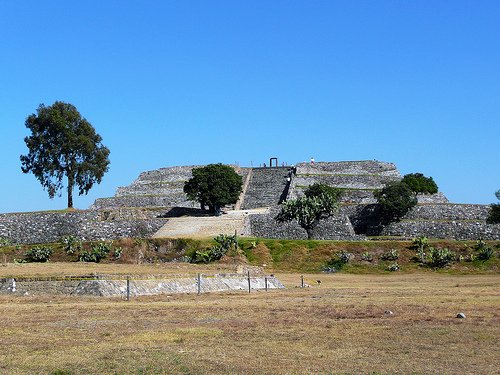
Location: 30 km (19 mi) North-west of Puebla, Tlaxcala Map
Open: 8am- 5:30pm
Admission: $46 MXP
Tel. (246) 416 0000
Cacaxtla is a major archaeological site in the state of
Tlaxcala, Mexico, near the town of San Miguel del Milagro (about
50 miles east of Mexico City in the Puebla-Tlaxcala Valley). It
served as a powerful political, military, and commercial center
for the Olmeca-Xicalanca people (likely with Gulf coast or
Maya-related origins) during the Epiclassic or Late Classic
period (roughly 650–900 CE). The site rose to prominence after
the collapse of nearby Teotihuacan and Cholula, controlling key
trade routes before being abandoned around 1000 CE for unknown
reasons.
Cacaxtla is renowned worldwide for its
extraordinarily well-preserved pre-Columbian murals—the best and
most extensive in all of Mesoamerica. These vibrant paintings
blend Maya artistic styles (fluid figures, rich “Maya blue”
pigments, serpent motifs) with Central Mexican (altiplano)
symbolism from Teotihuacan, Tlaloc, and other traditions. The
murals depict warfare, rulership, fertility, trade, mythology,
and nature in stunning detail, using mineral-based colors (red,
blue, yellow, black, white) that remain vivid after 1,300+ years
thanks to burial under later structures and modern protection.
The site was accidentally discovered in 1974–1975 when local
workers dug a tunnel and uncovered murals; INAH (Mexico’s
National Institute of Anthropology and History) quickly
excavated and prioritized conservation.
The Gran Basamento (Great Platform or Acropolis)
The central
landmark and heart of Cacaxtla is the Gran Basamento—a massive
200-meter-long (656 ft) by 25-meter-high (82 ft) natural hill adapted
into a fortified, multi-level platform with staggered sloping walls. It
functioned as an elite palace complex containing shrines, temples,
platforms, patios, residential quarters for priests and rulers, and
smaller pyramids. Its elevated, defensible position offered commanding
views over the valley and surrounding volcanoes.
In the 1980s, INAH
built one of the world’s largest protective sheet-metal roofs (spanning
over 100,000 square feet) over the main excavated area to shield the
murals and adobe/stucco structures from rain and sun. Visitors explore
via elevated wooden walkways and staircases that preserve the ancient
floors.
Key Murals and Structures
The murals are integrated
into the architecture across multiple construction phases (up to eight
layers). Here is a visitor-style walkthrough of the main landmarks
(roughly clockwise under the roof):
Red Temple (Templo Rojo) — One of
the earliest structures (~600 CE), located at the base of a staircase
leading to the Governors’ Room (Habitaciones de los Gobernantes). The
walls feature a brilliant red background with highly realistic
Maya-style scenes of people, deities, animals, cornstalks (symbolizing
fertility and life), water, fertile land, and trade symbols. These
represent the sources of Cacaxtla’s wealth. Only one side is visible
on-site; the opposite appears as a detailed reproduction in the museum.
Battle Mural (Mural de la Batalla) — The site’s most iconic and
longest Mesoamerican mural (~26 meters / ~85 feet wide, nearly 2 meters
/ 6 feet tall). Located in the northern plaza on the sloping wall of a
temple base (associated with Building A), it is dramatically split by a
central staircase. It narrates a fierce battle between two ethnic
groups: victorious jaguar-skinned warriors (local Olmeca-Xicalanca, with
grayish-brown skin and prominent noses) overpowering defeated
eagle/bird-clad enemies (likely Maya, shown with cranial deformation,
mostly naked except for plumes and jade). The graphic violence—spears,
obsidian knives, blood, dismembered bodies, and captives—makes it one of
the most dramatic pre-Columbian artworks. Painted before 700 CE, it may
commemorate a real conquest or serve as political propaganda.
Doorway Murals in Building A (Birdman and Jaguarman) — Among the most
spectacular and best-preserved. Flanking a central doorway on vivid red
backgrounds (with blue-background jambs/columns nearby):
Birdman
(south side): A regal Maya-style figure in bird costume and helmet,
standing atop or riding a plumed/bearded serpent while holding a serpent
bar. Often linked to Quetzalcoatl (feathered serpent deity of arts,
agriculture, and rulership).
Jaguarman (north side): A fierce
counterpart in jaguar skin and helmet, standing on a jaguar-skinned
serpent or dragon-like creature, holding darts dripping water
(symbolizing rain/fertility). These are thought to represent
ruler-priests or dual cosmic forces.
Additional jamb figures
include a jaguar-man pouring water into a Tlaloc (rain god) vessel and a
snail motif with an emerging red-haired sun figure.
Temple of
Venus (or Venus columns) — Murals on two columns depict a male figure
(and a probable female counterpart) wearing skirts marked with the Venus
symbol and, in the male’s case, a scorpion tail. These reference the
planet Venus (tied to warfare and sacrifice in Mesoamerican astronomy)
and calendrical or astronomical events.
Other notable features
include early portico rooms with columns, the Palace complex with open
patios (e.g., Patio of the Altars), and additional mural fragments
showing water scenes, corn symbolism, and priestly attire.
On-Site Museum
Near the entrance, the small but excellent Museo de
Sitio displays artifacts (pottery, obsidian tools, masks, figurines) and
high-quality full-size reproductions of key murals (including the Jaguar
Man, Scorpion Man, and Red Temple details). These allow close-up viewing
of painting techniques and colors that are harder to see on the
protected originals.
Cultural Significance and Visiting
Cacaxtla’s murals stand out for their eclectic fusion of distant
influences (Maya from 400+ miles away, plus local and Teotihuacan
elements), suggesting extensive trade, alliances, or even Maya artists
or settlers. They blend religion, history, and politics—celebrating
victory, fertility, rulership, and cosmic order. The site is often
visited alongside the nearby ceremonial center of Xochitécatl (about 1–3
km away, with its own pyramids and fertility figurines), though the two
are distinct.
Today, the site is managed by INAH and protected under
a massive roof with plexiglass barriers in places. It is open daily
(typically 9:00–17:00 or similar; check current hours), with modest
entry fees (free for Mexican nationals on Sundays). No flash
photography; stay on walkways. The remote location rewards visitors with
an intimate, almost private experience amid vivid 1,300-year-old art
that feels freshly painted.
Early Settlement and Origins (Formative to Classic periods)
Archaeological evidence shows human activity at Cacaxtla beginning
in the first centuries CE during the Formative (Preclassic) period,
though the site only rose to prominence much later. The inhabitants
are identified as the Olmeca-Xicalanca people—a group whose precise
origins remain mysterious. Colonial chronicler Diego Muñoz Camargo
(16th century) called them the “Olmeca” of Cacaxtla, but they are
unrelated to the much earlier Olmec civilization (ending ~400 BCE).
Most scholars believe they originated on the Gulf Coast and may have
been Maya settlers or migrants who arrived in central Mexico around
400 CE.
The nearby hill of Xochitécatl was occupied much earlier
(c. 800–100 BCE), functioning as a fertility and rain-making
ceremonial center with distinctive terracotta female figurines and
pyramids adapted to the terrain. Cacaxtla and Xochitécatl together
formed a single political-religious complex, with Xochitécatl
serving more public ritual functions while Cacaxtla housed elite
palaces and administration.
Rise to Power: The Epiclassic
Period (c. 650–900 CE)
Cacaxtla’s golden age began after the
sudden collapse of the great Classic-period powers. Teotihuacan (in
the Valley of Mexico) fell violently around 600 CE, followed by
Cholula (just south) between c. 650–750 CE. Cacaxtla may even have
played a role in Cholula’s downfall. In the power vacuum that
followed, the Olmeca-Xicalanca of Cacaxtla emerged as the dominant
force in the Puebla-Tlaxcala Valley, controlling key trade routes
linking the Gulf Coast (Tabasco/Campeche regions) with the Valley of
Mexico. The site’s population probably never exceeded 10,000, but
its strategic hilltop location and military prowess gave it regional
hegemony for about two centuries.
The heart of the city was the
Gran Basamento (“Great Platform” or “Great Plinth”)—a massive
artificial terrace 200 meters long and 25 meters high, built in at
least nine successive construction phases over three centuries. On
this elevated platform stood temples, palaces, priestly residences,
and administrative buildings. The complex functioned more like a
sprawling elite palace than a typical pyramid-temple center,
offering both defense and panoramic views. Smaller pyramids and
temple bases surround the main platform.
The Murals:
Masterpieces of Epiclassic Art
Cacaxtla’s greatest legacy is its
murals, painted directly on lime-plastered walls using mineral
pigments (red from cinnabar or ochre, blue from Mayan blue, yellow,
black, white from kaolin and other local sources). Unlike most
Mesoamerican murals that have faded or been destroyed, Cacaxtla’s
survived remarkably intact because the site was buried and later
protected. They combine Maya stylistic elements (profile figures,
dynamic movement, rich colors) with Central Mexican symbolism
(Teotihuacan, Totonac, Mixtec, and local altiplano motifs). The
paintings depict warfare, mythology, astronomy, fertility, and
rulership, often portraying the lords of Cacaxtla as priest-kings.
The most famous is the Battle Mural (Mural de la Batalla, dated
before 700 CE) in the northern plaza. Nearly 26 meters long, it
stretches across a sloping temple wall split by a staircase. It
narrates a decisive victory of Cacaxtla warriors (grayish-brown
skin, prominent noses, no cranial deformation, armed with atlatls,
spears, obsidian knives, and round shields) over a clearly different
ethnic group identified as Maya (elongated heads, naked except for
plumes, earplugs, and jade jewelry). The defeated are shown
humiliated and slaughtered in graphic detail. The mural is one of
the most realistic and narrative battle scenes in ancient America.
Other key murals include:
Building A (or Temple of the Bird
and Jaguar): On a red background, the “Bird Man” (linked to
Quetzalcoatl) rides a plumed serpent; opposite is the “Jaguar Man”
(associated with rain and fertility) standing on a jaguar-skinned
serpent, holding darts dripping water. These likely represent
deified ruler-priests.
Temple of Venus: Columns show figures with
Venus symbols and scorpion tails, alluding to the planet Venus’s
role in warfare and sacrifice calendars.
Red Temple (Templo Rojo)
and other fragments: Scenes of water rituals, Tlaloc (rain god), and
elite processions.
The murals portray the Cacaxtla lords as
inheritors of Teotihuacan and Cholula traditions—warlike yet tied to
agricultural fertility and cosmic order (gods such as Tlaloc, Xipe
Totec, and Tlazolteotl appear in related artifacts).
Decline
and Abandonment (c. 900–1000 CE)
Cacaxtla’s dominance ended
around 900 CE. Toltec expansion from the north likely forced the
Olmeca-Xicalanca out of Cholula and eventually overwhelmed Cacaxtla
itself. By 1000 CE the site was completely abandoned. The exact
causes—military conquest, environmental stress, or shifting trade
routes—remain uncertain.
Modern Rediscovery and Conservation
Cacaxtla lay forgotten under farmland and pasture for nearly a
thousand years. In September 1975, local farmers/maintenance workers
digging a tunnel (originally thought to be for treasure hunting)
accidentally struck the murals. Word reached archaeologists; the
National Institute of Anthropology and History (INAH) immediately
took charge. Major excavations (led by figures such as Jorge Angulo
Villaseñor, Sergio Vásquez Zárate, Diana López de Molina, and
others) continued into the 1980s, revealing the Gran Basamento’s
multi-layered history. To protect the murals from weather and
looting, INAH erected an enormous protective roof covering over
100,000 square feet (about 9,300 m²)—one of the largest in
Mesoamerica.
The on-site museum (opened 1986) displays 164
original artifacts, sculptures of the “Lords of Cacaxtla,” ceramics,
burial goods, and life-size mural reproductions. Exhibits are
organized thematically: Formative Period settlement, painting
techniques, “Gods and Men,” and the Epiclassic apogee. Today the
site is managed by INAH, open Wednesday–Sunday, and remains a key
window into the chaotic but culturally creative post-Classic
transition in central Mexico.
Cacaxtla’s murals continue to
fascinate scholars because they capture a moment of intense cultural
mixing just before the rise of the Toltecs and later Aztecs. The
site’s blend of Maya artistic brilliance with highland Mexican
militarism and symbolism makes it unique—no other place in
Mesoamerica preserves such vivid testimony to the “lords of
Cacaxtla” and their brief but brilliant era of regional power.
Best Time to Visit
The region has a mild highland climate
(altiplano), with temperatures usually ranging from about 41°F (5°C) at
night to 77°F (25°C) daytime, rarely extreme.
Ideal period: Late
March to late May (or spring broadly, April–June) for comfortable
weather, lower humidity, and vibrant landscapes—perfect for outdoor
exploration without intense heat or heavy rain.
Avoid the peak wet
season (June–September/October), when afternoon showers are common and
paths can get muddy/slippery.
Dry season (November–February) works
well too, with cooler, clearer days (and pleasant weather reported in
late fall/early winter visits).
Go early in the morning to beat any
potential crowds (though the site is rarely busy) and the stronger
midday sun/high-altitude UV.
Weekdays are quieter than
weekends/Sundays (when Mexican nationals may enter free or at reduced
rates at some INAH sites).
How to Get There
Cacaxtla is remote
and not heavily touristed, so public transport requires effort—it's in
southern Tlaxcala near Nativitas/San Miguel del Milagro, closer to
Puebla's airport than central Puebla city.
Easiest option: Base
yourself in Puebla (a beautiful colonial city worth 2–3 days) or fly
into Puebla International Airport (PBC). Hire a taxi or private driver
from there (negotiate; some travelers report reasonable rates,
especially if you speak basic Spanish). Many do round-trip with waits,
or combine with Xochitécatl.
Guided tours: Popular and
stress-free—many day trips from Puebla (or even Mexico City) include
transport, a guide, and often Tlaxcala city stops. Look for private or
small-group options covering Cacaxtla + Xochitécatl (around $100–150
USD/person, sometimes including entrances).
Public transport
(budget/adventurous): From Tlaxcala city bus station, take a colectivo
(shared van/minibus) to San Miguel de los Milagros or nearby, then walk
uphill (20–40 minutes, steep in sun) to the entrance. From Puebla, bus
to Tlaxcala first, then connect. No direct bus to the gate—ask locals at
stations for current routes.
Driving: Rent a car in Puebla for
flexibility; roads are decent but rural.
The two sites are only
about 10–15 minutes apart by car/taxi.
Practical Information
Opening hours: Generally daily (or Wed–Sun, confirm via INAH site or
recent signs) from around 9:00 AM to 5:00–5:30 PM. Last entry ~1 hour
before close. Double-check for holidays.
Entrance fee: Around 75–80
MXN (~$4–5 USD) per adult for the combo ticket (covers both sites +
museums). Cash preferred; prices can fluctuate slightly.
What to
expect:
Cacaxtla — Main highlight is the protected Great Platform
area under a large roof (to preserve murals). Fixed paths only—no
touching walls. Murals are stunning up close (life-size copies often in
the museum too).
Xochitécatl — More open-air: Climb pyramids, see
circular structures, enjoy panoramic volcano/countryside views
(Popocatépetl/Iztaccíhuatl possible on clear days).
Matriarchal/fertility-focused site with a different vibe.
Two small
site museums — Essential! One at each spot with artifacts, explanations,
and mural details. Allocate time for them.
Time needed: 3–5 hours
total for both sites + museums leisurely; half-day minimum.
In-Depth Travel Tips
What to bring/wear — Comfortable walking shoes
(uneven paths, some climbing at Xochitécatl). Hat, sunglasses, high-SPF
sunscreen (high altitude = strong UV). Bring water (limited facilities;
small stores near entrances sell snacks/drinks). Light layers for cooler
mornings/evenings.
Health/safety — Site is safe and peaceful (low
crowds = relaxed vibe). Stay hydrated; altitude is moderate
(~7,500–8,000 ft). No major accessibility issues noted, but paths
uneven—contact ahead if needed.
Enhance the visit — Hire a local
guide (on-site or via tour) for deeper context on murals' symbolism and
history—worth it for first-timers. Combine with Tlaxcala city (colonial
center, basilica, food) or nearby spots like the Ocotlán Basilica.
Etiquette — Follow paths, no flash photos on murals (to protect
pigments), respect quiet atmosphere.
Bonus — If time allows, extend
to Puebla for talavera pottery, mole poblano, and historic sites, or
Mexico City day trips.