
Location: Avenida Rio Churubusco 410, Coyoacán
Subway: Coyoacán
Tel. 56 58 87 32
Open: 10am- 5pm Tue- Sun

26 October (7 November) 1879- 21 August 1940
The Museo León Trotsky (officially the Museo Casa de León Trotsky or, in its full institutional name, Instituto del Derecho de Asilo – Museo Casa de León Trotsky) stands as one of Mexico City’s most poignant historical sites. Located at Av. Río Churubusco 410 in the quiet Colonia del Carmen neighborhood of Coyoacán, it preserves the modest early-20th-century house where Soviet revolutionary Leon Trotsky (Lev Davidovich Bronstein) lived in exile with his wife Natalia Sedova from April 1939 until his assassination on August 20, 1940. The site functions simultaneously as a house museum and the headquarters of an institute dedicated to defending the right of political asylum and public liberties.

Trotsky’s Path to Exile and Arrival in Mexico
Trotsky’s journey to
this house began far earlier. Expelled from the Soviet Union in February
1929 for his fierce opposition to Joseph Stalin, he and Natalia lived
under constant threat of assassination while wandering through Turkey
(1929–1933), France (1933–1935), and Norway (1935–1936). In 1937,
Mexican president Lázaro Cárdenas granted them political asylum at the
urging of Mexican muralists Diego Rivera and Frida Kahlo. The couple
arrived in Tampico on January 9, 1937, and initially stayed at Kahlo’s
family home, La Casa Azul (now the
Frida Kahlo
Museum), also in Coyoacán. There Trotsky wrote key works, including
Their Morals and Ours, while under heavy guard.
A personal and
political rupture with Rivera—variously attributed to ideological
clashes, Rivera’s growing Stalinist sympathies, or Trotsky’s brief
affair with Kahlo—prompted the Trotskys to move in April 1939 to the
house on what was then Viena Street (now readdressed as part of Río
Churubusco). Trotsky’s grandson Esteban Volkov (then a child, nicknamed
Seva) joined them in August 1939 and lived there until the
assassination. The house, originally owned by a man named Turatti and
featuring an eclectic tower topped by a bronze eagle gifted by
revolutionary leader Venustiano Carranza, became their final home.
Fortification and the Two Assassination Attempts
Mexico’s
Communist Party was deeply divided between Stalinists and Trotskyists,
making the household a target. On May 24, 1940, a group led by Mexican
painter David Alfaro Siqueiros (an avowed Stalinist) and Soviet NKVD
agent Iosif Grigulevich staged the first attack. Disguised as police,
they overpowered guards, sprayed the bedrooms with machine-gun fire, and
abducted Trotsky’s secretary-bodyguard Robert Sheldon Harte (later
murdered). The family survived by hiding under beds; young Esteban was
grazed by a bullet in the foot. This assault led to the immediate
construction of high brick walls, watchtowers, steel shutters, and
reinforced doors—transforming the modest residence into a fortress-like
compound whose bullet-pocked outer walls remain visible today.
The
second, successful attempt came on August 20, 1940. Spanish Stalinist
Ramón Mercader (alias Jacques Mornard, posing as the lover of Trotsky’s
secretary Sylvia Ageloff) had infiltrated the household’s trust. While
Trotsky sat at his desk reviewing an article Mercader had written,
Mercader struck him in the back of the skull with an ice axe (piolet).
Trotsky did not die instantly; he fought back, spat in his attacker’s
face, and called for his guards. He underwent emergency surgery but
succumbed the next day, August 21, 1940, from cerebral hemorrhage and
shock. Mercader served 20 years in a Mexican prison, was later decorated
in the Soviet Union, and died in Havana in 1978.
Preservation and
the Birth of the Museum
Natalia Sedova continued living in the house
until her death in 1962. The property was bequeathed to her by the
Mexican government (on behalf of the Mexican people) as a gesture of
solidarity. In 1982, President José López Portillo declared the entire
complex a national historical monument (catalog I-0013600091). On August
20, 1990—the 50th anniversary of the assassination—the house officially
opened to the public as a museum under the regency of Manuel Camacho
Solís and with coordination by historian Alejandra Moreno Toscano. A
civil association was formed (with Trotsky’s grandson Esteban Volkov
Bronstein playing a central founding role) to administer it. At the same
moment, the Instituto del Derecho de Asilo y las Libertades Públicas
(Institute for the Right of Asylum and Public Liberties) was established
on-site to assist political dissidents seeking refuge in Mexico; the
institute and museum formally merged in 1996.
The grandson Esteban
Volkov (who survived the 1940 attack) remained deeply involved for
decades as founder, soul of the project, and at times director; the
current director is Gabriela Pérez. The museum operates without regular
government funding beyond occasional support (e.g., tower restorations),
relying instead on ticket sales, donations, and its gift shop/café. It
welcomes roughly 17,000 foreign visitors and 50,000 Mexican students
annually.
What the Museum Preserves Today
The site remains a
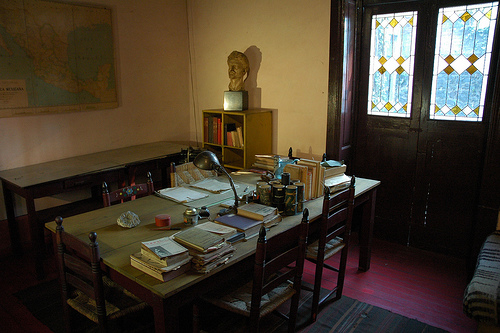
near-perfect time capsule. The study is frozen exactly as it was at the
moment of the attack: Trotsky’s glasses, unfinished manuscript on
Stalin, books, papers, and desk all in place. Bullet holes from the
Siqueiros raid still scar interior walls. The kitchen retains its
original pots and pans; bedrooms show lined-up shoes and Mexican
textiles; the former handball court now houses a 6,000-volume library
(Rafael Galván Library) and an 80-seat auditorium. Guard quarters along
the fortified walls have been converted into permanent exhibition halls
displaying photographs of Trotsky’s family, his role in the Bolshevik
Revolution, a genealogical tree, personal effects (including his round
spectacles), and biographical panels in Spanish. Guest rooms hold images
of Trotsky with Rivera, Kahlo, and other figures. Temporary galleries
host contemporary art, including an annual graffiti exhibition that the
museum uses to highlight marginalized urban artists.
In the lush
central garden—where Trotsky once tended rare cacti, rabbits, and
chickens—stands a simple stone stele designed by architect Juan
O’Gorman. It holds the ashes of both Trotsky and Natalia Sedova beneath
a flagpole that flies the Soviet flag (or red flag on commemorative
days). Tropical plants and cacti surround the monument, creating a
serene yet somber contrast to the fortress walls.
Enduring
Significance
The Museo León Trotsky is more than a monument to one
man’s violent death; it is a living reminder of 20th-century ideological
battles, Stalinist purges, and the fragility of political exile. Its
dual identity as museum and asylum institute underscores Mexico’s
historic role as a haven for persecuted intellectuals. Visitors often
describe the atmosphere as “real, tense, not with abundance and not
always happy”—a raw, unromanticized window into history that feels far
more intimate than larger revolutionary memorials. Open Tuesday–Sunday
10 a.m.–5 p.m., it continues to educate new generations while quietly
advancing the cause of political refuge that first brought Trotsky to
Mexico.
Original Construction and Eclectic Style (1909–1920)
The core
house is not a colonial structure but an early-20th-century country
residence built on a 1,317 m² plot in the former Colonia del Carmen.
Construction began around June 1909 on land sold by Francisca Brigout de
Bernard; it passed through owners (including Sara Weiss de Lecrit)
before Teófila López de Turati and her husband, Antonio Turati (who ran
an optical/scientific institute on the premises), completed it circa
1920.
The style is eclectic (a common Mexican residential approach of
the Porfirian-to-Revolutionary era), mixing historicist elements rather
than adhering to a single revival:
The prominent northeast
observation tower is eclectic overall, crowned by a bronze eagle (a gift
from President Venustiano Carranza to Turati during the Mexican
Revolution, when the house served as a Carrancista lookout point).
The south portico features Venetian Neo-Gothic detailing.
East and
west façades incorporate French Baroque influences.
The structure is
topped by a balustrade with decorative flowers in marble paste (a
lightweight stucco-like material).
Originally, the property
consisted of two main buildings separated by gardens: a large southern
room with portico and the northern tower. It bordered the Churubusco
River to the north, with views (from the tower) toward landmarks like
the Angel of Independence. Materials included red brick walls, stone
foundations/bases, wooden interiors, and tile or concrete floors—typical
of modest Coyoacán homes of the period. The interior was (and remains)
relatively plain and functional, with unpainted wood elements and a
somewhat austere feel.
Security Fortifications Under Trotsky
(1940)
After a failed machine-gun assault on May 24, 1940 (led by
painter David Alfaro Siqueiros, with attackers disguised as police
firing into the courtyard), the house was radically transformed into a
virtual fortress. Trotsky's supporters (with some Mexican government
assistance) raised the perimeter walls significantly, added three
watchtowers for surveillance, bricked up or barred numerous windows
(including the original main entrance on Viena Street), installed steel
shutters and bars, and constructed a dedicated guard house plus
ancillary structures like a chicken coop and garage. These changes give
the complex its tense, bunker-like character today—high blank walls,
limited sightlines, and a dark, enclosed interior. Bullet holes from the
Siqueiros attack remain deliberately preserved on both exterior walls
and interior surfaces (notably in the bedroom).
Interior Layout
and Preservation
The modest house contains just seven main rooms, all
frozen exactly as they were on the day of Trotsky's murder by Ramón
Mercader (who struck him with an ice axe in the study):
Study
(central and most iconic): Trotsky's desk with unfinished manuscript on
Stalin, glasses, papers, books, and typewriter left in situ.
Bedroom
(Trotsky and Natalia Sedova): Simple wooden beds covered in traditional
Mexican textiles/serapes, shoes lined up neatly, preserved bullet holes.
Kitchen and dining room: Everyday utensils, pots, and a long table with
yellow-painted wooden chairs.
Bathroom and grandson Esteban Volkov's
bedroom.
Natalia Sedova's office.
Floors and beds feature
Mexican textiles; the atmosphere is deliberately somber and lived-in,
with minimal decoration.
Garden, Tomb, and Later Museum Additions
The enclosed central garden—tended by Trotsky himself—features tropical
flowers, rare cacti he collected from Mexican countryside excursions,
and surviving rabbit hutches/coops. At its heart stands a simple stone
stele designed by renowned Mexican functionalist architect Juan O'Gorman
(also responsible for the nearby Frida Kahlo/Diego Rivera studio). The
stele contains the ashes of Trotsky, Natalia Sedova, and (per some
records) grandson Esteban Volkov; a flagpole above it flies the Soviet
flag.
Post-1990 museum interventions include:
Conversion of a
former rear handball court into the Rafael Galván Library (over 6,000
volumes on politics and social sciences), a contemporary art gallery,
permanent exhibition space, offices, and an 80-seat auditorium.
Repurposing of guard houses and watchtower bases into photo exhibits
(biographical images, family portraits with Rivera and Kahlo, Bolshevik
Revolution memorabilia).
Guest quarters displaying additional
black-and-white photographs.
A modern red entrance façade and
perimeter fencing (added for visitor access and security) that now
fronts the historic complex.
These additions respect the original
fortified envelope while expanding the site's educational role. The
overall complex sits in a quiet residential area beside an arroyo
parallel to the Churubusco River, contrasting sharply with the colorful
vibrancy of nearby Frida Kahlo's Blue House.