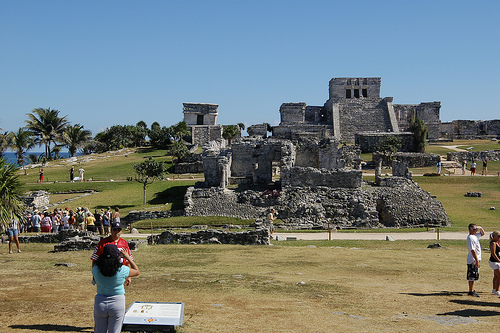
Location: Yucatan Peninsula
Tulum, Mexico, on the eastern coast of the Yucatán Peninsula in
Quintana Roo, blends one of the most iconic and best-preserved
coastal Maya archaeological sites with a modern beach town that has
exploded into a global tourism hotspot. The ancient city—originally
called Zama ("City of the Dawn" in Maya, for its east-facing
cliffs)—overlooks the Caribbean from 12-meter bluffs. Its later
name, Tulum (Yucatec Maya for "wall," "fence," or "trench"), comes
from the massive defensive stone wall that protected it on three
sides, with the sea guarding the fourth.
The ruins sit within a
compact walled zone that once housed elites and priests, while a
larger settlement sprawled outside. Today, the archaeological site
draws millions of visitors annually, while the nearby pueblo (town)
and hotel zone along the beach have transformed from a quiet fishing
village into a trendy, sometimes controversial destination known for
eco-luxury resorts, yoga retreats, and wellness tourism.
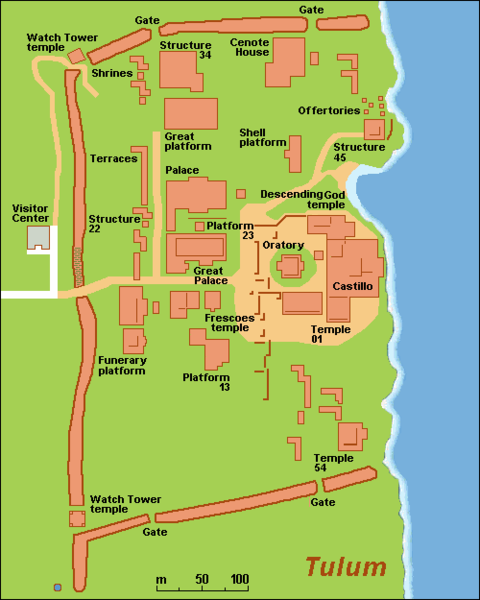
Pre-Columbian Maya History (c. 564–1550 AD)
Evidence of human activity at Tulum dates back much earlier, but the
site’s main story begins in the Classic and explodes in the Postclassic
period. A stela (stone monument) inside the Temple of the Initial Series
bears a Long Count date of AD 564, placing early occupation in the
Classic Period (roughly 250–900 AD). However, Tulum’s true
flourishing—and most of the visible structures—occurred much later,
during the Late Postclassic (c. 1200–1550 AD).
Tulum served as
the primary seaport for the powerful inland city of Cobá (about 40 km
west) and a vital node in a vast Maya trade network. Maritime routes
hugged the coast, while overland paths linked to Chichén Itzá and
beyond. Artifacts recovered include copper items from central Mexico,
jade from Guatemala, flint and ceramics from the Yucatán, and goods
reaching as far as Honduras and Central America. The Maya even cut an
artificial channel through the coral reef to control boat access; fires
lit atop El Castillo (the main pyramid) acted as a lighthouse at night.
The site was also a major religious and ceremonial center. It was
especially associated with the Descending (or Diving) God
(Ah-Muzen-Cab), whose image appears repeatedly in murals, stucco, and
sculptures—possibly linked to bees, an important Maya symbol. Other
deities honored included the wind god and Kukulcán (the feathered
serpent). The Temple of the Frescoes still shows traces of vibrant
murals depicting cosmology and daily life; the Temple of the Descending
God and the Castillo (a stepped pyramid-temple about 7.5 m tall)
dominate the skyline.
Tulum’s architecture belongs to the distinctive
“East Coast” or “Oriental” Yucatán style of the Postclassic: flaring
upper walls, narrow columned doorways, beam-and-rubble or vaulted roofs,
and altars. It is one of the few walled Maya cities from this era (along
with Mayapán), reflecting increased conflict and the need for defense
after the Classic Period collapse around 900 AD. During the Postclassic,
northern Yucatán saw political shifts—including the Mayapán League
(1263–1461)—and Tulum thrived in the coastal province of Ekab.
Peak
prominence occurred between the 13th and 15th centuries (roughly
1250–1450/1550 AD), making Tulum one of the last major Maya cities built
and one of the very few still inhabited when Europeans arrived.
Spanish Contact and Abandonment (1518–Late 16th Century)
In 1518,
members of Juan de Grijalva’s Spanish expedition became the first
Europeans to sight the city from the sea; they described a settlement
“as large as Seville.” Tulum was still thriving and actively trading.
The Maya continued living there for about 70 years after initial Spanish
contact, but Old World diseases (smallpox, measles) and the broader
conquest devastated the population. By the end of the 16th century, the
city was largely abandoned. Friar Diego de Landa’s writings document the
demographic collapse.
Rediscovery and Early Exploration (19th
Century)
The ruins lay forgotten under jungle growth until the 19th
century. Juan José Gálvez is credited with rediscovery in 1840. The
famous explorers John Lloyd Stephens and artist Frederick Catherwood
visited in 1841 during their second Yucatán expedition (just before the
Caste War erupted in 1847). Their bestselling book Incidents of Travel
in Yucatán (1843) included detailed maps, descriptions, and Catherwood’s
romantic engravings that introduced Tulum to the world. Stephens and
Catherwood named the site “Tulum” after the wall.
Systematic
Archaeology and 20th-Century Research
Serious scientific work began
in the early 20th century: Sylvanus Morley and the Carnegie Institution
(1916–1922), Samuel Lothrop (1924 mapping), Miguel Ángel Fernández
(1930s–1940s), William Sanders (1956), and especially Arthur G. Miller
(1970s), who studied murals and confirmed the Late Postclassic dating.
The site opened to the public with restored structures, and ongoing
research (including a 2016 underwater discovery of a ~9,900-year-old
female skeleton in a nearby cenote, unrelated to the Maya city)
continues to refine our understanding.
Modern Tulum: From Fishing
Village to Tourism Boom (20th–21st Centuries)
Until the mid-20th
century, Tulum was a tiny fishing village with a few hundred residents.
The Mexican government’s creation of Cancún as a mass-tourism resort in
the 1970s changed everything. Improved highways, the rebranding of the
coast as the “Riviera Maya” (1999), and growing international awareness
of the ruins turned Tulum into a backpacker and hippie destination in
the 1980s–1990s—think palapa huts, $5 hammocks, and pristine beaches.
By the early 2000s, it evolved into “eco-chic”: boutique hotels like
Coqui Coqui pioneered rustic-luxury aesthetics. The 2010s brought the
“Tuluminati”—wealthy digital nomads, celebrities, models, and wellness
influencers drawn to yoga, cenotes, and a bohemian-meets-luxury vibe.
Population skyrocketed (from ~2,000 in 1990 to ~12,000 by 2000, ~20,000
by 2020, with projections of 250,000 in the coming decade). The area
split into the archaeological zone, Pueblo (town center), Zona Hotelera
(beach road), Aldea Zama, La Veleta, and nearby Sian Ka’an Biosphere
Reserve. The ruins became Mexico’s third-most-visited archaeological
site (over 2.2 million visitors in 2017).
Contemporary Challenges
and Legacy
Rapid, often unregulated growth has brought serious
issues: deforestation, mangrove destruction, water pollution from
overbuilt hotels and cenote overuse, waste-management crises, and
skyrocketing living costs that displace local and Indigenous Maya
communities. Critics call it greenwashing—the “Tuluminati
takeover”—where luxury “eco-resorts” coexist with environmental strain
and cultural commodification. The controversial Maya Train project and
ongoing sustainability efforts by locals highlight the tension between
economic opportunity and preservation.
The ideal window is November to April for dry, pleasant weather
(highs around 80–85°F / 27–29°C, lows in the 60s–70s°F).
November–December offers a sweet spot: good weather, fewer crowds than
peak winter, and reasonable prices.
Peak season (December–April,
especially January–March): Perfect weather but highest crowds, prices,
and hotel rates (often 30–50% above shoulder season).
Shoulder
seasons (May, November): Warm and sunny with moderate crowds and better
deals.
Low/wet season (June–October): Hotter (90s°F), higher
rain/hurricane risk, but lowest prices. Sargassum seaweed peaks
July–August (and forecasts suggest 2026 could be heavy again),
potentially affecting beach quality.
Sargassum seaweed remains a
variable issue along the open Tulum coast. Levels change daily based on
currents/winds. Many hotels/beach clubs clean daily or use barriers. For
clearest water, aim for November–January, check real-time forecasts via
apps or local groups, or opt for protected spots farther north (e.g.,
Isla Mujeres). Early 2026 saw an unusually early arrival, but cleanup
efforts continue.
Most visitors fly into Cancún International Airport (CUN) (~2 hours
north) or the newer Tulum International Airport (TQO) (closer, ~30–45
minutes, with growing direct flights like Delta from some U.S. cities).
From the airport:
Shared shuttles/vans (~$30–60 USD/person).
Private transfer (~$80–150 USD).
ADO bus (cheaper but less direct).
Renting a car at the airport gives flexibility for cenotes/ruins.
Tulum splits into Tulum Pueblo (downtown, more affordable/local) and
Tulum Beach/Hotel Zone (~10–15 min apart along a sandy road).
Biking — Popular and scenic (rentals ~$6–10 USD/day). Great for
Pueblo-to-beach or short hops; bring a headlamp for night rides (limited
lighting).
Taxis — Convenient but pricey (negotiate!): ~$6–10 USD
around town, $10–15 USD to beach/ruins.
Colectivos (shared vans) —
Cheapest (~$1–3 USD) for routes like to ruins ("Ruínas"), cenotes, or
Playa del Carmen.
Scooters/ATVs — Fun for exploration but risky
(roads can be rough; accidents common).
Rental car — Best for day
trips to cenotes, Cobá ruins, or farther spots (~$30–60 USD/day +
gas/insurance).
Walking works in Pueblo or along beach paths, but
distances add up.
Budget (~$15–50 USD/night): Hostels or guesthouses in Pueblo.
Mid-range (~$100–250 USD): Boutique spots or eco-hotels.
Luxury
(~$300+ USD): Beachfront resorts like Habitas or high-end wellness
retreats.
Pueblo = cheaper/more local vibe. Beach zone = prettier
but pricier and touristy. Book early for peak season.
Tulum Archaeological Zone — Cliffside Mayan ruins with ocean views.
Go early (opens ~8 AM) to beat crowds/heat. In 2026, expect ~625 MXN
(~$31 USD) total entry (multiple fees: Jaguar Park + others; rising
prices noted).
Walk to nearby free/accessible beaches in Parque del
Jaguar (e.g., Santa Fe, Paraíso).
Cenotes — Swim in surreal
freshwater sinkholes. Popular: Gran Cenote, Dos Ojos
(snorkeling/diving), Calavera. Many near town; combine 2–3 via
bike/tour.
Beaches — Pristine white sand and turquoise water. Public
access exists (avoid "private" beach club claims). Northern beaches
calmer; southern more natural.
Wellness & Yoga — Temazcal ceremonies,
sound baths, retreats, or beach yoga.
Day trips — Cobá ruins (climb
pyramids), Muyil ruins + lagoons, Sian Ka'an biosphere, or Akumal for
snorkeling with turtles.
Food & Nightlife — From street tacos to
vegan/high-end spots. Try local taquerias in town.
Budget/local — Tacos/street food in Pueblo (~$5–10 USD/meal).
Mid-range — Beach clubs or cafes (~$15–30 USD).
High-end — Trendy
spots (~$30–60+ USD).
Eat in town to save; many vegan/healthy
options.
Tulum is generally safe for tourists, but petty theft occurs (don't
leave valuables on beaches). Use reputable transport at night; avoid
flashing cash/jewelry.
Drink bottled water; use reef-safe sunscreen.
ATMs in Pueblo; carry cash (MXN) as some spots don't take cards.
Bug
spray for jungle areas; modest dress at ruins.
Respect environment:
No touching coral/feeding wildlife.
Tulum can feel
"touristy/pretentious" to some—embrace the vibe or stick to local spots.
Budget Overview (2026 Estimates, Per Person/Day)
Budget — $50–80
USD (hostel, local food, colectivos/bike).
Mid-range — $140–200 USD.
Luxury — $400+ USD.