The Star- Spangled Banner
Francis Scott Key (1779- 1843)
O! say
can you see by the dawn’s early light
What so proudly we hailed at
the twilight’s last gleaming?
Whose broad stripes and bright stars
through the perilous fight,
O’er the ramparts we watched were so
gallantly streaming?
And the rockets’ red glare, the bombs bursting
in air,
Gave proof through the night that our flag was still there.
O! say does that star-spangled banner yet wave
O’er the land of the
free and the home of the brave?
On the shore, dimly seen through the
mists of the deep,
Where the foe’s haughty host in dread silence
reposes,
What is that which the breeze, o’er the towering steep,
As it fitfully blows, half conceals, half discloses?
Now it catches
the gleam of the morning’s first beam,
In full glory reflected now
shines in the stream:
’Tis the star-spangled banner! Oh long may it
wave
O’er the land of the free and the home of the brave.
And
where is that band who so vauntingly swore
That the havoc of war and
the battle’s confusion,
A home and a country should leave us no more!
Their blood has washed out their foul footsteps’ pollution.
No refuge
could save the hireling and slave
From the terror of flight, or the
gloom of the grave:
And the star-spangled banner in triumph doth wave
O’er the land of the free and the home of the brave.
O! thus be it
ever, when freemen shall stand
Between their loved home and the war’s
desolation!
Blest with victory and peace, may the heav’n rescued land
Praise the Power that hath made and preserved us a nation.
Then
conquer we must, when our cause it is just,
And this be our motto:
’In God is our trust.’
And the star-spangled banner in triumph shall
wave
O’er the land of the free and the home of the brave!
Location: Baltimore, MD Map
Area: 43 acres (0.17 km²)
Constructed: 1798
Open: Park 8am- 5pm
Star Fort: 8am- 4:45pm
Visitor Center: 8am- 4:45pm
Extended
Hours: May 26- Sept 3
Park: 8am- 8pm
Star Fort: 8am- 7:45pm
Visitor Center: 8am- 7:45pm
Closed: Thanksgiving Day, December 25,
January 1
Entrance Fee: $7, adults 15 and younger are free
Official site
Fort McHenry is located in Baltimore,
Maryland state of USA. These military fortifications were
constructed in 1789 under supervision of French immigrant
Jean Foncin and cover an area of 43 acres (0.17 km²). It was
named after Hames McHenry (November 16, 1753 – May 3, 1816)
who was a Scottish- Irish immigrant and a surgeon- soldier.
He eventually rose to Secretary of War under first American
president George Washington. Military fortifications stood
at the Locust Point peninsula that guarded the entrance to
the Baltimore Harbor. Bastions were encircled by a dry moat
that run around the fort perimeter.
The fort became
infamous during one of the battles of War of 1812. First
explosions fell at Fort McHenry at 6:00am on 13th of
September. Fort had an arsenal of 18, 24, and 38 pound (8
kg, 11 kg, and 17 kg) bombs. However their guns could cover
the entrance to the harbor, but couldn't reach the British
ships at a maximum range of only 1.5 miles or 2.4 km. The
British naval artillery on the other hand was armed with
rockets with a range of 1.75 miles or 2.8 km and naval guns
that reached maximum range at 2 miles or 3 km. The British
fleet could easily bomb the fortress, but it couldn't come
any closer to the Baltimore Harbor. Otherwise they risked
loosing ships, sailors and 5000 soldiers aboard the ships.
They decided to attack the citadel and force Americans to
leave it.
Bombardment continued for whole 25 hours
without stopping. Firing at a safe distance British expected
commandant of Fort McHenry to abandon his defenses. However
long range also made artillery barrage highly inaccurate.
Defenders lost four men, one woman who was cut in two by a
cannon ball and had 24 soldiers wounded. Fortunately for the
Americans one of the bombs managed to hit a powder magazine
and break through its thick ceiling, but it was extinguished
so it didn't explode. British had only one wounded sailor.
Eventually on September 14th the British ran out of
ammunition and were forced to retreat without a victory.
About this time an American lawyer Francis Scott Key and
American Prisoner Exchange Agent Colonel John Stuart Skinner
were invited as guests to the British war ship of HMS
Tonnant to Vice Admiral Alexander Cochrane, Rear Admiral
George Cockburn and Major General Robert Ross. They were
supposed to discuss the release of Dr. William Beanes, a
resident of Upper Marlboro, Maryland. Both men were forced
to stay aboard the ship until the attack wasn't over. Here
Francis Scott Key had a front seat to the whole attack on
the American fortress. The violent beating of the military
fortifications lasted all day. In the morning American Star
Spangled Banner still flew over defences marking the
inability of the English to break through the defenses of
the Republic. He later wrote a poem and it eventually became
an American anthem with the tune of "To Anacreon in Heaven"
(usually attributed to John Stafford Smith).
The Fort
McHenry continued its service. During the Civil War it
acquired new Rodman guns and became the training post for
the US army. In addition fort served as a prison for
Confederate soldiers and Confederate sympathizers or anyone
who was accused of sympathy to Confederacy. During wars
enemy list might be quiet broad and usually increases. Among
people accused of conspiring against the Union were
Baltimore Mayor George William Brown, Francis Key Howard
(grandson of Francis Scott Key, yes, the irony) and many
others. And the famous flag was shipped to England (again,
the irony).
During World War I Fort McHenry had several
dozens of new buildings added to house hospitals for the
wounded soldiers that came home from Europe. Most of these
were destroyed after the war when Fort became a National
Park in 1925 and later turned into a National Monument and
Historic Shrine in 1939. This Shrine served briefly as a
base for the Coast Guard that hunted German U- boats that
occasionally patrolled Eastern shores of the United States
at the time sinking ships and wrecking havoc on military and
civilian vessels. After the war Fort McHenry was completely
restored to the original appearance of War of 1812. A copy
of a flag that flew that day in 1814 is still flying over
this historic fort.
Hours and Best Time to Visit
Park grounds and parking: Generally
open daily 9:00 a.m.–5:00 p.m. (last entry ~4:45 p.m.). Summer hours may
extend slightly.
Visitor Center and Historic Star Fort: Open ~9:00
a.m.–4:45 p.m. (closes 15 minutes before the park).
Closed:
Thanksgiving, December 25, and January 1.
Best times:
Spring
and fall: Mild weather, fewer crowds, and pleasant for walking the
grounds and seawall trail. Fall offers nice foliage and views.
Summer: Extended hours and more ranger programs or living history events
(e.g., flag ceremonies), but hotter, more humid, and busier on weekends.
Weekdays or early mornings: Avoid peak crowds, especially in summer.
Check the NPS events calendar for ranger talks, flag changes (e.g.,
Saturdays in peak season), or special programs.
Allow 2–3 hours
for a full visit: orientation film, exhibits, self-guided fort tour, and
a walk around the perimeter.
Tickets and Fees
Free areas: Park
grounds, visitor center, orientation film, exhibits, seawall trail, and
picnic spots.
Historic Star Fort (inner area): $15 per adult (ages
16+). Ticket valid for 7 days. Children 15 and under free.
Buy ahead:
Strongly recommended via Recreation.gov to skip lines. Onsite purchase
(credit/debit only, cashless) at the visitor center (registers open ~9
a.m.–4 p.m.).
Passes: America the Beautiful (interagency), Senior,
Military, Access, etc., accepted and cover up to 3–4 adults. Annual park
pass available for $45.
Fee revenue supports preservation and
restoration.
Getting There and Parking
Address: 2400 East Fort
Avenue, Baltimore, MD 21230.
By car: ~3 miles southeast of Inner
Harbor. Follow brown signs from I-95 (Exit 55). GPS may suggest
suboptimal routes—follow signs via Key Highway and Lawrence Street.
Parking: Free onsite (including bus parking), but limited during peak
times (summer weekends). Arrive early or use alternatives.
Public
transit: MTA bus stop at main gate (e.g., Bus 1 or others); free Charm
City Circulator. Water Taxi from Inner Harbor (seasonal, buy tickets
elsewhere).
Rideshare/bike/walk: Good options when parking is tight.
Bikes allowed in designated areas.
Tip: During busy periods, public
transport or rideshare reduces stress.
What to See and Do
Visitor & Education Center (free): Start here for the ~10–15 minute
orientation film "The Battle for Baltimore" (closed-captioned, emotional
ending with fort view). Interactive exhibits on the War of 1812, flag,
and fort history. Rangers available for info.
Historic Star Fort ($15
area): Self-guided tour of the pentagonal bastion, barracks, powder
magazine, and ramparts. Audio tours via NPS app or onsite. Learn about
soldiers' lives, artillery, and later uses (Civil War, WWI, WWII
hospital).
Seawall Trail and Grounds: Paved ~0.9-mile loop with river
views, great for walking/running/biking. Picnic areas (bring your own
lunch—no concessions in the fort area).
Programs: Ranger talks,
flag-raising/changing ceremonies, Junior Ranger booklet (download ahead
or request onsite). Check schedule for living history.
Download the
NPS app for virtual tours, self-guided options, and multimedia before
arriving.
Practical Tips
Weather/Preparation: Wear comfortable
shoes (some uneven surfaces inside fort, though mostly accessible).
Bring water, sunscreen, hat—shade is limited in summer. Binoculars for
harbor views.
No cash: All transactions credit/debit only.
Internet/Cell: Spotty in some areas—download materials ahead.
Food:
No food sales inside historic areas; picnic on grounds. Nearby options
in Locust Point or Inner Harbor.
Pets: Service animals welcome; other
pets on leash in certain outdoor areas (check rules).
Photography:
Stunning flag and skyline shots. Respect historic structures (no
climbing/sitting on windowsills).
Crowds: Self-guided, so flexible,
but rangers enhance the experience—join talks when possible.
Combine
with other sites: Pair with Inner Harbor, Star-Spangled Banner Flag
House, or a harbor cruise for context.
Accessibility
Highly
accessible for a historic site:
ADA parking, ramps, paved paths
(Seawall Trail mostly flat with one moderate hill).
Loaner
wheelchairs at visitor center.
Accessible restrooms, exhibits
(open/closed captioning, audio narration), film.
Braille brochure;
ASL by request (14+ days advance).
Most fort interior accessible via
paved paths and ramps.
Family and Special Considerations
Kids:
Junior Ranger program is engaging. Grounds great for running around.
Groups: No special rates, but plan ahead for buses. Commercial groups
need CUA.
Recent visitor feedback (TripAdvisor/etc.): Highly rated
for history, rangers, views, and film. Some note parking challenges in
peak times, but worth it.
Pro Tips:
Arrive early for parking
and quieter experience.
Time your visit for a ranger program or flag
ceremony.
Use the free grounds even if skipping the paid fort area
(still rewarding).
Check nps.gov/fomc for alerts, current programs,
and virtual previews.
Early History: Revolutionary War Predecessor (Fort Whetstone)
The site's military importance dates to the American Revolution.
In 1776, amid fears of British attack on Baltimore (a key supply
hub and privateer base), colonists built a small earthen star
fort called Fort Whetstone on Whetstone Point, a strategic
peninsula narrowing access to the harbor.
Baltimore remained
largely untouched, so the fort saw no combat. It was manned by
Maryland state artillery companies (matrosses) under commanders
like Captain Nathaniel Smith. Life was harsh due to supply
shortages, leading to desertions. The fort protected the port
with cannons, booms, and chevaux de frise (underwater obstacles)
but was abandoned or fell into disuse after the war (1776–1797).
Construction of Fort McHenry (Late 18th–Early 19th Century)
After the Revolution, U.S. leaders recognized the need for
permanent coastal defenses. In 1794, Congress authorized the
First System of fortifications. Construction on a new
brick-and-stone fort on the Fort Whetstone site began in 1798
(designed by French engineer Jean Foncin) and was largely
completed by 1800–1803 (with some work continuing to 1805).
It was a pentagonal bastion fort surrounded by a dry moat for
land defense, with crossfire capabilities from bastions.
Named after James McHenry, a Baltimore native, signer of the
Constitution, and U.S. Secretary of War (1796–1800) under
Washington and Adams.
The fort featured earth-and-masonry
walls, barracks, a powder magazine, and gun platforms for heavy
cannons.
It served as a peacetime outpost for the small U.S.
Army and hosted the first light artillery unit.
War of
1812 and the Battle of Baltimore (1814)
This is the fort's
most famous chapter. After the U.S. declared war on Britain in
1812 (over trade and impressment issues), British forces
targeted the Chesapeake Bay in 1813–1814. Following their
victory at Bladensburg and the burning of Washington, D.C., in
August 1814, they advanced on Baltimore, a major port.
Key events (September 12–14, 1814):
About 5,000 British
troops landed at North Point and advanced but were halted by
American militia at Hampstead Hill.
On September 13, British
warships (including bomb vessels like Volcano, Terror, and
rocket ship Erebus) under Vice Admiral Alexander Cochrane began
a 25-hour bombardment starting around 6 a.m. They fired mortars,
rockets, and cannons from maximum range (about 2 miles), as
sunken ships and other defenses blocked closer approach.
Roughly 1,000 defenders under Major George Armistead (with
cannons of 18-, 24-, and 32-pounders) held firm. Damage was
minimal due to poor accuracy on both sides; one British vessel
was hit, and American casualties were low (4 killed, 24
wounded).
A large garrison flag (30 × 42 feet, sewn by Mary
Pickersgill) flew prominently. An earlier storm flag (17 × 25
feet) was used during the night.
On the morning of September
14, the flag was still flying "by the dawn's early light,"
signaling American victory. The British withdrew, ending the
Battle of Baltimore. This boosted U.S. morale and contributed to
the war's end via the Treaty of Ghent.
Francis Scott Key,
a lawyer detained on a truce ship, witnessed the bombardment and
wrote "Defence of Fort M'Henry," later set to the tune "To
Anacreon in Heaven" and renamed "The Star-Spangled Banner." It
became the national anthem in 1931.
Post-1812
Improvements and Civil War Era
In the following decades, the
fort underwent expansions, outer defenses, and modifications
(e.g., a ravelin added in 1813). Robert E. Lee (as an Army
engineer) worked on related Baltimore defenses like Fort
Carroll.
During the Civil War (1861–1865), Fort McHenry
guarded against Confederate threats and secessionist activity in
divided Maryland. Cannons pointed inland to deter unrest in
Baltimore. It served as a major prison for Confederate soldiers,
sympathizers, and political prisoners (including Mayor George
William Brown, police commissioner George P. Kane, legislators,
and editors). Some called it the "American Bastille" due to
Lincoln's suspension of habeas corpus. It also trained artillery
and held wounded from battles like Antietam and Gettysburg.
20th Century: Hospitals, Wars, and Preservation
World War
I: The site became a massive 100+ building, 3,000-bed U.S. Army
General Hospital No. 2 (1917–1925), treating returning
troops—its busiest period.
Post-WWI restoration returned it
to a mid-19th-century appearance.
World War II: Briefly used
for U.S. Coast Guard training; historic areas stayed open.
Designated a national park in 1925; redesignated a National
Monument and Historic Shrine in 1939 (the only such dual
designation). Transferred to the National Park Service in 1933.
Added to the National Register of Historic Places in 1966.
Modern Era and Today
Fort McHenry remains a popular
tourist site (hundreds of thousands of visitors annually) with
living history, reenactments (especially Defenders Day in
September), exhibits, and a visitor center. New U.S. flags are
traditionally first flown here. The original Star-Spangled
Banner flag is preserved at the Smithsonian.
It hosts
archaeological finds, maintains its star fort layout, and serves
as a recreational area. The site underscores themes of defense,
resilience, and national symbolism. As of recent years, ongoing
preservation includes brick and mortar work.
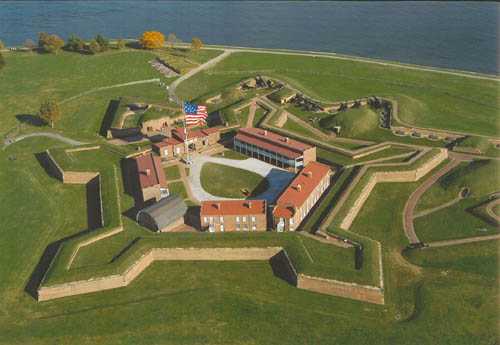
Overall Layout and Star Shape
The fort forms a regular pentagon
with a bastion (protruding star point) at each of its five angles. The
distance between points of adjacent bastions is approximately 290 feet,
while the inner parade ground is also pentagonal, measuring about 150
feet per side.
This star configuration eliminated "dead zones" (areas
attackers could approach without being fired upon) by allowing
overlapping fields of fire from the bastions. Each bastion could support
enfilading fire (along the walls) against land or sea assaults. The
design was part of the U.S. First System of coastal fortifications.
Key Defensive Elements
Ramparts and Walls: The fort combines
earthen embankments with brick and stone masonry facing. The scarp
(outer) walls are brick-faced for durability, topped with a parapet
(protective wall) and terreplein (gun platform). A dry moat (ditch)
surrounds most sides, providing additional protection and a sheltered
position for infantry.
Bastions: Each of the five bastions features
gun emplacements, originally with embrasures (openings) for cannon fire
on the flanks. Modifications during the War of 1812 included platforming
the bastions for barbette (open-top) firing and filling some embrasures.
Ravelin: Added in 1813 by American engineer Col. Decius Wadsworth, this
V-shaped outwork protects the main sally port (entrance). It extends
outward and enhances defense against direct approaches.
Outer Works:
Later additions (e.g., 1836) include breast-height earthen walls and
traverses for extra protection. A water battery and outer defenses faced
the harbor.
Moat and Glacis: The dry moat and sloping glacis (earthen
slope) outside the walls exposed attackers to fire while hindering
assaults.
Interior Structures
Inside the parade ground
(central open area) are the main buildings, mostly one-story brick
structures from the early 19th century:
Barracks: Two for enlisted
men and officers' quarters. These housed the garrison and now contain
exhibits.
Powder Magazine: A secure brick building for storing
ammunition, critical for withstanding bombardment.
Guardhouse and
Other Features: Includes prisons/cells, a cistern/well, and later
bombproofs (shelters). A flagstaff flew the large garrison flag during
the 1814 battle.
Additional structures like a Civil War-era powder
magazine exist outside the main fort.
Materials and Construction
Primary Materials: Brick facing on earthen ramparts, stone elements, and
sod-covered terrepleins. The low, thick walls resisted cannon fire
better than tall vertical ones.
Evolution: Built on the site of
Revolutionary War-era Fort Whetstone (an earlier earthen star fort).
Foncin refined earlier plans (e.g., by Major Louis Tousard). Post-1814
and mid-19th-century modifications incorporated elements of the Second
System of fortifications.
Architectural and Defensive Innovations
The bastion system allowed mutual support: fire from one bastion could
cover the walls of adjacent ones. This was highly effective against
smoothbore artillery and infantry of the era. The fort's position on a
peninsula maximized water-based defense while the landward star shape
handled potential overland threats.
Later History and
Preservation
Fort McHenry saw use through the Civil War (as a
prison), World War I (hospital), and World War II (Coast Guard
training). It became a national monument in 1939 and looks much as it
did in the early 20th century, with restored ramparts, cannons, and
buildings open to visitors.
Note: Modern additions like the Visitor
and Education Center (designed by GWWO Architects, completed 2011) draw
inspiration from the Star-Spangled Banner with curved brick and metal
walls but are separate from the historic fort itself.