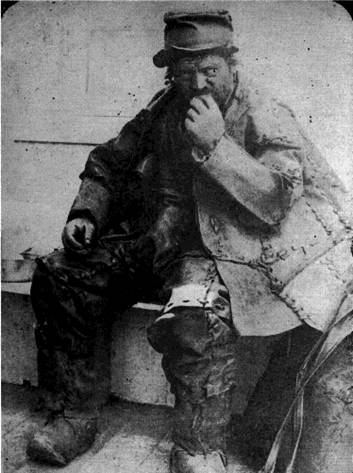
The Leatherman, a mysterious vagabond who roamed the American Northeast from approximately 1857 to 1889, is one of the most enduring legends of 19th-century New England. Known for his distinctive handmade leather suit and his clockwork-like 365-mile circuit between the Connecticut and Hudson Rivers, he captivated the communities of western Connecticut and eastern New York with his punctuality, solitude, and enigmatic persona. Despite his prominence in local lore, his true identity, origins, and motivations remain unknown, fueling speculation, myths, and cultural fascination.
Appearance and Habits
The Leatherman earned his nickname from his
distinctive outfit: a heavy, self-made suit, hat, scarf, and shoes
crafted from scraps of leather (often old boots and pieces stitched
together with leather ties). The suit reportedly weighed over 60 pounds
(about 27 kg) and made a distinctive "sandpaper" rustling sound as he
walked. He carried a heavy bag or knapsack and was known for his
taciturn nature—speaking rarely, mostly in monosyllables or broken
English, and using grunts and gestures.
He was fluent in French and
carried a French prayer book, leading many to believe he was French or
French-Canadian. He observed Fridays as meatless days, suggesting Roman
Catholic faith. Contemporaries described him as sturdy and resilient; he
endured harsh New England winters in rock shelters, heating them with
fires, and suffered frostbite but reportedly lost no fingers.
He
rarely accepted more than basic provisions (e.g., bread, sardines,
crackers, pie, coffee, and occasional brandy or beer) and declined
offers of lodging or excessive charity. He was generally peaceful and
well-regarded, prompting some towns to pass ordinances exempting him
from anti-tramp laws.
The Legendary Circuit
His route formed a
precise clockwise loop of approximately 365 miles, taking about 34–35
days to complete, so he returned to each stop roughly every five weeks.
It stretched from the Connecticut River to the Hudson River, passing
through around 40–41 small towns and rural areas in western Connecticut
and eastern New York (avoiding major cities).
Key areas included
parts of Litchfield, New Haven, and Fairfield counties in CT, and
Westchester County in NY. He slept in natural rock shelters, overhangs,
and caves (now known as "Leatherman caves"), many of which he maintained
with primitive fireplaces, sleeping areas, and small stores of food or
supplies. Some caves had vegetable patches or other improvements.
Notable caves and shelters (many accessible today via trails or with
permission):
Watertown/Thomaston, CT (Leatherman's Cave in
Mattatuck State Forest/Black Rock State Park): A popular fissure cave
near Crane's Lookout on the Mattatuck Trail. Steep hike, about 2 miles
round-trip.
Tory's Den (near Plymouth/Harwinton, CT): Used
historically by Tories during the Revolutionary War; near other
shelters.
Ward Pound Ridge Reservation, NY: Features a Leatherman's
Loop Trail and associated cave/shelter.
George Dell Farm / Saw Mill
Woods cave (near Ossining/Mt. Pleasant, NY): Site of his death.
Others in Ridgefield, Southington, Meriden (e.g., Hubbard Park, Mt.
Higby), Bedford Hills, Mt. Kisco, and more—some on public land, others
private.
Hikers and enthusiasts can follow approximations of his
route or visit individual caves; guides and books detail trail access,
though some require bushwhacking or landowner permission.
Life
and Death
He first appeared in records around 1857–1858 (possibly
earlier sightings farther north into Vermont or Canada) and maintained
the circuit for about 30 years. In 1888, the Connecticut Humane Society
briefly hospitalized him; he was deemed "sane except for an emotional
affliction" and released at his request.
He died on March 24, 1889
(aged ~49–50), in a cave on the George Dell farm in Mount Pleasant, NY,
from mouth cancer (possibly exacerbated by tobacco or poor diet). His
body was found with few possessions.
He was buried in Sparta Cemetery
in Briarcliff Manor, NY. His grave has been relocated (2011) due to road
widening; the current modest marker simply reads "The Leatherman" after
earlier erroneous inscriptions.
Identity and Legends
His true
origins remain unknown and controversial despite extensive research
(e.g., by historian Dan W. DeLuca). He was likely born around 1839,
possibly in French Canada or France, based on language and items found
with him.
A popular but debunked legend claimed he was Jules Bourglay
of Lyons, France: a leather worker who ruined his employer's business
(and lost his love, the boss's daughter) through a bad deal, then
wandered as penance. This story appeared in 1884 newspapers, was
retracted shortly after his death, but persisted in folklore and even
appeared on an old tombstone (later corrected). French officials
reportedly confirmed no such person existed in records.
Other
theories include him being a French-Canadian immigrant, a traumatized
Civil War veteran, or someone fleeing personal tragedy. DNA and
exhumation efforts in 2011 yielded limited new clues (no visible remains
recovered), deepening the mystery rather than solving it.
Legacy
and Modern Interest
The Leatherman symbolizes endurance,
self-reliance, and the pull of solitude in the American landscape. His
story appears in local histories, books (e.g., DeLuca's The Old Leather
Man: Historical Accounts of a Connecticut and New York Legend), museums
(e.g., Watertown History Museum), and even inspired a Pearl Jam song.
Today, "Leatherman caves" are hiking destinations, and the route
inspires ultra-hiking challenges (e.g., fastest known times). He remains
a beloved folk hero in the region—neither fully tragic nor romanticized,
but a quiet testament to a life lived on one's own terms amid the hills,
rivers, and towns of the Northeastern U.S.
Local Celebrity and Folklore
The Leatherman became a beloved local
celebrity across western Connecticut and southeastern New York thanks to
his remarkable punctuality and unforgettable appearance. For roughly
three decades (roughly 1860–1889), he followed a precise 365-mile
clockwise circuit every 34–36 days, regardless of weather. Residents
could reliably set their calendars by his arrivals, fostering a strong
sense of communal pride and affection.
He was known for his courteous
demeanor. M. Louise Bouton of Lewisboro fondly recalled his polite words
of gratitude: “Thank you so much, lady,” after receiving food or
supplies. Newspapers of the era eagerly tracked his movements, turning
him into a regional sensation. His story lived on through oral
traditions passed down through generations. The caves and rock shelters
he used along the route evolved into local landmarks, and the
“Leatherman’s Loop”—a popular 10K trail race held each spring at Ward
Pound Ridge Reservation in Cross River, New York—continues to
commemorate his enduring path through the scenic woodlands, river
crossings, and historic terrain he once traversed.
Media and
Artistic Representations
The Leatherman’s enigmatic legend has
inspired numerous works across popular culture:
Music: Pearl Jam
released the 1998 B-side track “Leatherman,” while Finnish artist J.
Karjalainen’s song “Mennyt mies” also nods to the wandering figure.
Literature: Dan W. DeLuca’s The Old Leather Man (2008) stands as the
definitive resource, meticulously compiling original newspaper
clippings, rare photographs, maps of the route, and historical analysis.
Earlier works include Dick Gackenbach’s children’s book The Leatherman
(1977) and references in David E. Philips’ Legendary Connecticut.
Media: A 1984 documentary produced for Connecticut Public Television
explored his life, and a 1965 episode of the WTIC-TV program Perception
featured an interview with historian Mark Haber. In the 2018 video game
Where the Water Tastes Like Wine, players can encounter a vignette
narrated by the Leatherman’s ghost, adding a haunting, folkloric layer
to the experience.
Historical Artifacts: The Connecticut Historical
Society preserves tangible pieces of his legacy, including a
hand-stitched mitten and leather bag that highlight the remarkable
craftsmanship and durability of his self-made 60-pound suit, fashioned
from boot tops and stitched with coarse thongs.
Paranormal and
Mythical Elements
Compared to haunted locales like Bara-Hack or
Dudleytown, the Leatherman’s tale features relatively little paranormal
folklore. However, some locals speculate that his restless spirit still
wanders the caves and shelters he once used, or that he may have buried
small caches of money along his well-trodden route. His profound
silence, strict daily routine, and heavy leather attire have fueled
theories ranging from obsessive-compulsive tendencies to a tragic
European backstory—possibly involving lost love, financial ruin, or
trauma from the Franco-Prussian War or earlier conflicts.
DeLuca and
other historians suggest his route was primarily practical: a carefully
honed circuit that guaranteed reliable access to food, shelter, and
sympathetic communities. Yet his true motives, identity, and origins
remain shrouded in mystery, adding to his mythic appeal.
Historical Significance
The Leatherman embodies a distinctive chapter
of 19th-century American life, an era marked by itinerant laborers,
post-Civil War displacement, and westward expansion’s human
undercurrents. Despite vagrancy laws targeting “tramps,” he enjoyed a
rare exemption and widespread communal support—residents regularly left
food, clothing, and supplies at designated spots, reflecting a
compassionate tolerance rarely extended to others in similar
circumstances.
Preservation and Research
Dan W. DeLuca, a dedicated historian and
retired educator from Meriden, Connecticut, devoted over two decades to
unraveling the enigmatic life of the Old Leatherman. His meticulous
scholarship culminated in the 2008 book The Old Leather Man: Historical
Accounts of a Connecticut and New York Legend (published by Wesleyan
University Press). This richly illustrated volume compiles original
19th-century newspaper reports, maps of the wanderer’s 365-mile circuit,
historic photographs of his rock shelters, and other primary sources. It
effectively separates verifiable facts from romanticized folklore, most
notably debunking the persistent but unsubstantiated myth that the
Leatherman was a heartbroken French immigrant named Jules Bourglay.
In 2011, the Ossining Historical Society led an exhumation of the
Leatherman’s grave in Ossining, New York. The effort sought to relocate
his remains to a more prominent site within the cemetery, install a
corrected marker (removing the fictional “Jules Bourglay” name), and
potentially recover DNA or artifacts for further study. However, the
project ignited significant ethical controversy. Critics, including
North Haven middle-school history teacher Don Johnson — who runs the
“Leave the Leatherman Alone” campaign — argued that disturbing the grave
violated the wanderer’s privacy and dignity, especially since he had
deliberately chosen a reclusive life. Ultimately, no human remains were
found at the original site, deepening the mystery surrounding his true
identity.
Local historical societies on both sides of the
Connecticut-New York border continue to preserve and display related
artifacts. Notable items include one of the Leatherman’s distinctive
leather mittens, held by the Connecticut Historical Society (part of the
Connecticut Museum of Culture and History). These organizations also
maintain records, photographs, and documentation of his numerous rock
caves and shelters scattered across the region.
Visitor
Experience
For modern-day explorers, several of the Leatherman’s
caves remain accessible and offer a tangible connection to this
19th-century legend. Notable public sites include the well-known shelter
at Ward Pound Ridge Reservation in Cross River, New York, and caves
within the Greenwich Audubon Preserve in Connecticut. Many other
locations, however, lie on private property, so visitors should always
seek landowner permission and practice Leave No Trace principles to
protect these fragile historic sites.
Outdoor enthusiasts can
actively celebrate the Leatherman’s legacy through the annual
Leatherman’s Loop 10K Trail Race, held each spring at Ward Pound Ridge
Reservation. This popular event draws runners and walkers to retrace
segments of his legendary route through scenic woodlands, rocky
outcrops, and historic landscapes. The race has become a community
tradition, blending athletic challenge with historical appreciation.
Dedicated trail runners, hikers, and amateur historians continue to
document and map the full network of caves. Resources such as the blog
The Air Land and Sea provide detailed guides, GPS coordinates,
photographs, and historical context for dozens of sites arranged in loop
order. These modern efforts help keep the Leatherman’s story alive,
inviting visitors to experience the same rugged terrain he traversed
more than 130 years ago.