Location: Newport, RI
Tel. (401) 847 2400
Open: sunrise- sunset daily
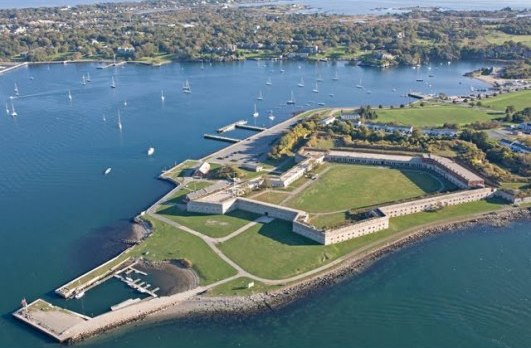
Fort Adams is a massive historic coastal fortification in Newport, Rhode Island, on a peninsula at the entrance to Newport Harbor and Narragansett Bay. It is a National Historic Landmark and the centerpiece of Fort Adams State Park. It stands as one of the largest and most complex 19th-century U.S. coastal defenses, designed to protect a key naval anchorage.
Getting There and Parking
Address: Fort Adams Drive, Newport, RI
02840.
Directions: From downtown Newport, head south on Thames
Street, turn right onto Wellington Avenue (which becomes Halidon
Avenue), then right onto Harrison Avenue. Follow signs to the park
entrance (about 1–2 miles from downtown).
Parking: Free and ample,
with lots near the fort, beach, and fields. Accessible spots are
available. During major events like the Newport Folk or Jazz Festival,
parking fills quickly or requires shuttles/fees—plan accordingly.
Public Transit/Biking: Limited bus service; biking or walking from
Newport is feasible but hilly. Sail Newport offers water access options.
The state park opens daily from sunrise to sunset (roughly 6 AM–9 PM in
summer). The historic fort interior has more restricted hours.
Tours and What to Expect Inside the Fort
The park grounds are free to
explore (including the Bay Walk loop trail with interpretive signs), but
entering the fort requires a ticket.
2026 Season Highlights (as of
recent updates):
Guided Tours (recommended, ~75 minutes): New options
include "Life at the Fort" (daily life, quarters, parade grounds) and
"Storm the Fort" (more action-oriented, defenses, tunnels). Offered
multiple times daily April–November, weather permitting. Adults ~$20,
youth (6–17) $10, under 5 free. Discounts for military, seniors,
students (~$15). Family tickets available.
Self-Guided Tours:
Available daily (e.g., 9:30 AM–4 PM, last ticket ~3 PM). Cheaper (~$10
adults, $5 youth). Includes tunnel access at set times.
Highlights
Inside: Underground tunnels (a visitor favorite), casemates, powder
magazines, cannon emplacements, panoramic overlooks, and officer
quarters. Expect stairs, uneven surfaces, and some low-light/cool
areas—dress in layers.
Tours sell out, especially weekends and
during festivals—book in advance via fortadams.org. Guides are often
praised as knowledgeable and engaging.
Special Experiences:
Reenactments, Halloween events ("Fright at the Fort"), youth overnights,
weddings, and private tours. Check the calendar for 2026 concerts (e.g.,
Newport Folk/Jazz Festivals draw huge crowds).
Other Activities
in the Park
Bay Walk / Trails: ~2-mile easy loop with bay views,
birding, and history signs—stroller- and pet-friendly (leashed). Great
for running, biking, or picnics.
Beach and Waterfront: Small
saltwater beach for swimming (lifeguards in season), fishing pier,
boating/kayaking launches. Sail Newport offers rentals and lessons.
Fields and Picnics: Soccer, rugby, open spaces, picnic tables, and
pavilions (reservations needed in peak season).
Views: Stunning
harbor vistas, especially at sunset. Bring binoculars for boats and
wildlife.
Practical Visiting Tips
Best Time to Visit:
Shoulder Seasons (May, September–early October): Mild weather
(60s–70s°F), fewer crowds, lower prices. Ideal for tours and walks.
Summer (June–August): Peak for swimming, sailing, and events—but busier
and hotter/humid. Avoid midday heat for outdoor exploration.
Off-Season: Limited tours (weekends or by appointment); focus on free
park grounds and walks. Weather can be windy/cold.
Duration: 1–2
hours for a quick visit (grounds + short walk); 3–4+ hours for a full
tour, beach time, and picnic.
What to Bring/Wear:
Comfortable
walking shoes (lots of stairs, gravel, grass).
Water, sunscreen, hat,
layers (windy by the water).
Picnic lunch (limited concessions in
summer; food trucks/events vary).
Camera/binoculars for views.
Bug
spray (coastal area).
Accessibility: Park grounds mostly
accessible; fort tours involve stairs/tunnels (some mobility challenges
noted). Check for ADA options or contact ahead.
With Kids/Families:
Highly recommended—tunnels and open spaces are fun. Self-guided family
tickets available. Combine with nearby Brenton Point or mansion visits.
Pets: Allowed on leash in park areas (not inside fort during tours).
Food/ Amenities: Restrooms, small gift shop. Limited on-site food
outside events—pack a lunch or eat in Newport beforehand.
Crowds and
Etiquette: Busy during festivals (traffic/parking issues). Respect
historic areas and stay on paths. Alcohol prohibited in some zones.
Cost Savings: Free park entry/parking. Military discounts and family
passes help. Membership in Fort Adams Trust offers perks.
Nearby
and Combining Visits
Fort Adams pairs well with a Newport day: Drive
or bike the 10-mile Ocean Drive loop, visit The Breakers or other
mansions, or take a harbor cruise. It's ~10–15 minutes from downtown.
Brenton Point State Park is adjacent for more views and kite-flying.
Early Colonial and Revolutionary Defenses
The site's
strategic importance dates back to the colonial era. William
Brenton originally owned the land (called "Hammersmith," a name
preserved in nearby Hammersmith Farm). An observation post
existed by 1740, with earthwork fortifications during the French
and Indian War. During the American Revolutionary War,
fortifications appeared in spring 1776 but were quickly captured
by British forces in December 1776. Newport remained occupied
until 1779, after which the initial works were destroyed.
First Fort Adams (1799)
After independence, the U.S.
built the first Fort Adams as part of the First System of
coastal fortifications. Construction occurred in 1798–1799 under
Major Louis de Tousard of the U.S. Army Corps of Engineers. It
was dedicated on July 4, 1799, and named for President John
Adams. This smaller star fort mounted about 17–20 guns (with
additions by 1809) and included masonry works and wooden/brick
barracks for one company.
It was garrisoned during the War of
1812 by Rhode Island militiamen but saw no major action. After
the war, a review of U.S. coastal defenses led to its
replacement due to obsolescence.
Construction of the
Current Fort (1824–1857)
The present Fort Adams, part of the
Third System of U.S. fortifications, was a much larger and more
advanced work. Construction began in 1824 after demolishing the
old fort. It continued (with interruptions) until 1857 at a cost
of over $3 million.
Key figures included:
French
engineer Brigadier General Simon Bernard (a former aide to
Napoleon), who provided the overall design in classic
Vauban-style French military architecture.
Lieutenant Colonel
(later Chief Engineer) Joseph G. Totten, who oversaw much of the
work from 1825–1838 and is considered a founding father of
American military engineering.
The fort used local shale,
granite from Maine, and bricks (likely from Rhode Island clay).
It featured a complex layout with a main fort, tenaille and
crownwork for land defense, a detached redoubt (built ~1846
during the Mexican-American War), casemates for guns, powder
magazines, tunnels, and extensive earthworks. Designed to mount
up to 468 guns and house 2,400 troops in wartime (with a
peacetime garrison of ~200), its perimeter exceeded 1,700 yards.
It was one of the most sophisticated fortifications in the
Western Hemisphere, rivaled in the U.S. only by Fort Monroe and
Fort Jefferson.
Irish immigrant laborers did much of the
construction, forming a community in Newport's Fifth Ward and
building St. Mary's Church (site of the 1953 Kennedy-Bouvier
wedding).
The fort was first garrisoned in August 1841.
19th Century: Wars and Upgrades
Fort Adams never fired a
shot in anger despite activity in multiple conflicts:
Mexican-American War (1846–1848) — Commanded by Benjamin
Kendrick Pierce (brother of President Franklin Pierce); the
southern redoubt was built then.
Civil War (1861–1865) —
Served as a key post. The U.S. Naval Academy relocated here
temporarily in 1861 (midshipmen housed at the fort, classes at a
Newport hotel) due to concerns over Maryland's loyalties. It
became a headquarters and recruit depot for the 15th Infantry
Regiment. Brig. Gen. Robert Anderson (of Fort Sumter fame)
commanded it briefly in 1863. Many notable officers trained or
served here.
1870s upgrades — Modernized with large Rodman
guns and Parrott rifles.
It also supported operations related
to the Indian Wars and other duties.
Early 20th Century:
Endicott Period and WWI
Under the Endicott and Taft programs
(1890s–1900s), new concrete batteries south of the main fort
upgraded coastal defenses for Narragansett Bay (paired with Fort
Wetherill). These included mortar batteries, disappearing guns,
and smaller rapid-fire pieces. Armament evolved from smoothbores
to rifled guns and mortars.
In World War I, Fort Adams served
as headquarters for the Coast Defenses of Narragansett Bay and a
training center. Several Coast Artillery regiments and railway
artillery units formed here and deployed to France. Author
Thornton Wilder briefly served here as a corporal.
World
War II and Later Military Use
In WWII, it was a nerve center
for Rhode Island's coastal defenses and military district,
hosting units like the 243rd Coast Artillery. Anti-aircraft guns
and other modern defenses were added. The fort supported broader
war efforts amid Rhode Island's industrial contributions
(torpedoes, ships, etc.).
Army use continued until 1953, when
ownership transferred to the Navy (which used parts for
housing). President Dwight D. Eisenhower used the former
commanding officer's quarters (Eisenhower House, built 1873) as
a summer White House in 1958 and 1960.
The fort was
deactivated around 1950–1953 after over 125 years of soldier
housing.
State Park Era (1965–Present)
In 1965, the
main fort and outer works were deeded to Rhode Island for use as
Fort Adams State Park (105 acres). The Navy retained some areas.
The park suffered neglect in the mid-20th century but has been
restored by the Fort Adams Trust (since 1994), which has
invested millions in preservation, exhibits, and tours.
It is
listed on the National Register of Historic Places (1970) and
designated a National Historic Landmark (1976). Today, it
offers:
Guided tours of the fort, redoubt, and Eisenhower
House.
The Newport Jazz Festival and Newport Folk Festival
(famous summer events).
Sailing (Sail Newport), swimming,
picnicking, rugby/soccer fields, fishing, and trails (including
the Bay Walk with views and a cemetery dating to 1836).
Permanent military history exhibits.
The fort's
engineering—its layered defenses, innovative construction, and
adaptation to evolving artillery—makes it a premier example of
19th-century American military architecture. Though it never saw
combat, it symbolized U.S. coastal defense strategy for over 150
years. Visitors can explore its vast scale, tunnels, and
commanding views of the bay.
Overall Form and Layout
The main work forms an irregular hollow
pentagon (roughly 1,200 by 1,000 feet overall), with a narrow base
facing north and sides splaying southward to a point. Its perimeter
measures about 1,700–1,749 yards (over 1 mile).
Projecting bastions
at the northwest, northeast, and southeast angles dominate key
approaches to Narragansett Bay, Newport Harbor, and Brenton’s Cove. This
bastioned trace ensures mutual defense: every wall face can be enfiladed
(swept by crossfire) from adjacent bastions or curtains.
Outer
defenses include a complex tenaille and crownwork on the southern
(landward) side to disrupt assaults, plus a detached redoubt about 650
yards south. Extensive ditches, earthen ramparts, and subterranean
galleries add layers of protection.
The design accommodates the
site's topography (a peninsula with water on three sides) while
addressing both seaward artillery duels and landward infantry attacks.
Materials and Construction
Builders used Maine granite (for
facing and structural walls), local shale, brick (for vaults and
interiors), and earth fill. Scottish mason Alexander McGregor executed
much of the high-quality ashlar masonry.
Construction (1824–1857)
cost over $3 million and employed many Irish immigrants. It served as a
training ground for early U.S. military engineers.
Defensive
Features
Casemates: Two levels of brick-arched, bomb-proof chambers
within the granite walls housed troops, ammunition, and guns. These
provided protected firing positions. Seaward sides often featured deeper
or double casemates.
Embrasures: Up to 438–468 slots for cannon fire.
Barbette/Parapet: An upper open gallery for additional guns.
Flanking
Elements: Tenailles, bastions, and redoubts created deadly crossfires.
Underground tunnels (some to the water’s edge for escape or listening)
ran through bedrock.
Capacity: Designed for ~468–500 guns (mix of
seacoast, flank howitzers, etc.) and up to 2,400 men in wartime
(peacetime garrison ~200).
Later upgrades (1870s onward) added
Rodman guns, Parrott rifles, and Endicott-era batteries (e.g., mortars
south of the main fort).
Interiors and Supporting Structures
Inside the walls lies a large parade ground. A one-story granite range
along the east and south walls (with elegant convex curves at angles)
supported brick barracks with covered galleries on cast-iron columns.
Upper barracks are largely roofless/ruined but structurally intact.
Casemate interiors feature robust brick vaulting, stone walls, and
arched openings—now often used for events but originally functional and
austere.
Other features include a rusticated segmental north portal
(originally moat-protected), a Greek Revival granite guardhouse, and
various 19th/20th-century auxiliary buildings.
Architectural
Significance
Fort Adams represents the pinnacle of smoothbore-era
coastal defense before rifled artillery and ironclads rendered such
massive masonry forts obsolete (e.g., after Fort Pulaski in 1862). Its
scale rivals Fort Monroe (VA) and Fort Jefferson (FL); it is the most
complex Third System fortification in the Western Hemisphere.
The
design draws heavily from Vauban-style French principles (polygonal
trace, bastions, outworks) but adapts them innovatively with American
resources and experiments. Subtle details—like recessed panels in
granite for visual relief—add understated elegance to the utilitarian
mass.
Today, as part of Fort Adams State Park, it hosts events (e.g.,
Newport Folk/Jazz Festivals) while ongoing restoration by the Fort Adams
Trust preserves its engineering marvel status. Though it never fired in
anger, its deterrent presence and architectural legacy endure.
Construction of the current large-scale fort began in 1824 (following
a smaller 1799 version) and finished around 1857. It was designed by
Simon Bernard (a former Napoleonic engineer) as part of the U.S. Third
System of coastal defenses, capable of housing up to 2,400 soldiers and
nearly 200 cannons. It served as a training and staging ground during
the Civil War, and remained active through later conflicts before
decommissioning.
Soldiers endured harsh New England winters, training
accidents, diseases, and the psychological strain of isolation in a
massive stone fortress. Specific documented tragedies include:
1819 murder: Private William Kane was shot by Private William Cornell
after a feud escalated; Cornell allegedly threw pebbles at Cornell,
prompting the fatal response. This ties into modern reports of stones or
pebbles being thrown at visitors.
1879 beating death: Two soldiers
argued, and one was later found beaten to death nearby.
1908
murder-suicide: A soldier, suspecting his wife of infidelity, shot her
(she survived) and then killed himself.
Other deaths occurred
from illness, accidents (including during construction or in the
tunnels), and possible suicides. These unresolved or violent ends are
often cited as reasons spirits linger.
Common Legends and
Reported Hauntings
Paranormal activity concentrates in the tunnels
(including "listening tunnels" for detecting enemy mining), casemates,
powder magazines, bakery area, barracks, and courtyards. Reports span
decades from visitors, staff, guides, and investigators.
Ghostly
Soldiers and Apparitions: Full-body apparitions of men in 19th-century
military uniforms appear, often patrolling or marching. They are seen in
tunnels and casemates, sometimes walking into walls or vanishing.
Phantom footsteps echo in empty corridors, along with muffled voices,
military commands, cannon fire, or marching sounds.
Poltergeist
Activity and Physical Interactions: Visitors and investigators report
being touched, jabbed, or having rocks/pebbles thrown at them (linked to
the 1819 pebble-throwing incident). Doors open/close unexpectedly,
knocking sounds occur, and objects move.
EVPs, Voices, and Child
Spirits: Electronic Voice Phenomena (EVPs) capture whispers, responses
to questions, or voices of soldiers/prisoners. A child’s voice
(sometimes described as a "little drummer boy" or similar) has been
recorded, along with whimpering. Some link this to accidents involving
young recruits or drummer boys.
Cold Spots, EMF Spikes, and
Atmosphere: Sudden temperature drops, strong electromagnetic field (EMF)
readings (especially in powder magazines and tunnels), and a heavy
"being watched" feeling are common. Some visitors feel unease strong
enough to leave early.
Shadow Figures and Other Phenomena: Shadowy
forms, light anomalies (flashes with no source), and footsteps following
investigators appear, especially in tunnels and barracks.
Paranormal Investigations and Media
Fort Adams has hosted numerous
investigations:
Ghost Hunters (Syfy, Season 10, Episode 8 "Fortress
of Phantoms"): The TAPS team documented footsteps (matching historical
marching paths), a child’s voice, whispering EVPs, thermal anomalies
(humanoid shapes), knocking, and physical touches. Caretaker reports
included apparitions, doors moving, and stone-throwing.
Kindred
Spirits: Amy Bruni, Adam Berry, and Chip Coffey investigated; one
episode highlights a touching encounter with a spirit amid soldiers and
crime victims.
Local and regional groups (e.g., Rhode Island
Paranormal, Alias Paranormal) regularly hold public ghost hunts,
capturing similar evidence. Books like True Tales of Life & Death at
Fort Adams by Kathleen Troost-Cramer detail historical deaths alongside
ghost reports.
Modern Experiences and Tours
Today, the fort is
a park and event venue (e.g., Newport Folk Festival). Daytime visitors
report activity, but nighttime ghost tours, paranormal events
(especially Halloween’s "Fortress of Nightmares" or guided hunts), and
self-guided tunnel access amplify experiences. The dark, echoing stone
passages and listening tunnels create an inherently eerie atmosphere.
Skeptics attribute much to natural echoes, wind, wildlife, or
suggestibility in a historic military site. Believers point to
consistent, corroborated reports across unrelated witnesses and
tech-captured evidence.
Fort Adams blends tangible military history
with lingering supernatural lore. Whether exploring for architecture or
the paranormal, the site’s scale and isolation make encounters feel
plausible—soldiers who "never left" still stand watch in the tunnels and
on the ramparts. For the latest tours or events, check the official Fort
Adams Trust site or local ghost tour operators. If you visit, bring a
flashlight and an open mind; the stones have stories, and some may not
be fully at rest.
Robert Anderson: Union Army major (later brevet brigadier
general) who commanded Fort Sumter in Charleston Harbor at the
start of the Civil War. His decision to hold the fort and the
subsequent Confederate bombardment in April 1861 ignited the
conflict. Anderson had earlier connections to coastal defenses,
including service related to Fort Adams.
John G. Barnard:
Distinguished Army engineer and brevet major general during the
Civil War. He served as Superintendent of the United States
Military Academy at West Point and played a key role in
designing and improving Union fortifications, including
contributions to the Third System coastal defenses of which Fort
Adams was a prime example.
Alexander Dallas Bache: Prominent
Army engineer and scientist who served as superintendent of the
U.S. Coast Survey (now NOAA). A great-grandson of Benjamin
Franklin, Bache applied advanced scientific methods to mapping
and coastal engineering projects that supported fortifications
like Fort Adams.
Pierre G.T. Beauregard: Confederate general
who commanded the bombardment of Fort Sumter. Earlier in his
career, as a U.S. Army engineer, he contributed to Third System
coastal fort designs, gaining expertise that he later used
against the Union.
Simon Bernard: French military engineer
and general who served under Napoleon. After the Napoleonic
Wars, he was recruited by the United States to design modern
coastal fortifications. He was the primary architect of Fort
Adams, creating its innovative star-shaped layout and advanced
defensive features.
Ambrose Burnside: Union Civil War general
best remembered for his distinctive side-whiskers (“sideburns”)
and commands at battles such as Antietam and Fredericksburg. He
later served as Governor of Rhode Island and U.S. Senator; his
early military career included time at coastal posts including
the Newport area.
Fox Conner: Lieutenant general in the
American Expeditionary Forces during World War I. He served as a
key operations officer and mentor to future leaders, most
notably Dwight D. Eisenhower, whom he advised extensively.
Conner’s strategic thinking shaped Allied planning in France.
George W. Cullum: Civil War general and longtime Superintendent
of West Point. An accomplished military engineer, he authored
influential works on fortifications and compiled a major
biographical register of West Point graduates.
Henry A. du
Pont: Medal of Honor recipient for gallantry during the Civil
War. A member of the prominent Du Pont family, he later became
president of the Wilmington & Northern Railroad and served as a
U.S. Senator from Delaware.
Dwight D. Eisenhower: Supreme
Allied Commander in Europe during World War II and 34th
President of the United States. Eisenhower vacationed at Fort
Adams during his presidency, enjoying the scenic coastal
location.
William P. Ennis: Army lieutenant general who was
born at Fort Adams. He had a distinguished career in the U.S.
military, continuing the fort’s long tradition as a place tied
to high-ranking officers and their families.
Robley D. Evans:
Navy rear admiral nicknamed “Fighting Bob.” He commanded the
Great White Fleet on its epic 1907–1909 world cruise, showcasing
American naval power. Evans had earlier connections to coastal
defense commands.
John G. Foster: Union Civil War general and
engineer who specialized in coastal fortifications. He served in
multiple theaters and later oversaw post-war improvements to
defenses along the Atlantic coast.
William Gates:
Long-serving Army officer with a career spanning several decades
in the early-to-mid 19th century. He held various commands,
including at coastal artillery posts during the period when Fort
Adams was being constructed and garrisoned.
John Henry:
Adventurer and first commander of Fort Adams. An Irish-born
officer with a colorful background, he led the initial garrison
at the fort in the early 19th century.
Henry Jackson Hunt:
Brevet major general and one of the Union’s foremost artillery
commanders. He directed artillery at the Battle of Gettysburg,
playing a decisive role in repelling Pickett’s Charge, and was
instrumental in the professionalization of the Army’s artillery
branch.
Lyman Lemnitzer: Four-star Army general who served as
Chairman of the Joint Chiefs of Staff during the Kennedy and
Johnson administrations. He had a long career that included
staff and command roles across multiple conflicts.
John B.
Magruder: Confederate major general known for his flamboyant
style and successful deception tactics during the Peninsula
Campaign. He had earlier served in the U.S. Army, including
artillery duties at coastal forts.
Franklin Pierce:
Fourteenth President of the United States and former U.S.
Senator from New Hampshire. Pierce achieved the rank of
brigadier general during the Mexican-American War and had ties
to the broader military community that supported coastal defense
projects like Fort Adams.
William S. Rosecrans: Union major
general who commanded the Army of the Cumberland. Known for his
engineering background and victories in the Western Theater, he
later served as U.S. Minister to Mexico.
Isaac Ingalls
Stevens: Union general who was killed at the Battle of
Chantilly. Before the war, he was a governor of Washington
Territory and a key figure in Western exploration and railroad
development.
Thomas W. Sherman: Union brigadier general who
commanded artillery and infantry units during the Civil War,
including operations along the coast.
Joseph G. Totten:
Longtime Chief Engineer of the U.S. Army and brevet major
general. He personally supervised much of the construction of
Fort Adams and was the leading advocate for the Third System of
coastal fortifications.
Louis de Tousard: French-born
Revolutionary War hero who fought for the American cause. A
skilled engineer, he designed the original (Second System) Fort
Adams in the 1790s before the much larger Third System version
was built.
Thornton Wilder: Pulitzer Prize-winning author of
Our Town and The Bridge of San Luis Rey. His novel Theophilus
North (filmed as Mr. North) drew heavily from his experiences as
a young soldier stationed at Fort Adams during World War I.
William Griffith Wilson (“Bill W.”): Co-founder of Alcoholics
Anonymous. Stationed at Fort Adams during World War I, the fort
and Newport area formed part of the environment where the future
recovery advocate served as a young Army officer.