/6104041729_100c286a38_z[1].jpg)
Location: East River Map
Area: 20.12 acres (81,400 m2)
North Brother Island is a small, uninhabited island (about 20
acres) in New York City's East River, between the Bronx and Rikers
Island, near the treacherous Hell Gate strait. It is now a protected
bird sanctuary (part of the Harbor Herons Preserve) and is strictly
off-limits to the public due to hazardous ruins and ecological
sensitivity.
Its history spans from colonial times through
quarantine, tragedy, and abandonment, making it one of NYC's most
haunting and forbidden places.
Early History (17th–19th Centuries)
Dutch explorers claimed the
island (along with the smaller South Brother Island) in 1614 as part of
the Dutch West India Company holdings. They named the pair De Gesellen
("the companions" or "the brethren"). The islands were later under
British control. In 1695, they were granted to James Graham, but
treacherous currents limited development.
In the late 18th century,
the "Two Brothers" islands were auctioned (e.g., in 1791 at the
Merchants' Coffee House) and described with some structures like a
dwelling, barn, and orchard on North Brother. Ownership remained private
for much of the 19th century. North Brother was initially part of
Westchester County (via the Bronx) before transfers to New York City
jurisdiction in 1881.
A lighthouse was built in 1869 (after earlier
failed attempts) on the southern tip to aid navigation through Hell
Gate's dangerous waters, which had wrecked many ships. This was one of
the first permanent structures. The keeper, sometimes referred to in
lore as "Lighthouse Dan," lived there in relative isolation.
Riverside Hospital and Quarantine Era (1880s–1940s)
In the mid-1880s,
the city established Riverside Hospital on North Brother Island by
relocating it from Blackwell's Island (now Roosevelt Island). The goal
was to isolate and treat patients with highly contagious diseases like
smallpox, typhoid, tuberculosis, typhus, yellow fever, and later polio
(notably during the 1916 epidemic).
The hospital opened around 1885,
with buildings constructed over time (oldest in 1885; Tuberculosis
Pavilion as late as 1943). It included pavilions for specific illnesses,
laboratories, staff housing, dormitories, and other
facilities—eventually about 25 buildings. The island's isolation was
seen as a public health success, protecting the dense city from
outbreaks, though practices involved forced quarantines that
disproportionately affected poorer and immigrant communities.
Photographer and social reformer Jacob Riis documented the island in the
1890s, capturing images of the hospital, lighthouse, and "coffin corner"
(a grim area associated with the dead).
The General Slocum Disaster
(1904): On June 15, 1904, the paddle steamer General Slocum caught fire
while carrying over 1,300 German-American passengers (mostly women and
children from St. Mark's Evangelical Lutheran Church) on a picnic
outing. Faulty life-saving equipment, panic, and the captain's decisions
led to the ship beaching near the island. Over 1,000 people died from
fire, drowning, or related causes—the deadliest disaster in NYC history
until 9/11. Hospital staff helped rescue survivors, and bodies washed
ashore. The tragedy devastated the Lower East Side's German community.
Typhoid Mary (Mary Mallon): The island's most famous resident was Mary
Mallon, an Irish immigrant cook and the first known asymptomatic carrier
of typhoid fever in the U.S. She infected dozens (estimates vary; at
least 122 people, with several deaths) through her work in wealthy
households. First quarantined on the island from 1907–1910, she was
released on the condition she not cook but violated it (under an alias),
causing more outbreaks. She was forcibly returned in 1915 and lived
there (in a small cottage) until her death from pneumonia in 1938, after
over two decades of isolation. She maintained she was unfairly targeted.
Her case highlighted tensions around public health, civil liberties, and
immigration.
The hospital declined in necessity by the 1930s–1940s as
medical advances (e.g., vaccines and antibiotics) reduced the need for
mass quarantines.
Post-WWII and Later Uses (1940s–1960s)
After
WWII, the island housed returning veterans and their families as student
housing amid a housing shortage. A small community of up to ~500–1,500
people emerged, with amenities like a grocery store, library, and movie
theater. A ferry shuttled residents to the mainland for work or classes.
It was described as idyllic by some former residents.
In 1952, it was
repurposed as a pioneering (but controversial) drug rehabilitation
center for adolescent heroin addicts—the first of its kind offering
treatment, rehab, and education. Patients faced isolation, locked rooms,
and harsh conditions; graffiti from this era remains visible. Issues
like staff corruption, high costs, and patient resentment led to closure
in 1963–1964. It reportedly inspired the play Does a Tiger Wear a
Necktie? (which boosted Al Pacino's career).
Abandonment and
Current Status (1960s–Present)
The island was abandoned after 1964.
Various proposals followed—selling it, using it for homeless housing,
extending Rikers Island jail, or even casinos ("Vegas of the East")—but
none materialized. It became overgrown, with ruins decaying amid dense
vegetation (including invasive species like kudzu).
In 2007, the
federal government (with partners like the Trust for Public Land)
acquired it and transferred control to NYC. It is managed by the NYC
Department of Parks & Recreation as a "Forever Wild" site and bird
sanctuary, vital for herons, egrets, and other wading birds. Public
access is prohibited except for rare academic/scientific permits
escorted by staff, due to collapsing buildings, hazards (e.g., open
manholes, poison ivy), and wildlife protection.
A 2014–2016 study
explored limited public access, but costs and risks halted progress.
Occasional visits by journalists or researchers (e.g., 2017) highlight
its eerie beauty and dangers. A structure fire occurred in 2025.
Today, North Brother Island stands as a time capsule of NYC's public
health history, maritime tragedies, and urban wilderness—its ruins
slowly reclaimed by nature just miles from one of the world's busiest
cities. Books like North Brother Island: The Last Unknown Place in New
York City (by Christopher Payne and Randall Mason) and resources from
the Bowery Boys provide deeper dives with photos and details.
Historical Development and Overall Layout
The island saw limited
early use, including a lighthouse constructed in 1869 (the first
permanent structure). Significant development began in the mid-1880s
after the City of New York purchased it around 1880–1885 to relocate
Riverside Hospital from Blackwell's (now Roosevelt) Island. The facility
treated smallpox, typhoid (famously Typhoid Mary, quarantined there
until her death in 1938), tuberculosis, typhus, polio, and other
diseases.
Early phase (1880s): Architect George B. Post or related
plans (sometimes associated with the Haight Plan) featured a cohesive
network of mostly brick structures centered on the northwest shore near
a large dock. Wood-frame pavilions radiated outward in a half-circle
from a central building for isolation. Sanborn maps from 1885 show this
layout. The first building was the c. 1885 Male Dormitory (a pavilion).
Other early structures included an ice house, boiler room, storehouse,
and about five heated pavilions spaced ~50 feet apart for ventilation.
Expansion: Over decades, the complex grew to around 25–32 buildings,
including support infrastructure for a self-contained community (power
plant, morgue, chapel, staff housing, recreation like tennis courts).
The last major addition was the Tuberculosis Pavilion (cornerstone 1941,
opened ~1943), a four-story structure by architect Electus D.
Litchfield.
Later uses: Post-WWII (1946–1951) as veterans' housing;
1951–1963 as a juvenile drug rehabilitation center (repurposing
isolation features). Closed in the mid-1960s and abandoned, with ~25
buildings remaining in extreme dilapidation by the 21st century.
The island has a concrete seawall (breached in places, contributing to
erosion), paved roads (now overgrown), fire hydrants, lampposts, and
utility remnants. Buildings are spread somewhat randomly but clustered
around former functional zones, now densely overgrown with invasive
vegetation (vines, trees growing through structures).
Key
Buildings and Architectural Styles
Most surviving structures are red
brick with limestone or simple detailing, typical of
late-19th/early-20th-century institutional architecture—practical,
durable, and designed for hygiene/isolation rather than ornament.
Wood-frame elements were earlier and more perishable. Styles mix
Victorian/Queen Anne influences in early pavilions with more modernist
or utilitarian mid-20th-century forms.
Tuberculosis Pavilion (c.
1943, largest/most prominent): A multi-story (four-story) brick building
with long, narrow wards featuring extensive rows of windows for maximum
light and fresh air circulation (a key TB treatment principle
pre-antibiotics). Steeply gabled or flat roofs, institutional scale. Now
heavily ruined—roofs collapsing, trees/vines overtaking interiors,
creating a haunting, cathedral-like atmosphere amid tall trees.
Interiors once included dormitory wards with visible doors and frames.
Male Dormitory/Pavilions (c. 1885): One-story (or low-rise) wood-frame
or early brick isolation pavilions. Long and narrow for
cross-ventilation and patient separation. The male dormitory is among
the oldest and has served as a reference for early layouts. Several
similar pavilions existed; remnants show simple, functional design.
Nurse’s Residence/Home: Substantial brick building with
domestic/institutional hybrid features. Visible in street views;
interiors included bathrooms and living spaces. Part of staff housing
cluster.
Physician’s Home / Staff Houses / Doctor’s Quarters: More
residential in character—brick with details like gables, dormers, or
porches. One (Physician’s Home) was noted for potential adaptive reuse.
Warm red brick, limestone accents, steeply gabled roofs with copper
dormers in some descriptions.
Boiler House / Power Plant / Coal House
/ Smokestacks: Industrial utility buildings with prominent brick
smokestacks (highly visible from the Bronx shore). Coal storage and
boiler rooms supported the self-sufficient campus. Now ruined, with
kudzu and vegetation overtaking.
Morgue: Functional brick structure
near the boiler area; part of the grim infrastructure of a quarantine
hospital.
Chapel (St. John-by-the-Sea Church): Modest religious
building with front and side views showing simple ecclesiastical
architecture.
Administration / Service Buildings / Kitchen /
Storehouse: Support structures, including a kitchen/staff house. Varied
in scale; some incorporated into later uses.
Lighthouse (1869): On
the southern tip (federal portion). Originally a square wooden keeper’s
residence with an octagonal tower and mansard roof. One of the earliest
structures; later iterations existed.
Other features included
docks/gantries for ferry access, a school, recreation areas,
laboratories, isolation cottages, and utility vaults.
Current
State and Architectural Significance
Today, the buildings are in
advanced decay: roofs gone or failing, walls crumbling, interiors
exposed to elements, and nature (trees through windows, vines, dense
forest) dominating. This creates a powerful "ruins aesthetic"—eerie yet
beautiful, symbolizing nature's reclamation. Hazards include collapse
risks, poison ivy, and overgrowth; public access is strictly limited
(mostly for research or ecological reasons; it's a key heron nesting
site).
Architecturally, the island illustrates evolving public health
and institutional design: from pavilion plans promoting airflow
(influenced by miasma theory transitioning to germ theory) to
consolidated brick facilities. It represents broader NYC
history—quarantine, immigration/public health responses, and
20th-century social programs—within a rare, largely intact (if ruined)
ensemble. Preservation efforts (e.g., University of Pennsylvania
studies) have assessed stabilization, balancing ecology and heritage.
Photographers like Christopher Payne have documented its seasonal
transformations, highlighting lost infrastructure (buried streets,
hydrants) beneath the greenery. Historical photos show a tidy, bustling
campus contrasting today's wild state.
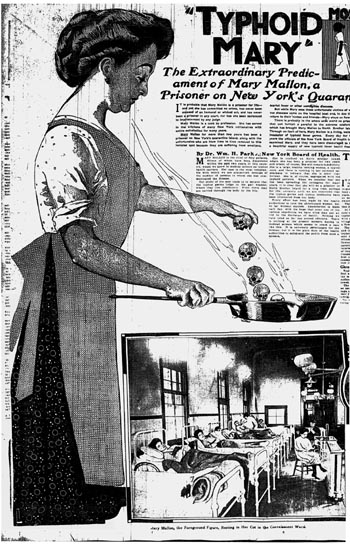
Early Life and Immigration
Mary Mallon was born in Cookstown,
County Tyrone, Ireland (then part of the UK). Little is known
about her early education, but she had some schooling. At around
age 15 in 1883 (or 1884 in some accounts), she emigrated to the
United States aboard the steamship Ethiopia. She initially lived
with an aunt in New York City and soon found work as a domestic
servant, primarily as a cook for wealthy families. She earned a
good reputation for her cooking skills and wages, which was
notable for an unmarried Irish immigrant woman at the time. Her
career involved both live-in positions and moving between
households.
Career as a Cook and Early Outbreaks
(1897–1906)
Between 1897 and 1907, Mallon worked for several
affluent New York families and households, often in summer homes
on Long Island or elsewhere. Typhoid fever outbreaks followed
her path in multiple instances, though connections were not
immediately obvious. Typhoid fever, caused by the bacterium
Salmonella enterica serotype Typhi, spreads through contaminated
food or water handled by carriers. It causes high fever,
weakness, abdominal pain, and can be fatal without treatment.
Mallon was a "healthy carrier"—infected but asymptomatic, with
the bacteria likely harbored in her gallbladder.
Key early
incidents included:
Households in Mamaroneck, New York; a
family in New York City (laundress affected); the Drayton family
in Dark Harbor, Maine (multiple family members and staff ill,
but Mallon helped nurse them); Sands Point (staff affected); and
others.
In 1906, she worked for banker Charles Henry Warren's
family in Oyster Bay, Long Island. Six of eleven people fell ill
shortly after she started. The property owner hired sanitary
engineer and epidemiologist George Soper to investigate.
Soper traced the outbreaks to Mallon after mapping her
employment history. He eliminated other common sources (water,
milk, etc.) and noted her role in preparing items like peach ice
cream, which could transmit the bacteria if contaminated. She
had worked for eight families, with seven experiencing typhoid
cases. Soper identified around 26 cases linked to her at that
point.
Discovery, Resistance, and First Quarantine
(1907–1910)
In early 1907, while Mallon worked for the Walter
Bowen family on Park Avenue in Manhattan, more cases emerged,
including the death of Bowen's daughter. Soper confronted her,
requesting blood, urine, and stool samples. Mallon reacted
angrily, brandishing a carving fork and chasing him away. She
firmly denied being ill or a carrier, viewing the accusations as
persecution.
Health officials, including Dr. Sara Josephine
Baker, eventually involved police. Mallon resisted arrest
fiercely—hiding in a shed and fighting back—before being taken
to Willard Parker Hospital. Tests confirmed high levels of
typhoid bacilli in her stool. She refused treatments like
gallbladder removal. She was transferred to Riverside Hospital
on North Brother Island, a quarantine facility for contagious
diseases in the East River between the Bronx and Rikers Island.
On the island (about 16–20 acres), she lived in a small cottage,
had some freedom to walk around, and access to facilities like
the chapel. She was not entirely isolated from care but felt
like "a leper." She sued for release in 1909, arguing violations
of her rights, but lost in court (the balance favored public
safety). After about three years, she was released in 1910 on
the condition that she not work as a cook, report regularly to
health authorities, and use good hygiene.
Release,
Relapse, and Second Quarantine (1910–1938)
Mallon tried to
comply at first, working in a laundry (lower pay). But cooking
was her skilled profession and source of better income. She
changed her name to Mary Brown and resumed cooking, leading to
more outbreaks.
In 1915, a major outbreak hit Sloane
Maternity Hospital in Manhattan (25 cases, 2 deaths), where she
worked under an alias. She was tracked down (reportedly in
Westchester County) and forcibly returned to North Brother
Island. This second quarantine lasted until her death—over 23
years.
On the island, she lived relatively quietly. She
reportedly worked washing lab bottles and glassware. She
suffered a paralytic stroke in 1932, which led to a slow
decline. She died of pneumonia on November 11, 1938, at age 69,
still on North Brother Island. She was buried at Saint Raymond's
Cemetery in the Bronx.
The island's reputation as haunted or cursed stems directly from
its grim uses:
Quarantine Hospital (Riverside Hospital, late
1800s onward): Relocated here to isolate patients with highly
contagious diseases like smallpox, tuberculosis, typhus, and
yellow fever. Conditions were often dire—overcrowding led to
patients in tents, food shortages, and inadequate heating. Many
died and were handled in an on-site morgue. Patients were
sometimes held against their will with limited contact to the
outside world.
Typhoid Mary (Mary Mallon): The most famous
resident. An Irish immigrant and asymptomatic carrier of typhoid
fever, she infected dozens (estimates 51–122 people, with
several deaths) while working as a cook. Quarantined on the
island twice (1907–1910 and 1915–1938), she lived in a cottage,
worked as a lab technician, and died there of pneumonia in 1938.
She vehemently denied being a carrier and resisted treatment
(e.g., gallbladder removal). Her story of forced isolation has
become legendary, symbolizing tensions between public health and
individual rights.
General Slocum Disaster (June 15, 1904):
One of NYC's deadliest tragedies before 9/11. The paddle steamer
General Slocum, carrying ~1,300–1,400 mostly German-American
women and children on a church picnic, caught fire in the East
River. Faulty lifeboats, rotten life vests, and poor crew
response led to panic. Captain beached it on North Brother
Island, but over 1,000 died (many by drowning or burning; many
couldn't swim). Hospital staff and patients heroically rescued
survivors and recovered bodies that washed ashore. The event
devastated the community and is often linked to ghostly maritime
apparitions.
Later uses included housing for WWII
veterans and a controversial 1950s–1960s drug rehab for
adolescent heroin addicts (closed amid corruption reports). The
island has been abandoned since the mid-1960s, with ~25
buildings now in extreme disrepair, overtaken by nature.
Key Local Legends and Hauntings
The combination of mass
death, forced quarantine, disease, and isolation has produced
rich oral and paranormal folklore:
Screams and Voices from
the Ruins: Visitors and those viewing from boats or shore report
hearing screams, cries, and pleas emanating from the middle of
the island or the crumbling Riverside Hospital
buildings—especially at night. These are often attributed to
dying patients, Slocum victims, or quarantined individuals. Some
distinguish them from distant Rikers Island prison noise.
Apparitions and Hospital Gowns: Ghostly figures in hospital
attire or period clothing are said to wander the shores or
ruins. Whispers, unexplained movements, shadow figures, and
glowing orbs are commonly reported by urban explorers. Some
claim to see remnants of the General Slocum or spirits along the
water's edge.
Cursed or Haunted Island Overall: Many locals
and paranormal accounts describe the island as inherently cursed
due to its "spotty history" of suffering, exile, and death. The
morgue, forced quarantines (where patients sometimes vanished
from public view), and tragic shipwrecks amplify this. The
forbidden status and decaying structures enhance the sense of
lingering unrest.
Typhoid Mary Lore: Her restless spirit is
sometimes invoked in tales of the island. As a symbol of
unwilling captivity and denial, legends portray her presence as
a lingering force tied to disease and isolation. Her story has
mythologized her into a near-supernatural figure in NYC
folklore.
Maritime and Rescue Ghosts: Apparitions linked to
the General Slocum (bodies on the beach, desperate swimmers) and
earlier shipwrecks in Hell Gate add layers. Heroic rescuers or
victims are said to appear in visions.
These stories
circulate in ghost tours, urban exploration communities,
podcasts, Instagram/TikTok videos, and books like North Brother
Island: The Last Unknown Place in New York City. The island's
inaccessibility turns it into a modern urban legend
hotspot—similar to other forbidden or tragic NYC sites.
Modern Context and Bird Sanctuary
Today, the island is a
thriving sanctuary for birds like black-crowned night herons,
creating a stark contrast: life reclaiming a place of death.
This "eerie but beautiful" juxtaposition (overgrown ruins amid
flourishing nature) adds to the folklore—some see it as nature
reclaiming a cursed site.
Note: Trespassing is illegal and
highly dangerous due to unstable buildings. Legends are best
explored through historical accounts, virtual views, or guided
ghost tours rather than risky visits. The stories endure because
they blend verifiable tragedy with the human tendency to imagine
unrest in places of profound suffering.