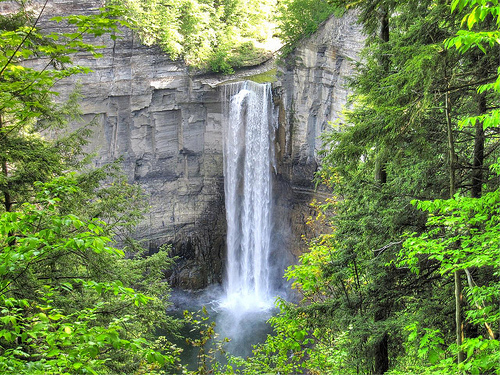
Location: 10 mi (16 km) North of Ithaca, Route 89, Tompkins County, NY
Map
Height: 215 ft (65 m)
Tel. (607) 387 6739
Open: 8am- sunset daily
Cabins: Apr 19 - Oct 19
Shelters/ Pavilions late Apr- mid- Oct
Marina: April 16 - Oct. 22
Official site
Taughannock Falls State Park, located in the Finger Lakes region of New York near Ithaca, is a 750-acre state park renowned for its dramatic 215-foot waterfall, Taughannock Falls, one of the tallest single-drop waterfalls east of the Rocky Mountains. Situated along the western shore of Cayuga Lake, the park offers a blend of natural beauty, geological significance, and recreational opportunities, drawing hikers, campers, and nature enthusiasts year-round. Named for a Lenape chief and rooted in the Indigenous history of the Cayuga Nation, the park’s rugged gorge, scenic trails, and lakeside access make it a jewel of New York’s state park system.
Taughannock Falls State Park lies within the traditional homelands
of the Haudenosaunee Confederacy, specifically the Cayuga Nation,
whose territory encompassed the Finger Lakes before European
colonization. The name “Taughannock” derives from a Lenape
(Delaware) chief, though the exact etymology is debated, with
possible meanings like “great fall in the woods” or a reference to
the chief’s name. The area was a seasonal hunting and fishing ground
for Indigenous peoples, with archaeological evidence suggesting
human presence for thousands of years. European settlers arrived in
the 18th century, displacing the Cayuga through treaties and
conflicts, such as the 1779 Sullivan Campaign, which devastated
Haudenosaunee communities.
The park’s modern history began in
the late 19th century when the area’s scenic beauty attracted
tourists, facilitated by steamboat and railroad access along Cayuga
Lake. Wealthy families, including the Treman family, owned estates
nearby, and Robert H. Treman, a prominent Ithaca banker, played a
key role in its preservation. In 1924, Treman donated 387 acres to
establish the park, which opened to the public in 1925. Additional
land acquisitions expanded it to 750 acres, protecting the gorge,
waterfall, and lakeside areas from development. The park’s creation
reflects the Progressive Era’s conservation movement, akin to
efforts that preserved sites like the Smallpox Hospital, though
Taughannock’s focus is natural rather than architectural heritage.
Unlike Plimoth Patuxet, which recreates 17th-century history
through living history, or the Smallpox Hospital, a static ruin tied
to medical history, Taughannock Falls State Park emphasizes natural
and geological history. However, all three sites engage with
Indigenous narratives: Plimoth Patuxet through Wampanoag
collaboration, the Smallpox Hospital indirectly via smallpox’s
impact on Native populations, and Taughannock through its Cayuga
heritage, though interpretive signage about Indigenous history is
limited compared to Plimoth Patuxet’s robust programming.
Taughannock Falls is the park’s centerpiece, plunging 215 feet into
a 400-foot-deep gorge carved by Taughannock Creek over millennia.
The waterfall is taller than Niagara Falls (167 feet) and is one of
the highest single-drop waterfalls in the eastern U.S., surpassed
only by a few like Kaaterskill Falls (260 feet). The gorge, formed
during the retreat of the Laurentide Ice Sheet about 12,000 years
ago, exposes layers of Devonian-era sedimentary rock, primarily
shale, sandstone, and limestone, dating back 400 million years.
Fossils of marine organisms, such as trilobites and brachiopods, are
embedded in the gorge walls, offering a glimpse into the region’s
ancient seafloor environment.
The creek’s erosive power
sculpted the gorge’s steep, amphitheater-like walls, creating a
natural cathedral that amplifies the falls’ visual impact. The
surrounding landscape includes hardwood forests of maple, oak, and
hemlock, interspersed with wetlands and meadows that support diverse
wildlife, including white-tailed deer, red foxes, and migratory
birds like bald eagles. Cayuga Lake, one of the 11 Finger Lakes,
forms the park’s eastern boundary, its deep, glacially carved basin
providing swimming, boating, and fishing opportunities. The lake’s
microclimate moderates temperatures, fostering a longer growing
season and supporting local vineyards, a hallmark of the Finger
Lakes region.
The park’s natural features contrast with the
human-made recreations of Plimoth Patuxet and the architectural ruin
of the Smallpox Hospital. While Plimoth Patuxet reconstructs a
historical moment and the Smallpox Hospital preserves a decaying
structure, Taughannock’s “preservation” is of a living, dynamic
ecosystem, shaped by geological processes and minimally altered by
human intervention beyond trails and facilities.
Taughannock Falls State Park offers diverse recreational activities,
catering to families, adventurers, and casual visitors. Its trails,
lake access, and camping facilities are accessible year-round, with
distinct seasonal experiences.
Trails
The park features 6
miles of well-maintained trails, with the Gorge Trail and Rim Trails
being the most popular:
Gorge Trail (1.5 miles round-trip,
easy): This flat, gravel path follows Taughannock Creek from the
base of the falls to a viewing platform 0.75 miles upstream,
offering a close-up view of the waterfall’s plunge pool and mist.
The trail is accessible for most visitors, though it closes in
winter due to ice and rockfall risks. Fossils in the gorge walls and
interpretive signs enhance the educational experience.
North and
South Rim Trails (2.5 miles combined, moderate): These trails form a
loop along the gorge’s edges, providing elevated views of the falls
and creek. The North Rim Trail connects to the Falls Overlook, a
roadside viewpoint on Taughannock Park Road, while the South Rim
Trail passes through forests and fields. The trails involve steeper
sections and uneven terrain, requiring sturdy footwear. The
overlook, accessible by car, is a highlight, offering a panoramic
view of the falls framed by the gorge’s 400-foot walls.
Multi-Use
Trail: A lesser-known trail connects the park to Black Diamond
Trail, a 15-mile path to Robert H. Treman State Park, popular for
hiking, biking, and cross-country skiing.
The trails’
accessibility and scenic payoffs draw comparisons to Plimoth
Patuxet’s walkable English Village and Patuxet Homesite, though
Taughannock’s focus is natural rather than historical immersion.
Unlike the Smallpox Hospital, where access is restricted to exterior
viewing, Taughannock encourages active exploration, though both
sites evoke a sense of awe—geological at Taughannock, architectural
at the hospital.
Cayuga Lake Activities
The park’s
lakeside area, along Route 89, offers a marina, boat launch, and
swimming beach. The beach is lifeguard-supervised in summer, with
shallow waters ideal for families. Boating includes kayaking,
canoeing, and motorized vessels, with rentals available nearby in
Ithaca. Fishing yields trout, bass, and perch, supported by the
lake’s cold, oxygen-rich depths. In winter, the lake’s edge hosts
ice fishing and skating when conditions permit, though the marina
closes seasonally.
Camping and Picnicking
Taughannock
offers 76 campsites, including 16 with electric hookups, 10 cabins,
and a group campsite, open mid-April to mid-October. Sites are
wooded, with fire pits, picnic tables, and access to modern
restrooms and showers. Cabins are rustic, lacking plumbing but
equipped with bunk beds and electricity. Reservations via
ReserveAmerica are recommended, especially for summer weekends, with
rates around $18–$30 per night for campsites and $50–$80 for cabins
(as of 2023 data). Picnic areas with grills and pavilions are
available, some reservable for events.
Seasonal Activities
Summer concerts at the lakeside pavilion, part of the park’s
cultural programming, draw crowds, while winter offers snowshoeing
and sledding on gentler slopes. The park’s sledding hill, near the
marina, is a local favorite, though less structured than commercial
resorts. Cross-country skiing on unplowed trails appeals to
adventurers, with rentals available in Ithaca.
Taughannock Falls State Park is a cultural and ecological
touchstone, embodying the Finger Lakes’ identity as a region of
natural splendor and Indigenous heritage. Its proximity to Cornell
University and Ithaca College makes it a hub for environmental
education, with geology and ecology students studying the gorge’s
Devonian strata and fossil record. Guided tours, offered seasonally,
cover the park’s natural history, though Indigenous history is less
emphasized, a contrast to Plimoth Patuxet’s robust Wampanoag
programming.
The park’s role in conservation mirrors broader
efforts to protect New York’s natural heritage, akin to the Smallpox
Hospital’s preservation as a historical artifact. Robert H. Treman’s
donation parallels Henry Hornblower II’s founding of Plimoth
Patuxet, both driven by a desire to preserve heritage for public
benefit. Taughannock’s annual visitors—estimated at 500,000—rival
Plimoth Patuxet’s draw, though its appeal is recreational rather
than historical.
The waterfall’s cultural resonance extends
to literature and media, with poets and artists inspired by its
grandeur, much like the Smallpox Hospital’s romanticized ruin.
Social media platforms like Instagram amplify its visibility, with
hashtags like #TaughannockFalls showcasing drone footage and hiker
selfies, a modern parallel to the hospital’s illumination for public
awareness.
Preservation and Environmental Challenges
Managed by the New York State Office of Parks, Recreation and
Historic Preservation, Taughannock is maintained through state
funding, user fees, and volunteer efforts via groups like Friends of
Taughannock. Preservation focuses on trail maintenance, erosion
control, and habitat protection. The gorge’s shale walls are prone
to rockfalls, necessitating seasonal trail closures, while Cayuga
Lake faces threats from agricultural runoff and invasive species
like zebra mussels, which impact water quality and fisheries.
Climate change poses long-term risks, with heavier rainfall
increasing erosion and drought affecting creek flow, potentially
diminishing the falls’ spectacle. The park’s management plan,
updated in 2010, prioritizes sustainable tourism, limiting
development to preserve the natural landscape, a contrast to the
Smallpox Hospital’s struggle with structural decay. Unlike Plimoth
Patuxet, which faces cultural debates over historical
representation, Taughannock’s challenges are primarily
environmental, though calls for more Indigenous interpretation
persist.
Visitor Experience and Practical Details
A visit
to Taughannock Falls State Park typically takes 2–4 hours, depending
on activities. The Falls Overlook on Taughannock Park Road (off
Route 89) is the easiest access point, with free parking and a short
walk to the viewpoint. The Gorge Trail, accessed from the base
parking lot, requires a 15-minute hike to the falls. The lakeside
area, 2 miles north, offers additional parking, restrooms, and a
visitor center with maps and exhibits. A $5 vehicle entry fee
applies at the lake entrance (May–October), payable via cash or
card, with free entry for hikers and bikers.
The park is open
year-round from dawn to dusk, with 24/7 access for registered
campers. Trails are dog-friendly (leashed) and stroller-accessible
on the Gorge Trail, though the Rim Trails are less accommodating.
The overlook is wheelchair-accessible, unlike the Smallpox
Hospital’s restricted site or Plimoth Patuxet’s uneven paths. Cell
service is reliable near the lake but spotty in the gorge, and Wi-Fi
is unavailable, encouraging a disconnected experience.
Tripadvisor and AllTrails reviews praise the falls’ “majestic”
beauty and trail accessibility, with 4.5-star averages. Some note
crowded parking on summer weekends and slippery trails after rain,
recommending early visits and hiking boots. The lakeside beach and
concerts are family-friendly, contrasting Plimoth Patuxet’s
educational focus and the Smallpox Hospital’s contemplative
solitude.
Directions:
By Car: From Ithaca (10 miles
south), take Route 89 north to Taughannock Park Road. From Syracuse
(50 miles north), take I-81 south to Route 13 south, then Route 89.
Free parking is ample at the overlook and gorge trailhead; lakeside
parking requires the $5 fee.
Public Transit: Limited options
exist. TCAT bus Route 14 from Ithaca stops near Route 89, requiring
a 2-mile walk. Amtrak to Syracuse or Rochester, followed by a rental
car, is viable for out-of-state visitors.
Coordinates: Falls
Overlook at 42.5456, -76.5869; lakeside entrance at 42.5644,
-76.6055.
Nearby Attractions:
Robert H. Treman State Park
(5 miles south): Offers similar gorge hiking and swimming.
Ithaca
Farmers Market (8 miles): A vibrant Saturday market.
Finger Lakes
Wine Trail: Vineyards like Sheldrake Point are within 20 miles.
Taughannock Falls State Park excels as a natural preserve but falls
short in cultural interpretation compared to Plimoth Patuxet. Its
signage and tours focus heavily on geology and ecology, with minimal
acknowledgment of the Cayuga Nation’s history, despite the park’s
name and location on their ancestral lands. This gap mirrors
critiques of the Smallpox Hospital’s limited Indigenous context
regarding smallpox’s colonial impact. Plimoth Patuxet’s
collaboration with Wampanoag advisors sets a higher standard for
Indigenous inclusion, which Taughannock could emulate through
partnerships with Cayuga leaders.
The park’s accessibility
and free overlook make it more inclusive than the Smallpox
Hospital’s fenced-off ruin or Plimoth Patuxet’s ticketed exhibits.
However, its environmental focus risks overshadowing human stories,
unlike Plimoth Patuxet’s immersive historical narrative or the
hospital’s medical legacy. The falls’ spectacle can feel like a
“tourist trap” on crowded days, a contrast to the hospital’s quiet
contemplation or Plimoth Patuxet’s educational depth.
Preservation at Taughannock is proactive but faces climate-driven
threats, unlike the Smallpox Hospital’s urgent structural needs or
Plimoth Patuxet’s cultural debates. The park’s balance of recreation
and conservation is a model for sustainable tourism, but expanding
Indigenous programming could enrich its narrative, aligning it
closer to Plimoth Patuxet’s multivocal approach.