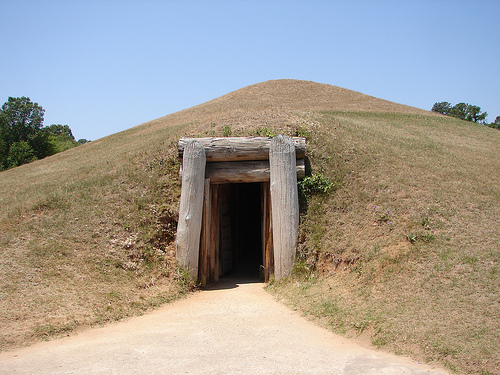
Location: 1207 Emery Hgw Macon, GA Map
Area: 702 acres (2.8 km²)
Inhabited: 17,000 years ago
Ocmulgee Mounds National Historical Park (formerly known as
Ocmulgee National Monument until its redesignation in 2019) is one
of the most significant archaeological and cultural sites in the
southeastern United States. Located in Macon, Georgia, along the
Ocmulgee River on the Macon Plateau near the Fall Line, the park
preserves evidence of more than 12,000 years of continuous human
habitation. It is the ancestral homeland of the Muscogee (Creek)
Nation and features prominent earthen mounds, a reconstructed earth
lodge, village sites, and the largest collection of artifacts (over
2 million items) in any National Park Service unit.
The site
holds Traditional Cultural Property status (designated in 1997, the
first east of the Mississippi River) due to its ongoing sacred and
cultural importance to the Muscogee people. As of 2026, the park
spans approximately 3,000+ acres (with expansions ongoing), remains
free to enter, and is actively involved in efforts to potentially
become Georgia's first full national park (possibly redesignated as
Ocmulgee National Park and Preserve through pending legislation,
which would expand protections, include more river corridor lands,
and feature co-management with the Muscogee Nation—the first such
arrangement in the U.S.).
Prehistoric Periods: Foundations of 12,000+ Years of Habitation
Paleo-Indian Period (ca. 17,000–9,600 BCE)
The earliest people
arrived during the Late Pleistocene as highly mobile bands of hunters
and gatherers following the last Ice Age. They crossed into North
America via the Bering land bridge around 17,000 years ago and reached
the Southeast shortly after. At Ocmulgee, they hunted megafauna
(mammoths, mastodons, and other large Ice Age animals) in a landscape of
boreal forests transitioning to oak-hickory-pine. Diagnostic artifacts
include Clovis fluted projectile points. Subperiods show a shift from
broad exploration (Early: 15,000–13,000 BCE) to adaptation in optimal
zones (Middle) and localized hunting of smaller game like deer with
side-notched Dalton points (Late). Stone tools were transported long
distances, reflecting high mobility.
Archaic Period (9,600–1,000
BCE)
As climates warmed and megafauna disappeared, people adapted to
a more stable environment. Bands grew larger, establishing seasonal base
camps along rivers with storage pits and house floors. They hunted deer
and small game, gathered nuts, berries, seeds, and shellfish, and
experimented with early horticulture. New tools appeared: knives,
drills, atlatl (spear-thrower) hooks, bone points, fishhooks, and—late
in the period—fiber-tempered pottery and boiling stones for cooking.
Trade in non-local chert increased. Subperiods mark growing sedentism
and population: Early (stable bands), Middle (diverse diets and
shellfish use), and Late (specialized diets, ceramics spreading across
the Southeast, and early mound-building foundations). These people laid
groundwork for later settled societies.
Woodland Period (1,000
BCE–900 CE)
This era brought the first semi-permanent villages
sustained by horticulture of starchy seeds (sunflowers, grasses) and the
bow and arrow for hunting. Pottery evolved dramatically: Early Woodland
sand- or grit-tempered vessels replaced fragile stone tools. Burial
practices included isolated mortuary sites with offerings and, in the
Middle Woodland, elaborate earthen mounds and enclosures containing
elite burials with exotic trade goods. Trade networks reached the
Rockies, Great Lakes, and beyond (mica, shells, copper, obsidian).
Villages expanded in the Late Woodland amid population growth and new
crops (maize, beans, squash). Mound construction and long-distance
exchange declined toward the end, possibly due to resource pressures,
but innovations set the stage for the Mississippian florescence.
Mississippian Culture (ca. 900–1350 CE)
Around 900 CE, newcomers from
the Mississippi River Valley (or related regions) arrived, displacing
Woodland groups and building a major ceremonial center and town on the
Macon Plateau—the most visible legacy today. They constructed
flat-topped pyramidal platform mounds (some with ramps) topped by wooden
temples, homes, or elite structures built in stages. The site included a
large village, defensive features, and an earth lodge used for council
meetings or ceremonies. Society was complex and hierarchical, likely
organized into chiefdoms under priest-chiefs, with strong religious
elements centered on platform mounds.
Farming of corn, beans, squash,
sunflowers, and tobacco supported a sedentary population; surplus
storage in pottery and baskets freed time for trade, crafts, and
mound-building. Hunting supplemented diets with deer, turkey, and small
game. Artifacts include elaborate pottery (coiled and incised, sometimes
with effigies), shell gorgets, copper ornaments (indicating wide trade),
and gaming pieces for chunkey and a lacrosse-like ball game. The Great
Temple Mound (about 55 feet high) and other platform mounds formed the
core of the ceremonial complex. A reconstructed Earth Lodge (original
floor dates to ca. 1015 CE) features a central fire pit, eagle effigy
platform, and 50 molded seats around a bench—likely for elite councils.
The Macon Plateau town declined around 1200–1350 CE (possibly due to
migration, environmental factors, or assimilation), though Mississippian
culture persisted elsewhere (e.g., Etowah, Moundville).
The archaeological excavation, establishment, and ongoing
preservation of Ocmulgee Mounds National Historical Park represent a
pivotal chapter in American heritage protection, blending large-scale
New Deal-era fieldwork, federal designation, and contemporary advocacy
for expanded recognition.
In the 1930s, the site underwent one of the
most extensive archaeological projects ever conducted in the United
States, spanning from 1933 to 1941. This massive effort was funded
through New Deal programs, including the Works Progress Administration
(WPA), Civilian Conservation Corps (CCC), and other relief initiatives.
Led by prominent archaeologist Dr. Arthur R. Kelly, the project
mobilized more than 800 workers at its peak. Their excavations across
eight major mounds and extensive village areas unearthed an
extraordinary collection of approximately 2.5 million
artifacts—including pottery sherds, stone tools, shell ornaments, copper
items, plant remains, and animal bones. These discoveries provided
crucial evidence for establishing the site's remarkable timeline of
human occupation stretching back over 12,000 years, from Paleo-Indian
hunters to Mississippian mound builders. The CCC also played a key role
in site development, reconstructing the iconic Earth Lodge (which opened
to the public in 1937 based on original clay floors and features) and
constructing roads, trails, bridges, and other visitor infrastructure
that still form the backbone of the park today.
Congress took formal
steps to protect the site in the mid-1930s. It was authorized as
Ocmulgee National Monument in 1934 and officially established on
December 23, 1936, under the National Park Service. In 1966, the site
was added to the National Register of Historic Places, affirming its
national significance. A major milestone came in 2019 when the John D.
Dingell, Jr. Conservation, Management, and Recreation Act (part of a
broader public lands package) redesignated it as Ocmulgee Mounds
National Historical Park and expanded its boundaries by roughly 2,100
acres, bringing the total to about 3,000 acres (with some additional
acquisitions and transfers occurring in subsequent years, such as state
land donations along transportation corridors).
As of March 2026,
strong momentum continues toward elevating the park to full national
park and preserve status—potentially making it Georgia's first national
park. This effort is driven by the Ocmulgee National Park and Preserve
Initiative (ONPPI), in close partnership with the Muscogee (Creek)
Nation, local leaders, bipartisan congressional supporters (including
Sens. Jon Ossoff and Raphael Warnock, and Reps. Sanford Bishop and
Austin Scott), and conservation groups. Key legislation, such as S.1131
and H.R.2345 (the Ocmulgee Mounds National Park and Preserve
Establishment Act), was reintroduced in the 119th Congress (2025–2026)
after earlier versions stalled. These bills propose redesignating the
site as Ocmulgee Mounds National Park and Preserve, adding several
thousand acres (current proposals center on around 7,000–7,100 acres of
mostly private land along the Ocmulgee River corridor, connecting to
areas like Bond Swamp National Wildlife Refuge). The expansion would
enhance protections for sacred Indigenous landscapes, wildlife habitats,
and bottomland hardwood swamps while enabling new recreational
opportunities—including regulated hunting and fishing in preserve
zones—and exploring innovative joint management between the National
Park Service and the Muscogee Nation.
Despite progress—including
Senate committee hearings and community planning—the push has faced
hurdles. In late 2025, the National Park Service expressed opposition
during congressional testimony, citing resource constraints and a
preference for maintaining existing parks over new designations amid
budget pressures. Advocates remain optimistic, emphasizing congressional
authority, broad bipartisan support (over a dozen members across parties
and chambers), and the modest scale of the addition relative to the
federal land portfolio. Strategic planning sessions, community input
(including virtual and in-person feedback in 2025), and Indigenous
leadership (such as from Muscogee citizens like Tracie Revis of ONPPI)
continue to advance the vision.
Today, visitors experience the park
through an extensive network of trails (including the Dunlap Trail with
Civil War earthworks), a modern visitor center and museum housing
thousands of artifacts and interpretive exhibits, ranger-led programs,
and educational events. Annual highlights include the Ocmulgee
Indigenous Celebration, featuring traditional Muscogee dances, crafts,
storytelling, and ceremonies that reaffirm living cultural ties. The
park actively honors the Muscogee (Creek) Nation's enduring
connections—through oral histories, ceremonial practices like the Green
Corn Ceremony, and design elements echoing the ancient Earth Lodge
(reflected even in their Oklahoma capitol building)—while safeguarding
this multilayered sacred landscape as a powerful symbol of Indigenous
resilience, continuity, and deep-time heritage for all.
Ocmulgee Mounds National Historical Park (often still referred to by
its former name, Ocmulgee National Monument) is a remarkable site in
Macon, Georgia, preserving over 12,000–17,000 years of continuous Native
American habitation. It features ancient earthen mounds built by
prehistoric cultures, including the Mississippian period, and is sacred
to the Muscogee (Creek) people. The park spans about 600+ acres
currently (with ongoing efforts to expand it significantly toward
national park status), and it's free to enter—no entrance fee is
required.
Getting There and Logistics
Location — The main
entrance is at 1207 Emery Highway, Macon, GA 31217, just east of
downtown Macon across the Ocmulgee River (very accessible from I-75 or
I-16).
Operating Hours — Grounds open daily 8:00 AM–5:00 PM
year-round. The Visitor Center and Earth Lodge open 9:00 AM–5:00 PM
daily. The park closes on Thanksgiving, Christmas, and New Year's Day.
Entrance and Fees — Completely free entry and parking. No pass needed.
Pets — Leashed pets are allowed on trails and grounds (a big plus for
many visitors).
Accessibility — Some areas (like the Great Temple
Mound stairs) are not wheelchair-accessible, but the Visitor Center,
museum, and parts of trails offer accommodations—check the NPS site for
details.
Best Time to Visit
Spring (March–May) and fall
(September–November) offer the most comfortable weather: mild
temperatures, blooming flowers or autumn colors, and fewer bugs/humidity
than summer.
Spring often includes special events like Lantern
Light Tours during Macon's famous International Cherry Blossom Festival.
Fall highlights the annual Ocmulgee Indigenous Celebration (usually
mid-September), a vibrant two-day festival with traditional dancing,
crafts, vendors, food, and cultural demonstrations—shuttles help with
transport.
Summer (June–August) is peak season but hot and
humid—bring plenty of water, sunscreen, and a hat, as shade is limited.
Winter is quietest and least crowded but can be chilly.
Aim for
mornings to beat heat/crowds and afternoon for indoor exhibits if
needed. Weekends in spring/summer often have more ranger programs.
What to See and Do (Recommended Itinerary)
Plan 2–4 hours for a
solid visit (1–2 hours for a quick stop, longer if hiking extensively).
Start at the Visitor Center (9 AM opening)
Watch the short film,
explore exhibits on 17,000+ years of history (Paleo-Indian to
Mississippian cultures, plus colonial trading post era), and pick up
maps/brochures. It's air-conditioned and informative—great intro before
heading outside.
Earth Lodge (Reconstructed Mississippian council
house)
A highlight: walk on the original 1,000-year-old clay floor
inside a rebuilt structure. Guided ranger tours often occur Saturdays in
spring/summer—check the calendar. It's a short walk from the Visitor
Center.
Main Path Trail (Most popular, ~0.5–1 mile downhill loop)
Easy walk from Visitor Center to key sites: Earth Lodge → Lesser Temple
Mounds → British trading post site → Great Temple Mound.
Climb the
stairs to the top of the Great Temple Mound (impressive views over the
Ocmulgee River, Macon skyline, and surrounding area—best panoramic spot
in the park).
Hiking Trails (Total ~8 miles, mix of easy to moderate)
Opelofa Trail/Loop (~1 mile) — Best for wetlands, river views,
birdwatching (waterfowl, wildlife).
Heritage Trail, Dunlap Trail
(~0.25 mile), McDougal Trail (~0.5 mile), etc. — Wind through forests,
open fields.
Trails are well-marked, mostly flat/easy, but bring
water (average trail ~1 mile; no shade in spots). Bikes/e-bikes allowed
only on certain roads and trails (River Trail, Heritage Trail).
Other Experiences
Look for prehistoric trenches, borrow pits, and
other earthworks.
Wildlife spotting: deer, birds, river life.
If
timing aligns, attend ranger-led programs, pottery activities for kids,
or special events.
Practical Tips for a Great Visit
Weather &
Gear — Georgia weather varies: hot/humid summers, potential storms.
Always bring water (no matter the season—trails can be unshaded),
comfortable walking shoes, bug spray (especially near wetlands),
sunscreen, hat, and layers. Sturdy shoes for stairs and dirt paths.
Safety — Stay on trails (mounds are fragile and culturally
significant—don't climb unauthorized areas). Watch for uneven ground,
roots, or wet spots. No major hazards, but take standard precautions.
What to Bring — Snacks/picnic (no concessions inside), camera/binoculars
for views/wildlife, phone (some use GPS-guided audio tours available via
apps).
Crowds & Pace — Self-guided mostly—little supervised touring,
so explore at your own speed. Less crowded weekdays or off-season.
Nearby — Combine with Macon attractions (downtown, museums, Cherry
Blossom events in spring). Macon has hotels, restaurants, and is an easy
day trip from Atlanta (~1.5 hours).
Respect — This is sacred land to
Indigenous peoples (especially Muscogee). Be respectful—no littering, no
climbing off-trail mounds.