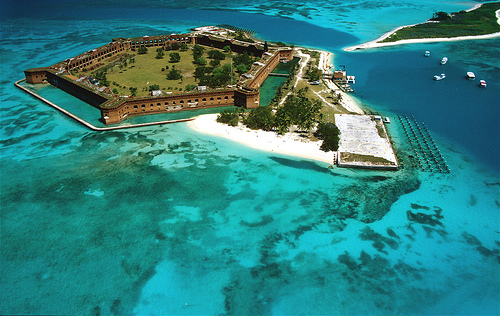
Location: Monroe County Map
Area:
64,700 acres (262 km2)
www.nps.gov/drto
Dry Tortugas National Park, located about 70 miles (113 km) west of
Key West in the Gulf of Mexico, is one of the most remote and pristine
U.S. national parks. It encompasses 100 square miles, mostly open water,
with seven small islands (keys). The park protects Fort Jefferson—the
largest masonry fort in the Western Hemisphere—superb coral reefs,
marine life, shipwrecks, and vital bird habitats.
Its isolation
(accessible only by boat or seaplane) makes visits logistically
demanding and expensive, but the rewards include crystal-clear turquoise
waters, historic exploration, world-class snorkeling, and incredible
solitude. It suits travelers seeking adventure, history, nature, and
escape from crowds.
Spanish explorer Juan Ponce de León named the islands "Tortugas"
(turtles) in 1513 due to abundant sea turtles; "Dry" was added later to
note the lack of fresh water. The U.S. began constructing Fort Jefferson
in 1846 on Garden Key as a coastal defense, but it was never completed.
It served as a Civil War prison (notably holding Dr. Samuel Mudd, linked
to Lincoln's assassination). The park was established in 1992 to
preserve its marine and historic resources.
The seven islands include
Garden Key (home to Fort Jefferson and the main visitor area),
Loggerhead Key (largest island, with a lighthouse and research history),
Bush Key (often closed for bird nesting), and smaller keys. The
surrounding waters are part of the third-largest coral reef system.
Expect white-sand beaches, shallow snorkel spots (5-15 feet), and deeper
dive sites.
How to Get There
No roads or cars—options are
limited:
Yankee Freedom Ferry (most popular, from Key West):
High-speed catamaran. Day trip: ~2–2.5 hours each way, ~4–5 hours on the
island. Departs ~8 AM, returns ~5:15 PM. Includes breakfast/lunch,
snorkel gear, and park entrance. Book months in advance (sells out 9–12
months ahead, especially peak season). Adult day-trip fares ~$235+ in
2026 (varies with discounts for passes/military/seniors; kids cheaper).
Camping trips available with earlier check-in.
Seaplane: Faster (~40
minutes each way) but more expensive (~$350+). Limited seats;
morning/afternoon/full-day options via Key West Seaplane Charters. Great
for views but no camping transport.
Private Boat or Charter: Requires
a free boat permit upon arrival at Garden Key. Overnight anchoring
allowed in designated areas within 1 nautical mile of Fort Jefferson
harbor light (sand/rubble bottom). Check NPS boating guidelines.
Spearfishing/lobstering prohibited in the park.
Parking in Key
West: Use the city garage near the ferry terminal (~$48/day). Arrive
early for check-in (campers ~6 AM, day-trippers ~7 AM). Photo ID
required.
Best Time to Visit
Peak/Recommended: December–May
(winter/early spring). Calmer seas, excellent visibility, fewer
hurricanes, comfortable temps for exploration. January–March is busiest.
Snorkeling/Diving: May–August (warmer waters, calmer conditions).
Birding: Spring migration.
Shoulder: April–June balances weather,
wildlife, and crowds.
Avoid/Hurricane Season: June–November (peak
risk July–October); ferries can cancel for rough weather. Summers are
hot/humid.
Monitor forecasts closely—rough seas affect trips.
Park open 24/7, but services depend on transport.
Entrance Fees
and Permits
Entrance Fee: $15/person (good for 7 days; under 16
free). Included in ferry tickets; seaplane/private boat pay on arrival
or via Recreation.gov. America the Beautiful passes accepted with
discounts.
Camping: Additional $15/night per individual site (up to 6
people); $30/night for large group site (10–20 people, reservable). Pay
via Recreation.gov app on-site (limited cell service).
Fishing:
Florida saltwater license required (16+). Free boat permit needed. No
fishing in Research Natural Area (RNA).
Other: Tortugas North Access
permits for some restricted areas (request 72+ hours ahead).
What
to Do: Top Activities
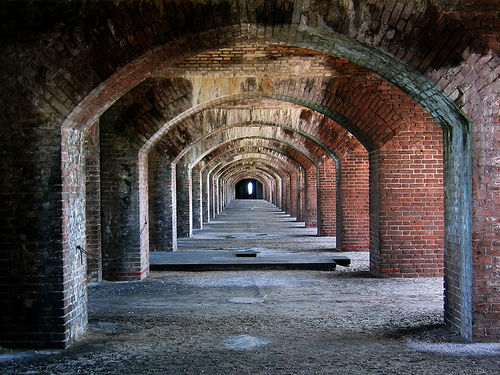
Explore Fort Jefferson: Massive brick structure
(16+ million bricks). Join a free ~45-minute guided tour (usually 11 AM
on ferry days) or self-explore. Climb for views, learn prison history.
Open sunrise to sunset. Watch for uneven surfaces.
Snorkeling and
Swimming: World-class in shallow waters around the moat wall, beaches,
and shipwrecks (e.g., Windjammer Wreck). Ferry provides gear. Vibrant
reefs, turtles, fish. No scuba on ferry (bring own for private boats).
Stick to designated areas.
Beaches and Relaxing: Small, pristine
beaches on Garden Key for swimming, sunbathing, picnicking. Limited
shade outside the fort.
Birdwatching: Important stopover on the Great
Florida Birding Trail. Sooty terns, frigatebirds, etc., especially on
Bush Key (seasonally closed).
Camping: Primitive on Garden Key.
Experience stargazing, sunsets/sunrises, night snorkeling (with
caution). First-come, first-served regular sites (guaranteed spot if
arriving by ferry); bring everything (tent required, 2+ gallons
water/person/day, food in hard containers for rats/crabs). No showers,
composting toilets (limited hours). Quiet hours 10 PM–6 AM. Pack out all
trash.
Kayaking/Paddling, Fishing, Diving: Bring your own gear.
Excellent for exploring keys (respect closures).
Shipwrecks and
Marine Life: Over 300 wrecks; snorkel/dive accessible ones.
Practical Visiting Tips
What to Bring (essentials for day trip or
camping):
Sun protection: High-SPF sunscreen, hat, sunglasses, long
sleeves/pants (no shade).
Swimsuit, towel, change of clothes,
reef-safe sunscreen.
Water (plenty; ferry provides some), snacks/food
(ferry meals for day trips).
Comfortable shoes for fort exploration.
Camera/binoculars, snorkel gear (if not provided), insect repellent (wet
season).
First aid, medications, flashlight, trash bags.
For
camping: Tent, sleeping gear, charcoal (no gas on ferry), hard coolers,
rain gear.
What NOT to Bring: Pets (except service animals),
drones, firearms, wood for fires, single-use plastics (pack out
everything).
Health and Safety: Remote location—no medical
facilities, stores, or fresh water on islands. Heat, sun, dehydration,
seasickness risks. Bring extra supplies for delays. Watch for currents,
jellyfish, sharp coral. Tell someone your plans. No lifeguards.
Accessibility: Challenging due to boat travel, uneven fort terrain, and
primitive conditions. Contact park for details.
Etiquette and
Regulations: Leave No Trace. Respect wildlife/closures (e.g., bird
nesting). No collecting artifacts or disturbing reefs.
Fishing/spearfishing rules strict.
Costs: Expect $250–400+ per person
for a day trip (ferry + parking + extras). Camping adds fees but extends
experience.
Location and Setting
The park sits near the southwestern edge of
the broad, flat Florida Platform—a massive carbonate platform that has
accumulated sediments for nearly 200 million years. The platform is
mostly submerged, with water depths reaching about 300 feet (90 m)
before dropping sharply into much deeper ocean. The Dry Tortugas mark
the end of the Florida Keys chain, with additional reefs and submarine
banks extending westward beyond the park boundaries.
Coordinates are
roughly 24°37′43″N 82°52′24″W. The area is accessible only by boat or
seaplane, contributing to its isolation and relatively pristine
condition. It borders the Florida Keys National Marine Sanctuary and
includes or adjoins protected zones like the Tortugas Ecological
Reserve.
Islands
The park includes seven main low-lying coral
islands (keys), with a total land area of about 144 acres (58 hectares).
These islands are dynamic—changing in size, shape, and number due to sea
level fluctuations, sediment movement, storms, and hurricanes.
Historically, up to 11 islands have existed at times; some smaller ones
have disappeared and reappeared. The islands consist of carbonate sands
and muds from marine organisms, with thin vegetation (mangroves,
grasses) on larger ones and sparse or no plant life on smaller ones.
Highest elevation is only about 10 ft (3 m) on Loggerhead Key.
Major
islands (west to east):
Loggerhead Key: Largest (~64 acres / 26 ha),
home to the Dry Tortugas Lighthouse. Features beachrock outcrops that
help stabilize it.
Garden Key: Second largest (~42 acres / 17 ha),
site of historic Fort Jefferson (a massive 19th-century brick fortress)
and the main visitor area. Connected at times to Bush Key by a sandbar.
Bush Key: Third largest (~30 acres), important bird rookery (closed
seasonally for nesting).
Long Key, Hospital Key, Middle Key
(intermittently submerged), and East Key: Smaller, low-lying islands.
The three largest islands (Loggerhead, Garden, Bush) account for
most of the land area. Former islands like Bird Key and Southwest Key
have become shoals.
Geology and Formation
The islands are the
surface expression of an ancient arcuate chain of Pleistocene reef and
oolitic limestone, part of the southern Florida carbonate platform. Key
bedrock units include:
Key Largo Limestone: Fossilized Pleistocene
coral reefs (up to 200 ft / 61 m thick) with corals, calcarenites, etc.
Underlies modern reefs and sediments.
Miami Limestone: Thinner
oolitic and bryozoan facies, representing subtidal shoals.
Holocene (recent) carbonate sands, primarily from disarticulated
Halimeda (calcareous green algae) plates, form sand banks and islands.
These are excellent examples of modern sediment accumulation. Between
the Tortugas and Key West lie thick "quicksands" deposits.
The
islands formed on Pleistocene reefs exposed as sea levels fluctuated
during ice ages. Live coral reefs have grown for ~11,700 years
(Holocene) and can exceed 50 ft (15 m) thick in places.
Other
seafloor features include:
Live coral reefs — Pristine, with over 50
species (including threatened elkhorn and staghorn corals). These are
among the least disturbed in the Florida Keys.
Seagrass beds —
Stabilize sediments, improve water clarity, and serve as nurseries
(dominated by turtle grass, manatee grass, etc.).
Unconsolidated
sediments and sand banks — Easily moved by currents; form ripples and
shoals.
Pavement/hardbottom — Cemented sediments supporting soft
corals.
Shipwrecks — Over 300 documented, providing hard substrates
for marine growth.
The park includes an atoll-like elliptical
coral reef formation ~27 km long and 12 km wide, with shallow channels
(12–20 m deep).
Marine and Coastal Environments
The waters are
exceptionally clear turquoise, supporting vibrant coral reefs, seagrass
meadows, and diverse marine life (over 400 species of reef fish, plus
sharks, rays, turtles, etc.). The remote location and protections (e.g.,
Research Natural Area with no-take/no-anchor rules in parts) help
maintain healthier reefs compared to more accessible Keys areas, though
challenges like bleaching, disease, and climate impacts persist.
Seagrass traps sediments and protects against erosion during storms.
Reefs and banks create varied habitats, from shallow flats to deeper
areas. The park is a key spawning ground for some fish species due to
currents and gyres.
Climate and Environmental Dynamics
Dry
Tortugas has a tropical savanna climate (Aw), the driest place in
Florida with ~38 inches (970 mm) annual precipitation. Rainy season
(May–October) aligns with hurricane season; dry season is
November–April. Temperatures are stable: summer highs ~91°F (33°C),
winter lows ~65°F (18°C), with water temps 74–86°F (23–30°C). No
recorded freezes.
Islands experience intense sun, quick-draining
sandy soils, and drought-like conditions. Hurricanes reshape islands,
erode/accrete sediments, and impact reefs. Sea level changes and storms
drive the dynamic nature of the keys.
Indigenous and Pre-Colonial Context
Little detailed evidence
survives of long-term indigenous habitation on the Dry Tortugas due to
the islands' small size, lack of fresh water, and exposure to storms.
The area was part of the broader territory of indigenous groups in
southern Florida, such as the Calusa or related peoples, who navigated
these waters for fishing and resources. The islands' strategic location
made them occasional stopping points or hazards rather than permanent
settlements.
European Discovery and Early Exploration (1513
Onward)
Spanish explorer Juan Ponce de León first sighted the islands
on June 21, 1513, during his expedition. He named them "Las Tortugas"
(The Turtles) after the abundant sea turtles in the surrounding waters;
his crew reportedly caught over 100. The "Dry" prefix was later added to
warn mariners of the complete absence of fresh surface water, a critical
detail for navigation. This name is one of the oldest surviving European
place-names in the United States.
The islands lay along vital
shipping routes connecting the Gulf of Mexico, the Caribbean, and the
Atlantic. Spanish explorers, merchants, and later other European powers
used these waters, but the low-lying keys and treacherous coral reefs
created a "ship trap," leading to numerous wrecks dating back to the
1600s. The Dry Tortugas now host one of the richest concentrations of
shipwrecks in North America, many of which are protected cultural
resources.
19th Century: Lighthouses and Strategic Importance
After the U.S. acquired Florida from Spain (1819 treaty, formalized
around 1821–1822), the islands' military and navigational value grew. A
lighthouse was built on Garden Key in 1825 to guide ships through the
hazardous reefs. A more powerful brick lighthouse followed on Loggerhead
Key in 1856–1858.
In the 1840s, the U.S. recognized the Dry Tortugas
as a key defensive point for controlling the Straits of Florida and Gulf
shipping lanes. Construction of Fort Jefferson began in 1846 on Garden
Key. Designed as a massive coastal fortress (hexagonal, with walls up to
50 feet high and 8 feet thick), it was built primarily of brick—over 16
million bricks shipped from the mainland—making it the largest masonry
structure in the Western Hemisphere. Construction involved enslaved
labor initially and continued for about 30 years but was never completed
due to subsidence issues (the weight caused sinking), supply problems,
and shifting military technology (e.g., rifled cannons rendering thick
masonry walls obsolete).
A visible change in brick color in the walls
marks the outbreak of the Civil War, when supply lines shifted. The fort
served as a Union stronghold during the Civil War, controlling Gulf
access and functioning as a prison for deserters and others. It held
around 600 prisoners at times. Notable prisoners included Dr. Samuel
Alexander Mudd, convicted (controversially) of conspiring in the
assassination of President Abraham Lincoln by setting John Wilkes
Booth's broken leg. Mudd was imprisoned there from 1865 until his pardon
in 1869; he earned early release by heroically treating victims during a
yellow fever outbreak. Other Lincoln conspirators were also held there.
The fort also featured a hospital on Hospital Key (a now-submerged or
eroded island has revealed Civil War-era cemetery and hospital remains
through recent surveys). The U.S.S. Maine departed from the Dry Tortugas
in 1898 en route to Havana, an event tied to the outbreak of the
Spanish-American War.
Post-Military Era and Early Protection
(Late 19th–Early 20th Century)
The military largely abandoned Fort
Jefferson in 1874. It fell into disuse, occasionally sheltering pirates,
squatters, or shipwreck survivors. In 1908, President Theodore Roosevelt
designated the area a federal bird reservation to protect nesting
colonies (especially sooty terns on Bush Key) from egg collectors. It
later served briefly as a quarantine or isolation site.
National
Monument and Park Status (1935–1992)
On January 4, 1935, President
Franklin D. Roosevelt proclaimed Fort Jefferson National Monument under
the Antiquities Act (initially ~47,125 acres). This protected the
historic fort and surrounding resources. The monument expanded in 1983.
On October 26, 1992, Congress redesignated and expanded it as Dry
Tortugas National Park to better protect the islands, marine ecosystems,
coral reefs, shipwrecks, and Fort Jefferson while allowing regulated
public access. It is co-managed with Everglades National Park.
Modern Significance and Resources
The park's history reflects broader
themes: European exploration, U.S. territorial expansion, 19th-century
coastal defense, the Civil War, maritime trade hazards, and
conservation. Today, it safeguards pristine coral reefs (among the least
disturbed in the Florida Keys), sea turtle nesting, bird rookeries (Bush
Key is a critical sooty tern site), and submerged cultural resources.
Fort Jefferson remains a focal point for visitors, who access the park
primarily by ferry (e.g., Yankee Freedom) or seaplane.
Ongoing
challenges include erosion of islands, sea-level rise, hurricane
impacts, and preservation of the fort (which requires continuous
stabilization). Submerged sites, like Civil War hospital/cemetery
remnants, continue to yield archaeological insights.
Flora (Plants and Marine Vegetation)
The park's vegetation faces
harsh conditions: intense sun, salt spray, sandy/poor soils, and storms.
Of the approximately 125 reported plant species on the islands, about
65% (81 species) are exotic or non-native, introduced accidentally or
deliberately by humans over the past century. Smaller islands host
mostly native Caribbean flora, while larger ones like Garden Key (home
to Fort Jefferson) and Loggerhead Key have more exotics due to
historical habitation and disturbance. Some culturally/historically
significant non-invasive exotics are preserved.
Terrestrial plants
include salt-tolerant species adapted to coastal dunes, beaches, and
scrub. Common natives feature seagrapes and other hardy shrubs/trees
that provide cover for birds and wildlife. On islands like Loggerhead
Key, management has removed invasives to restore ecology.
Marine
vegetation dominates, as most of the park is underwater. Seagrass beds
(e.g., Thalassia testudinum turtle grass and Syringodium filiforme) are
extensive in shallow waters and serve as foundational habitats. They
stabilize sediments, improve water clarity, provide food/shelter for
marine life (including juvenile fish and sea turtles), and support the
broader coral reef ecosystem. Algal communities (e.g., genera like
Laurencia, Dictyota, Sargassum) are also present and can be ephemeral.
These underwater "meadows" are vital but vulnerable to disturbances like
storms, anchoring, or water quality changes.
Fauna (Animals)
The park's fauna is exceptionally diverse, especially marine life, due
to healthy reefs and seagrasses. It serves as a sanctuary for nesting
birds, sea turtles, and reef inhabitants.
Marine Life: Corals and
Reef Ecosystems
The coral reefs are among the most vibrant in the
Florida Keys, with excellent visibility for snorkeling/diving. The park
hosts about 30 species of coral, including structurally important ones
that create complex habitats.
Key species include:
Elkhorn
coral (Acropora palmata) and Staghorn coral (Acropora cervicornis) —
both federally threatened; they form large branches resembling antlers
or thickets, providing shelter for many species. Staghorn is one of the
fastest-growing in the region.
Others: Pillar coral, rough cactus
coral, lobed/mountainous/boulder star corals, and more.
Corals
rely on symbiotic zooxanthellae algae for color and nutrients; stress
(e.g., warming waters, pollution) can cause bleaching. Threats include
Stony Coral Tissue Loss Disease (identified in the park), hurricanes,
sedimentation, and human impacts. The reefs also support sponges, sea
fans, anemones, lobsters, sea stars, and other invertebrates.
Reef Fishes and Other Marine Animals
Reef fishes are colorful and
abundant, with species adapted for maneuverability in complex structures
(e.g., flat bodies of angelfish for darting). Approximately 400+ species
of reef fish inhabit the area.
Common examples:
Parrotfish
(e.g., beaked), angelfish (queen, gray), yellowtail snappers, sergeant
majors, grunts, groupers, amberjacks.
Predators: Barracudas, sharks
(including nurse sharks — "couch potatoes" that rest on the bottom),
tarpon, wahoos.
Schools provide safety; many use camouflage, spines,
or venom for defense.
Other marine life includes spiny lobsters,
various invertebrates, and pelagic species like dolphins and flying fish
visible en route. Nurse sharks are common and generally docile.
Sea Turtles
The park is a major nesting site (historically named "Las
Tortugas" for its turtles) and one of the most active in the Florida
Keys. All five sea turtle species in the region occur here: loggerhead
(most common nester, threatened), green (forages on seagrass), hawksbill
(reef forager, critically endangered), leatherback, and Kemp's ridley
(all federally protected).
Nesting peaks in spring/summer on sandy
beaches (e.g., East, Loggerhead, Bush, Garden Keys). Females lay
ping-pong-ball-sized eggs; incubation ~60 days (temperature influences
sex ratio). Park biologists monitor nests since 1980. Hatchlings face
high predation (1 in 1,000–10,000 survive to adulthood). Threats include
natural predators (ghost crabs, birds, fish, sharks), habitat loss,
fishing bycatch, plastics, lighting disorientation, and climate change.
Birds
The bird list exceeds 299 species, but few are year-round
residents. It is a critical stopover for migrants and nesting site for
seabirds. Only ~7 species nest regularly; most are transients during
spring/fall migrations (peaks in April–May). Bush Key hosts the only
regular U.S. nesting colony of Sooty Terns (tens of thousands, up to
80,000–100,000).
Notable:
Sooty Terns and Brown Noddies
(thousands nesting on Bush Key, closed seasonally for protection).
Magnificent Frigatebirds (year-round, males with red throat pouches).
Others: Masked/Brown Boobies, Roseate/Bridled Terns, Black Noddy,
various warblers, raptors, shorebirds, and rarities like Caribbean
Short-eared Owl or White-tailed Tropicbird.
Winter: Gulls, terns,
some landbirds (kestrels, kingfishers, warblers, sparrows).
Many
islands close seasonally or year-round to protect nesting birds.
Other Fauna
Mammals: Limited on islands (possibly rats or other small
introduced species); marine mammals like dolphins.
Reptiles/Amphibians: Sea turtles primary; possible American crocodile
sightings (rare).
Invertebrates and others fill ecological roles in
reefs and seagrass.