Location: Jefferson County, Montana Map
Found: 1872
Abandoned: 1970s
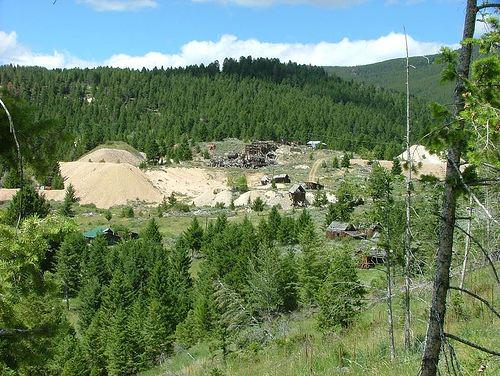
Elkhorn, Montana, is a historic silver-mining town nestled in the Elkhorn Mountains of southwestern Montana, in Jefferson County, approximately 18 miles northeast of Boulder and 50 miles south of Helena. Once a bustling community of 2,500 people during its 1880s peak, Elkhorn is now a sparsely populated ghost town with a 2010 census population of just 10. Its two best-preserved buildings, Fraternity Hall and Gillian Hall, form Montana’s smallest state park, Elkhorn State Park, a one-acre site that draws visitors for its frontier architecture and poignant historical remnants. Unlike many transient mining camps, Elkhorn was a family-oriented settlement of European immigrants, leaving behind a legacy of resilience, tragedy, and preservation. Today, it offers a window into Montana’s mining past, surrounded by the rugged beauty of the Helena National Forest.
Elkhorn’s story begins with the discovery of rich
silver veins in 1868 by Peter Wys, a Swiss immigrant, in the
mineral-rich Boulder Batholith of the Elkhorn Mountains. Wys’s find,
initially called the Holter Lode, was developed in 1875 by Anton M.
Holter, a Norwegian entrepreneur from Helena who had already made his
mark in Virginia City. The Elkhorn Mine, named after the town and its
surrounding range, became one of the nation’s richest and
longest-operating silver mines, producing over $14 million in silver,
8,902,000 ounces of silver, 8,500 ounces of gold, and 4 million pounds
of lead by 1900.
The town grew rapidly around the mine in the
1870s and 1880s. By 1888, the Elkhorn Mine was extracting ore valued at
$30,000 monthly, employing up to 1,500 mules and 500 woodsmen (mostly
French and Norwegian) to supply timber. The 1890 Sherman Silver Purchase
Act, which mandated federal purchases of silver, sparked a boom,
swelling Elkhorn’s population to 2,500. Unlike typical mining camps
dominated by single men, Elkhorn was home to married European
immigrants, fostering a stable community with three schools (serving 200
students), a post office, a church, a hotel, saloons, brothels, a
doctor’s office, a newspaper, a livery stable, and specialty shops like
Hoffman’s Barbershop (the only place to bathe due to water scarcity),
Ford’s Candy Store, and a jewelry shop. Social life thrived, with
outdoor events like horse races, rock-drilling contests, and skating
parties, alongside community gatherings in the newly built Fraternity
Hall (1893), a modified Greek Revival structure hosting dances, theater,
and lodge meetings.
The boom was short-lived. A diphtheria
epidemic during the harsh winter of 1888–1889 devastated the town,
killing many children, whose graves now dot the hillside cemetery. The
Silver Crash of 1893, triggered by the repeal of the Sherman Act, caused
silver prices to plummet, leading to a 75% population drop within two
months. By 1900, the town’s decline was evident, though the mine
operated intermittently until 1971. The Northern Pacific Railroad, which
had connected Elkhorn to Boulder since 1889 for ore transport and
passenger service, removed its tracks in 1931, sealing the town’s
isolation.
Elkhorn lies in the valley of Elkhorn Creek, on the
south side of the Elkhorn Mountains, a 300,000-acre range of inactive
volcanic peaks formed 74–81 million years ago during the Late
Cretaceous. The range, part of the Boulder Batholith, features granitic
rocks rich in silver, gold, and lead, with Crow Peak (9,414 feet) and
Elkhorn Peak (9,381 feet) as its highest points. The landscape is rugged
yet rounded, shaped by millions of years of weathering, with steep
gulches, dry valleys, and meadows hosting diverse wildlife, including
Montana’s largest elk herd.
Accessing Elkhorn is an adventure.
From Interstate 15, take the Boulder exit, travel 7 miles southeast on
Montana Highway 69 (paved), then 11 miles north on a maintained gravel
road through private land and the Beaverhead-Deerlodge National Forest.
The 18-mile journey from Boulder is passable year-round by passenger
vehicles, though high-clearance vehicles are recommended in winter or
after rain due to potential mud or snow. The route immerses visitors in
a 19th-century mining landscape, with mill foundations, tailing piles,
and abandoned structures visible along the way.
Elkhorn is not a true ghost town, as it has never been
fully abandoned. As of 2010, 10 residents live in privately owned
cabins, some descended from original mining families. The town blends
preserved history with modern use, but most properties are private, and
visitors are urged to respect boundaries and refrain from smoking due to
fire risks in the dry, high-altitude environment (7,000 feet).
Elkhorn State Park, established in 1980, preserves Fraternity Hall and
Gillian Hall, both listed in the Historic American Buildings Survey for
their frontier architecture. Fraternity Hall, built in 1893 by the
Fraternity Hall Association, features a two-story design with a large
first-floor hall for community events and a second-floor meeting room
for groups like the Masons, Oddfellows, and Knights of Pythias. Its
castellated cornices and second-story outcropping are iconic, and the
interior, with original fixtures, has hosted everything from dances to
prizefights. Gillian Hall, a commercial building from the 1890s, stands
alongside it, equally photogenic. Both are open year-round for
exploration, though visitors should tread carefully, especially on
Fraternity Hall’s second floor.
The Western Montana Ghost Town
Preservation Society has spearheaded restoration efforts, and local
landowner Bruce Bell, whose great-grandfather ran a livery barn in
Elkhorn in 1888, is helping install 20 informational signs along Main
Street with grant funding. These signs, incorporating family stories and
photos dating back to 1886, aim to enrich the visitor experience. Other
structures, like cabins and mining relics, are in varying states of
decay, with some boarded up or collapsing. The wooden water tower has
been repaired, but many buildings are untouched, adding to the town’s
haunting charm.
The Elkhorn Cemetery, three-quarters of a mile up
the main road, is a must-visit. It holds the grave of Peter Wys and
dozens of children who died in the 1888–1889 epidemic, with markers
ranging from grand tombstones to crumbling wooden plaques. Visitors are
advised to walk carefully, as some graves are unmarked. No new burials
are permitted due to the presence of unknown graves.
Elkhorn State Park is open daily from sunrise to
sunset with no entry fee. Visitors can enter Fraternity and Gillian
Halls to explore their interiors, which retain original fixtures,
offering a tactile connection to the 1890s. The surrounding town, though
private, is dotted with mining artifacts, tailing dams, and mill
foundations, evoking its industrial past. The cemetery’s sad history,
especially the children’s graves, leaves a lasting impression.
The Elkhorn Mountains, part of the Helena National Forest, offer
recreational opportunities like hiking, cycling, and wildlife viewing.
Trails like the 8.1-mile Elkhorn Wildlife Management Area trail (2,083
feet elevation gain) or the 3-mile Willard Creek Trail provide chances
to spot elk, deer, moose, bighorn sheep, and songbirds. The area’s 1988
forest fire left visible burn scars, but new lodgepole pine forests are
regenerating. Peak baggers can access Crow and Elkhorn Peaks from a
trailhead north of town.
Visitors should bring cameras, water,
and weather-appropriate clothing, as the high-altitude climate can be
cold in winter or hot and dry in summer. Respect for private property is
critical, and the area’s fire risk necessitates caution. Parking is
ample, and the site is rarely crowded due to its remote location.
Elkhorn stands out among Montana’s ghost towns for its
family-oriented community and well-preserved structures. Its residents,
primarily European immigrants, created a social fabric distinct from the
rough-and-tumble bachelor camps of the era, with schools, churches, and
community events fostering stability. The diphtheria epidemic and Silver
Crash underscore the fragility of such boomtowns, while the cemetery
serves as a somber memorial to the children lost.
The town’s
preservation reflects Montana’s commitment to its mining heritage, with
Fraternity and Gillian Halls as enduring symbols of frontier
architecture. Local efforts, like Bell’s signage project, ensure that
family stories and historical details endure. Elkhorn’s designation as a
state park and its recognition by groups like the Western Montana Ghost
Town Preservation Society highlight its status as one of the West’s most
important historical sites.
Access: From I-15, take the Boulder exit, follow MT-69 southeast
for 7 miles, then take the gravel county road north for 11 miles. A
passenger vehicle suffices, but 4WD is ideal in adverse conditions.
Timing: Allow 2–3 hours to explore the state park, cemetery, and
surroundings. Summer offers the best weather, but the site is open
year-round.
Respect: Stay within state park boundaries, avoid
private property, and do not remove artifacts. Refrain from smoking
due to fire risks.
Preparation: Bring water, sunscreen, and
layers. Check weather, as winters are harsh at 7,000 feet.
Nearby: Visit Boulder Hot Springs or Tizer Gardens and Arboretum in
Boulder. Helena, 50 miles north, offers museums and dining.
Safety: Watch for fragile structures and small grave markers in the
cemetery. Be bear-aware in the surrounding forest.