Location: Colorado Map
Found: 1880
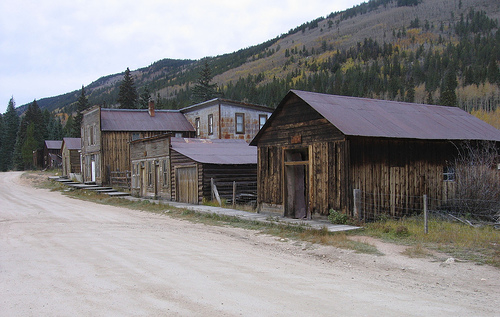
Tucked away in the dramatic Chalk Creek Canyon of Chaffee County, Colorado, Saint Elmo stands as one of the most remarkably preserved ghost towns in the American West. Perched at an elevation of about 10,000 feet (3,048 meters) in the Sawatch Range—part of the Rocky Mountains—this former mining boomtown exudes an eerie, frozen-in-time allure with its weathered wooden facades, narrow dirt streets, and surrounding aspen groves. Coordinates pinpoint it at 38°41′21″N 106°20′57″W, roughly 16 miles (26 km) southwest of Buena Vista and 20 miles (32 km) west of Nathrop. Founded amid the silver and gold rushes of the late 19th century, Saint Elmo once buzzed with over 2,000 residents but faded into obscurity by the mid-20th century as mining fortunes waned. Unlike more commercialized sites, it remains largely private property, with a handful of year-round residents (around 7-10 as of recent counts) maintaining its authenticity. Today, it draws about 50,000 visitors annually, offering a tangible portal to Colorado's Wild West era—complete with tales of hardy miners, rowdy saloons, and lingering ghost stories—while serving as a gateway for off-road adventures into the high country. Its intact structures and isolation make it a favorite for history enthusiasts, hikers, and four-wheelers seeking unspoiled frontier vibes.
Saint Elmo's origins trace back to the explosive mining booms of the
1870s, spurred by the discovery of rich silver lodes in nearby
Leadville. The area's first permanent settler was prospector Abner Ellis
"A.E." Wright, who arrived in 1871 at the head of Chalk Creek Canyon,
drawn by promising outcrops on Chrysolite Mountain. By 1875, Wright and
his partner John Royal had staked the Mary Murphy Mine—the richest in
the district—after uncovering a high-grade vein of silver and gold ore.
This strike ignited interest, but it was the broader Leadville rush of
1878 that flooded the Arkansas River Valley with fortune-seekers, many
of whom pushed westward into Chalk Creek.
In 1880, Griffith P. Evans
and Charles O. Seitz, key figures in the Mary Murphy Mine, hired
surveyor J.A. Wilcox to plat a townsite amid six feet of snow. Initially
dubbed "Forest City," the name was rejected by the U.S. Post Office due
to an existing town in California, so it was rechristened "Saint
Elmo"—likely inspired by the popular 1866 romantic novel St. Elmo by
Augusta J. Evans, or possibly after the patron saint of sailors
(reflecting the "sea" of miners). The post office opened that year,
formalizing the settlement. Early infrastructure was rudimentary: canvas
tents, pine-covered dugouts, and log cabins sprouted along the canyon
floor, housing a transient population of prospectors. By late 1880, the
Denver Tribune marveled at the rapid development, noting two sawmills, a
smelter, a concentrator, three hotels, five restaurants, and several
stores—all erected in under six months.
The Denver, South Park &
Pacific Railroad's arrival in 1881 was a game-changer, extending tracks
from Nathrop to a depot at the town's east edge (Fisher Station). This
connected Saint Elmo to broader markets, facilitating ore shipment and
supply influx. The line's crowning achievement was the 1,845-foot Alpine
Tunnel, bored through the Continental Divide in 1882 at a staggering
cost of $250,000 (about $7.5 million today), lined with redwood to
withstand moisture and cold. During construction, the town swelled with
workers, saloons, and "bawdy houses" catering to the mostly male
populace. Key mines like the Mary Murphy (producing 70-100 tons of ore
daily by 1881), Theresse C, Molly, and Pioneer fueled the economy, with
the district boasting 50 active operations by 1883. Civic life emerged
too: a telegraph office, jail, town hall, firehouse, two banks, a
schoolhouse, and the St. Elmo Mountaineer newspaper (started as the
Rustler in 1880) kept residents informed. Toll roads, like the Chalk
Creek and Elk Mountain route, linked it to Aspen and Maysville, while
stagecoaches hauled passengers and freight.
Saint Elmo's zenith came swiftly in the early 1880s, transforming it
from a rough camp into a bustling supply hub for the Chalk Creek
District. Population estimates vary, but it peaked at nearly 2,000
residents around 1881—miners, merchants, and families crammed into log
cabins, balloon-frame homes, and false-front stores along Main Street.
The Mary Murphy Mine alone employed over 250 men, yielding 220,000
ounces of gold by 1925, though silver dominated early output. Daily life
was a gritty blend of toil and revelry: Irish and Cornish miners
descended shafts up to 1,000 feet deep, battling cave-ins and avalanches
in subzero winters, while extracting carbonate ores that were smelted
on-site or shipped via rail. Women managed boardinghouses like the Home
Comfort Hotel, run by Anna Stark from 1881, and laundries; children
attended the one-room schoolhouse. Saloons such as the Blarney Stone and
Elkhorn offered whiskey, poker, and fiddle music, while dance halls and
brothels provided escapism—earning the town a saucy reputation during
the tunnel's build.
The business district hummed: assayers tested ore
purity, blacksmiths shod mules for pack trains, and stores stocked
everything from dynamite to calico. The Mountaineer chronicled strikes
and scandals, fostering community. Yet, isolation bred
hardships—blizzards isolated the town for months, and the high altitude
(with thin air and harsh weather) took lives. Notable families like the
Starks—Anton (miner), Anna (hotelier), and reclusive daughters Tony and
Annabelle—epitomized endurance, living above their store and shunning
outsiders. By 1890, U.S. Census data showed 750 residents, reflecting
growth from a handful in 1871. Prosperity peaked with the railroad's
efficiency, but underlying issues loomed: lower-grade ores required
costlier processing, and the town's remote gulch location deterred
investors.
Saint Elmo's downfall mirrored Colorado's silver bust. A
devastating fire in June 1890 razed the south side of Main Street
and several north-side buildings, gutting the commercial core and
prompting an exodus—population dropped to 500 by 1891. The 1893
repeal of the Sherman Silver Purchase Act crashed prices, idling
even top mines like Mary Murphy. A second blaze in January 1898
incinerated the rebuilt district, though some structures rose from
ashes by year's end. Brief gold revivals in the 1890s offered
respite, and in 1905, an English syndicate reopened Mary Murphy, but
by 1910, the Alpine Tunnel closed due to avalanches and disrepair.
Ore depletion accelerated the slide: the railroad pulled out in 1922
(last train that year), severing lifelines. Population plummeted—367
by 1900, then to seven by 1930.
The Starks clung on, converting
to tourism by leasing cabins and running a dingy general store. Anna
died in 1934, followed by son Roy; siblings Tony and Annabelle,
increasingly eccentric and impoverished, persisted until Tony's
death in 1956 and Annabelle's in 1960 (she was briefly
institutionalized). The post office shuttered in 1952, officially
ghosting the town. By 1958, it was virtually abandoned, though a few
holdouts remained. A 2002 wildfire destroyed six buildings,
including the Town Hall and Stark home, but preservation efforts by
the Buena Vista Heritage Museum and private owners have stabilized
the rest. Unlike gambling-revived spots like Central City, Saint
Elmo slumbered as a true relic, its decline a stark reminder of
mining's volatility.
Of the original 200+ structures, 43 endure remarkably intact—false-front stores, log cabins, and a jail from the 1880s-1890s, with minimal alterations. Highlights include the Home Comfort Hotel (now haunted lore central), the clapboard St. Elmo General Store (open May-October, selling ice cream, souvenirs, and renting a pet-free cabin), the courthouse/jail, a saloon shell, the schoolhouse (museum-managed), and scattered mine ruins like the Mary Murphy adits. Dirt streets wind past private residences of the few locals, who maintain the site. Tailing piles and rusted relics dot the hillsides, while wildflowers and wildlife (deer, elk, bears) reclaim the edges. Ghost tales persist: Annabelle's apparition reportedly slams doors, moves tools, and appears in a white dress at the hotel—earning it a spot on paranormal TV shows. No major treasures or legends dominate, but the isolation amplifies its spectral charm. As of 2025, it's stable, with no significant changes from preservation guidelines—no interior access without permission, and "No Trespassing" signs enforce privacy.
Saint Elmo is free and accessible year-round, ideal for a half-day trip from Buena Vista or Salida. From Buena Vista, take US 24/285 south to Nathrop, then County Road 162 west for 19 miles through Chalk Creek Canyon—paved then gravel, suitable for 2WD sedans in dry weather (high-clearance recommended for rain/snow; chains in winter). The 45-minute drive passes Mt. Princeton Hot Springs Resort and Agnes Vaille Falls. Park at the general store lot (Nathrop, CO 81236) and stroll Main Street (20-30 minutes), admiring exteriors—stay on paths to respect privacy. The store (cash/debit only) offers maps, snacks, and history chats; donations appreciated. For adventure, rent a Jeep for the 4x4 trail over Tincup Pass to Pitkin (22 miles, alpine views, aquamarine rockhounding). No camping on the road, but nearby dispersed sites exist. Best in summer/fall for wildflowers and mild temps (50-70°F days); winter brings snowshoeing but road closures. Bear spray advised, and depart by dusk—no lights. Combine with Buena Vista's rafting or the Alpine Tunnel hike. For context, visit the Buena Vista Heritage Museum. Saint Elmo isn't polished tourism—it's raw history, whispering of faded dreams amid Colorado's eternal peaks.