Location: King Salmon Map
Area: 4,725,188 acres (19,122 km²)
Official site
Katmai National Park and Preserve is a vast, remote wilderness area
located at the base of the Alaska Peninsula in southwestern Alaska, not
far from Kodiak Island. This rugged park is renowned for its dramatic
volcanic landscapes, abundant wildlife—especially brown bears—and rich
human history.
Visitor services within the park are extremely
limited, reflecting its backcountry character. There are no grocery
stores, post offices, or other typical amenities inside the park
boundaries. The nearest grocery store and post office are both in the
small community of King Salmon, just outside the park.
The main hub
for visitors is Brooks Camp, situated on the northern part of the Alaska
Peninsula along the shores of Naknek Lake at the mouth of the Brooks
River. This area is about 30 miles east of King Salmon and roughly 290
air miles southwest of Anchorage. Access to Katmai is only possible by
floatplane or boat—no roads connect it to the outside world, making it
one of the most isolated national parks in the U.S.
At Brooks Camp,
the park's concessionaire operates Brooks Lodge, where visitors can
purchase meals and limited sundry items (such as snacks and basic
supplies) from the lodge store and restaurant. These services are
typically available from early June through mid-September (historically
June 1 to September 17, though exact dates can vary slightly by year and
may extend with limited options into late September or early October).
Beyond the lodge, no other commercial services are available to general
visitors—campers and day-trippers must come prepared for
self-sufficiency in a remote Alaskan environment.
The park's origins
trace back to 1918, when Katmai National Monument was established
primarily to protect the extraordinary Valley of Ten Thousand Smokes.
This 40-square-mile valley was blanketed by a massive ash flow—ranging
from 100 to 700 feet deep—following the colossal 1912 eruption of
Novarupta Volcano, the largest volcanic event of the 20th century. The
valley earned its name from the thousands of steaming fumaroles that
vented through the ash for years afterward, creating an otherworldly,
moon-like landscape.
Katmai also safeguards significant cultural
heritage, including the Brooks River Archeological District, designated
as a National Historic Landmark. This site boasts an exceptional
concentration of prehistoric human dwellings—approximately 900 known
structures—representing one of the highest densities of such sites in
North America, with evidence of human occupation spanning thousands of
years.
The Brooks Camp Visitor Center serves as the primary entry point and
orientation hub for everyone arriving at Brooks Camp. Open seasonally
(typically June 1 through late September, such as September 17 or 29 in
recent years), it is staffed by park rangers who offer essential
services: providing park information, campground check-in, backcountry
trip planning, and—most importantly—mandatory bear safety orientations.
All visitors to Brooks Camp are required to attend a 20-minute bear
etiquette and safety talk upon arrival. This session covers essential
rules for safely coexisting with the park's famous brown bears, which
gather in large numbers along the Brooks River to feed on spawning
salmon. An Alaska Geographic Association bookstore inside the center
sells books, maps, souvenirs, and other Katmai-themed items.
The
visitor center is uniquely accessible only by plane (usually floatplane)
or boat, with no road access. Rangers lead daily interpretive programs,
and the center supports overall trip planning in this bear-centric,
weather-variable environment where preparation for rain, wind, and cold
is essential.
There are daily commercial flights from Anchorage to King Salmon, the
nearest hub. From King Salmon (or sometimes directly from Anchorage or
Homer), commercial air taxis and floatplanes operate daily flights to
Brooks Camp, weather permitting. Many private lodges in the area also
arrange their own transportation services, such as chartered flights or
boats, for guests.
Fees and Permits
Katmai has no entrance fee
for the park itself, making it free to visit. However, charges apply for
certain activities and accommodations: camping at the Brooks Camp
Campground costs $18 per person per night during the peak season (June
1–September 17) and $10 per person per night in the shoulder seasons
(May and late September–October), with reservations required through
recreation.gov (plus a small reservation fee). Other fees cover stays at
historic Fure's Cabin or commercial filming permits.
One of the park's most dramatic features is the Valley of Ten
Thousand Smokes, a vast 40-square-mile (about 100 km²) landscape created
by the massive 1912 eruption of Novarupta—the largest volcanic eruption
of the 20th century. The eruption buried the valley under thick ash
deposits, and for years afterward, thousands of steaming fumaroles
(earning the name) vented heat from below. Today, while fewer fumaroles
remain active, the ash-filled terrain offers a stark, otherworldly view
of volcanic aftermath.
During the main operating season, daily guided
bus tours depart from Brooks Camp. These full-day natural history tours
(typically running from early June through mid-September, such as June
5–September 17 in recent years) travel along the 23-mile (37 km) park
road through dense boreal forest, across rushing streams, and into open
alpine tundra. The journey ends at the Three Forks Overlook and Griggs
Visitor Center, where a Park Service interpreter provides insights.
After a lunch break, adventurous visitors can opt for a challenging
3-mile round-trip hike down to the valley floor (dropping about 800
vertical feet), allowing close-up views of the ash layers—but the steep
climb back up is strenuous, so conserve energy and come prepared with
plenty of water, rain gear, warm layers, and sturdy hiking boots. A fee
applies for the bus tour (around $115 including lunch in recent
seasons), and reservations are handled through Katmailand, the park's
concessioner.
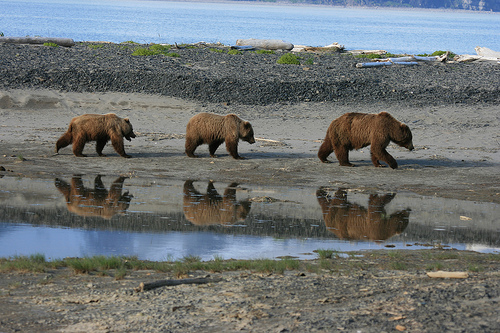
Bear Viewing — Katmai is world-famous as one of the premier
destinations for observing brown bears, with an estimated over 2,200
brown bears inhabiting the park and preserve—one of the highest
protected concentrations anywhere. At the heart of the action is Brooks
Camp, where bears gather in large numbers to feast on abundant sockeye
salmon during their seasonal runs, especially at the iconic Brooks Falls
and along the Brooks River. Multiple elevated viewing platforms
(including the famous Lower River, Riffles, and Falls platforms,
connected by boardwalks) allow safe, close-up observation without
disturbing the bears' natural behavior. Peak viewing often occurs in
late June–July (sockeye run) and September (another strong salmon push).
Beyond Brooks Camp, coastal spots like Hallo Bay and Geographic Harbor,
as well as inland areas in the preserve such as Moraine Creek and Funnel
Creek, offer excellent bear viewing opportunities. Bear activity shifts
seasonally based on food sources—salmon runs dictate much of the
timing—so planning around these patterns maximizes sightings.
Sport
Fishing — Long before bear viewing took center stage, Katmai drew
anglers for its exceptional fishing. The park boasts world-class
opportunities for trophy rainbow trout in numerous lakes and streams,
along with Arctic grayling and Dolly Varden char. Seasonal salmon runs
provide thrilling action, particularly strong returns of sockeye (red)
salmon and coho (silver) salmon in key rivers and coastal areas.
Lodging Options
The park offers limited but high-quality lodging,
primarily focused on immersive experiences like bear viewing and fishing
in this remote wilderness area. The most convenient option for accessing
the famous Brooks Falls (renowned for its brown bear congregations) is
Brooks Lodge, the only lodge within easy walking distance of the falls.
Brooks Lodge (toll-free: +1-800-544-0551 or visit katmailand.com)
This iconic, full-service lodge has operated since 1950 and sits
directly overlooking the legendary Brooks River, providing unparalleled
opportunities for observing Alaskan brown bears in their natural
habitat, often just minutes from your arrival. It features 16 modern
rooms, each equipped with private facilities and typically configured
with bunk beds to accommodate 2–4 guests per room (ideal for small
groups or families). Buffet-style meals are served three times daily in
the main lodge dining area, and a bar offers cocktails for purchase in
the afternoons and evenings. The lodge also provides amenities like a
cozy lobby with a large circular fireplace, gift shop, recreation
equipment rentals, guided services, and transportation options. Due to
extremely high demand—especially during peak bear-viewing
season—reservations are secured through a random lottery system
(applications typically open in late fall/winter for the following year;
check the official site for current deadlines). Book as early as
possible, as spots fill quickly. The lodge operates seasonally from June
1 to September 17.
Other in-park lodges, also managed by the
park's concessionaire Katmailand, include:
Grosvenor Lodge
This intimate, remote retreat caters to a maximum of just 4–6 guests at
a time, creating a private, personalized feel in the heart of Katmai. It
appeals especially to anglers, as two adjacent rivers host massive
annual runs of over 100,000 chinook salmon. Accommodations consist of
three rustic yet cozy guest cabins equipped with heat and electricity,
plus a separate bathhouse for shared but private facilities. The main
lodge building serves complimentary evening cocktails and provides a
welcoming gathering space. While bear viewing (including guided trips to
Brooks Falls or backcountry areas) is available, the primary draw is
world-class fishing in a serene setting.
Kulik Lodge
Fly fishing
enthusiasts flock here for exceptional rainbow trout opportunities in
the surrounding legendary rivers and lakes. Guest accommodations are in
comfortable cabins designed for two people each (with some newer
two-room options for larger parties). The main lodge offers dining
services and complimentary evening cocktails, along with expert guides
familiar with park regulations and prime fishing spots.
In
addition to these, several private lodges on or near the Alaska
Peninsula (outside direct park boundaries) offer tour packages that
include access to Katmai for bear viewing, fishing, and exploration.
Examples include options in nearby communities like King Salmon, Naknek,
Homer, Kodiak, or Anchorage—check resources like VisitBristolBay.com for
more.
Camping Options
Developed Campground
Brooks Camp
Campground (located on the shores of Naknek Lake, roughly 0.3 miles /
0.6 km from the Brooks Camp Visitor Center)
This is the only
developed campground in the entire 4-million-acre Katmai National Park
and Preserve. It provides essential facilities such as a food cache (to
protect against bears), gear cache, fuel storage lockers, potable water,
covered cooking shelters, fire rings, and vault toilets. For added
safety in this bear-heavy area, the campground is fully enclosed by an
electric fence. Strict bear-aware regulations apply here and throughout
the Brooks Camp area (e.g., mandatory food storage rules, no food in
tents).
Capacity is limited to a maximum of 60 campers per night
across 18 shared sites—campsites are often shared when full or during
high water/flooding events. Group size per permit is capped at 6 people,
with limits of 7 nights in July and 14 nights per calendar year.
Reservations are required and highly competitive (especially in July,
when prime dates book within hours of release). For 2026, reservations
open in phased blocks at 8:00 AM AKST (noon EST) via recreation.gov or
by calling +1-877-444-6777: January 7 for May–June nights, February 7
for July–August, and March 7 for September–October. A $6 non-refundable
reservation fee applies per booking. Camping fees are $18 per person per
night during peak season (June 1–September 17) and $10 per person per
night in shoulder seasons (May 1–31 and September 18–October 31).
November 1–April 30 is free (but conditions are extreme and access
limited).
Backcountry / Wilderness Camping
Vast areas of the
park—over 4 million acres—are open for primitive backcountry or
wilderness camping, allowing adventurous visitors to experience true
solitude amid stunning landscapes. No permits are required, but campers
must follow Leave No Trace principles and bear safety protocols.
Important restrictions: Backcountry camping is prohibited year-round
within the Brooks Camp Developed Area (within 1.5 miles / 2.4 km of
Brooks Falls) and in the core Hallo Bay meadows from April 1 through
October 31 to protect sensitive habitats and wildlife. Always check
current conditions and regulations with the National Park Service before
heading out.
Brown bears in Katmai are abundant and active around the clock, so
vigilance is essential at all times.
Proper Food and Odor
Management
Never leave food, drinks, garbage, cooking gear,
toiletries, or any scented items (like sunscreen or insect repellent)
unattended—even for a moment. Always store them in an approved
bear-resistant container (often called a BRC or "bear barrel"). In
Katmai, hanging food in trees is unreliable and not recommended due to
the sparse, low, or unsuitable vegetation in many areas.
Limited
numbers of bear-resistant containers are available for free, temporary
loan at Brooks Camp and the King Salmon Visitor Center—plan ahead and
don't rely on them being available if you're heading into the
backcountry. Secure storage prevents bears from obtaining human food,
which reduces the risk of them becoming food-conditioned and potentially
dangerous to people both in the park and nearby communities.
Protect Your Gear and Belongings
Always keep your backpack, clothing,
tents, or any equipment with you. Leaving items unattended can attract
curious bears, who may investigate, damage, or destroy them. Worse, the
bear could begin associating human gear with food or rewarding smells,
increasing future risks for everyone.
Stay Vigilant and Announce
Your Presence
Bears can appear anywhere and at any time—day or night.
In areas with poor visibility, such as thick willow thickets, alder
stands, tall grass, or noisy streams, make plenty of noise to avoid
surprising a bear. Clap your hands, sing, talk loudly, or call out
periodically.
Traveling in a group (ideally 4 or more people) is much
safer: groups produce more noise, are easier for bears to detect from a
distance, and appear more intimidating, making bears more likely to
avoid you.
Prevent Close or Unwanted Encounters
If you spot a
bear that hasn't noticed you or is at a safe distance, retreat slowly
and quietly while facing the bear—don't turn your back or run.
Never
approach a bear for any reason, including photos. The recommended
minimum safe distance is at least 50 yards (about 46 meters) in most
Katmai areas (especially near concentrated food sources like salmon runs
at Brooks Camp, where regulations prohibit closer approaches). In less
crowded backcountry spots, aim for even greater separation to avoid
interfering with the bear's natural foraging, travel, or resting.
Handling a Bear Approaching You
Bears sometimes come close to
investigate or stand on hind legs to get a better look/smell—stay calm.
Back away slowly and diagonally to get out of its intended path, perhaps
stepping off a trail temporarily if needed.
If the bear follows, stop
moving, stand your ground, speak firmly in a calm, low voice, wave your
arms, and make yourself appear as large as possible (raise arms or
jacket overhead).
Never run—bears can sprint over 30 mph (50 km/h),
and running often triggers their chase instinct.
If a Bear Makes
Physical Contact
In the rare case of an attack, play dead to signal
you're not a threat: Drop face-down on your stomach, spread your legs
wide for stability, clasp hands behind your neck to shield your head and
spine, and stay still and silent. If rolled, keep turning until you're
face-down again. Remain in position until the bear leaves the area.
Only if the attack persists aggressively after you've played dead
(suggesting predatory rather than defensive intent), fight back fiercely
with whatever you have—aim for sensitive areas like eyes, nose, and
face.
Fishing Near Bears
Bears flock to Katmai's rivers for
salmon, so competition with anglers is common during peak runs.
Immediately stop fishing and reel in/break your line if a bear
approaches close enough to notice you or your activity. Bears learn
quickly that splashing fish or struggling catches mean easy meals—they
can snatch your fish in seconds. Never try to defend your catch.
Camping Precautions
At Brooks Camp (typically June 1–September 17),
the campground is enclosed by a maintained electric fence to reduce bear
intrusions—still, never leave attractants inside your tent or
unattended.
In the backcountry, consider bringing your own portable
electric fence system, which many experienced visitors and even park
staff use effectively to protect campsites. The park does not supply
fencing materials, so plan and pack accordingly. Always follow Leave No
Trace principles and store all attractants properly to avoid drawing
bears to your site.
Katmai National Park and Preserve occupies a vast, remote stretch of
the Alaska Peninsula in southwestern Alaska, directly across the
Shelikof Strait from Kodiak Island. Its headquarters sits in nearby King
Salmon, roughly 290 miles (470 km) southwest of Anchorage. The park
spans 4,093,077 acres (16,564 km² or about 6,395 square miles), ranking
it among the largest units in the U.S. National Park System. A small
southwestern corner belongs to the national preserve, where regulated
hunting is allowed, while the bulk (roughly 3.9 million acres) is
designated national park with stricter protections.
The park’s
497-mile (800 km) coastline runs from Kamishak Bay in the north to Cape
Kubugakli in the south, deeply indented with fjords, bays, cliffs, and
beaches. It borders Becharof National Wildlife Refuge to the south and
abuts McNeil River State Game Sanctuary to the north. Access is
primarily by floatplane or boat, with limited roads (such as the one
from Brooks Camp to the Valley of Ten Thousand Smokes overlook).
Aleutian Range Province (Eastern and Southeastern Katmai)
This
province forms the dramatic backbone of the Alaska Peninsula and
includes three main landforms:
Shelikof Strait seacoast — A
rugged, 10-mile-deep (16 km) strip of steep cliffs, headlands (such as
Cape Douglas), intricate coves, fjords, cascading rivers, and beaches.
Rivers tumble directly onto ocean shores, and the coastline supports
diverse habitats from narrow fjords to broad tidal flats.
Aleutian
Mountain zone — A chain of 15 volcanic peaks rising steeply from the
coast to elevations exceeding 7,000 feet (2,134 m). Prominent
stratovolcanoes include Mount Denison (7,605 ft / 2,318 m, the park’s
highest point), Mount Griggs (7,602 ft), Mount Mageik (7,103 ft), Snowy
Mountain, Mount Katmai (6,716 ft / 2,047 m with its famous lake-filled
caldera), Trident Volcano, Mount Martin, and others such as Fourpeaked,
Kukak, Devils Desk, and Kaguyak. Many are active or fumarolically
steaming; the range sits along the Pacific Ring of Fire.
Glaciers
mantle the higher slopes and upper valleys on both sides of the Aleutian
divide. A few eastern glaciers reach nearly to sea level; the largest
are 3–4 miles (5–6 km) wide and 10–12 miles (16–19 km) long. Low-relief
travel corridors across the range include Katmai Pass, Kaguyak Pass, and
the Kanatak Trail near Becharof Lake.
Lake Region and Transition
Zone
The north-central and northwestern sections form the “lake
region,” centered on massive Naknek Lake (the park’s largest) and a
multi-lake watershed. Glacial deposits dammed ancient valleys to create
these lakes; eastern shores are flanked by steep mountains rising over
3,000 feet (914 m) above the water. Westward, the terrain opens into
rolling hills that gradually merge into the Bristol Bay Lowlands. Key
lakes include Brooks, Iliuk Arm (part of Naknek), Kukaklek, and others.
Major rivers such as the Naknek, Savonoski, Grosvenor, and Alagnak (a
designated Wild River) drain westward.
Nushagak-Bristol Bay
Lowlands (Southwestern Katmai)
This province occupies only a small
corner of the park but features low, rolling tundra-covered terrain with
millions of acres of poorly drained lakes, kettle ponds, low ridges,
sand dunes, and streams. Permafrost occurs in patches. The landscape is
far gentler than the volcanic highlands to the east.
Geology and
Landscape-Shaping Forces
Katmai’s geology shifts dramatically east to
west. Basement rocks belong to the Peninsular Terrane (Mesozoic age).
The inactive Bruin Bay Fault runs north-south and separates older
Jurassic sedimentary and intrusive igneous rocks (east) from
metamorphic/igneous rocks (west). Much of the mountainous core consists
of the Late Jurassic Naknek Formation (marine siltstone/sandstone)
overlain by younger Tertiary and Quaternary volcanics. Glaciation during
the Pleistocene sculpted peaks, carved valleys and lakes, deposited
moraines and outwash plains, and left kettle ponds. Erosion and ongoing
volcanism continue to shape the terrain.
The defining event was the
1912 Novarupta eruption—the largest volcanic event of the 20th century
(30 times more magma than Mount St. Helens 1980). It produced a massive
pyroclastic flow that filled a 40-square-mile (100 km²) valley with up
to 700 feet (213 m) of ash and pumice, creating the iconic Valley of Ten
Thousand Smokes. Fumaroles (steam vents) once numbered in the tens of
thousands; today the landscape is deeply eroded into colorful canyons,
with Novarupta’s lava dome still visible. The eruption also caused the
collapse of Mount Katmai’s summit into a 2-by-3-mile (3–5 km) caldera
now filled with a turquoise lake.
Hydrology and Drainage
The
Aleutian Range acts as a divide. Western rivers and lakes (Naknek River
system, Alagnak Wild River) drain into Bristol Bay and the Bering Sea.
Eastern drainages flow directly into the Shelikof Strait (Pacific
Ocean). Glacial moraines dam many lakes; the park contains extensive
wetlands, kettle ponds, and clear, cold rivers fed by snowmelt and
precipitation.
Climate
Katmai has a subarctic climate (Köppen
Dfc): cool summers (highs ~63 °F / 17 °C), long cold winters (lows –4 to
40 °F / –20 to 4 °C), and precipitation year-round (heaviest near the
coast—up to 60 inches / 152 cm annually; drier inland). Weather is
highly variable, often rainy or drizzly, with possible warm spells even
in winter. Fall tends to be drier. Permafrost is present at higher
elevations but absent in lowlands.