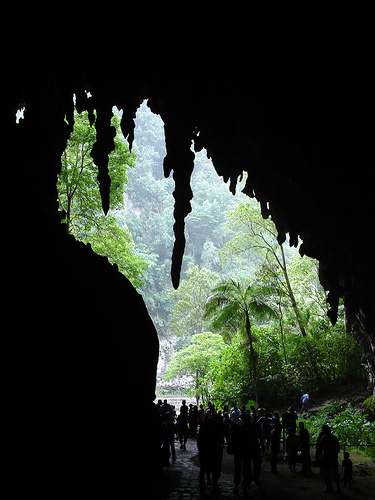
Location: 12 km from Caripe, Monagas state Map
Area: 627 km²
Tel. 0292 641 7543
Entrance Fee: $6, kids $3
Open: 8am- 4pm
Cueva del Guácharo National Park is located 12 km
from aripe in Monagas state of Northwest Venezuela. This national
park covers an area of 627 km² and protects the delicate ecosystem
of Guácharo Cave that also gives the name to this nature reserve.
Guácharo Cave is largest natural underground system that measures a
total of 10.2 km (6.3 miles) in length. One of the first visitor of
the cave was famous German (Prussian) biologist Alexander von
Humboldt. Cueva del Guachara gets its name from guacharo birds or
oilbird that live inside. This nocturnal bird lives in the cave
system by day and leaves it to hunt by night. It has a radar
location system similar to bats to navigate underground as well as
night rain forests. You can camp out at the entrance to the cave and
watch these beautiful rare birds leave the cave around 6pm and come
back early in the morning around 4 am.
You can get here by
bus or by getting a car from Caripe or Cumana, closest large
settlement close to the cave entrance. Try to keep your voice down
then you enter the cave. Many of its local inhabitants like oil
birds and bats might be scarred by loud sudden noises. The
temperature inside the cave usually remains at the comfortable 19 °C
with humidity up to 100%. Although the whole underground system
measures over 10 km in length only small fraction of this is open to
the public.
Location and Getting There
The park lies in the Serranía del
Interior of the Coastal Cordillera, roughly 12 km from the town of
Caripe in Monagas state (and close to the Sucre state border). Caripe is
the main gateway and a pleasant mountain town known for coffee, flowers,
and cooler highland climate.
By road from Maturín (Monagas state
capital, ~80–90 km / 1.5–2 hours): Paved roads, though conditions can
vary. Shared taxis, private drivers, or rental cars are common.
From
Caracas or other cities: Fly to Maturín or Barcelona/Puerto La Cruz,
then transfer by road (several hours). Intercity buses reach Caripe.
Local transport: From Caripe, taxis or organized tours cover the short
distance to the park entrance. Some visitors stay overnight in Caripe
for early morning access.
Road conditions, fuel availability, and
public transport reliability in Venezuela can fluctuate; check current
status closer to travel and consider private transfers for convenience
and safety.
Best Time to Visit
The oilbirds are present
year-round, but the park is most rewarding during the dry season
(roughly December–April), when trails and the approach are more reliable
and the forest is lush. The rainy season (May–November) brings heavier
precipitation, higher humidity, and potential for slippery paths or
temporary access issues. Mornings are ideal for tours (cooler
temperatures and active birds). The highland setting around Caripe is
milder than Venezuela’s lowlands (typically 18–25 °C / 64–77 °F), which
is a pleasant change.
What to See and Do
The main attraction
is the guided tour of the Cueva del Guácharo itself. Tours typically
last 1–1.5 hours and cover the first section of the cave system (the
full cave is much longer and not open to the public for conservation
reasons). Highlights include:
Large colonies of oilbirds (noisy,
fruit-eating nocturnal birds that navigate by echolocation; they nest on
ledges and exit at dusk).
Stalactites, stalagmites, and other
speleothems.
Underground streams and the unique cave fauna (insects,
bats, and specialized invertebrates).
Interpretive information on the
cave’s geology, ecology, and the oilbirds’ natural history.
Outside the cave there are short forest trails in the surrounding
montane rainforest, viewpoints, and opportunities to see highland birds
and vegetation. The park also has an interpretive center/museum area
with exhibits on the cave and local ecology. Evening visits can offer a
chance to see oilbirds leaving the cave, though access is regulated.
Most visitors combine the park with time in Caripe (coffee farms, local
markets, churches, and the pleasant highland atmosphere).
Practical Visiting Tips
Guided tours only: Entry and cave access are
strictly guided. Tours depart at set times; arrive early. Independent
exploration inside the cave is not permitted.
What to bring:
Comfortable closed-toe shoes with good grip (wet or uneven ground),
light layers or a light jacket (caves are cool and damp), a small
flashlight or headlamp (guides provide light, but a backup helps),
insect repellent, water, and a rain jacket in the wet season. Cameras
are usually allowed but flash photography may be restricted near birds.
Duration: Plan at least a half-day (travel + tour + forest time). Many
people make a full day trip from Caripe or overnight.
Facilities:
Basic services at the entrance area (tickets, restrooms, sometimes small
vendors). Food and lodging are better in Caripe.
Accessibility: The
cave tour involves walking on uneven, sometimes slippery surfaces and is
not suitable for all mobility levels. Check with guides in advance.
Group size and language: Tours are often in Spanish; English-speaking
guides may be available through better-organized operators or hotels in
Caripe. Booking through a reputable local operator or hotel is
recommended.
Conservation rules: Stay on designated paths, do not
touch formations or disturb wildlife, and follow guide instructions.
Oilbird colonies are sensitive.
Fees, Hours, and Booking
Entrance fees and tour schedules change; confirm current rates and times
locally or through a Caripe-based operator. Typical hours are daytime
only (mornings preferred). Advance booking is advisable in peak periods
or if traveling with a group, though walk-up access is often possible
outside holidays.
Safety, Health, and Logistics
Venezuela’s
overall security and infrastructure situation requires caution. Stick to
reputable transport, avoid night travel on remote roads when possible,
and keep valuables discreet. The park area itself is generally quiet and
nature-focused.
Standard travel precautions apply: insect protection,
sun protection outside the cave, and basic first-aid supplies. Tap water
is not recommended for drinking.
Cash (bolívares or USD in some
cases) is useful; card acceptance can be limited.
Check for any
temporary closures related to weather, maintenance, or conservation.
Geological Background
The cave is carved in Cretaceous limestone
(roughly 130 million years old) deposited in an ancient sea. Uplift of
the eastern mountain range, followed by dissolution and erosion by
groundwater, created the extensive network of galleries, chambers,
stalactites, stalagmites, and underground streams. The entrance sits at
about 1,065–1,066 m elevation; inside, temperature stays near 19°C with
near-100% humidity. Known development is approximately 10.5 km; the full
extent remains incompletely mapped. Notable chambers include the Gran
Salón del Derrumbe, Salón de Alén, Salón Precioso, Salón del Silencio,
and Salón de los Gigantes. The tourist sector covers the first ~1.2–1.5
km (Humboldt, Silencio, and Precioso halls).
Indigenous History
(Pre-Columbian and Early Contact)
The Chaima people of northeastern
Venezuela knew the cave long before Europeans. It was a sacred place.
According to Humboldt’s account, the Chaima believed the souls of the
dead resided in its depths among the guácharos (oilbirds). “To join the
guácharos is synonymous with joining your ancestors, that is, to die.”
Shamans (piaches) and others used the cave for rituals, including
summoning spirits such as Ivorokiamo. Only the entrance galleries, where
the oilbirds nest, were entered for practical purposes.
The Chaima
harvested oilbird chicks annually for their high-fat content, rendering
an oil used for cooking and lighting that lasted the year.
Archaeological evidence at the cave mouth indicates human activity as
far back as around 1500 BC. The cave thus combined spiritual
significance with a renewable resource economy.
Colonial Period
and Early European Accounts
Capuchin missionaries established
missions in the Cumaná province in the mid-17th century. Santa María de
los Ángeles del Guácharo (near modern Caripe) was founded around
1659–1660. The earliest documented European description comes from Fray
Francisco de Tauste in 1678, who noted the entrance section, the noisy
birds, and indigenous beliefs. Fray Íñigo Abbad y Lasierra provided a
more detailed account in 1773 after visiting, describing the entrance,
interior formations, the birds, indigenous oil harvest, and rituals. In
1794, Bishop Francisco de Ibarra of Guayana entered roughly 802 m during
a pastoral visit.
Missionaries later used the rendered oilbird fat
for cooking.
Humboldt and Bonpland, 1799
On 18 September 1799,
Alexander von Humboldt and Aimé Bonpland visited the cave with local
missionaries and indigenous guides. They penetrated about 472 m.
Humboldt produced the first comprehensive scientific description of both
the cave and its birds. He formally described the oilbird as Steatornis
caripensis (“fat bird of Caripe”), noting its nocturnal, fruit-eating
habits, size (roughly the size of a hen), and adaptations. His accounts
in Personal Narrative of a Journey to the Equinoctial Regions of the New
Continent brought the cave and the species to worldwide scientific
attention. Humboldt also recorded the indigenous cosmology linking the
cave and birds to the afterlife.
The oilbird (Steatornis caripensis)
is a large nocturnal frugivore that navigates in darkness by
echolocation (clicks). Colonies of thousands (estimates often cite
around 10,000 or more in the main Venezuelan colony) nest on ledges in
the first galleries. They leave at dusk in flocks to forage on fatty
fruits (palms, laurels) in the surrounding forests, sometimes traveling
tens of kilometers, and return before dawn. Their guano and regurgitated
seeds form the base of the cave’s food web. The nightly exodus remains a
major visitor attraction.
19th-Century Exploration
Italian
military engineer and geographer Agustín Codazzi visited on 3 February
1835 with local officials and indigenous assistants. He went farther
than Humboldt—reaching the Salón de los Pechos (roughly 825 m) and
providing detailed measurements and descriptions of three main branches.
Other 19th-century visitors included Karl Moritz and painter Ferdinand
Bellermann (1843), Hermann Karsten (1850), Anton Goering (1867), German
geologist Alfred Scharffenorth (1890, who reached the Paso del Viento
and opened the non-tourist sector), and Wilhelm Sievers (1892). These
accounts expanded knowledge of the cave’s length and features.
20th-Century Exploration and Protection
Local Caripe residents
(including the Cirigliano brothers and Jesús Agustín Rodríguez) pushed
farther in the 1940s, reaching the Paso del Viento and, by 1949, the
Galería de los Italianos. Systematic scientific speleology began in 1951
with the Speleology Group of the Sociedad Venezolana de Ciencias
Naturales, including Eugenio de Bellard Pietri, who documented
previously unknown sections such as the Salón Codazzi. Later work
involved the Sociedad Venezolana de Espeleología and groups from the
Universidad Simón Bolívar, producing detailed maps of the
multi-kilometer system.
Legal protection milestones:
15 July
1949: By Decree 180 under the military junta (Carlos Delgado Chalbaud),
the cave and Cerro Negro area were declared Venezuela’s first natural
monument—the Monumento Natural Alejandro de Humboldt (initially covering
about 162 ha). This recognized both its geological/biological value and
Humboldt’s scientific legacy.
27 May 1975: The broader Parque
Nacional El Guácharo was established (Decree) covering approximately
62,700 ha (Cerro Negro sector ~15,500 ha + middle Caripe River basin
~47,200 ha). The expansion protected the cloud forests, watersheds, and
foraging range essential to the oilbirds and the cave’s hydrological
system. The park straddles municipalities in Monagas and Sucre.
1982:
The Museo Humboldt was inaugurated near the entrance—the first
speleological museum in Venezuela—interpreting the cave, the oilbird,
Humboldt’s visit, and local history.
The park is managed by
INPARQUES. It is an Important Bird Area with ~367 bird species and forms
part of the Cordillera de Caripe Alliance for Zero Extinction site.
Beyond oilbirds, it supports diverse montane forest fauna (including
monkeys, peccaries, and other species) and rich cloud-forest flora
(orchids, epiphytes, ferns).