Location: 230 mi (370 km) East of Corrientes, Misiones Province Map
Constructed: 1632
Official site
San Ignacio Miní is one of the most prominent and well-preserved ruins of the Jesuit missions (known as "reducciones") established in South America during the 17th and 18th centuries. Located in the Misiones Province of northeastern Argentina, it represents a unique blend of European Jesuit missionary efforts and indigenous Guarani culture. Founded as part of a broader network of settlements aimed at evangelizing and organizing indigenous populations, the site flourished as a self-sufficient community before its decline and eventual abandonment. Today, it stands as a UNESCO World Heritage Site, attracting visitors for its historical significance, architectural remnants, and insights into colonial-era interactions between Europeans and native peoples.
Location
San Ignacio Miní is situated in the San Ignacio valley, approximately 60 kilometers (37 miles) north of Posadas, the capital of Misiones Province, Argentina. Its geographic coordinates are 27°15′S 55°31′W. The site lies within a tropical forest region, near the Paraná River, which historically facilitated trade and transportation. It is part of the larger Jesuit Missions of the Guaranis network, which spans Argentina and Brazil, including nearby Argentine sites like Santa Ana, Nuestra Señora de Loreto, and Santa María la Mayor, as well as the Brazilian Ruins of São Miguel das Missões. The ruins are integrated into the modern town of San Ignacio, with the historic structures embedded within the urban grid.
The Great Exodus and Relocations
Repeated bandeirante attacks in
the 1620s and early 1630s devastated the Guayrá missions. San Ignacio
and the nearby Nuestra Señora de Loreto were abandoned around 1631–1632.
Under the leadership of Jesuit priest Antonio Ruiz de Montoya, roughly
12,000 Guarani people undertook a dramatic exodus southward, traveling
by canoe and raft along rivers and through dense forests and jungles.
The journey involved multiple temporary settlements, including sites
near the Yabebirí stream. After several moves, the community established
itself permanently at its current location in 1696, near the Paraná
River in what is now Misiones Province, Argentina. The name “Miní”
(meaning “minor” or “small” in Guarani) distinguished it from the larger
San Ignacio Guazú (“great”) in Paraguay.
Prosperity in the 18th
Century
At its peak in the 18th century, San Ignacio Miní housed
approximately 3,000 to 4,500 inhabitants, predominantly Christianized
Guarani. The mission operated as a largely self-sufficient community
organized around a central plaza. Residents engaged in agriculture,
cattle raising, handicrafts, and the production of cultural artifacts.
Goods were traded along the Paraná River. The settlement featured
schools, workshops, a hospital, and other communal facilities. It
developed a distinctive Guaraní Baroque architectural style that blended
European forms with indigenous motifs such as local flora, angels, and
birds.
The main church, designed by Italian Jesuit brother Juan
(José) Brasanelli, was a monumental structure built of local red
sandstone (asperón rojo). It measured roughly 74 meters in length and 24
meters in width, with thick walls that helped it survive later
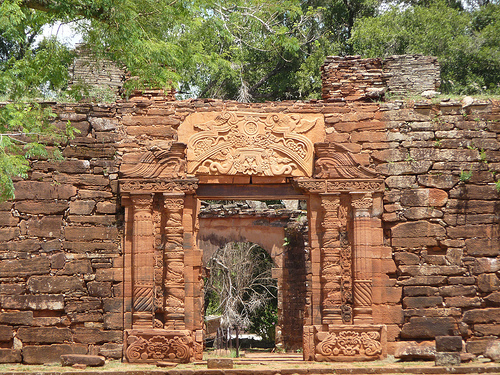
destruction. Ornamented portals and carved details remain among the most
striking surviving features. The urban layout followed the typical
Jesuit reduction plan: the church and cabildo (town hall) fronted the
plaza, with the priests’ residence, school, refectory, workshops,
cemetery, cotiguazú (house for widows and orphans), and gardens arranged
around it. Guarani dwellings occupied surrounding blocks.
Decline, Destruction, and Abandonment
The 1767 Suppression of the
Society of Jesus by the Spanish Crown (under King Charles III) led to
the Jesuits’ expulsion from Spanish territories. The priests left San
Ignacio Miní in 1768, after which secular authorities assumed control
and the community began a gradual decline. In 1817, during regional
conflicts linked to independence movements in the Banda Oriental (modern
Uruguay), Luso-Brazilian forces destroyed and burned the mission, along
with other reductions in the area. Subsequent Paraguayan raids in 1821
further devastated attempts at resettlement by remaining Guarani groups
under leaders such as cacique Cristaldo. The site was abandoned,
overgrown by dense subtropical forest, and largely forgotten for
decades.
Rediscovery, Restoration, and Heritage Status
Explorers rediscovered the overgrown ruins in 1897. Wider public
interest followed a 1903 expedition led by Argentine poet Leopoldo
Lugones, which drew attention to the site’s cultural and historical
value. Formal archaeological exploration, clearing of vegetation, and
restoration work began in 1940 under architect Carlos Luis Onetto and
continued into the 1950s. These efforts stabilized walls, restored key
structures, and transformed the ruins into a protected monument.
Argentina declared San Ignacio Miní a National Historic Monument in
1943.
In 1984, UNESCO inscribed the site as part of the transnational
World Heritage property “Jesuit Missions of the Guaranis,” which also
includes the Argentine missions of Santa Ana, Nuestra Señora de Loreto,
and Santa María la Mayor, as well as São Miguel das Missões in Brazil.
The designation recognizes the exceptional urban, architectural, and
social organization of these reductions and the cultural exchange
between Jesuit missionaries and Guarani communities. San Ignacio Miní is
widely regarded as the best-preserved Jesuit mission ruins in Argentine
territory. Today it lies within the town of San Ignacio, about 56–60
kilometers north of Posadas, and houses the Museo Jesuítico de San
Ignacio Miní. Visitors can explore the central plaza, church ruins with
their carved portals, remaining residential blocks, and interpretive
exhibits that present both Jesuit and Guarani perspectives. A
sound-and-light show is sometimes offered in the evenings.
The ruins
stand as a testament to the unique experiment of the Jesuit-Guarani
reductions—communities that combined religious mission, economic
self-sufficiency, and cultural synthesis for more than a century before
external conflicts brought their abrupt end.
San Ignacio Miní exemplifies the "Guaraní Baroque" architectural
style, a fusion of European Baroque elements with indigenous motifs and
local materials. Constructed primarily from red sandstone sourced from
the region, the structures feature thick walls (approximately 2 meters)
that have endured for over two centuries. The layout followed a
standardized Jesuit mission plan: a central plaza surrounded by key
buildings, including the church, cabildo (town hall), cemetery,
monastery, and residential houses.
The centerpiece is the church,
designed by Italian Jesuit architect Juan Brasanelli, measuring 74
meters in length and 24 meters in width. It includes ornate portals,
such as the restored lateral (eastern) and main entrances, adorned with
intricate carvings like fan-like patterns, Greek-style columns, and
Jesuit symbols. Surrounding the plaza are remnants of workshops, a
college with residences, schools, and a vegetable garden, emphasizing
the mission's self-sufficiency. Indigenous dwellings, visible along
wooded paths, highlight the communal living arrangements. The cemetery
is divided into sections for men, women, children, and infants,
reflecting social organization. Overall, the architecture reflects the
Jesuits' efforts to create ordered, functional spaces that integrated
Guarani craftsmanship, such as decorative elements influenced by local
traditions.
As part of the Jesuit Missions of the Guaranis, San Ignacio Miní
illustrates the complex interplay between European colonialism and
indigenous societies. The missions represented a form of "utopian"
socialism, where Guarani people were organized into productive
communities protected from slavery, while being converted to
Christianity. This system included economic activities like mate
plantations, ranches, and trade networks, fostering a unique cultural
synthesis. The site meets UNESCO Criterion (iv) for being an outstanding
example of architectural and building ensembles from a significant
historical period, symbolizing Jesuit evangelization in South America.
However, this era was not without controversy; the missions have been
critiqued for cultural imposition and the disruption of traditional
Guarani ways of life, though they also provided refuge from more
exploitative colonial practices. The ruins serve as a reminder of the
broader history of Spanish-Portuguese rivalries and the impacts of the
Jesuit suppression on regional development.
San Ignacio Miní was inscribed as a UNESCO World Heritage Site in
1984, alongside other Guarani missions, covering a total area of 265.78
hectares across the serial property. In Argentina, it is protected as a
National Historic Monument (designated in 1943) under Provincial Law
1280 of 1983 and managed by the National Commission for Museums,
Monuments, and Historic Places. Conservation efforts include restoration
by the National Architectural Service, with ongoing projects to maintain
integrity amid urban encroachment.
The site was featured in the 1996
World Monuments Watch list, leading to repairs funded by organizations
like American Express, including portal restorations. An interpretation
center and the Museo Jesuítico de San Ignacio Miní enhance educational
value. As of 2025, management involves periodic reporting, tourism
promotion, and international collaborations, such as workshops from
2005–2007 supported by the World Monuments Fund. While no major threats
are reported, long-term plans focus on sustainable conservation and
socio-economic integration with local communities.
The mission was first established in 1610 in the Guayrá region
(present-day Brazil) by Jesuit priests José Cataldino and Simón Maceta.
Repeated attacks by Brazilian bandeirantes forced several relocations.
The community settled at the present site in 1696. At its height it
housed roughly 3,300–4,500 Guaraní inhabitants organized around a
central plaza, church, workshops, residences, cemetery, and gardens.
After the expulsion of the Jesuits in 1767 the reduction declined; it
was largely destroyed in 1817. The ruins, built in the distinctive
Guaraní Baroque style using local red sandstone, were rediscovered in
the late 19th century and restored in the 1940s. In 1984 they were
inscribed on the UNESCO World Heritage List as part of the Jesuit
Missions of the Guaranis.
What Visitors See
Entry is through a
colonial-style building that houses a small museum focused on
archaeology and the history of the missions (most labels are in Spanish,
with limited English). The ruins themselves occupy a park-like setting.
The main church, originally about 74 meters long, retains substantial
walls, arched openings, columns, and carved ornamentation, some
supported by scaffolding. Surrounding structures include the priests’
residence, workshops, a college area, vegetable gardens, and the
cemetery. Paths lead through woodland to the stone foundations of
Guaraní houses, giving a sense of the original urban layout. The overall
atmosphere is calm and immersive, especially early in the day.
A
Centro de Interpretación (interpretation center) offers additional
context through multimedia displays, models, and exhibits on Guaraní and
Jesuit life. In the evenings (typically Thursday to Sunday, subject to
weather and demand) an Imagen y Sonido (image-and-sound) show projects
light and narrative onto the walls for about 45 minutes; this requires a
separate ticket purchased on site.
Practical Information
Hours: Open daily roughly 7:30 a.m. to 6:00 p.m., with visitors allowed
to remain until about 6:30 p.m. Last guided tours usually leave around
5:30 p.m. Confirm current times locally.
Fees (approximate, updated
periodically): As of September 2026 official rates listed general
admission for foreigners around 22,000 Argentine pesos, with lower tiers
for Argentine residents (around 10,000) and Misiones residents (around
5,000). Children under six, people with disabilities, and certain local
students often enter free with documentation. The daytime ticket covers
the four main mission sites for 15 days. The evening show uses the same
price categories but is paid separately. Rates change; check the
official Misiones tourism site or the on-site ticket office.
Getting
there: The ruins lie about 60–64 km north of Posadas along National
Route 12 (roughly one hour by bus or car). From Puerto Iguazú the
distance is about 240 km (approximately three hours). Frequent buses run
along the highway; from the San Ignacio bus station the ruins are a
short walk (cross the road, head north a couple of blocks, turn left
after the rise, and continue a short distance). Day tours from Puerto
Iguazú are also available, sometimes combined with other stops such as
the Wanda mines.
Tips: Most on-site information is in Spanish, so an
audio guide, app, or guided tour helps. Tropical humidity is
common—arrive early to avoid the strongest heat and larger crowds. Wear
comfortable shoes, bring water and sun protection, and check local
conditions or any temporary adjustments before visiting. The site is
open year-round.