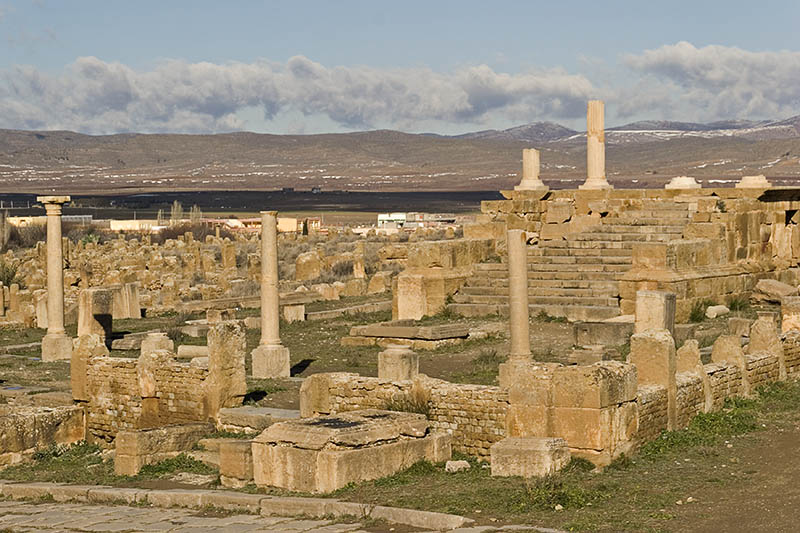
Location: village of Tazoult Map
7 miles (11 km) Southeast of Batna
17 miles (27 km) West of Timgad
Found: 123- 129 AD
Lambaesis (also spelled Lambæsis, Lambaisis, or
Lambaesa; modern Tazoult-Lambèse in Algeria) was one of the most
important Roman military installations in North Africa and the
permanent headquarters of Legio III Augusta, the only legion
permanently stationed on the entire African continent for nearly
three centuries. Located 11 km southeast of Batna and 27 km west of
the famous colony of Timgad (Thamugadi), in the Batna Province at
about 622 m elevation on the lower slopes of the Aurès Mountains, it
controlled the strategic corridor between the Sahara and the
Mediterranean.
The site today consists of extensive but partially
ruined military and civilian remains—fortress walls, the principia
(headquarters), temples, triumphal arches, an amphitheatre, baths,
aqueducts, and private houses—making it one of the best-preserved
examples of a 2nd-century Roman legionary fortress anywhere in the
empire.
Early History and Pre-Roman Context (1st Century CE)
The area
around Lambaesis had strategic value long before the Romans arrived,
lying in the heart of ancient Numidia near Berber (Numidian/Moorish)
territories. There is no strong evidence of a major pre-Roman
settlement at the exact spot, but the region was contested during
the Punic Wars and Jugurthine War. Roman military interest began in
earnest after the annexation of Numidia.
An initial auxiliary
outpost or subunit of Legio III Augusta occupied the site as early
as c. 81 CE (under Vespasian or Domitian), possibly as a forward
base while the main legion was still at Theveste (modern Tébessa).
The full transformation into the legion’s permanent castra (camp)
occurred between 123 and 129 CE under Emperor Hadrian, when he
transferred the legion here from Theveste to better secure northern
Numidia against Saharan nomadic tribes and Berber resistance.
Hadrian’s Visit and the Golden Age of the Legionary Base
(128–early 3rd Century CE)
Hadrian personally inspected the
troops in 128 CE during his grand tour of the provinces. He watched
military exercises (exercitatio) on a parade ground 2 km west of the
fortress and delivered a famous adlocutio (address) to the legion
and attached auxiliary units (e.g., Ala I Pannoniorum and Cohors VI
Commagenorum). A monumental inscribed pillar (discovered in the
second camp) records his speech in detail: he praised the legion’s
engineering feats (building a full camp in one day on rocky ground),
their discipline, and their ability to construct field
fortifications, while gently criticizing cavalry tactics. This
inscription is one of the most important surviving documents of
Roman military life.
The fortress itself was a massive
rectangular enclosure (roughly 500 × 450 m) laid out in the classic
“playing-card” plan with gates, barracks, baths, an arsenal
(containing thousands of projectiles), and the central principia
(headquarters building). The principia included the aedes signorum
(sanctuary of the standards) under which archaeologists recently
identified a purpose-built carcer castrensis (military prison)—a
rare subterranean cell block with five distinct chambers, graffiti,
and architectural parallels to other North African carceral sites.
Civilian life quickly developed around the camp. By 166 CE the
associated vicus (settlement) already had ten named curiae (wards).
Under Marcus Aurelius (161–180 CE) it was elevated to municipium
status, and under Septimius Severus (193–211 CE) Lambaesis became
the capital of the newly separated province of Numidia. It received
the title Colonia Lambaesitanorum and attracted Roman veterans,
merchants, and Romanized Berbers. Latin was the official language,
though local Berber dialects with Latin loanwords persisted.
The site flourished with monumental architecture:
Two triumphal
arches (one dedicated to Septimius Severus, another to Commodus).
Temples to Jupiter, Juno, Minerva (Capitolium), Aesculapius (with a
surviving column), and a Mithraeum built by legionary officers.
An amphitheatre, public baths, aqueduct, and numerous private
houses.
Over 4,000 inscriptions (many now in the Tazoult museum
or Algiers), providing an extraordinarily detailed picture of
legionary careers, cults, and daily life.
3rd–4th Centuries:
Crisis, Restoration, and Decline
In 238 CE, during the Year of
the Six Emperors, Legio III Augusta sided with Gordian III and was
disbanded as punishment. The camp was briefly abandoned, but the
legion was restored around 253 CE by Valerian and Gallienus (as
Legio III Augusta Restituta). The principia was renovated under
Gallienus, and the grand praetorium (commandant’s residence) visible
today dates to 268 CE.
The legion finally departed around 392 CE
(under Theodosius I or later), after which the town rapidly
declined. Vandal raids and desertification accelerated the decay.
The Byzantines reoccupied parts of the region in the 6th century,
but the site never regained its former glory. Arab forces conquered
the area c. 683 CE; by the 10th century the ruins were known locally
as Bar-el-Molouk (“the king’s wells”).
Modern Era: French
Colonial Discovery and Excavation (19th–21st Centuries)
French
forces occupied the region in the 1830s–1840s. The modern village of
Tazoult (Lambèse) was founded in 1848 by agricultural colonists
attracted to the fertile soil. In 1852 the French established a
large convict prison for political deportees right next to the
ruins; many Roman stones were reused in its construction, and some
monuments were lost.
Systematic excavations began in the 1840s
under officers such as Colonel Carbuccia of the Foreign Legion.
Major campaigns in the 1880s–1890s (including work by incarcerated
Algerians in 1897–98) uncovered the principia, temples, and
inscriptions. The famous Hadrian inscription and many
statues/mosaics were removed to museums in Algiers, Paris (Louvre),
or left in the small on-site museum (now part of the Tazoult
collection).
In the 20th century the site was classified as a
protected Algerian monument (1900) and fenced. A 2021 archaeological
study definitively identified the underground prison beneath the
aedes signorum, adding a new chapter to our understanding of Roman
military justice.
Today Lambaesis is a fenced archaeological park
with ongoing (if underfunded) conservation. Vandalism, erosion, and
limited resources remain challenges, though it is occasionally
compared to nearby UNESCO sites like Timgad for potential future
protection. The adjacent Tazoult museum displays statues
(Aesculapius, Hygieia), mosaics, and hundreds of inscriptions that
continue to illuminate Roman North African history.
The camp (castrum) was laid out in classic Roman military fashion
with defensive walls, towers, four main gates, and the standard grid of
streets (via principalis east-west and via praetoria north-south
intersecting at the center).
The Groma (often miscalled the
“Praetorium”): This is the site’s most iconic and best-preserved
standing monument—the monumental four-sided arch/gateway at the heart of
the camp, serving as the grand entrance to the principia (headquarters
complex). Dating mainly to ~AD 268 (with possible earlier 2nd-century
foundations and later restorations under Gallienus, Diocletian, and
Maximian), it measures roughly 28 m × 20 m (92 ft × 66 ft) at the base
and stands about 15 m (49 ft) high. The southern façade features a
splendid peristyle: a front row of massive Ionic columns with an engaged
row of Corinthian pilasters rising halfway up the wall. Keystones bear
reliefs of legion standards (including “LEG III AUG”), victories, and
laurel wreaths. It allowed wheeled and pedestrian traffic through
multiple arches and included an upper level possibly used as a
guardhouse. Behind it lay a large paved courtyard (65 m × 37 m) with a
colonnaded portico leading to the basilica, offices, armories, and the
aedes signorum (shrine of the standards).
Principia
(Headquarters): Centered on the groma, this included a basilica with
three naves, apses for official functions, and the underground sanctuary
of the standards that doubled as a military prison (carcer castrensis)
with five cells—unique evidence of Roman military justice. An altar to
Disciplina (military discipline personified as a goddess) was found
here.
Other Camp Features: Barracks, officer housing with courtyards,
workshops, storage, a hospital, and an arsenal (thousands of projectiles
were recovered). The camp could house ~6,000 soldiers. Parts were later
reused for a 19th-century French prison.
Major Landmarks of the
Civilian Town and Surroundings
The town sprawled around the camp’s
southern and eastern sides, with its own grid of streets, forum area,
and public buildings.
Amphitheatre: Located ~200 m east of the
camp, built in AD 169 under Marcus Aurelius and restored in AD 180 and
194. It had an estimated capacity of 12,000 spectators. The elliptical
structure is now heavily ruined—French colonial authorities quarried
much of the seating stone in 1852 for the prison—but the core arena and
some substructures remain visible.
Triumphal Arches: Two major
examples survive. The Arch of Septimius Severus stands at the edge of
the civilian town (marking its formal entrance), built by the legion.
The Arch of Commodus (c. AD 180–192) lies east of the camp. Both are
single- or multi-bay structures with pilasters; they are among the
best-preserved freestanding arches on the site.
Temples and
Sanctuaries:
Temple of Aesculapius (Asclepius) and Hygieia/Salus: A
healing sanctuary dedicated by the legion in AD 162. Only one column
stands today (the full Ionic façade was intact in the mid-19th century).
Statues of Aesculapius and Hygieia recovered here are now in the local
museum.
Capitolium: Dedicated to Jupiter, Juno, and Minerva (plus the
Genius of the Colony), built AD 246 and restored later. It featured an
eight-column porticoed façade within a rectangular precinct.
Additional shrines to Silvanus and local deities, plus a Severan
Septizonium (monumental nymphaeum/fountain with seven niches, built AD
203 and restored under Alexander Severus).
Baths (Thermae) and
Aqueduct: Multiple bath complexes exist, including one near the Severus
arch with preserved mosaics. Fragments of the aqueduct that supplied the
town and camp are still traceable.
Private Houses and Infrastructure:
Extensive remains of masonry from homes, streets, and a possible small
forum. Over 2,500 camp-related inscriptions and thousands more from the
town provide rich epigraphic evidence.
Cemeteries: Vast necropolises
lie to the north and east (tombstones still in original alignments) and
west (many stones reused for modern buildings). They offer insight into
legionary and civilian burial practices.
Current State and
Visiting
Despite centuries of stone-robbing, vandalism, and
19th-century colonial reuse (the French built a prison and farmhouses
from the ruins), Lambaesis remains one of North Africa’s most important
Roman military sites. The fenced area is accessible (though facilities
are limited), and a small museum in Tazoult holds statues, mosaics
(including Apollo and Cyrene), and inscriptions—though it has been
reported as dusty or occasionally closed.
Many visitors combine it
with nearby Timgad for a fuller picture of Roman Numidia. The site
evokes a melancholic, windswept frontier outpost—quiet, sun-baked stone
ruins against the Aurès backdrop—perfect for history enthusiasts
interested in Roman army life rather than grand imperial cities.