Location: Malanje Province Map
Area: 600 km²
Cangandala National Park is Angola's smallest national park, covering an area of approximately 630 square kilometers (240 square miles), though some sources note it as 600 square kilometers. Located in the Malanje Province in north-central Angola, it lies between the Cuije River to the north and two unnamed tributaries of the Cuanza River to the east and west. The park is bordered by the towns of Techongolola to the south and Culamagia to the east. Established initially as an Integral Nature Reserve on May 25, 1963, it was reclassified as a national park on June 25, 1970, primarily to safeguard the critically endangered giant sable antelope (Hippotragus niger variani), which is endemic to Angola and serves as the country's national symbol. Also known locally as Malange National Park, it represents a vital conservation area in Angola's central highlands, emphasizing the protection of unique biodiversity amid the country's post-colonial and post-civil war recovery efforts.
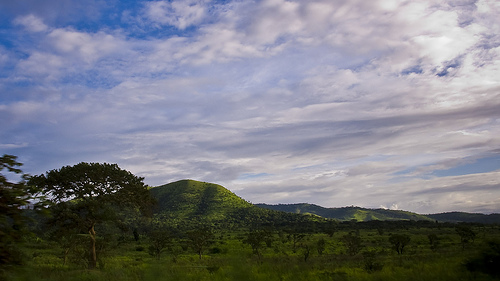
The park's landscape is characterized by flat to undulating terrain within the Angolan savanna biome, featuring open miombo woodlands interspersed with grasslands and denser forest patches along river courses. The vegetation is dominated by tree species such as Brachystegia, Julbernardia, Piliostigma, Burkea, Monotes, Strychnos, Sterculia, and Dombeya, with papyrus swamps and seasonal wetlands forming along the rivers due to the influence of the Cuanza River system. This creates a mosaic of habitats, including riverine forests and open savannas, which support a range of ecological niches. The region experiences a tropical climate with distinct wet and dry seasons, receiving an average annual rainfall of about 1,350 millimeters, which sustains the lush woodlands and contributes to the formation of temporary water bodies during the rainy period. The park's elevation and sandy soils (often described as undulating sandlime or sandy substrates) further shape its ecology, making it resilient yet vulnerable to seasonal fluctuations.
Cangandala National Park (Parque Nacional da Cangandala) is Angola’s
smallest national park, covering roughly 600–630 km² in Malanje
Province, north-central Angola. It lies on the Angolan plateau
within the Cuanza (Kwanza) River drainage basin, between the Cuije
River (northern boundary) and tributaries such as the Maúndo and
Cuaza. The landscape consists of classic miombo woodlands (dominated
by Brachystegia and Julbernardia trees), open grasslands, seasonal
floodplains, and glades—an ideal habitat mosaic for the park’s
flagship species.
The park’s name derives from the Mbunda
language spoken by local peoples in the region (“canga” referring to
iron/metal and “ndala” to blacksmiths), reflecting the area’s
historical association with metalworking communities. It is
sometimes informally called Malange National Park. While the broader
Malanje region has ancient ties to Mbundu-speaking peoples and
pre-colonial trade routes of the Lunda and Kasanje kingdoms, the
park itself has no significant pre-colonial protected-area history;
its story is one of modern conservation centered almost exclusively
on the giant sable antelope (Hippotragus niger variani), known
locally as the palanca negra gigante. This striking subspecies—males
with deep black coats and exceptionally long, curved horns up to 1.6
m—is Angola’s national symbol, appearing on currency, emblems, and
folklore. Local tribes such as the Lwimbi and Songo traditionally
regarded it with totem-like reverence and secrecy, helping shield it
from outsiders for centuries. Western science first documented it in
the early 20th century (sightings around 1909–1916 by explorer
Thomas Varian).
Establishment Under Portuguese Colonial Rule
(1960s–1975)
The park’s formal protection began during the final
years of Portuguese colonial administration. In 1963 it was first
designated an Integral Nature Reserve (or game reserve) specifically
to safeguard a small but viable population of giant sable antelopes
that roamed the miombo woodlands. On 25 June 1970 it was officially
proclaimed a national park (Decree or equivalent colonial
legislation), with the explicit goal of protecting this critically
endangered subspecies. At the time, the giant sable was already
recognized as distinct and rare; pre-war estimates placed roughly
150 individuals in what would become Cangandala, out of a regional
total of 2,000–2,500 across Cangandala and the adjacent Luando
Strict Nature Reserve to the south.
The 1960s–early 1970s
represented a brief “golden era” for the park under colonial game
laws, with some enforcement and research. However, Angola’s broader
independence struggle (beginning in the 1960s) already foreshadowed
instability.
The Angolan Civil War and Near-Extinction
(1975–2002)
Angola gained independence from Portugal in 1975,
triggering a devastating 27-year civil war (1975–2002) between MPLA
government forces, UNITA rebels, and other factions. Cangandala,
like virtually all Angolan protected areas, was abandoned.
Infrastructure was destroyed, management collapsed, and the park
became a no-go zone amid widespread conflict, displacement, and
militarization. Malanje Province suffered heavily, with sieges on
the provincial capital and military activity spilling into the
woodlands (including reported presence of foreign-backed forces).
The giant sable suffered catastrophic losses from poaching (for
bushmeat to feed soldiers and civilians), habitat disruption,
starvation, and uncontrolled fires. By the mid-1980s sightings had
become extremely rare; the last reliable pre-2000s records date to
around 1982. Post-war surveys initially found no confirmed animals,
leading scientists worldwide to fear the subspecies was extinct.
Hybridization emerged as a new threat: with so few pure giant sables
left, surviving females in Cangandala mated with more numerous roan
antelopes (Hippotragus equinus), producing infertile or genetically
compromised hybrids (identifiable by floppy ears and atypical
markings). By the early 2000s, the park held only about nine pure
giant sable females and no breeding males.
Post-War
Rediscovery and the Rescue Mission (2002–2010s)
Peace arrived
with the 2002 ceasefire. Angolan biologist Dr. Pedro Vaz Pinto, who
had returned from studies in Portugal, became the driving force
behind the species’ salvation. Appointed environmental adviser to
the Catholic University of Angola and head of the Giant Sable
Antelope Conservation Project (supported by the Kissama Foundation
and later international partners), Vaz Pinto began intensive field
surveys in Cangandala in 2002–2003. Working with local Songo
“shepherds” and rangers, his teams walked hundreds of kilometers
through the woodlands.
In 2004–2005, motion-activated camera
traps placed near sodium-rich termite mounds (a favorite grazing
spot) captured the first photographic evidence of giant sables in
nearly three decades—confirming survival in Cangandala. This
“dramatic conservation moment” electrified the global conservation
community. DNA analysis and ground tracking revealed the tiny
population’s precarious state: nine females (some already
hybridized) and no resident bulls.
Vaz Pinto’s team built a
secure 17-square-mile (≈4,400 ha) fenced sanctuary inside the park.
They captured the remaining pure females and their hybrid offspring
(sterilizing the hybrids to prevent further genetic swamping). The
critical missing piece was males. In 2009, an audacious
helicopter-based capture-and-translocation operation brought bulls
from the larger Luando Strict Nature Reserve (≈60 miles south) to
Cangandala. One dramatic moment involved tranquilizing a 500-pound
bull exactly where dung DNA had indicated its presence; it was
airlifted north to join the females. This marked the start of the
world’s first in-situ captive breeding program for the giant sable.
Locals celebrated the arrival with tears, songs, and dancing.
Recovery, Modern Management, and Ongoing Challenges
(2010s–Present)
The breeding program has been a remarkable
success. From a low of ≈9–10 pure individuals, the Cangandala
sanctuary herd has grown to roughly 100 animals (as of recent
estimates circa 2020–2025), with the total subspecies population
(Cangandala + Luando) rebounding to ≈250–300. Regular monitoring
uses GPS collars, camera traps, aerial censuses, genetic sampling,
and anti-poaching patrols. Vegetation has regenerated significantly
since the war. Hybridization is now managed, and veterinary
interventions treat injuries or illness.
In 2018, Presidential
Decree No. 260/18 approved the Statute of the Cangandala National
Park Management Service, formalizing governance under the Angolan
Ministry of Environment. Community outreach engages nearby villages,
and limited eco-tourism (hiking, birdwatching) is promoted as a
sustainable revenue source, though the park remains primarily a
strict conservation site rather than a big-game destination.
Challenges persist: poaching (though largely controlled inside the
sanctuary), funding shortages (exacerbated by Angola’s economic
pressures and global events like the pandemic), occasional
aggressive bull behavior within the enclosure, and the subspecies’
overall critically endangered status. The park and Luando remain the
only places on Earth where pure giant sables survive. Ongoing
collaboration between the Angolan government, the Giant Sable
Project, and international partners continues to focus on habitat
restoration, genetic purity, and expanding the population toward
self-sustaining viability.
Cangandala National Park boasts unique biodiversity, centered around
its role as a haven for the giant sable antelope, but extending to a
variety of other species. The giant sable, known for its impressive
curved horns and dark coat, is the flagship species, with the park
hosting one of only two remaining wild populations in Angola (the
other in Luando Reserve). As of 2021, the total population was
estimated at around 300 individuals, with about 100 in Cangandala
itself. These antelopes have specialized feeding habits, preferring
tree leaves at heights of 40–140 millimeters, which may contribute
to their vulnerability. Other mammals include various antelope
species, zebras, and smaller herbivores adapted to the savanna
environment.
The flora is diverse, with miombo woodlands
providing a canopy for understory plants and supporting the park's
herbivores. Grasslands and riverine areas add to the habitat
variety, fostering seasonal wetlands that attract wildlife.
Avifauna is particularly noteworthy, drawing birdwatchers to the
park. Notable bird species include the Guinea turaco, pale-billed
hornbill, Finch's francolin, Anchieta's barbet, red-capped crombec,
Angola babbler, Souza's shrike, sharp-tailed glossy starling,
broad-tailed paradise whydah, and miombo tit. The park's woodlands
and swamps create ideal conditions for these and other species,
though comprehensive bird lists are limited due to historical
inaccessibility. Recent herpetological surveys have also highlighted
the park's reptile and amphibian diversity, contributing to Malanje
Province's status as a herpetological hotspot in Angola, with
species like skinks and other endemics potentially present.
Conservation in Cangandala is inextricably linked to the giant sable
antelope, listed as critically endangered on the IUCN Red List and
protected under CITES Appendix I, where hunting is strictly
forbidden. Post-civil war recovery has involved camera trapping,
population monitoring, and habitat restoration, with initiatives
like "Operation Noah's Ark" in the 2010s aiming to bolster numbers
through translocations and anti-poaching measures. The park benefits
from broader Angolan conservation frameworks, including
UNDP-supported projects combating illegal wildlife trade and
human-wildlife conflict, as well as GEF-funded efforts to enhance
national park management and climate resilience. Community
involvement and biodiversity surveys have been key, addressing
Angola's paradox of rich natural resources amid historical
under-protection.
Major threats include poaching, which persists
despite protections, habitat degradation from human encroachment,
and climate change impacts on rainfall patterns. The civil war's
legacy left landmines and disrupted ecosystems, while limited
infrastructure hampers enforcement. Illegal wildlife trade remains a
concern, as does potential human-wildlife conflict in surrounding
areas. Despite these challenges, the park's role in preserving
Angola's endemic species underscores its importance, with ongoing
rediscovery and recovery programs offering hope for stabilization.
The park is primarily a destination for hiking and nature immersion, offering trails through its woodlands and opportunities to appreciate Angola's natural beauty in a relatively undisturbed setting. Birdwatching is a highlight, given the diverse avifauna, while wildlife viewing focuses on the elusive giant sable, though sightings are rare and require guided tours for safety and conservation reasons. Access is typically via Malanje city, the provincial capital, though detailed travel routes are sparse due to Angola's developing tourism infrastructure. Visitors should prepare for basic facilities, potential seasonal road inaccessibility during rains, and the need for permits from Angolan authorities. The park's significance extends beyond ecology; as a symbol of national pride tied to the giant sable, it embodies Angola's commitment to biodiversity amid its vast, under-explored wilderness, contributing to global efforts in conserving African savannas.