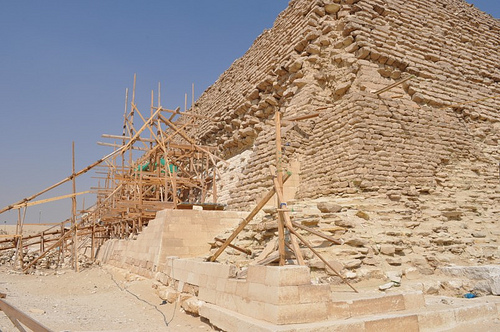
Location: Map
Abu Ghurab (also spelled Abu Gorab or Abu Gurob) is an ancient
Egyptian archaeological site located on the west bank of the Nile
River, approximately 1 kilometer (0.6 miles) north of Abusir and
situated between the larger necropolises of Saqqara to the south and
Giza to the north. This site, part of the broader Memphite
necropolis, dates primarily to the Old Kingdom's Fifth Dynasty
(circa 2494–2345 BCE), around 4,500 years ago, and is renowned for
its sun temples dedicated to the worship of the sun god Ra. Unlike
the more famous pyramid complexes, Abu Ghurab exemplifies a shift in
royal funerary architecture toward solar symbolism, reflecting the
growing prominence of heliocentric cults during this era. The site's
name derives from modern Arabic, but in ancient times, the temples
here were known by names like "Delight of Ra" for Nyuserre Ini's
temple.
The desert environment has preserved much of the site's
structures, though erosion, quarrying, and time have left them in
ruins. Abu Ghurab is less visited than nearby pyramids, offering a
quieter glimpse into ancient Egyptian religious practices. It
highlights the pharaohs' divine connection to Ra, where the king was
seen as the god's earthly representative, ensuring cosmic order
(maat) through rituals.
Abu Ghurab (also spelled Abu Gorab, Abu Gurab, Abu Gurob, or Abū
Jirāb) is a major archaeological site in Egypt’s Memphite necropolis,
located on the western bank of the Nile about 15 km (9.3 mi) south of
modern Cairo, between Giza/Saqqara and roughly 1 km north of the Abusir
pyramid field. It sits at the edge of the desert plateau and is best
known for its two preserved Old Kingdom sun temples dedicated to the god
Ra — rare monuments that highlight a unique chapter in ancient Egyptian
religious architecture and royal ideology during the 5th Dynasty (c.
2494–2345 BCE).
Unlike the more famous pyramids nearby (which focused
on the king’s afterlife), these open-air sun temples emphasized the
pharaoh’s divine connection to the sun god Ra during his lifetime,
reflecting the 5th Dynasty’s strong emphasis on solar cult worship.
Ancient texts record that as many as six (or possibly seven) such
temples were built by 5th-Dynasty kings, but only two have been fully
identified and excavated until very recent discoveries expanded the
picture.
Early History: Early Dynastic Cemetery (c. 3100–2900
BCE)
Long before the sun temples, Abu Ghurab served as a burial
ground during the Early Dynastic Period, specifically the 1st Dynasty.
North of the later Nyuserre temple lies a cemetery used for
middle-ranking officials and members of society. Burials continued
sporadically into the 5th Dynasty before the area was largely abandoned
as a necropolis. This early use underscores the site’s long sacred
significance in the broader Memphis region.
The 5th Dynasty and
the Rise of Sun Temples
The 5th Dynasty marked a religious shift.
After the monumental pyramid-building of the 4th Dynasty, kings
increasingly promoted the cult of Ra (the sun god) as the central deity,
possibly to legitimize their rule. Sun temples were built as standalone
cult centers (sometimes linked to nearby pyramid complexes) where the
king could be presented as the living son of Ra. Offerings, festivals,
and daily rituals sustained the sun’s eternal cycle.
The two
confirmed temples at Abu Ghurab belong to:
Userkaf (first king of
the 5th Dynasty, r. c. 2494–2487 BCE) — his temple, named Nekhen-Re
(“Stronghold of Ra”), is the earlier and more ruined of the two.
Nyuserre Ini (sixth king, r. c. 2445–2421 BCE) — his temple, named
Shesep-ib-Re (“Favorite Place of Ra” or “Joy of Re”), is the largest,
best-preserved, and most thoroughly studied example.
Recent
research (2021–2022) revealed an even earlier mudbrick sun temple
beneath Nyuserre’s structure, and 2024–2025 excavations uncovered its
long-lost valley temple, dramatically expanding our understanding.
Userkaf’s Sun Temple
Userkaf’s temple was the first of its kind.
It originally may have resembled a mastaba (low, flat-topped tomb)
before a squat obelisk was added. Heavily damaged and less well
preserved than Nyuserre’s, it was excavated in the mid-20th century
(primarily by Herbert Ricke in the 1950s–60s). It provided key evidence
of daily rituals, including records of offerings (two oxen and two geese
per day). Like later temples, it featured an open courtyard for direct
sun worship.
Excavation History and Recent Discoveries
1898–1905: Borchardt/von Bissing excavation of Nyuserre’s upper temple;
many reliefs went to Berlin (some lost in WWII).
1950s–60s: Work on
Userkaf’s temple.
2010–present: Italian mission (with Polish and
Czech collaboration) re-examines the site, producing 3D reconstructions
and new publications.
2021–2022: Polish Academy of Sciences team
discovered a 4,500-year-old mudbrick predecessor temple beneath
Nyuserre’s (c. 60 × 20 m, with storage rooms, portico, beer jars, seal
impressions naming 5th/6th Dynasty kings).
2024–2025: Italian
discovery of the valley temple — one of the most important advances in
sun-temple studies in over a century.
Historical Significance
Abu Ghurab’s sun temples illuminate the 5th Dynasty’s religious
revolution: the elevation of Ra, the use of open-air architecture to
harness sunlight, and the integration of royal renewal (Sed festival)
with cosmic cycles. Reliefs provide rare glimpses into daily life,
ecology, and ritual practice. The site’s decline after Nyuserre
(sun-temple building largely ended) coincided with a return to more
traditional pyramid-focused cults under later kings.
Today, the ruins
are visible but not a major tourist draw — visitors often combine it
with Abusir. Ongoing Italian and Polish work continues to reveal new
layers, including potential earlier temples and festival inscriptions,
ensuring Abu Ghurab remains a living source of discovery about Egypt’s
“age of the great pyramids” and its solar religion.
This temple exemplifies Old Kingdom monumental architecture,
deliberately modeled on the tripartite layout of contemporary royal
pyramid complexes (valley temple, causeway, and upper temple) but
adapted for open-air solar rituals rather than enclosed funerary cults.
The design emphasizes light, the sun's daily cycle, purification, and
royal rejuvenation. Construction evolved in phases: an initial mudbrick
version (possibly overlying an even earlier pre-temple) was later
rebuilt in stone during Nyuserre's reign, with limestone as the primary
material, accented by high-quality alabaster and granite. Recent
Italian-Polish excavations (ongoing since 2010, with major valley temple
work in 2024–2025) have refined our understanding using laser scanning,
3D modeling, and Building Information Modeling (BIM), correcting earlier
reconstructions by Ludwig Borchardt (who excavated 1898–1901).
Tripartite Layout: Valley Temple, Causeway, and Upper Temple
The
complex follows a standard Old Kingdom processional axis aligned roughly
east-west, rising from the Nile floodplain to a natural limestone
outcrop/terrace (enhanced by artificial terraces for elevation). The
entire upper temple enclosure measures approximately 110 m × 70 m.
Valley Temple (Lower Temple): This served as the riverside entry
point and "landing stage" for boats arriving via the Nile or its
branches. Long thought unexcavated due to a high water table, about half
was uncovered in 2024–2025 by an Italian mission. It features a
monumental colonnaded portico with column bases (granite and limestone),
granite shingles, doorways with stone cladding, and a quartzite doorway.
A ramp likely connected it to the water, and a staircase led to the
roof—possibly for astronomical observations. Outside the entrance, a
carved stone block bears one of the earliest known public calendars,
listing festivals (e.g., the feast of Sokar, Min festival, and Ra
processions). The layout is unique among Memphite valley temples in
scale and ambition, underscoring Nyuserre's solar ideology. Later
domestic reuse (e.g., senet game pieces) is evident. It connects to the
upper temple via a covered causeway (likely decorated with reliefs).
Causeway: A covered processional corridor linking the valley and upper
temples, facilitating ritual movement and symbolizing the transition
from the earthly Nile realm to the solar cult area. Details are less
preserved but align with pyramid-complex standards.
Upper Temple: The
core ritual space on the elevated plateau. It is enclosed by a massive
limestone perimeter wall. An elongated entrance hall leads into a vast
open-air courtyard occupying roughly half the enclosure. The design
prioritizes openness to the sun, contrasting with dark, enclosed pyramid
temples.
Key Architectural Features of the Upper Temple
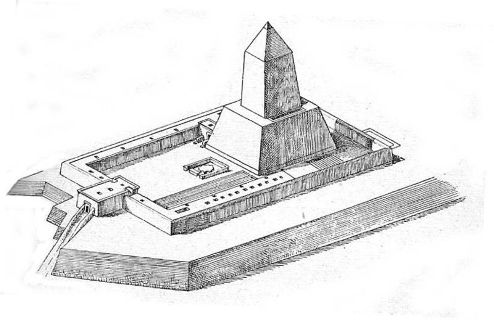
Central Obelisk (Benben Stone) and Pedestal:
The temple's focal point
is a massive obelisk representing the primordial mound and sun rays,
built of stacked limestone blocks (not monolithic) on a granite plinth
and a huge tapering pedestal (roughly 20 m high in classical estimates;
recent laser-scanning reassessments suggest the total height was more
modest, around 30–35 m rather than Borchardt's overstated 56 m). The
obelisk has steeply sloping sides (c. 76°). A small "Chamber of the
Universe" (a dark limestone room) lies south of it, with an internal
ladder access; its walls feature reliefs of plants, animals, and natural
cycles, symbolizing fertility/death transitioning to solar rebirth
(south-to-north axis).
Alabaster Altar:
East of the obelisk in
the open courtyard stands one of the most impressive features: a
monumental altar of four (or five) huge alabaster slabs arranged in the
shape of the hetep ("offering" or "satisfied") hieroglyph, with a
central sun-disk motif. This symbolized Ra's satisfaction and was used
for daily offerings. Its precise carving and scale highlight the
temple's high-quality stonework.
Northern Functional Areas:
Storehouses/Magazines: Ten elongated rooms oriented north-south,
accessed via small doorways inscribed with the royal protocol. These
stored offerings, ritual equipment, and provisions.
Purification
Area: Adjacent is a wide open-air zone with 9–10 (originally 10) finely
carved circular alabaster basins aligned east-west along grooved
pavements with drainage channels. A second set of limestone basins may
exist further north. These facilitated ritual lustration (cleansing) and
possibly offerings or animal processing, emphasizing purity in solar
worship.
Southern Cultic Rooms:
Two main chambers: the
"Chapel" with finely carved reliefs of the king's Sed-festival (royal
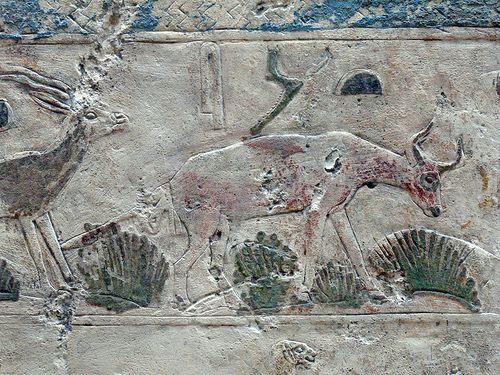
rejuvenation jubilee) and the "Room of the Seasons" depicting the three
Egyptian seasons with detailed scenes of nature, agriculture, animals,
and human activities—some of the finest Old Kingdom reliefs (many now in
Berlin museums). These rooms reinforced themes of cosmic order, royal
power, and the sun's life-giving cycle.
Additional Elements and
Construction Notes
Solar Boat: Outside the southeastern enclosure
wall lies a large mudbrick boat pit (c. 30 m × 10 m), containing a
symbolic "Maaty" boat for the king's eternal journey with Ra. It is now
reburied under sand.
Materials and Phases: Early mudbrick
construction (with plaster) was replaced by limestone core and facing,
with alabaster for ritual elements and granite for plinths/door
elements. Precision joints and dovetail cramps appear in some areas. The
temple underwent multiple building stages, with evidence of domestic
reoccupation later.
Userkaf's Temple (Nearby): For context, this
earlier structure (c. 2494–2487 BCE) began as a simpler mudbrick
rectangular enclosure with a central mound. Successors (including
Neferirkare and Nyuserre) added an obelisk on a pedestal and limestone
chambers. It shares the tripartite layout but is far less intact and
smaller in scale.
Significance of the Architecture
The design
integrates solar theology (open courtyard, obelisk as benben, east-west
solar axis) with royal ideology (Sed-festival scenes, purification
rituals). It was not a tomb but a living cult center for daily Ra
offerings and royal renewal. Ongoing 3D reconstructions by the
Italian-Polish mission (using laser scans and photogrammetry) provide
the most accurate modern visualizations, correcting 19th/20th-century
plans.
Abu Ghurab's temples underscore the Fifth Dynasty's theological
evolution, where Ra became central to kingship ideology. Rituals here
likely involved daily offerings to "feed" the sun god, ensuring the
Nile's floods and agricultural bounty. The reliefs portray the pharaoh
as intermediary between gods and people, reinforcing royal legitimacy.
Architecturally, the site innovated with open layouts and obelisks,
influencing later New Kingdom temples like those at Karnak.
Economically, endowments from these temples supported priesthoods and
estates, integrating religion with state administration.
Excavations began in the late 19th century by German archaeologists,
revealing the temples' layouts. In recent years, Polish-Egyptian teams
have uncovered artifacts like pharaonic seals and pottery, suggesting
the site was a hub for brewing and feasting rituals. A 2021 find of
mudbrick structures beneath Nyuserre's temple may confirm a previously
unknown sun temple, potentially built by an earlier king like
Shepseskare.
Today, Abu Ghurab faces threats from urban encroachment
and tourism, but it remains a vital site for understanding ancient
Egyptian cosmology. Visitors can access it via tours from Cairo, often
combined with Abusir and Saqqara. Ongoing research continues to unveil
its secrets, blending archaeology with insights into ancient engineering
and beliefs.