Location: Map
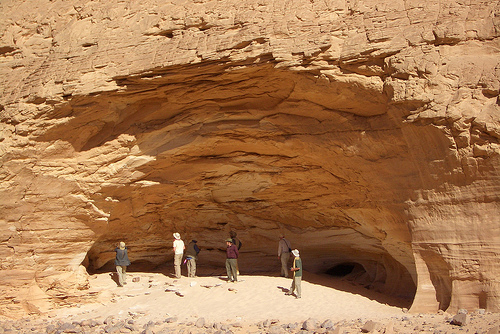
The Cave of Swimmers, also known as Wadi Sura I, is a prehistoric rock art site renowned for its Neolithic-era paintings that depict human figures in poses resembling swimming. Located in the remote southwestern corner of Egypt's Western Desert, it is part of the Gilf Kebir plateau, a vast sandstone massif in the Sahara often referred to as "the Great Barrier." Discovered in 1933 by Hungarian explorer László Almásy, the site gained international fame through its depiction in Michael Ondaatje's novel "The English Patient" and its 1996 film adaptation. The cave is not a deep cavern but a shallow rock shelter, housing artwork estimated to date between 6,000 and 9,000 years ago, during a period when the Sahara was a lush, savanna-like environment with lakes and rivers. This site exemplifies the Sahara's dramatic climatic transformation from a humid, life-sustaining region to one of the world's driest deserts, offering invaluable insights into prehistoric human life, art, and environmental history. As of 2025, it remains a focal point for archaeological research and conservation amid challenges from tourism and erosion.
The Cave of Swimmers is situated in Wadi Sura, translated as the "Valley of Pictures" or "Valley of Paintings," a sheltered inlet within a promontory of the Gilf Kebir plateau. This plateau, roughly the size of Switzerland and rising nearly 1,000 feet above the surrounding desert, spans southwestern Egypt and extends into southeastern Libya, forming part of the hyper-arid Libyan Desert. The site lies approximately 1,000 kilometers southwest of Cairo, near the border with Libya, in an isolated region characterized by sandstone formations, deep wadis (dry river valleys), and expansive sand seas like the Great Sand Sea to the north. The cave itself consists of two side-by-side shallow shelters under an overhanging rock face, providing natural protection for the artwork. Geologically, the area features ancient river systems and fossil lake beds, remnants of a wetter epoch. Nearby sites include the Cave of Beasts (Wadi Sura II), discovered in 2002 about six miles away, which contains nearly 8,000 images. The remote and rugged terrain makes access challenging, requiring specialized expeditions with off-road vehicles or camels, and the site's coordinates are around 23°35'N 25°30'E.
Today, the Gilf Kebir region endures an extreme hyper-arid climate, with annual rainfall less than 5 millimeters, scorching daytime temperatures often exceeding 40°C in summer, and nighttime lows dropping below freezing in winter. Windswept dust storms and intense solar radiation dominate, creating one of Earth's harshest environments. However, during the Neolithic period (approximately 9,000–6,000 years ago), the area experienced the African Humid Period, a phase of increased monsoon activity that transformed the Sahara into a verdant landscape with grasslands, lakes, and rivers. Evidence from sediment cores and fossil pollen indicates perennial water bodies supported diverse flora and fauna, enabling human habitation. This climatic shift around 4,000 BCE led to desertification, forcing populations to migrate. Modern climate change exacerbates aridity, posing risks to the site's preservation through accelerated erosion.
The Cave of Swimmers is a prehistoric rock shelter renowned for its
ancient rock art, situated in the remote Gilf Kebir plateau within
the Libyan Desert section of the Sahara, in southwest Egypt's New
Valley Governorate, near the Libyan border. Known locally as part of
Wadi Sura (meaning "Valley of Pictures"), it lies in a sheltered
inlet amid rugged sandstone formations. This site is one of the most
famous rock art locations in the Sahara, offering insights into
early human life in a region that was once far more hospitable than
the arid desert it is today.
Prehistoric Context: The Green
Sahara
The cave's artwork dates back to the Neolithic period
during the African Humid Period, roughly between 8000 BC and 4500
BC, when the Sahara was a lush savannah with rivers, lakes, and
abundant wildlife including gazelles, antelopes, lions, giraffes,
elephants, and hippopotami. This "Green Sahara" era resulted from
natural climatic shifts, such as changes in Earth's orbital tilt
(precession) that altered monsoon patterns, bringing increased
rainfall and vegetation. Human inhabitants were likely itinerant
hunter-gatherers who transitioned to pastoralism, herding cattle,
goats, and sheep. Some researchers, like archaeologist David Wright,
suggest that overgrazing by these early herders may have accelerated
desertification by degrading soil and reducing vegetation cover,
though this is debated due to low population densities at the time.
By around 4500 BC, monsoon belts shifted southward, leading to rapid
aridification and the migration of people and animals, transforming
the landscape into the hyper-arid desert seen today.
The Gilf
Kebir region, including Wadi Sura, is rich in rock art sites,
indicating it was a cultural hub during this wet phase. Nearby
shelters, such as the Cave of Beasts (discovered in 2001), feature
similar motifs and suggest evolving symbolic practices that may have
influenced later Nile Valley cultures.
Description of the
Rock Art
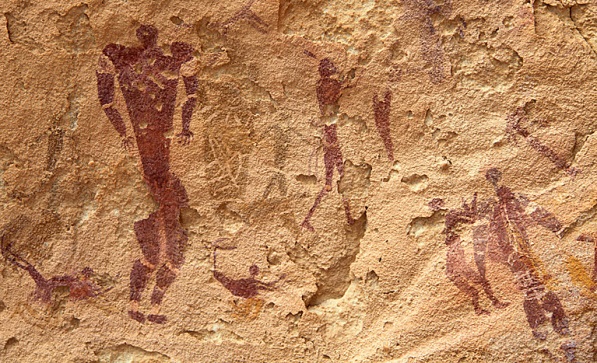
The cave's interior walls feature hundreds of
pictographs painted in red and yellow ochre, white kaolin, and
occasional brown hues, created using simple techniques like
finger-painting or brushes made from plant fibers. The most iconic
elements are diminutive human figures (about 10-20 cm tall) with
elongated bodies and limbs bent in postures resembling swimming—arms
outstretched and legs splayed. These "swimmers" form continuous
lines across the shelter, often interspersed with animals like
giraffes, cattle, hippopotami, and abstract shapes. Surrounding
sites in Wadi Sura, cataloged as Caves C, D, and F by ethnologist
Hans Rhotert, include panels of archers, female figures, engravings
of giraffes, and extended cattle scenes, highlighting a diverse
artistic tradition.
Dating estimates place the art in the Wadi
Sura style, around 6100-4800 BCE, based on stylistic comparisons and
associated archaeological evidence, though some sources suggest as
early as 8000 BCE.
Interpretations and Debates
Initial
interpretations viewed the figures as literal depictions of people
swimming in ancient lakes, possibly located 124 miles (200 km) south
of the site, reflecting a wetter climate. However, modern scholars
like Andras Zboray, Hans Rhotert, Jean-Loïc Le Quellec, and Yasser
Al-Laithy argue for symbolic meanings, suggesting the "swimmers"
represent deceased souls floating in primordial waters, akin to the
Egyptian concept of Nun (the watery chaos of the afterlife).
Parallels exist with ancient Egyptian texts like the Coffin Texts,
Book of Gates, and Book of the Dead, where drowned figures symbolize
the dead navigating the netherworld, guarded by headless or
devouring creatures. In the nearby Cave of the Beasts, similar
swimmers interact with large, headless beasts interpreted as defaced
animals or underworld guardians, possibly to neutralize their power
magically—a practice echoed in later Egyptian beliefs. These motifs
may indicate early conceptual developments that influenced Nile
Valley civilizations, bridging Saharan prehistoric art with
pharaonic Egypt.
Discovery and Exploration History
European exploration of Gilf Kebir began in the late 1920s with
figures like Ralph Bagnold, Patrick A. Clayton, Douglas Newbold, and
Kennedy Shaw, who conducted motor expeditions and aerial surveys.
Clayton discovered the "Giraffe rock" site in 1931. The Cave of
Swimmers itself was found in October 1933 by László Almásy during
the Frobenius expedition. Almásy documented it in his 1934 book The
Unknown Sahara, proposing the climate change theory, which was
groundbreaking but met with skepticism. Artist Elisabeth Pauli
recorded the paintings in detail using pigments like caput mortuum
and ultramarine. Post-World War II, archaeological research remained
limited, but sites like the Cave of Beasts were identified in 2001,
expanding knowledge of the area. In 2014, artifacts from early
explorers, including Pauli's materials, were rediscovered in the
cave.
The artwork in the Cave of Swimmers consists of hundreds of diminutive paintings in red and yellow ochre, white kaolin, and occasionally black, applied to the sandstone walls. The most iconic elements are small human figures (about 10–20 cm tall) with splayed limbs, interpreted as swimming or floating, often in groups. These are accompanied by depictions of animals such as giraffes, cattle, ostriches, and possibly dogs, as well as archers, female figures, and abstract motifs. Handprints, created by blowing pigment over splayed hands, adorn the walls, alongside engravings. The style is characteristic of the Wadi Sura tradition, dated to 6100–4800 BCE via associated pottery and tools. Nearby "Giraffe Rock," discovered in 1931 by Clayton, features engravings of giraffes, while other shelters (Caves C, D, and F) contain extended panels of cattle, human figures, and overlapping paintings and engravings. The Cave of Beasts, with over 8,000 images including gazelles, lions, and mythical "beasts," dates to around 7,000 years ago and includes hand stencils, suggesting ritualistic or narrative purposes.
The Cave of Swimmers is a cornerstone of Saharan rock art studies, providing evidence of Neolithic hunter-gatherer and pastoralist societies in a once-fertile region. Hand axes and pottery fragments indicate human occupation from 9,000 years ago, during a time when the Sahara supported lakes—confirmed by 2007 research identifying ancient shorelines. The art reflects daily life, hunting, herding, and possibly spiritual beliefs, with the "swimmers" symbolizing adaptation to water-rich environments. It underscores the Sahara's role as a cradle of human innovation before desertification displaced populations around 4000 BCE. Historically, the site highlights colonial-era exploration and the blend of adventure and science, while its pop culture resonance in "The English Patient" has raised global awareness. Broader Gilf Kebir findings, including thousands of artworks, position it as one of Africa's premier prehistoric art complexes, comparable to Lascaux or Altamira.
Initial interpretations by Almásy viewed the figures as literal swimmers, supporting his radical theory of climatic change from temperate to arid conditions—a hypothesis now validated by paleoclimatology. Modern scholars debate whether the poses depict actual swimming in ancient lakes or metaphorical concepts like floating spirits, dreams, or ritual dances. The animal motifs suggest herding and hunting economies, while handprints may indicate territorial marking or shamanistic practices. In the Cave of Beasts, hybrid human-animal figures imply mythological narratives. These artworks reveal prehistoric creativity, social structures, and environmental interactions, challenging Eurocentric views of ancient art and emphasizing Africa's contributions to human cultural evolution.
Conservation of the Cave of Swimmers faces significant threats from natural erosion, vandalism by tourists (e.g., graffiti and pigment removal), and environmental degradation exacerbated by climate change. Since the 1990s, increased visitation—spurred by the site's fame—has accelerated damage, with debris accumulation and water drips fading the paintings. A key initiative is the Italian-Egyptian Cooperation Programme, supported by the Italian Ministry for Foreign Affairs and Development Cooperation, led by Dr. Giulio Lucarini and Professor Barbara Barich. This project stabilizes the art through debris clearance, structural reinforcements, and educational programs for local communities and guides. During 2014 efforts, original 1933 materials from Elisabeth Pauli (watercolor tubes and tacks) were rediscovered, now preserved at the Leo Frobenius Institute. Challenges include the site's remoteness, limiting monitoring; political instability in the region; and balancing tourism revenue with protection. UNESCO and Egyptian authorities advocate for regulated access and community involvement to foster stewardship, with ongoing research into pottery and tools aiding long-term preservation strategies.
Visiting the Cave of Swimmers requires organized expeditions from
Cairo or Luxor, typically via 4x4 vehicles or camel treks, lasting
10–14 days and costing USD 2,000–5,000 per person. Activities
include guided rock art viewing, hiking wadis, stargazing in the
pristine desert skies, and cultural interactions with Bedouin
guides. Permits from Egypt's Supreme Council of Antiquities are
mandatory, and self-guided trips are inadvisable due to navigation
hazards and security concerns near borders. Best visited in cooler
months (October–April) to avoid extreme heat. Accommodations are
basic desert camps with tents and campfires.
The site's
overarching significance lies in its testament to human resilience
and creativity amid environmental upheaval, bridging archaeology,
climatology, and history. It underscores the Sahara's dynamic past,
inspires global conservation dialogues, and symbolizes the
intersection of myth (Zerzura) and science, while promoting
sustainable tourism to benefit local economies.