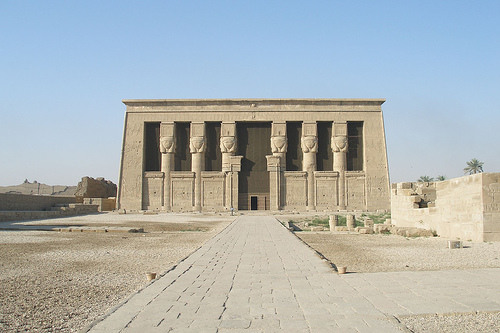
Location: 5 km (3 mi) Southwest of Qena, Qena Governorate Map
Open: 6am- 4pm daily
Dendera (ancient Egyptian: Iunet or Tantere; Greek: Tentyra or
Tentyris), located on the west bank of the Nile about 2.5 km
southeast of the modern town of the same name (near Qena in Upper
Egypt), was the capital of the sixth nome of Upper Egypt, south of
Abydos. It served as one of ancient Egypt’s most important religious
centers for over 4,000 years, primarily dedicated to the goddess
Hathor in her aspects as goddess of love, beauty, music, dance,
fertility, motherhood, joy, and healing (often depicted as a cow or
a woman with cow ears). The site also honored related deities such
as her son Ihy (or Ahy), Horus (as Harsomtus), Isis, and others.
While the town itself was an oasis settlement inhabited by thousands
at its peak and later became a Christian bishopric, its fame today
centers on the exceptionally well-preserved Dendera Temple
complex—one of the finest and most intact temple ensembles from
ancient Egypt.
The history of Dendera unfolds across millennia of
continuous religious activity, with layers of construction,
modification, and cultural blending from pharaonic through
Greco-Roman, Christian, and modern eras. The temple was built atop
older structures, and much of the complex was later buried under
sand, aiding its remarkable preservation (including vibrant original
colors in many areas).
Earliest Evidence and Old Kingdom Foundations (Predynastic to c. 2250
BCE)
Archaeological evidence points to human activity at Dendera as
early as the Predynastic Naqada IIC-D period, with a settlement and
possible early sanctuary. The necropolis (separate from the temple
precinct) dates back to the Early Dynastic Period and continued into the
First Intermediate Period.
The earliest clear religious structures
date to the Old Kingdom, around 2250 BCE. Inscriptions and remains
suggest a temple or shrine was begun under Pepi I (Sixth Dynasty) and
possibly completed by his son Merenre Nemtyemsaf I. Early texts refer to
the site being rebuilt or expanded then, establishing it as a Hathor
cult center. A small Eleventh Dynasty (Middle Kingdom) chapel by
Montuhotep Nebhepetre (with later Nineteenth Dynasty references to
Merenptah) also once stood there but was later dismantled and is now in
the Cairo Museum.
Middle Kingdom, New Kingdom, and Intermediate
Developments (c. 2040–1070 BCE)
The site saw ongoing modifications
during the Middle Kingdom and into the New Kingdom. Evidence exists of a
temple from the Eighteenth Dynasty (c. 1500 BCE), with contributions
from pharaohs including Thutmose III, Amenhotep III, Ramesses II, and
Ramesses III. These additions reinforced Dendera’s role as a major cult
center. A small chapel from Montuhotep Nebhepetre (Eleventh Dynasty)
featured inscriptions linking to later kings.
Hathor’s worship here
emphasized healing, music (via the sistrum rattle), and festivals. The
site hosted processions and rituals tied to the goddess’s mythology,
including her connections to Horus at Edfu (about 100 km south), forming
part of a sacred “marriage” or family triad.
Late Period and Last
Native Pharaohs (c. 664–343 BCE)
By the Late Period, particularly the
Thirtieth Dynasty, major surviving early structures emerged. The oldest
extant building in the complex today is the mammisi (birth house) built
by Nectanebo II (360–343 BCE), the last native Egyptian pharaoh. This
structure celebrated the divine birth of Hathor’s son Ihy (or
Harsomtus). Another smaller mammisi was initiated by Nectanebo I and
later decorated in the Ptolemaic era. These “birth houses” were key to
rituals reenacting the goddess’s motherhood and the pharaoh’s divine
legitimacy.
Nectanebo II also contributed to other elements, such as
a Temple of Isis (later completed under Ptolemy X). The site’s sacred
lake and well provided ritual water for blessings and healing.
Ptolemaic Period: Construction of the Current Temple (c. 54 BCE–30 BCE)
The magnificent Temple of Hathor visible today was largely built in the
late Ptolemaic period, a time of Greek rule that blended Egyptian and
Hellenistic traditions. Construction of the main structure began on July
16, 54 BCE, under Ptolemy XII Auletes (Ptolemy the Flute-Player). It was
substantially advanced by his daughter, Cleopatra VII (with her son
Ptolemy XV Caesarion, fathered by Julius Caesar), who is prominently
depicted on the temple walls and exterior rear relief (alongside
Caesarion). Many cartouches were left blank due to dynastic instability.
The temple followed traditional Egyptian design but incorporated
Ptolemaic innovations. It was dedicated to Hathor, with shrines for
associated gods (e.g., Isis, Sokar, Harsomtus). Key features from this
era include:
Crypts (14 subterranean chambers in 3–4 stories, 11
decorated): Used to store sacred vessels, treasures, and Hathor’s
ba-statue. Accessed via hidden trapdoors. Famous reliefs here include
the so-called “Dendera lightbulbs” (actually depicting a lotus-born
snake symbolizing creation or ritual objects) and offerings by Ptolemy
XII.
Roof chapels: Two Osirian chapels for the god’s death and
resurrection; one originally housed the famous Dendera zodiac (a
Greco-Roman astronomical ceiling showing constellations, planets, and
zodiac signs like Taurus and Libra, dated to the first century BCE). The
original zodiac was removed in 1820 (now in the Louvre; a copy remains
on-site). The roof was used for the New Year festival, where Hathor’s
statue was carried to a kiosk to “merge with the rising sun.”
Acoustics and ceilings: Hypostyle halls with Hathor-headed columns
(sistrum-shaped capitals) and a star-chart ceiling depicting Nut (sky
goddess).
The complex was enclosed by a massive mudbrick wall
(sides ~280–300 m). A sanatorium (unique “healing spa”) allowed pilgrims
to bathe in sacred waters or sleep for dream-cures from Hathor; water
poured over inscribed statues was believed to heal diseases.
Roman Period: Completion and Final Flourishing (30 BCE–c. 2nd century
CE)
After Egypt became a Roman province (30 BCE), emperors continued
building in pharaonic style to legitimize rule. The hypostyle hall
(outer hall with 18 columns) was completed under Tiberius (14–37 CE),
with decorations by later emperors (Augustus to Nero). Gateways of
Domitian and Trajan (1st–2nd century CE) pierced the enclosure wall. A
second Roman mammisi (birth house) was built on a raised platform
(possibly initiated under Nero, associated with Trajan and Marcus
Aurelius), featuring reliefs of divine births and Bes (childbirth
protector) on columns.
Roman emperors (e.g., Trajan, Domitian,
Claudius) are depicted as traditional pharaohs offering to Hathor and
other gods. A limestone sphinx (possibly of Claudius) was found in 2023.
The temple remained active for festivals, including processions linking
to Edfu.
Late Antiquity, Christian Era, and Decline (c. 4th–7th
centuries CE)
With the rise of Christianity, the temple fell out of
use. A Coptic Christian basilica (5th century CE) was built within the
complex (near the Roman mammisi and Hathor temple), using some earlier
materials. Dendera became a bishopric. Pagan worship gradually ceased,
though some reliefs show vandalism (e.g., faces on columns). The site
was largely abandoned and buried under sand and debris.
Modern
Rediscovery and Preservation (18th–21st centuries)
The complex was
known to early travelers but gained prominence during Napoleon’s 1798
Egyptian campaign. French troops camped nearby; legend says an
ammunition box collapse revealed the buried temple, still with original
colors. Scholars like Jean-François Champollion studied the zodiac
(deciphered as part of his hieroglyphic breakthrough). The zodiac relief
was removed in 1820 and taken to France.
Excavations and restorations
occurred in the 19th–20th centuries. The Supreme Council of Antiquities
began major restoration in 2005 (halted 2011, resumed 2017); the Great
Pillars Hall was cleaned and colors restored by 2021. Today, the site is
a major tourist attraction and open-air museum, with access to crypts,
roof, and sanatorium. It remains one of Egypt’s best-preserved temples
due to its late date and sand burial.
The Dendera Temple complex (ancient Iunet or Tantere) in Upper Egypt,
located about 2.5 km southeast of modern Dendera near Qena on the west
bank of the Nile, is one of the best-preserved and most architecturally
significant religious sites from late ancient Egypt.
It spans roughly
40,000 square meters and exemplifies traditional Egyptian temple design
from the Ptolemaic (305–30 BCE) and Roman periods (30 BCE–395 CE), built
atop much older structures dating back to the Old Kingdom (c. 2250 BCE)
and with clear layers from the Middle and New Kingdoms. The surviving
monuments primarily date to the late Ptolemaic era onward, with
construction of the main Temple of Hathor beginning around 54 BCE under
Ptolemy XII Auletes and continuing under Cleopatra VII, with major
additions (including the outer hypostyle hall) completed under Roman
emperors like Tiberius, Nero, Domitian, and Trajan.
The complex is
dedicated primarily to Hathor (goddess of love, music, motherhood, and
the sky), but also incorporates cults of Isis, Osiris, Horus, and
others. Its architecture blends strict Pharaonic
traditions—progressively restricted sacred spaces symbolizing the
transition from chaos to divine order—with subtle Hellenistic and Roman
influences in proportions, decoration, and imperial patronage.
Overall Layout and Enclosure
The entire complex is enclosed by a
massive rectangular mudbrick wall (approximately 280 × 290 m, 10–12 m
thick at the base, and about 10 m high), constructed using a distinctive
“pan bedding” technique that creates a wavy, undulating profile. This
wavy form likely symbolized the primordial waters of Nun (chaos), with
the sacred precinct inside representing ma’at (cosmic order).
An
unfinished inner stone wall once stood inside it. The main northern
gateway is a Roman-era propylon (not a traditional massive pylon) built
by Domitian and Trajan; smaller Roman kiosks flank the exterior
approach. A secondary gate pierces the southern end of the east wall.
Key structures within the enclosure include the dominant Temple of
Hathor, two mammisi (birth houses), a sacred lake, a sanatorium for
healing rituals, an Isis chapel, a barque shrine, and later Roman/Coptic
ruins (including a Christian basilica). The main temple follows a
classic north–south axial layout.
The Temple of Hathor: Exterior
and Façade
The main Temple of Hathor, built of fine sandstone,
measures approximately 79–81 m long and 34 m wide. Unlike earlier
temples with towering pylons, its façade is a unique, monumental screen
wall (about 42 m wide by 18 m high) pierced by a central doorway and
featuring six massive columns (part of the outer hypostyle hall)
connected at their lower half by intercolumnar walls. This creates an
open, colonnaded effect that reveals glimpses of the painted ceiling and
upper columns from the courtyard.
Each column rises about 15 m and is
topped by a square capital with four faces of Hathor (cow-eared goddess,
often with a sistrum or naos form above), oriented to the cardinal
directions. The shafts are densely carved with reliefs of rulers
offering to gods, hieroglyphic texts, and floral motifs; traces of
original blue paint remain on Hathor’s hair. The intercolumnar panels
and walls are covered in finely carved scenes of mythology and royal
rituals.
Interior: Hypostyle Halls and Astronomical Ceilings
Entering through the façade leads directly into the large (outer)
hypostyle hall (pronaos), an architectural masterpiece filled with 24
colossal Hathor-headed columns arranged in six rows of four (the six
façade columns form the front row). The hall is one of the most
photogenic and best-preserved interiors in Egypt, with every
surface—walls, columns, and ceiling—adorned with reliefs and vibrant
paint (recently restored in parts to reveal original turquoise, blue,
and gold tones).
The ceiling is an astronomical tour de force: a star
map dominated by the sky goddess Nut, constellations, planets, and the
famous Dendera Zodiac (one of the earliest known circular zodiac
representations in Egypt, blending Egyptian and Greco-Roman elements).
It depicts the heavens as understood in the Ptolemaic/Roman era, with
the sun god Ra and detailed celestial cycles.
Beyond lies the smaller
inner hypostyle hall (Hall of Appearances) with six columns, used for
rituals and featuring foundation-laying scenes. Further progression
includes functional rooms: a laboratory (for ritual perfumes/oils),
storage magazines, treasury, offering hall, and Hall of the Ennead (nine
gods).
Sanctuaries, Crypts, and Roof Chapels
At the rear is
the main sanctuary (“Great Seat”), a small, dark chamber that once
housed the cult statue of Hathor in a naos shrine, surrounded by 11
smaller shrines (including those for Isis, Sokar, and Harsomtus). A
false door at the back symbolizes the god’s connection to the divine
realm.
Beneath the floor and within the walls are 14 crypts
(multi-level underground chambers, some accessible via hidden stairs).
These stored sacred objects, relics, and ritual equipment; their walls
feature unique reliefs, including the so-called “Dendera light” scenes
(often misinterpreted but actually depicting ritual rebirth or
protective symbolism).
Two staircases (decorated with processional
scenes) lead to the roof, which hosts chapels dedicated to Osiris’s
resurrection mysteries and New Year festivals. A kiosk on the roof
allowed Hathor’s ba (soul) to unite with the rising sun at dawn. One
roof chapel originally held the Dendera Zodiac.
Supporting
Structures
Mammisi (Birth Houses): Two examples—one from Nectanebo II
(30th Dynasty, the oldest surviving building on site) and a later Roman
one—where the divine birth of Hathor’s son Ihy was ritually reenacted.
Sacred Lake and Sanatorium: For ritual purification and healing
(patients slept in the sanatorium hoping for divine dreams/cures from
Hathor).
Roman Additions: Gateways, kiosks, and the monumental
entrance emphasize imperial continuity of pharaonic cult.
Architectural Significance
Dendera’s architecture is remarkable for
its exceptional preservation, vibrant original coloring (especially
post-restoration), and astronomical sophistication. It retains the
classic Egyptian temple progression (open court → hypostyle → restricted
sanctuary) while introducing open façade elements and Greco-Roman
zodiacal motifs. The Hathor capitals and celestial ceilings make it
visually and symbolically unique, illustrating the continuity of
Egyptian religion under foreign rule and its deep integration of
astronomy, ritual, and cosmology.
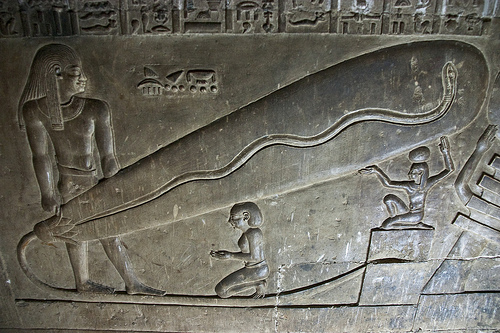
In Egyptology, a group of motifs that can be seen in several places
in the Temple of Hathor is interpreted as a representation of the “god
on the flower”.
Some also refer to this group of motifs as the
“bulbs of Dendera,” which gives rise to parascientific speculation on
the question of whether the ancient Egyptians knew about electric light
in the form of incandescent lamps.
During Napoleon's expedition, two famous zodiacs were found on the
ceiling of the hall of the main temple in addition to the gigantic
figure of the sky goddess Nut (hence also called the Celestial Hall),
one of which was sawn out by a Frenchman in 1820 and has been in the
Egyptian department of the Louvre since 1822 is exhibited in Paris.
France later had a copy made for Egypt.
In this zodiac, Leo
appears as the initial sign after the intersection of the ecliptic and
the Earth's equator. However, the location of the solstice (solstitium)
depends on the location of these average points, which must always be in
the middle of both. On the Dendera zodiac he is recorded in Cancer. From
this deviation from the current position of the sun, scientists believed
they could deduce the age of this zodiac. There was only one difference
depending on whether that solstice was viewed as the winter or summer
solstice.
The dispute over this has given rise to a wide variety
of claims, such as: B. Fourier describes the creation of the same
between 2500 BC. and 2100 BC, Lalande around 1300 BC. or 1200 BC, Biot
not before 716 BC and Visconti not before 328 BC sets. The discoveries
of Jean-François Champollion put an end to this speculation.
According to the Louvre, it dates back to 51 BC. estimated as Ptolemy
XII. (Theos Philopator Philadelphos Neos Dionysos) rebuilt it, as the
crypts of the House of Commons show. Some of the depictions come from
the reign of Queen Cleopatra, who is depicted on the outer back wall of
the temple together with her son Caesarion in a 4 m high figure.
The temple's porch, which contains the second zodiac, was built between
32 and 37 AD by the residents of Tentyra under Emperor Tiberius. The
wall sculptures of the rear temple were made in the reigns of Cleopatra
and Augustus, those of Pronaos under Tiberius, Caligula, Claudius and
Nero.