Location: Map
Saint Catherine's Monastery (also known as the Sacred Monastery
of the God-Trodden Mount Sinai) is one of the world's most
remarkable religious and historical sites. It is the oldest
continuously inhabited Christian monastery, located at the foot of
Mount Sinai (also called Mount Horeb or Jebel Musa) in Egypt's Sinai
Peninsula.
It is a UNESCO World Heritage Site (inscribed in 2002
as the Saint Catherine Area) valued for its exceptional Byzantine
architecture, art, manuscripts, and spiritual significance to
Judaism, Christianity, and Islam.
The site has deep biblical
roots. It is traditionally where Moses encountered the Burning Bush
and received the Ten Commandments. In the 4th century, Empress
Helena (mother of Constantine the Great) ordered a small chapel
built near the bush. The main monastery was constructed between 548
and 565 AD by order of Byzantine Emperor Justinian I, who fortified
it to protect monks and the surrounding area.
The monastery has
never been abandoned or destroyed in its 1,500+ year history,
surviving thanks to its remote desert location, diplomatic
protections (including from Muslim rulers), and self-sufficiency. It
is run by Greek Orthodox monks (about 25–30 today) under the
autonomous Church of Sinai.
It was later named after Saint
Catherine of Alexandria, whose relics (said to have been
miraculously transported there) were discovered in the area, making
it a major pilgrimage site.
Architecture and Fortifications
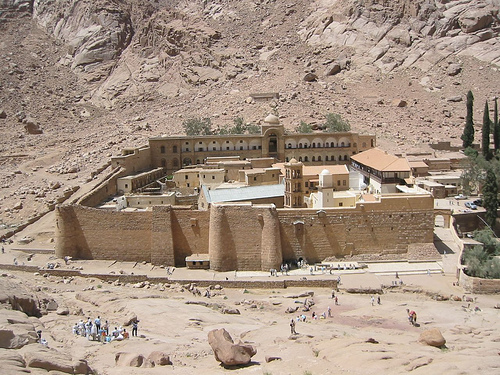
The monastery resembles a
fortress, built with massive granite blocks quarried locally. Its walls
are 10–35 feet (about 3–11 meters) high and up to 10 feet thick in
places, with towers and arrow slits for defense. The enclosed complex
measures roughly 76 x 90 meters.
Key structures inside include:
The Basilica of the Transfiguration (also called the Church of Saint
Catherine or Church of the Theotokos): The centerpiece, a 6th-century
basilica with a narthex, central nave, side aisles, and apse. It
features a magnificent mosaic of the Transfiguration of Christ (with
Moses, Elijah, Peter, James, and John) in the apse, one of the finest
surviving early Byzantine mosaics. The church incorporates elements of
both basilican and central plans, with side chapels. It houses relics of
Saint Catherine (her head and right hand in the altar area) and other
treasures.
The Burning Bush (Neopalimaya Kupina): A living bush
(Rubus sanctus) in the courtyard, claimed to be the one from the
biblical story (or a descendant). It is a focal point for pilgrims;
visitors often leave prayer notes nearby.
Fatimid Mosque: Built
around 1106 AD inside the walls (originally a guesthouse converted), it
symbolizes interfaith respect and protection granted by Muslim rulers.
Other buildings: A refectory, library, monk cells, bakery, guesthouse,
and a 19th-century Russian belfry. There is also a well associated with
Moses.
The complex has largely retained its 6th-century layout,
making it an outstanding example of early Byzantine monastic
architecture.
Treasures: Icons, Library, and Artifacts
The
monastery is renowned for its unparalleled collections, preserved due to
its isolation:
Icons: It houses the world's finest and largest
collection of early Christian icons (over 2,000), including many from
the 6th–7th centuries in encaustic technique. The most famous is the
Icon of Christ Pantocrator (6th century), one of the oldest known
depictions of Jesus, notable for its asymmetrical face symbolizing his
dual human-divine nature.
Library: The oldest continuously operating
library in the world (founded 6th century), second only to the Vatican
in its collection of early manuscripts and codices (around 3,300
manuscripts, with some dating to the 4th century). It includes the Codex
Sinaiticus (one of the oldest complete New Testaments, parts of which
are now elsewhere) and the Syriac Sinaiticus. It also holds the largest
collection of palimpsests (reused manuscripts). Many have been digitized
through international projects.
Surrounding Area and Pilgrimage
The monastery sits in a dramatic desert mountain landscape. Nearby
landmarks include:
Paths up Mount Sinai (with chapels, gates, and a
summit mosque/chapel).
The broader Saint Catherine Area (UNESCO site)
with natural reserves, vegetation, and other monastic sites.
It
remains an active place of worship and pilgrimage, open to visitors for
limited hours (typically mornings). It attracts tourists, scholars, and
faithful from multiple religions due to its biblical ties and peaceful
history.
Biblical and Early Christian Context
The monastery stands on a
site revered across the three Abrahamic faiths. According to tradition,
it encloses the location where Moses encountered the Burning Bush (from
which God spoke) and nearby the "Well of Moses," where he met his wife
Zipporah. The area is also linked to Moses receiving the Tablets of the
Law (Ten Commandments) on the mountain above.
Christian monastic
presence in the Sinai dates back to at least the 3rd–4th centuries, with
hermit monks and anchorites settling in the remote, rugged landscape for
ascetic isolation. The earliest written record comes from the
Itinerarium Egeriae (c. 381–386 CE), a travel journal by the pilgrim
Egeria, which describes monastic life at Mount Sinai.
In the early
4th century, Empress Helena (mother of Constantine the Great) reportedly
ordered a small chapel built at the Burning Bush site (often called
Saint Helen's Chapel). This laid early foundations for veneration of the
site.
Founding under Justinian I (6th Century)
The main
monastery was constructed between approximately 548 and 565 CE by order
of Byzantine Emperor Justinian I (r. 527–565). It was built as a
fortified complex to protect the monks and pilgrims from raids
(following complaints from the hermit community) while enclosing the
Burning Bush chapel. The architect is sometimes identified as Stephanos
of Aila.
Key original features from this period that survive include:
Massive gray granite walls (roughly 280 by 250 feet / 85 by 76 meters).
The Church of the Transfiguration (or Basilica), dedicated to the Virgin
Mary, with a famous early Byzantine mosaic of the Transfiguration in the
apse.
The overall fortress-like design, which helped it endure as a
"combination fortress and shrine."
The monastery's king post
truss roof is noted as one of the oldest surviving examples in the
world. It was originally known as the Monastery of the God-Trodden Mount
Sinai.
Naming and Relics of Saint Catherine
Centuries later
(likely 8th–9th century or around the time of the Crusades), the
monastery acquired its current name. According to tradition, the body of
Saint Catherine of Alexandria—a 4th-century martyr—was miraculously
transported by angels to a mountain near the site. Her relics (including
her head and right hand) were brought to the monastery, making it a
major pilgrimage destination. The patronal feast is the Feast of the
Transfiguration.
Survival Through Conquests and Centuries
The
monastery has an extraordinary record of continuity, never being
abandoned despite regional upheavals. During the 7th century, as Islam
rose and many Christian communities faced threats, the Sinai monks found
refuge within its walls. Tradition holds that the monks built (or
converted a chapel into) a small mosque around 1106 CE during the
Fatimid Caliphate to conciliate Muslim rulers; this mosque remains
preserved and is occasionally used.
It received protection from
various rulers, including a famous Ashtiname (charter) attributed to the
Prophet Muhammad granting privileges and protection to the Christian
community. Later patrons included Ottoman sultans, Napoleon Bonaparte
(who granted special protections during his Egyptian campaign), and
others.
Throughout the Middle Ages, it attracted pilgrims, especially
after the Crusades increased European interest. It maintained
dependencies (metochia) in places like Cairo, Suez, Palestine, Syria,
Crete, Cyprus, and Constantinople, supporting its operations. The
monastic community was multiethnic (including Greek, Arab, Syrian,
Slavonic, and Georgian monks) before becoming predominantly Greek
Orthodox in the Ottoman period.
Challenges included Bedouin raids, a
decline in the number of monks during the later Mamluk Sultanate (from
hundreds to dozens), and a sacking in 1505. Access was historically via
a high door in the walls (until modern times). One early abbot was St.
John Climacus (author of The Ladder of Divine Ascent).
Treasures:
Manuscripts, Icons, and Library
The monastery houses one of the
world's most important collections of early Christian artifacts, often
called the world's oldest continuously operating library (founded in the
6th century).
Manuscripts: It preserves thousands of codices in
Greek, Syriac, Arabic, Georgian, and other languages. The most famous is
the Codex Sinaiticus (4th century), one of the oldest nearly complete
Bibles, discovered by Constantin von Tischendorf in the 19th century
(parts now in the British Library and elsewhere; some fragments remain
or were rediscovered at the monastery). Other highlights include the
Syriac Sinaiticus (discovered by Agnes Smith Lewis) and a major 1975
find of additional ancient manuscripts hidden in a wall.
Icons: An
exceptional collection, including some of the earliest known Christian
icons (pre-8th century), such as the famous Christ Pantocrator icon.
These survived the Byzantine Iconoclasm period due to the monastery's
relative isolation.
The library and treasures have drawn scholars for
centuries, with microfilming efforts in the mid-20th century and ongoing
projects like the Sinai Palimpsests Project using modern imaging.
Modern Era and UNESCO Status
The monastery remains active with a
small community of Greek Orthodox monks (limited to around 36, including
those in dependencies). The abbot also serves as Archbishop of Sinai,
Paran, and Raithu; the Church of Sinai has a unique autonomous status
within Eastern Orthodoxy (often linked to the Patriarchate of
Jerusalem).
It was designated a UNESCO World Heritage Site in 2002
(as the Saint Catherine Area) for its architectural, artistic,
spiritual, and historical value—criteria including its Byzantine
architecture, collections, and role as a sacred site for three
religions. The surrounding rugged landscape includes archaeological
sites, chapels, and paths up the mountain.
In recent years, it has
faced modern pressures: tourism, a 2017 ISIS-linked attack nearby, and
legal disputes in Egypt over land and administrative status (ongoing as
of 2025–2026, involving usufruct rights and tourism development
projects). Despite this, its religious autonomy and heritage status are
affirmed internationally.
Significance Today
Saint Catherine's
Monastery stands as a living testament to early Christian monasticism,
Byzantine art and architecture, and interfaith respect in a shared
sacred landscape. Its survival for over 1,400 years in a harsh desert
environment, its unparalleled collections, and its role as a bridge
between faiths make it one of the most remarkable religious sites in the
world. Visitors can see parts of the complex (including the basilica,
Burning Bush area, and a museum with select treasures), though much
remains reserved for the monastic community.
The monastery remains a living Greek Orthodox community of monks, not
primarily a tourist site. Its fortress-like granite walls (built under
Emperor Justinian I around 565 AD), ancient icons, manuscripts (one of
the world’s finest collections after the Vatican), and serene
high-mountain setting make it a profound spiritual and cultural
destination.
Best Time to Visit
The ideal periods are
October–November or March–April for comfortable temperatures (valley
15–25°C / 59–77°F), clear skies, fewer crowds, and good hiking
conditions. November often stands out for crisp air and low crowds.
Summer (June–August): Very hot in the valley (up to 35°C+ / 95°F+);
dawn summit hikes are still feasible but demanding.
Winter
(December–February): Cold nights (summit can drop to -5°C / 23°F or
below, possible snow); atmospheric but prepare layers and gear for the
hike.
Avoid major Greek Orthodox feast days, Fridays, and Sundays
when the monastery is typically closed to visitors.
Check current
conditions and holidays in advance, as hours can vary slightly.
Opening Hours and Entry (as of 2026)
Generally open Monday–Thursday
and Saturday: ~9:00 AM–12:00 noon (or 11:30 AM in some reports).
Fridays and Sundays: Often closed or very limited (e.g., ~10:45–11:30 AM
on Fridays).
Closed on major Greek Orthodox holidays and some Islamic
holidays. Confirm via the official site or your tour operator.
Entry: Free for the main grounds (donations appreciated for
conservation). Small fee (varies, often negligible ~25 EGP / ~$1–2) for
the museum/Ikon Gallery.
Dress Code (Strictly Enforced): Shoulders
and knees must be covered for everyone (men and women). No shorts,
sleeveless tops, short skirts, or revealing clothing. Women may need a
headscarf in some areas. The monastery may provide wraps/scarves, but
don’t rely on them—bring your own modest layers. Remove shoes before
entering the basilica.
Photography: Allowed in courtyards and gardens
(respect signs and monks); strictly prohibited inside the
basilica/church, library, and museum.
Duration: Plan at least 1–1.5
hours inside; visits are self-paced but guided in some contexts. Arrive
early to beat groups and maximize your narrow window.
What to See
and Experience
Basilica of the Transfiguration (main church):
6th-century structure with stunning early Byzantine mosaics (e.g.,
Transfiguration in the apse). Built over the site of the Burning Bush.
Burning Bush: A living shrub in the garden, believed by tradition to
descend from the biblical one (a different species now grows where the
original was).
Museum (Ikon Gallery): Icons, manuscripts, liturgical
objects, and artifacts from the monastery’s vast collection.
Library:
World-renowned but limited public access; advance arrangements may be
needed for deeper viewing.
Courtyards, gardens, and walls: Explore
the fortified complex, olive trees, and monk-maintained spaces. The site
feels timeless and peaceful.
Note: Only parts of the monastery are
open to visitors; it is an active religious community—maintain quiet
respect, no loud talking, and follow monk instructions.
Combining
with Mount Sinai (Jebel Musa) Climb
Most visitors pair the monastery
with a hike up Mount Sinai for sunrise or sunset. The monastery is at
the trailhead.
Routes: Camel Path (longer, gentler, ~2.5–4 hours up;
camels available for part); Steps of Repentance (steeper, ~3,750 stone
steps, more direct).
Typical Itinerary: Night departure from Sharm El
Sheikh/Dahab (~midnight–1 AM start), summit for sunrise (~5:30–6 AM),
descend, then visit monastery.
Sunset Option: Quieter, less crowded;
descend in daylight or with headlamp.
Tips: Sturdy hiking shoes,
headlamp/flashlight, layers (cold at night/summit, warmer daytime),
water, snacks, warm blanket/jacket for summit. Hire a local Bedouin
guide (recommended/required in some contexts; tip generously). Fitness
level matters—take it slow.
How to Get There
From Sharm El
Sheikh: ~3–3.5 hours by road (popular day/overnight tours).
From
Dahab: ~1.5–2 hours.
From Cairo: ~5–7 hours (longer bus ~8 hours).
Private taxi, shared tours, or 4x4. Checkpoints are common—keep
passport/ID handy. Small local airport exists for select flights.
Tours: Widely available from Red Sea resorts. Private options allow
more flexibility, better guides, and potential special monastery access.
Practical Visiting Tips
Preparation: Bring water (desert
climate), sun protection, modest clothing, cash (small donations/fees),
passport/ID. Layers for temperature swings. Respectful behavior is
essential.
Health/Safety: The area is generally safe for tourists
(South Sinai, not North). Altitude ~1,600 m at base—acclimatize if
hiking. Stay hydrated; watch for rocky terrain. Military presence at
checkpoints is standard.
Accommodation: Stay overnight in St.
Catherine (Al-Milga town) for a fuller experience—monastery guesthouse,
eco-camps, or hotels like Daniela Village. Allows peaceful exploration
beyond day tours.
Food: Simple local/Bedouin meals, teas, and herbs
available. Try fresh Sinai produce.
Other Activities: Explore nearby
wadis (e.g., Colored Canyon), higher peaks like Mount Catherine (Egypt’s
highest), oases, or Bedouin culture. Longer hikes in the protectorate
are rewarding.
Etiquette: Quiet, no public displays of affection,
follow all rules. Support locals (guides, shops, herbalists like Dr.
Ahmed Saleh for traditional teas).
For Website/Content Creators:
Capture exterior architecture, landscapes, and permitted areas. Note
historical context for rich narratives. Paraphrase sources ethically.
Contact: Official site (sinaimonastery.com) for updates; guesthouse
reservations possible.
Historical and Religious Foundations
The monastery was constructed
around the site traditionally identified as the Burning Bush where Moses
encountered God (Exodus 3). It also encloses the "Well of Moses," where
Moses met his wife Zipporah. Empress Helena (mother of Constantine) had
earlier built a chapel there in the 4th century, but Justinian fortified
it into a monastery to protect hermits from raids.
It is sacred to
Judaism, Christianity, and Islam due to its ties to Moses and Mount
Sinai (where the Tablets of the Law were received). A small Fatimid-era
mosque (built ~1106 CE inside the walls) remains in use on special
occasions, symbolizing historical Christian-Muslim coexistence.
Tradition holds that the Prophet Muhammad granted protection to the
monks via the Ashtiname (covenant), which helped the community survive
Islamic conquests.
The monastery later became associated with Saint
Catherine of Alexandria (a 4th-century martyr). Her relics (head and
hand) were reportedly discovered on a nearby mountain and enshrined
here, boosting its pilgrimage status in the Middle Ages. It is
officially part of the autonomous Church of Sinai (under the broader
Greek Orthodox tradition), with the abbot also serving as Archbishop.
The community has historically included diverse monks (Greek, Arab,
Georgian, etc.), though it became predominantly Greek Orthodox in later
centuries.
It is a UNESCO World Heritage Site (2002) for its
Byzantine architecture, art, manuscripts, and spiritual significance to
the three Abrahamic faiths.
Monastic Culture and Daily Life
The culture is one of asceticism, prayer, obedience, hospitality, and
preservation of tradition in a harsh desert environment. With around
25–36 monks (including those in dependencies in Cairo or Suez), it
follows a coenobitic (communal) life influenced by earlier eremitic
(hermit) traditions.
Daily rhythm (subject to variation for feasts or
Lent):
Begins around 4:00 AM with Mesonyktikon (Midnight Office),
Orthros (Matins), and Divine Liturgy in the 6th-century Basilica of the
Transfiguration.
Midday: Reading of the Third and Sixth Hours.
Afternoon (around 4:00 PM): Ninth Hour, Vespers, and Small Compline.
Meals are simple and often eaten in silence while religious texts are
read. Monks fast several days a week and rely on garden produce (olives,
fruits, vegetables). Gardens and olive groves have sustained the
community for centuries.
Balance of private prayer in cells, communal
worship, and assigned labors (library work, icon maintenance,
hospitality for pilgrims, gardening, etc.).
Lights out around 10:00
PM, with allowance for candlelight reading.
Monks emphasize humility,
obedience to the Hegoumenos (abbot), and ministry to pilgrims. The
setting—rugged mountains, isolation, and fortress-like granite walls
(originally with a high door for access)—reinforces detachment from the
world while serving as a sanctuary.
Artistic and Intellectual
Treasures
The monastery's culture centers on preservation and
veneration of sacred heritage:
Icons: Houses one of the world's
finest collections of early Byzantine icons, many pre-Iconoclasm (before
the 8th century), preserved due to its remote location. The 6th-century
Christ Pantocrator (one of the earliest surviving panel icons) is
especially renowned for its realistic, dual-natured depiction of Christ.
Library: The oldest continuously operating library in the world (founded
6th century), second only to the Vatican in early codices/manuscripts.
It includes Greek, Syriac, Arabic, Georgian, and other texts; the Codex
Sinaiticus (4th century, one of the oldest near-complete Bibles) was
famously found here (parts remain or were discovered later). Thousands
of manuscripts, including palimpsests, offer insights into early
Christianity, linguistics, and history. A 1975 discovery added thousands
more items.
Architecture and Relics: The basilica features a rare
early mosaic of the Transfiguration. Other treasures include liturgical
objects, vestments, and relics of Saint Catherine (displayed in
processions on feast days). A small museum showcases highlights for
visitors.
This scholarly and artistic focus makes the monastery a
"veritable Ark" of spiritual and cultural treasures.
Interfaith
and Pilgrimage Aspects
The monastery exemplifies peaceful
coexistence. Bedouin tribes have long served as guards and been
supported by the monks. It attracts pilgrims and tourists from many
faiths, drawn to the Burning Bush (a living bramble said to descend from
the biblical one), Moses sites, and spiritual ambiance. Visiting hours
are limited (typically mornings) to preserve the monastic rhythm.
Feast days, especially the Transfiguration and Saint Catherine's,
involve special liturgies and processions. The culture blends solemn
ritual with hospitality.
Location and Coordinates
Geographic Position: Nestled at the foot
of Mount Sinai (Jebel Musa / Mount Moses) in a narrow, steep-sided wadi
(dry riverbed valley) within the Sinai high mountain region, often
called the "Roof of Egypt."
Coordinates: Approximately 28°33′20″N
33°58′34″E.
Nearby Town: The monastery lies within or immediately
adjacent to the small town of Saint Catherine (Sant Katrin), at the
confluence of several wadis (e.g., Wadi El Dier, Wadi El Arbain / Wadi
El Lega, Wadi Raha, Wadi Sheikh).
Regional Context: About 120 km (75
mi) from Nuweiba on the Gulf of Aqaba, roughly 230 km from Sharm El
Sheikh, in the rugged granite massif of southern Sinai. The broader
Saint Catherine Area is a UNESCO World Heritage Site (inscribed 2002),
encompassing the monastery, Mount Sinai, and surrounding sacred
landscapes revered by Christianity, Islam, and Judaism.
Elevation
and Topography
Monastery Elevation: Around 1,500–1,600 m
(≈4,900–5,250 ft) above sea level. The town of Saint Catherine sits at
about 1,586 m (5,203 ft).
Surrounding Terrain: Dramatic granite
mountains dominate the landscape. Key peaks form a dramatic backdrop:
Mount Sinai (Jebel Musa): ≈2,285 m (7,497 ft), about 2 km south of the
monastery.
Mount Catherine (Jebel Katherina): Egypt’s highest peak at
≈2,629–2,642 m, nearby.
Other nearby peaks: Ras Sufsafeh / Willow
Peak (possibly biblical Mount Horeb, ≈1 km west); Jebel Arrenziyeb (≈1
km south).
The monastery occupies a compact, fortress-like site
(roughly city-block sized) against a slope in a wadi, surrounded by
rocky, barren slopes, boulders, and sparse vegetation. Steep, rugged
granite formations create a sense of isolation, with valleys and passes
connecting to higher plateaus.
Topographic Range (in the
immediate area): Average elevation ≈5,912 ft (1,802 m), with local
minima around 4,970 ft and maxima up to 7,047 ft or higher on
surrounding peaks.
The area features a mix of high peaks, deep wadis
(which can experience flash floods), and smaller connecting valleys. The
rugged, arid terrain has preserved the site's isolation and authenticity
over centuries.
Climate
Desert Climate (Köppen BWh / BWk):
Arid with very low humidity and minimal rainfall (mean annual ≈60 mm /
2.4 in, though higher peaks receive more orographic precipitation,
including snow up to ≈300 mm in some years).
Temperature Extremes:
Due to high altitude, it has the coldest nights in Egypt. Summers are
hot during the day but mild/cool at night; winters are cool/cold, with
sub-zero temperatures possible at night and occasional snow (especially
Dec–Feb, sometimes into spring/autumn). Record high ≈42°C; record low
≈−6°C.
Daily Means (example): January mean ≈9.5°C (min ≈1.7°C); July
mean ≈26.5°C (min ≈17.7°C). Strong diurnal swings are typical of
high-desert environments.
This climate, combined with the granite
landscape, has helped preserve ancient manuscripts and artifacts in the
monastery's library.
Geology and Landscape Features
Geology:
Primarily ancient granite and metamorphic rocks of the Sinai massif. The
area includes ruins of ancient mines and temples (e.g., turquoise,
copper) from Pharaonic times nearby.
Vegetation and Ecology: Sparse
desert vegetation in lower areas, with more diverse high-altitude
ecosystems in the Saint Catherine Protectorate (established 1988).
Features endemic/rare species such as the Sinai baton blue butterfly
(world’s smallest), Nubian ibex, medicinal plants, Sinai agamas, rock
hyraxes, and foxes. Wadis support some gardens and trees (e.g.,
cypresses near the monastery) cultivated by monks and Jebeliya Bedouins.
Water: Relies on groundwater from mountain catchments, snowmelt, and
limited rain. A pipeline now supplements with Nile water. Flash floods
are a periodic risk in wadis.
Human and Cultural Geography
The
monastery integrates deeply with its natural setting—its thick granite
walls (built 548–565 CE) blend with the surrounding rock. It sits in the
shadow of sacred peaks, with paths like the Path of Moses (Sikket
Sayidna Musa) leading to the summit, featuring chapels and arches.
Local inhabitants include Jebeliya Bedouins, who maintain a symbiotic
relationship with the monastery (gardening, support roles). The broader
area supports religious tourism, hiking (e.g., Mount Sinai sunrise
climbs), and limited agriculture in protected valleys.