Location: Jiayuguan, Gansu, Map
Area: 33,500 sq km
Entrance Fee: 120 yuan (60 yuan for students)
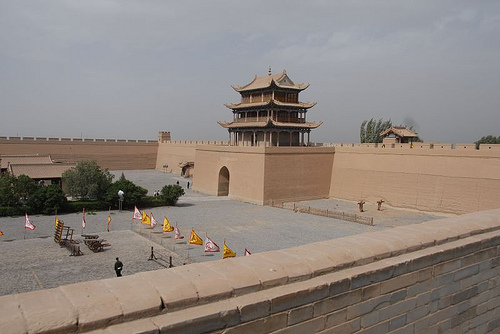
Jiayuguan Castle, also known as Jiayuguan Pass (Jiayuguan 嘉峪关), is a monumental fortress located in Jiayuguan City, Gansu Province, China. It is the westernmost end of the Great Wall of China, built during the Ming Dynasty (1368–1644), and is often referred to as the “First and Greatest Pass Under Heaven” due to its strategic importance and imposing architecture. Situated at the narrowest point of the Hexi Corridor, a vital trade and military route of the ancient Silk Road, the castle served as a critical defensive outpost and gateway between China’s heartland and the western frontier. A UNESCO World Heritage Site (as part of the Great Wall since 1987), Jiayuguan Castle is celebrated for its robust construction, historical significance, and cultural legacy.
Jiayuguan Castle was constructed in 1372 during the early Ming
Dynasty, under the reign of Emperor Hongwu (Zhu Yuanzhang). The Ming
rulers, having overthrown the Mongol-led Yuan Dynasty, sought to secure
China’s northwestern frontier against nomadic invasions from the Mongols
and other Central Asian tribes. The Hexi Corridor, a narrow passage
between the Qilian Mountains to the south and the Mazong Mountains to
the north, was a critical choke point for controlling trade and military
movements along the Silk Road. Jiayuguan Pass was established to guard
this corridor, regulate commerce, and serve as an exile point for
banished officials and criminals sent to the remote frontier.
The
fortress was designed by General Feng Sheng, a prominent Ming military
commander, and completed in just five months, a testament to the
dynasty’s engineering prowess. Over the centuries, it was expanded and
reinforced, particularly during the reigns of Emperors Jiajing
(1522–1566) and Wanli (1572–1620). The castle’s strategic role extended
beyond defense; it was a customs checkpoint for Silk Road caravans, a
cultural exchange hub, and a symbol of imperial authority in a region
far from Beijing.
Jiayuguan’s historical significance is tied to
its role as the “endpoint” of Chinese civilization. Beyond the pass lay
the vast Gobi Desert and foreign territories, earning it the nickname
“Mouth of China.” Legends abound of exiled poets and officials passing
through its gates, leaving inscriptions lamenting their banishment.
During the Qing Dynasty (1644–1911), the pass lost some military
importance as China expanded westward, but it remained a regional
administrative center. By the 20th century, neglect and natural erosion
threatened the structure, but restoration efforts since the 1980s have
preserved its grandeur.
Jiayuguan Castle is located in the arid Jiayu Valley, 6 kilometers
southwest of modern Jiayuguan City, at an elevation of about 1,600
meters. It sits at the western edge of the Great Wall, marking the
transition from the fertile Hexi Corridor to the desolate Gobi Desert.
The fortress is flanked by natural barriers: the snow-capped Qilian
Mountains to the south and the rugged Mazong (Horse Mane) Mountains to
the north, with the Black Mountain providing a backdrop. The Taolai
River, a tributary of the Heihe, flows nearby, supporting a small oasis.
Strategically, the castle controlled access to the Hexi Corridor, a
1,000-kilometer-long passage linking central China to Central Asia. This
made it a linchpin for defending against invasions and securing trade
routes for silk, spices, and cultural exchanges. The pass’s isolation,
surrounded by desert and mountains, reinforced its role as a frontier
outpost, both a gateway and a barrier.
Jiayuguan Castle is a masterpiece of Ming military architecture,
combining defensive functionality with aesthetic elegance. Covering
approximately 33,500 square meters, the fortress is a trapezoidal
complex with inner and outer courtyards, fortified walls, and strategic
towers. Its design integrates rammed earth, brick, and wood, built to
withstand both military assaults and the harsh desert environment.
Overall Structure
Fortress Layout: The castle consists of an
Inner City (main fortress), an Outer City (protective enclosure), and
additional defensive structures like moats and barbicans. The Inner City
is the core, measuring 640 meters in perimeter, with walls 11 meters
high and 3–5 meters thick.
Materials: The walls are made of rammed
earth (compacted soil and straw), faced with fired bricks for
durability. Wooden beams support gates and towers, with tiled roofs in
traditional Chinese style.
Defensive Features: The fortress includes
moats, drawbridges, watchtowers, and artillery platforms, designed to
repel cavalry and infantry attacks. Its elevated position on a plateau
enhances visibility and defensibility.
Cultural Elements:
Calligraphic inscriptions, decorative frescoes, and symbolic
architecture (e.g., triple-layered gates) reflect Ming aesthetics and
imperial authority.
Key Architectural Components
Inner City:
The core fortress, rectangular with rounded corners, houses
administrative and military buildings. Its walls are topped with
crenelated battlements and 17 watchtowers.
Three Main Gates:
Guanghua Gate (East Gate): The primary entrance, facing the Hexi
Corridor, symbolizing the path to China’s interior. Its name, “Gate of
Radiant Splendor,” reflects optimism.
Rouyuan Gate (West Gate):
Facing the Gobi Desert, known as the “Gate of Conciliation,” it was used
for exiles and trade caravans heading west. A poignant inscription,
“Beyond the Pass, No Return,” underscores its frontier role.
Jiayuan
Gate (North Gate): A smaller gate for local access, less ornate but
fortified.
Each gate is flanked by barbicans (semi-circular outer
defenses) and topped with three-story watchtowers, 17 meters high,
equipped with arrow slits and cannon platforms.
Wenchang and Jiugong
Pavilions: Elegant towers on the eastern and western corners, used for
ceremonies and signaling. Their upturned eaves and painted beams add
aesthetic flair.
Outer City:
An additional walled enclosure,
added in the 16th century, extends eastward from the Inner City,
protecting the main fortress. It includes a moat (now dry) and a
drawbridge at the Guanghua Gate.
The Outer City housed garrisons,
warehouses, and stables, supporting the fortress’s self-sufficiency.
Defensive Outworks:
Great Wall Integration: The castle is
connected to two sections of the Great Wall, extending north and south
to the mountains and river, forming a defensive network. Beacon towers
on nearby hills allowed long-range communication.
Overhanging Great
Wall (Xuandi): A restored section of the wall, 1.7 kilometers north,
dramatically “overhangs” a cliff, showcasing Ming engineering.
Moat
and Traps: A 10-meter-wide moat surrounded the Outer City, with hidden
pits and “horse-tripping ropes” to deter cavalry.
Interior
Buildings:
General’s Mansion: A restored courtyard complex within the
Inner City, used by the garrison commander. It features traditional
Chinese architecture with tiled roofs and wooden columns.
Guandi
Temple: A small Taoist temple dedicated to Guan Yu, the god of war,
reflecting the garrison’s spiritual life.
Theater Stage: A platform
for performances to entertain soldiers, indicating the fortress’s role
as a cultural hub.
First Beacon Tower:
Located 7.5 kilometers
southwest, near the Taolai River, this 14-meter-high rammed-earth tower
marks the Great Wall’s western terminus. Perched on a cliff, it was used
for signaling invasions with smoke or fire.
Architectural
Significance
Jiayuguan’s design reflects Ming military principles:
layered defenses, strategic positioning, and psychological intimidation.
The fortress’s trapezoidal shape maximizes wall coverage, while its
gates’ staggered alignment prevents direct assaults. The use of rammed
earth, abundant in the desert, was cost-effective and resilient, with
brick facing protecting against wind erosion. The integration of
cultural elements, like pavilions and inscriptions, elevated the
fortress beyond a mere military outpost, symbolizing imperial prestige.
Jiayuguan Castle is a multifaceted symbol of China’s imperial past:
Military Stronghold: As the Great Wall’s western anchor, it
protected China from nomadic threats and secured the Silk Road. Its
garrisons, often numbering thousands, deterred invasions and maintained
order.
Silk Road Hub: The pass regulated trade, taxing caravans
carrying silk, tea, porcelain, and spices eastward, and jade, horses,
and Buddhist texts westward. It facilitated cultural exchanges, with
influences from Central Asia, Persia, and India evident in local
artifacts.
Exile and Frontier Life: The Rouyuan Gate was a poignant
exit for exiles, including disgraced officials and criminals, sent to
labor in the desert. Poetic inscriptions, such as “Parting at
Jiayuguan,” capture the melancholy of banishment.
Cultural Legacy:
The fortress inspired literature, folklore, and art. Legends of ghostly
exiles and heroic defenders abound, while Ming-era frescoes and
calligraphy adorn its walls. The Guandi Temple reflects the soldiers’
spiritual reliance on martial deities.
Symbol of Endurance:
Jiayuguan’s survival through centuries of sandstorms, earthquakes, and
neglect underscores its engineering and cultural resilience.
The
castle’s role diminished after the Ming Dynasty, as the Qing expanded
into Central Asia, but its historical aura grew. It became a
romanticized symbol of China’s frontier spirit, celebrated in modern
Chinese nationalism as a testament to unity and strength.
Today, Jiayuguan Castle is a major tourist attraction, drawing over 1
million visitors annually for its historical significance, architectural
grandeur, and desert setting. As part of the Great Wall’s UNESCO
designation, it is a highlight of Gansu’s cultural tourism, often paired
with nearby Dunhuang’s Mogao Caves.
Visitor Experience:
Exploration: The fortress is fully accessible, with tours covering the
Inner and Outer Cities, gates, pavilions, and temple. Visitors can climb
watchtowers for panoramic views of the desert and Qilian Mountains.
Museum: The Jiayuguan Great Wall Museum, within the fortress, displays
Ming-era artifacts (armor, weapons, maps) and Silk Road relics, offering
historical context.
First Beacon Tower: A separate site, reachable by
shuttle or taxi, offers a rugged contrast to the castle’s polish, with
views of the Taolai River gorge.
Overhanging Great Wall: A short hike
or drive from the fortress, this restored section showcases the Wall’s
dramatic engineering.
Cultural Events: Annual festivals, like the
Jiayuguan International Kite Festival and Great Wall Marathon, celebrate
the site’s heritage. Reenactments of Ming military drills occasionally
occur.
Practical Tips:
Access: Jiayuguan City is accessible by
high-speed train from Lanzhou (3 hours), Xi’an (7 hours), or Dunhuang (2
hours). The fortress is 6 km from downtown, reachable by taxi (CNY 15)
or bus (CNY 2). Jiayuguan Airport connects to major cities.
Admission: CNY 100–120 (includes fortress, museum, and First Beacon
Tower). Discounts for students and seniors.
Opening Hours: 8:30
AM–6:00 PM (summer); 9:00 AM–5:30 PM (winter).
Best Time to Visit:
Spring (April–May) or autumn (September–October) for mild weather.
Summer (June–August) is hot (30–35°C), and winter (December–February) is
cold (–10°C) but less crowded.
Duration: 2–4 hours for the fortress
and museum; 5–6 hours with the Beacon Tower and Overhanging Wall.
Essentials: Wear comfortable shoes for climbing towers and walking on
uneven ground. Bring sunscreen, a hat, and water, as the desert sun is
intense. Guided tours (CNY 100–200) provide historical depth.
Safety:
The fortress is well-maintained, but watch for steep steps and uneven
surfaces. The Beacon Tower’s cliffside path requires caution.
Nearby Attractions:
Mogao Caves (Dunhuang, 4 hours): UNESCO-listed
Buddhist grottoes.
Yulin Caves: Lesser-known Buddhist caves, 3 hours
away.
Qilian Mountains: Scenic hiking, 2 hours south.
Jiayuguan
City: Modern museums and Silk Road-themed parks.
Visitor Feedback:
Reviews praise the fortress’s imposing scale, restored condition, and
historical narrative but note the arid setting can feel stark. The
museum is lauded for its exhibits, though English signage is limited.
Early morning visits avoid crowds and heat.
Jiayuguan Castle faces several preservation issues:
Environmental
Wear: The desert’s sandstorms and temperature extremes (–20°C to 40°C)
erode rammed earth and brickwork. Wind-driven sand scours frescoes and
inscriptions.
Tourist Impact: Heavy foot traffic, especially during
holidays, stresses walkways and interiors. Vandalism, though rare,
threatens artifacts.
Restoration Balance: Post-1980s restorations,
while saving the fortress from collapse, used modern materials (e.g.,
concrete) that some criticize for reducing authenticity. Ongoing efforts
aim for historical accuracy.
Climate Change: Increased
desertification and erratic rainfall weaken the rammed-earth core,
requiring advanced stabilization techniques.
Urban Encroachment:
Jiayuguan City’s growth risks polluting the site’s pristine desert
setting, though buffer zones mitigate this.
The Chinese government,
with UNESCO support, invests in conservation, including windbreaks,
brick reinforcement, and digital documentation of frescoes. Visitor caps
(8,000/day) and restricted access to fragile areas protect the site.