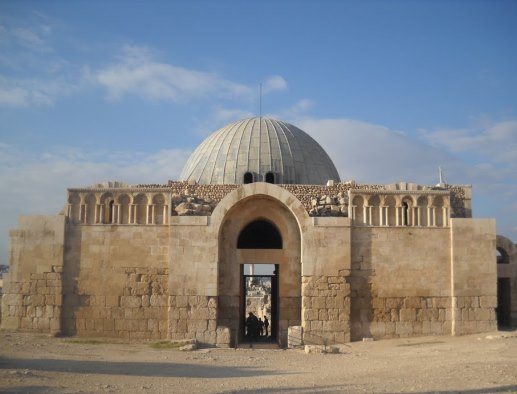
Location: Amman Citadel, Amman
The Umayyad Mosque at the Amman Citadel in Amman, Jordan, is a significant archaeological site from the Umayyad period (661–750 CE), reflecting the early Islamic architectural and cultural heritage of the region. Located on Jebel Al-Qala’a (Citadel Hill), the highest point in Amman at approximately 850 meters above sea level, the mosque is part of the Umayyad palatial complex, which includes the Umayyad Palace, Audience Hall, and Open Cistern. Built around 710–730 CE, the mosque served as the congregational mosque for the Umayyad administrative center in Amman, then a provincial capital of the Al-Balqa district. Though now in ruins, its remains provide valuable insights into early Islamic mosque architecture and the Umayyad dynasty’s urban planning.
The Umayyad Mosque was constructed during the Umayyad Caliphate, a
period when Amman, known as Philadelphia in classical antiquity, was a
key administrative hub under Islamic rule. The Umayyads, the first
hereditary Muslim dynasty (661–750 CE), established their capital in
Damascus and governed a vast empire stretching from Spain to Central
Asia. Amman, as the capital of the Al-Balqa district, was strategically
important due to its location on trade routes and its fertile
surroundings.
The mosque’s construction is generally dated to
around 710 CE for the earlier phase, with later modifications around 740
CE, based on archaeological evidence and historical sources. The earlier
phase, associated with the reign of Caliph Abd al-Malik (r. 685–705 CE)
or his successors, faced a “Between Qibla” direction (a transitional
orientation used in some early mosques), while the later phase, possibly
under Caliph Hisham (r. 724–743 CE), aligned with Mecca, reflecting the
standardization of the qibla (direction of prayer) after the Second
Fitna (Islamic civil war, 680–692 CE). The shift in qibla orientation,
visible in the mosque’s layout, is a significant historical marker,
illustrating evolving religious practices in early Islam.
The
mosque was part of a larger Umayyad complex that included the Umayyad
Palace, a governor’s residence, administrative offices, a bathhouse, and
a large cistern. This complex was likely built to serve the
administrative and religious needs of the Umayyad elite and local Muslim
community. The mosque’s location south of the palace, on a raised
platform, underscores its central role in the Citadel’s urban layout.
The devastating earthquake of 749 CE severely damaged the mosque and
palace, and after the Abbasid Revolution (750 CE), the Citadel lost its
political significance, leading to the mosque’s abandonment. Subsequent
occupations by the Abbasids, Fatimids, and Mamluks left minimal traces,
with the mosque falling into ruin until modern archaeological efforts
began in the 20th century.
The Umayyad Mosque at the Amman Citadel is a rare example of an early
Islamic congregational mosque, characterized by its Persian-style
apadana hall influence, a design typically found in Persia and
Mesopotamia rather than the Levant. Despite its ruined state, the
mosque’s layout and features provide insights into Umayyad architectural
innovation. Below are the key architectural elements, based on
archaeological descriptions and web sources:
1. Layout and
Dimensions
Square Plan: The mosque’s foundation measures
approximately 30 meters by 30 meters, making it a compact but
significant structure for its time. This square plan is typical of early
congregational mosques, designed to accommodate communal Friday prayers.
Raised Platform: The mosque sits on a raised platform, elevating it
above the surrounding plaza and emphasizing its religious importance.
The platform is accessed by steps, and the mosque is surrounded by seven
rows of six columns forming a colonnaded portico.
Central Courtyard
(Sahn): The mosque features a central open courtyard, a hallmark of
early Islamic architecture inspired by the Prophet’s Mosque in Medina.
The courtyard, likely paved, was surrounded by a colonnaded portico
(riwaq) on three sides, providing shade and space for worshippers.
Prayer Hall (Haram): The southern side of the mosque contains the
covered prayer hall, oriented toward the qibla. The hall likely
consisted of three aisles running parallel to the qibla wall,
intersected by a perpendicular central nave leading to the mihrab, a
layout influenced by Byzantine basilicas and seen in the Umayyad Mosque
of Damascus.
2. Mihrab and Qibla Wall
Concave Mihrab: The
mihrab, a niche indicating the direction of Mecca, is a concave feature
within a rectangular frame that projects slightly beyond the south wall,
an unusual design for early mosques. This projection may have served
both functional and symbolic purposes, emphasizing the qibla’s
importance.
Qibla Orientation: The mosque’s earlier phase (circa 710
CE) faced a “Between Qibla” direction, a transitional orientation used
in some Umayyad mosques before the qibla was standardized to face Mecca.
The later phase (circa 740 CE) realigned the qibla toward Mecca,
reflecting changes in religious practice. The mosque’s dual orientations
are a unique feature, visible in its architectural adjustments.
3. Columns and Arcades
Forest of Columns: The mosque is noted for its
“forest of columns”, a Persian-style apadana hall feature characterized
by numerous columns supporting the roof. These columns, likely reused
from Roman or Byzantine structures, were arranged in seven rows of six
around the courtyard, creating a hypostyle effect.
Vaulted Arcades:
An unusual feature is the evidence of vaulted roofs covering the
intersecting arcades, a departure from the flat or gabled roofs of most
early mosques. These vaults, possibly constructed with stone or brick,
suggest Umayyad experimentation with roofing techniques.
Reused
Materials: Like the nearby Byzantine Basilica and Umayyad Cistern, the
mosque incorporates Roman columns and capitals, possibly from the Temple
of Hercules. This reuse reflects the Umayyads’ pragmatic approach to
construction, adapting pre-Islamic materials to Islamic purposes.
4. Construction Materials
Limestone Masonry: The mosque was built
primarily from local limestone, consistent with Jordanian architectural
traditions. The walls and columns used ashlar blocks and rubble core,
similar to the Umayyad Cistern and palace structures.
Mortar and
Plaster: The masonry was set with gray, friable mortar mixed with ash, a
technique also found in other Umayyad sites like Qusayr Amra and Qasr
al-Kharraneh. Traces of plaster may have covered interior surfaces,
though little remains.
Decorative Elements: While no mosaics or
frescoes are documented, the mosque may have featured simple decorative
elements, such as stucco colonnettes or geometric patterns, similar to
those in the Umayyad Palace’s entrance hall. The lack of surviving
decoration suggests a functional rather than ornate design.
5.
Architectural Influences
Persian Apadana Hall: The mosque’s “forest
of columns” and hypostyle layout draw on the Persian apadana hall, a
large, columned audience hall typical of Achaemenid architecture. This
influence, rare in the Levant, suggests Umayyad architects adapted
Mesopotamian and Persian models, possibly via their capital in Damascus.
Byzantine and Roman Elements: The use of a basilical plan, reused Roman
columns, and vaulted arcades reflects Byzantine and Roman influences,
seen in structures like the Umayyad Mosque of Damascus and Al-Aqsa
Mosque.
Islamic Consciousness: The absence of human or animal
representations, as noted in Umayyad religious architecture, aligns with
Islamic aniconism, emphasizing geometric and vegetal motifs.
6.
Relationship to the Palace
The mosque is located south of the Umayyad
Palace, with a different orientation due to its alignment with Mecca,
while the palace followed pre-existing Roman foundations. This
distinction highlights the mosque’s religious priority, as its qibla
dictated its layout, unlike the palace’s administrative function.
The
mosque was accessed via the palace’s plaza, integrating it into the
Umayyad administrative center while maintaining its sacred role.
The Umayyad Mosque at the Amman Citadel is a key artifact of early
Islamic architecture and Umayyad governance, with several dimensions of
significance:
Early Islamic Architecture: The mosque is one of
the earliest congregational mosques in Jordan, predating many surviving
Umayyad structures. Its Persian-style apadana hall and vaulted arcades
represent an experimental phase in mosque design, influencing later
hypostyle mosques in Syria, Egypt, and Spain.
Qibla Evolution: The
mosque’s dual qibla orientations (Between Qibla circa 710 CE and Mecca
circa 740 CE) reflect the standardization of prayer direction in early
Islam, a process shaped by theological debates and political
consolidation after the Second Fitna.
Umayyad Urban Planning: As part
of the Umayyad palatial complex, the mosque underscores Amman’s role as
a provincial capital. The integration of a mosque, palace, cistern, and
bathhouse illustrates the Umayyads’ sophisticated urban planning, seen
in other sites like Anjar (Lebanon) and Qusayr Amra (Jordan).
Cultural Synthesis: The mosque’s use of Roman columns, Byzantine
basilical elements, and Persian apadana influences highlights the
Umayyads’ ability to blend pre-Islamic architectural traditions with
Islamic needs, a hallmark of their rule.
Archaeological Value: The
mosque’s remains, excavated since the 1920s by Italian, British, French,
Spanish, and Jordanian teams, contribute to our understanding of Umayyad
religious and administrative life. Its preservation, despite the 749 CE
earthquake, makes it a valuable case study compared to better-preserved
sites like the Umayyad Mosque of Damascus.
Historical Transition: The
mosque’s abandonment after the Abbasid takeover in 750 CE marks the
decline of Amman’s political significance, reflecting broader shifts in
Islamic governance from the Umayyads to the Abbasids.
Compared to
other Umayyad mosques, such as the Great Mosque of Damascus (705–715
CE), which is renowned for its mosaics and monumental scale, or the
Jerash Umayyad Mosque, the Amman mosque is smaller and less ornate but
significant for its early date and unique Persian influences. Its
proximity to the Umayyad Cistern and palace also distinguishes it as
part of a cohesive administrative complex.
The Umayyad Mosque is in a ruined state, heavily damaged by the 749
CE earthquake and subsequent neglect, but its foundations and key
features remain visible. Key aspects of its current condition include:
Preserved Elements: The raised platform, courtyard layout, mihrab
niche, and portions of the colonnaded portico are discernible, with some
columns re-erected during modern restorations. The qibla wall and
projecting mihrab frame are notable surviving features.
Damage: The
earthquake of 749 CE collapsed much of the roof, walls, and columns,
leaving only the foundations and lower sections intact. Exposure to the
elements and looting over centuries further eroded decorative elements,
with no mosaics or frescoes surviving.
Restoration: Archaeological
excavations since the 1920s, intensified in the 1990s by the Jordanian
Ministry of Tourism and Antiquities with USAID support, have stabilized
the mosque’s remains. The Spanish Archaeological Expedition and other
teams have documented the site, re-erecting columns and clarifying the
dual qibla orientations.
Integration with Citadel: The mosque is part
of the Amman Citadel’s open-air museum, alongside the Temple of
Hercules, Byzantine Basilica, Umayyad Palace, and Jordan Archaeological
Museum (though some artifacts have moved to the Jordan Museum). Its
location south of the palace enhances its visibility within the complex.
The mosque’s modest remains are less striking than the Umayyad Palace’s
domed Audience Hall or the Temple of Hercules, but its historical
significance and informative signage make it a compelling stop for
visitors.
Visiting the Umayyad Mosque offers a chance to explore early Islamic
architecture within the historic Amman Citadel. Here’s what visitors can
expect:
Duration of Visit: Exploring the mosque takes 10–15
minutes, as it is a compact ruin. A full visit to the Citadel, including
the Temple of Hercules, Umayyad Palace, Byzantine Basilica, Open
Cistern, and Jordan Archaeological Museum, typically takes 1–2 hours.
Accessibility: The mosque is within the Amman Citadel on Jebel
Al-Qala’a, accessible by a steep 10–15-minute walk from downtown Amman
or a short taxi ride (1–2 JOD) from the Roman Theatre. The mosque is
located south of the Umayyad Palace, near the Audience Hall.
Entry Requirements:
Admission: Entry to the Citadel costs 2 JOD
(~2.82 USD) for tourists, free with the Jordan Pass. Jordanian residents
pay ~0.25 JOD.
Hours: Open Saturday–Thursday, 8:00 AM–7:00 PM
(April–September) or 8:00 AM–4:00 PM (October–March); Fridays, 10:00
AM–4:00 PM. Confirm with the Jordan Tourism Board
(www.visitjordan.com).[](https://en.wikipedia.org/wiki/Umayyad_Palace)
Highlights:
Mosque Ruins: The raised platform, mihrab niche, and
colonnaded courtyard evoke the mosque’s original layout, with the
projecting mihrab frame being a unique feature. The forest of columns,
though partially restored, hints at the Persian apadana influence.
Information Signage: A signboard in English and Arabic details the
mosque’s history, qibla orientations, and architectural features, making
it accessible to casual visitors.
Citadel Context: The mosque’s
proximity to the Umayyad Palace and Cistern illustrates the Umayyad
administrative complex, while the Citadel’s panoramic views of Amman,
including the Roman Theatre, enhance the experience.
Atmosphere: The
Citadel is an open-air site with a quiet, reflective ambiance, though it
can be busy with tourists and school groups. The mosque’s ruins,
described as “minor but authentic,” evoke the Umayyad era’s simplicity
and ingenuity.
Photography: Photography is permitted, with the
mosque’s columns, mihrab, and platform offering compelling shots,
especially against the Citadel’s skyline. Morning or late afternoon
light enhances the limestone’s texture.
Guided Tours: The signboard
is informative, but English-speaking guides (~15 JOD/hour) at the
Citadel’s ticket office provide deeper context about the mosque’s qibla
shift and Umayyad architecture. Audio tours or apps like GPSmyCity offer
additional details.
Nearby Attractions:
Temple of Hercules
(within Citadel): A 2nd-century Roman temple with massive columns.
Umayyad Palace (within Citadel): An 8th-century complex with a domed
audience hall.
Byzantine Basilica (within Citadel): A 6th-century
church with Corinthian columns.
Open Cistern (within Citadel): A 730
CE Umayyad reservoir with a 17.5-meter diameter.
Jordan
Archaeological Museum (within Citadel): Houses artifacts like the Ain
Ghazal statues (some moved to the Jordan Museum).
Roman Theatre (1 km
downhill): A 6,000-seat amphitheater from the 2nd century CE.
Roman
Nymphaeum (1.5 km): A public fountain from 191 CE.
Downtown Amman
(Al-Balad) (1–2 km): Markets, the Grand Husseini Mosque, and cafes.
Limitations:
The mosque’s ruined state, with only foundations and
partial columns, may disappoint visitors expecting grand structures like
the Umayyad Mosque of Damascus or King Abdullah I Mosque.
Limited
decorative elements (no mosaics or frescoes) reduce its visual appeal
compared to sites like Qusayr Amra.
Signage is informative but
minimal, requiring a guide or research for full context.
The
Citadel’s exposed location can be hot and windy, necessitating sun
protection and water.
Location: Umayyad Mosque, Amman Citadel, Jabal Al-Qala’a, K. Ali Ben
Al-Hussein St., Amman, Jordan.
Opening Hours: Saturday–Thursday, 8:00
AM–7:00 PM (April–September); 8:00 AM–4:00 PM (October–March); Fridays,
10:00 AM–4:00 PM. Confirm with the Jordan Tourism Board
(www.visitjordan.com).[](https://en.wikipedia.org/wiki/Umayyad_Palace)
Admission: 2 JOD (~2.82 USD) for the Citadel, free with the Jordan Pass.
Reduced rates for Jordanian residents.
Getting There:
On Foot:
A steep 10–15-minute walk from downtown Amman (e.g., Roman Theatre).
By Taxi/Rideshare: Costs 1–2 JOD from downtown. Uber or Careem are
reliable.
By Car: Limited parking near the Citadel entrance.
Public Transport: Buses or shared taxis from the Raghdan Tourist
Terminal serve the area.
Tips for Visitors:
Visit early
morning or late afternoon for cooler temperatures and better lighting
for photos.
Wear comfortable shoes for the Citadel’s uneven terrain
and steep paths.
Bring water, sunscreen, and a hat, as the site is
exposed to the elements.
Hire a guide or use an audio tour for deeper
historical context, especially on the qibla shift.
Combine with the
Roman Theatre, Nymphaeum, or Jordan Museum for a half-day itinerary.
Contact: Check the Jordan Tourism Board website (www.visitjordan.com) or
contact the Citadel administration via local tourism offices for
updates.
The Umayyad Mosque at the Amman Citadel is a significant but
understated site, overshadowed by more intact Umayyad structures like
the Great Mosque of Damascus or Qusayr Amra’s frescoed bathhouse. Its
“forest of columns” and vaulted arcades are innovative but less visually
striking due to the lack of surviving decoration, limiting its appeal to
casual visitors. The dual qibla orientations, while historically
fascinating, are subtle and require explanation, as the physical
evidence is not immediately obvious without signage or a guide.
The mosque’s Persian apadana influence, as noted in sources, is a unique
feature but may be overstated, as the hypostyle plan also draws heavily
on Byzantine and Medinan models. The narrative of the Umayyads as sole
innovators should be tempered; their architecture built on Roman,
Byzantine, and Nabataean precedents, as seen in the reused columns and
cistern design. Additionally, claims about the mosque’s exact
construction dates (710 vs. 740 CE) are speculative, as absolute dating
remains challenging, and sources like nabataea.net rely on
circumstantial evidence.
Compared to Amman’s King Abdullah I
Mosque, with its vibrant blue dome and tourist-friendly facilities, or
the Grand Husseini Mosque, with its Ottoman heritage, the Umayyad Mosque
is a niche attraction for those interested in archaeology and early
Islam. Its integration into the Citadel’s broader historical narrative,
however, makes it a valuable stop, particularly for understanding
Amman’s role as an Umayyad capital. The lack of extensive
English-language documentation on-site, noted in visitor reviews,
suggests a need for improved interpretive materials to enhance
accessibility.