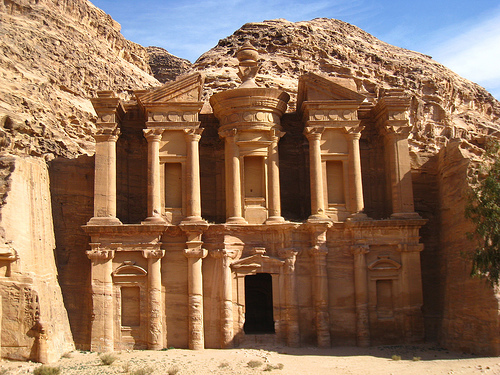
Al-Deir, also known as the Monastery, is one of the most iconic and grandiose rock-cut monuments in Petra, the ancient Nabataean capital in southern Jordan. Located in the Ma’an Governorate, approximately 250 kilometers south of Amman and 210 kilometers from Madaba, Al-Deir is perched high in the rugged mountains northwest of Petra’s city center, accessible via an arduous climb of over 800 steps. Carved into rose-red sandstone cliffs in the 1st century CE, this monumental structure, measuring about 50 meters wide and 45 meters high, is renowned for its architectural magnificence, remote setting, and speculative historical function as a temple, tomb, or ceremonial site.
Petra, a UNESCO World Heritage Site since 1985, was the flourishing
capital of the Nabataean Kingdom from the 4th century BCE to the 2nd
century CE. The Nabataeans, an Arab nomadic people who settled as master
traders, controlled caravan routes linking Arabia, Egypt, and the
Mediterranean, amassing wealth that funded Petra’s rock-cut
architecture, including Al-Deir. By the 1st century CE, under kings like
Aretas IV (9 BCE–40 CE) and Malichus II (40–70 CE), Petra reached its
architectural zenith, blending Hellenistic, Roman, and indigenous
Arabian influences. Al-Deir, likely constructed during this period,
reflects this cultural synthesis, though its exact date and purpose
remain debated due to the absence of inscriptions.
The historical
context of Al-Deir is shaped by Petra’s role as a trade hub and its
religious landscape:
Nabataean Society: The Nabataeans were
polytheistic, worshipping deities like Dushara (their chief god) and
Al-Uzza, alongside Hellenistic and Arabian gods. Al-Deir’s architectural
similarities to the Treasury (Al-Khazneh) suggest it may have been a
temple or tomb, possibly linked to royal or divine veneration, though
its remote location hints at a ceremonial or monastic function.
Roman
Influence: Petra’s annexation by Rome in 106 CE under Trajan, forming
Arabia Petraea, postdates Al-Deir’s construction, but its Hellenistic
features (e.g., urn and pediments) reflect earlier Nabataean trade with
Roman-controlled Alexandria and Palmyra.
Byzantine and Christian
Period: By the 4th–6th centuries CE, Petra became a Christian bishopric,
with churches like the Urn Tomb repurposed for worship. Local tradition,
noted by early explorers, suggests Al-Deir was used as a monastery,
possibly by Christian ascetics, giving rise to its modern name. However,
no definitive evidence supports this Christian use.
Biblical
Connections: Petra is linked to biblical Edom and possibly Sela (2 Kings
14:7), with nearby Wadi Musa associated with Moses’ miracle of striking
a rock for water (Numbers 20:2–13). While Al-Deir has no direct biblical
role, its location in this sacred region enhances its spiritual allure.
Rediscovery and Modern Era: Petra was rediscovered by Swiss explorer
Johann Ludwig Burckhardt in 1812, with Al-Deir gaining fame through
19th-century travelers’ accounts and 20th-century media, including
Indiana Jones and the Last Crusade (filmed at the Treasury). The
Monastery’s remote setting preserved it from early looting, but its
exposure to tourism poses modern challenges.
The name “Al-Deir”
(Arabic for “the Monastery”) is a modern designation, likely coined by
Bedouin or early explorers based on its isolated location and perceived
Christian use. Its Nabataean name is unknown, and its function—temple,
tomb, or ceremonial site—remains speculative.
Al-Deir is a colossal rock-cut monument, carved into a sandstone
cliff at an elevation of about 1,100–1,200 meters above sea level,
overlooking a vast plateau. Its facade, one of Petra’s largest, rivals
the Treasury in grandeur but is simpler in ornamentation, emphasizing
monumental scale over intricate detail. Below are its key architectural
features:
Facade and Dimensions:
Size: The facade measures
approximately 50 meters wide, 45 meters high, and 9 meters deep, making
it Petra’s largest rock-cut structure. Its scale dwarfs visitors,
amplifying its awe-inspiring presence.
Design: The facade is a
single-story composition with a classical Hellenistic layout, featuring
a central doorway flanked by columns, a broken pediment, and a crowning
urn. Its simplicity contrasts with the Treasury’s ornate two-story
design but retains Nabataean elegance.
Symmetry: The facade is nearly
symmetrical, though natural rock fissures and erosion disrupt perfect
alignment. The Nabataeans adapted the design to the cliff’s contours,
showcasing their rock-cutting expertise.
Classical Elements:
Doorway and Columns: The central doorway, about 8 meters high and 4
meters wide, is flanked by four engaged columns (pilasters) with
Nabataean-style capitals, resembling simplified Corinthian or Ionic
forms with geometric and floral motifs. These capitals are less ornate
than the Corinthian Tomb’s but align with Nabataean aesthetics.
Entablature and Pediment: Above the doorway, a frieze and cornice
support a broken pediment, a Hellenistic feature where the triangular
gable is split to frame a central tholos (circular niche). The
pediment’s segments curve outward, adding dynamic visual interest.
Tholos and Urn: A small tholos, carved within the pediment’s gap,
contains a niche, possibly for a statue or urn. Atop the facade, a large
urn (2–3 meters tall) crowns the structure, similar to the Treasury’s,
symbolizing funerary or divine significance. Local Bedouin legend claims
the urn held treasure, leading to bullet marks from 19th-century
attempts to break it.
Nabataean Features:
Crow-Step Motifs:
The facade includes crow-step (stepped) patterns, a Nabataean hallmark
derived from Mesopotamian and South Arabian architecture, visible on the
lateral sections. These contrast with the Hellenistic elements,
grounding the design in regional traditions.
Rock-Cut Precision: The
facade was carved top-down using chisels, scaffolding, and levers, with
the Nabataeans removing thousands of cubic meters of sandstone. The
smooth surface, despite erosion, reflects their mastery of soft
sandstone, a friable material prone to weathering.
Interior
Chamber:
Layout: The interior is a single, square chamber,
approximately 11.5 meters wide, 11 meters deep, and 10 meters high, hewn
into the cliff. It is starkly unadorned, with plain walls and a flat
ceiling, typical of Nabataean tombs where the facade held symbolic
weight.
Features: The chamber has no loculi (burial niches) like the
Corinthian Tomb, but a raised platform or niche at the back wall
suggests a cultic or ceremonial function, possibly for a statue of
Dushara or another deity. A small drainage channel in the floor
indicates water management, perhaps for rituals.
Condition: The
interior is intact but empty, with no inscriptions or artifacts, likely
looted in antiquity or never furnished due to a non-funerary purpose.
Surrounding Area:
Plateau: Al-Deir sits on a broad, rocky
plateau, offering panoramic views of Petra’s mountains, Wadi Araba, and
distant Israel/Palestine. The plateau includes smaller rock-cut
structures, possibly triclinia (dining halls) or shrines, used for
funerary or religious banquets.
Cisterns and Channels: Nabataean
water channels and cisterns nearby ensured water supply, critical in
Petra’s arid climate (annual rainfall ~193 mm). These fed rituals or
supported visitors to the remote site.
Obelisks and Shrines: Two
rock-cut obelisks, 6–7 meters high, stand near the trail to Al-Deir,
possibly representing Dushara and Al-Uzza or marking a sacred precinct.
Nearby caves and niches suggest a broader religious complex.
Erosion and Weathering:
The facade shows significant erosion from
wind, rain, and temperature fluctuations, softening details like the
capitals and pediment. The sandstone’s rose-red hue remains vibrant, but
upper sections appear melted or blurred, a common issue in Petra.
The
interior is better preserved due to its sheltered position, though
natural fissures in the rock pose long-term stability risks.
Architectural Context:
Al-Deir’s design echoes the Treasury, with
shared features like the urn, broken pediment, and tholos, suggesting a
similar period (1st century CE) or purpose. Its remote location, unlike
the Treasury’s Siq entrance, implies a specialized function, possibly as
a temple for elite ceremonies or a royal memorial.
The tomb’s
Hellenistic elements align with Alexandria’s rock-cut tombs, while its
crow-step motifs connect to South Arabian sites like Mada’in Saleh,
illustrating Petra’s cultural crossroads.
Al-Deir is a critical site for understanding Nabataean architecture,
religion, and society, though its study is constrained by limited
excavations and looting:
Architectural Innovation:
Al-Deir’s
colossal scale and precise carving demonstrate Nabataean engineering,
adapting Hellenistic models to sandstone cliffs. The top-down carving
technique, using minimal tools, is studied for its efficiency and
artistry.
The facade’s blend of classical (pediment, tholos) and
Nabataean (crow-step, simplified capitals) elements reflects cultural
synthesis, a focus of archaeological research on Petra’s trade networks.
Functional Debate:
Temple Hypothesis: The interior’s raised niche
and lack of loculi suggest a temple, possibly dedicated to Dushara or a
deified king like Obodas I (96–85 BCE), whose cult was prominent. The
plateau’s triclinia support ceremonial use, akin to the Qasr al-Bint
temple.
Tomb Hypothesis: The facade’s funerary motifs (urn, niches)
and Petra’s tomb tradition imply a royal burial, perhaps for Aretas IV
or Malichus II. The absence of burial niches may indicate an unfinished
or symbolic tomb.
Monastery Hypothesis: The “Monastery” name stems
from local tradition of Christian use, but no crosses or Christian
artifacts confirm this. Byzantine hermits may have occupied nearby
caves, not the chamber itself.
The lack of inscriptions, unlike the
Urn Tomb’s dedication, fuels speculation, with archaeologists favoring a
temple or memorial function based on parallels with the Treasury.
Cultural Interactions:
Al-Deir’s Hellenistic features reflect
Nabataean trade with Ptolemaic Egypt and Seleucid Syria, while crow-step
motifs link to South Arabia. This eclecticism is studied for insights
into Nabataean identity as Arab traders in a Greco-Roman world.
The
obelisks and surrounding shrines suggest a sacred precinct, possibly
linked to Nabataean high places (open-air altars), a topic of ongoing
research.
Archaeological Challenges:
Looting, likely from
Roman times, has stripped Al-Deir of artifacts, limiting biographical
data. The chamber’s emptiness frustrates attempts to confirm its
function.
Excavations in Petra, led by the Jordanian Department of
Antiquities and teams like Brown University, focus on urban areas (e.g.,
Great Temple), with Al-Deir receiving less attention due to its
remoteness. Geophysical surveys could reveal hidden chambers or ritual
spaces.
Erosion poses a preservation challenge, with studies
monitoring sandstone degradation to guide conservation.
Al-Deir is a cultural and historical landmark, embodying Petra’s
Nabataean legacy and modern global appeal:
Nabataean Heritage:
Al-Deir symbolizes Petra’s wealth, artistry, and religious devotion,
whether as a temple or tomb. Its remote setting suggests exclusivity,
reserved for elite or sacred rites, reflecting Nabataean social
hierarchy.
As part of Petra, a New Seven Wonders of the World (2007),
Al-Deir contributes to global recognition of Nabataean culture,
alongside the Treasury and Royal Tombs.
Biblical and Regional
Context:
Petra’s ties to Edom, Sela, and Moses’ miracle at Ain Musa
(4 km away) place Al-Deir in a biblically significant landscape. While
not religious itself, its location attracts pilgrims exploring Jordan’s
sacred sites.
The obelisks and potential Dushara link connect Al-Deir
to Nabataean spirituality, enriching its cultural narrative.
Tourism and Modern Identity:
Al-Deir is a must-see for Petra’s
~500,000–1 million annual visitors, drawing adventurers for its
challenging climb and iconic facade. Its image graces travel media,
Jordanian tourism campaigns, and films, cementing Petra’s mystique.
Tourism sustains Wadi Musa’s economy, employing Bedouin (e.g., Bdoul
tribe) as guides, vendors, and animal handlers. Al-Deir’s Bedouin tea
shops, offering views and hospitality, enhance the cultural experience.
Jordan’s promotion of Petra as a global destination reinforces national
pride, with Al-Deir’s grandeur symbolizing Nabataean ingenuity.
Interfaith and Global Appeal:
While not a pilgrimage site like Tell
Mar Elias, Al-Deir attracts diverse visitors—Christians, Muslims, Jews,
and secular tourists—drawn to Petra’s historical and aesthetic allure.
Its universal appeal mirrors Jordan’s interfaith harmony.
Visiting Al-Deir is a rewarding but physically demanding experience,
requiring a 40–60-minute climb from Petra’s city center. Below is a
detailed overview:
Access and Logistics:
Location: Al-Deir is
4–5 km northwest of the Petra Visitor Center, accessed via the Siq, city
center, and a 2.5-km trail with 800–850 steps. GPS coordinates are
approximately 30.3375°N, 35.4315°E.
Getting There: From Madaba, Petra
is 210 km (2.5–3 hours by car, ~20 JOD in fuel) via the Desert Highway
(Route 15) or King’s Highway (Route 35). Taxis from Madaba cost ~50–60
JOD; from Amman (250 km), ~80–100 JOD. JETT buses from Amman to Wadi
Musa cost ~10 JOD (4 hours). From the Visitor Center, reach Al-Deir via:
Walking: 1.5–2 hours total (30 minutes through Siq to city center, 40–60
minutes up steps). The trail starts near the Basin Restaurant, past the
Royal Tombs.
Donkey Ride: Donkeys (~10–20 JOD round-trip, negotiable)
reduce climb time to 20–30 minutes but are controversial due to animal
welfare concerns. Riders must dismount for some steps.
Entry and
Costs: Petra entry is 50 JOD (1 day), 55 JOD (2 days), or 60 JOD (3
days), included in the Jordan Pass (~70–80 JOD). Al-Deir requires no
additional fee. Guided tours (~20–50 JOD) or audio guides (~10 JOD)
cover the Monastery trail.
Opening Hours: Petra is open 6:00 AM–6:00
PM (summer) or 5:00 PM (winter). Start the Al-Deir climb by 2:00 PM to
return before closing.
Best Time to Visit: Spring (March–May) and
autumn (September–November) offer mild temperatures (15–25°C/59–77°F).
Summer (June–August) exceeds 35°C (95°F), requiring early starts. Winter
(December–February) brings cooler weather (5–15°C/41–59°F) and rare
rain.
What to Expect:
The Trail: The climb to Al-Deir involves
800–850 rock-cut steps, winding through a narrow valley with cliffs,
obelisks, and caves. The ascent takes 40–60 minutes (descent 30–45
minutes), with rest stops and Bedouin stalls selling water (~2 JOD) and
souvenirs. The trail is strenuous, with uneven steps and no handrails,
but offers stunning views of Petra’s mountains.
The Site: Al-Deir’s
facade emerges dramatically at the trail’s end, filling a cliff face
with its colossal urn and pediment. Visitors can explore the plateau,
enter the chamber, and climb nearby rocks for photos. Bedouin tea shops
(e.g., “Best View” stall) offer seating, tea (~2 JOD), and panoramic
vistas of Wadi Araba.
Experience: A visit takes 1–1.5 hours,
including 30–45 minutes at Al-Deir for photos, exploration, and rest.
The chamber’s simplicity contrasts with the facade’s grandeur, while the
plateau’s vastness evokes solitude. Sunset visits cast a golden glow on
the sandstone, though time constraints may limit this.
Surroundings:
The plateau includes triclinia, caves, and obelisks, with trails to
viewpoints like the Lion Triclinium or Umm Sayhoun village. The Basin
Restaurant (1 km back) offers lunch (~15 JOD buffet).
Visitor
Feedback:
Positives: Tripadvisor reviews (~5,000 for Petra, 4.8/5)
call Al-Deir “breathtaking” and “worth the climb,” praising its
“massive” facade and “remote serenity.” The plateau’s views and Bedouin
hospitality (tea, stories) are highlights. Visitors value the sense of
achievement after the ascent.
Negatives: The climb’s difficulty
deters some, with complaints of exhaustion, uneven steps, and heat in
summer. Donkey rides raise ethical concerns, with reports of overworked
animals. The chamber’s emptiness disappoints those expecting artifacts,
and minimal signage requires guides for context. Crowds at peak times
(10 AM–2 PM) can disrupt tranquility.
Tips: Start early (6–8 AM) to
avoid heat and crowds, allowing 4–6 hours for a round-trip including
city center sites. Wear sturdy shoes, bring water (1–2 liters), and use
sunscreen/hat in summer. Hire a guide or download a Petra app for
context. Avoid donkey rides if concerned about animal welfare; walk at a
steady pace with breaks. Bargain politely with Bedouin vendors.
Cultural Sensitivity:
Respect Bedouin culture by dressing modestly
(covering shoulders and knees), bargaining courteously, and declining
donkey rides politely if opting out. Avoid climbing the facade or
entering restricted areas to preserve the site. Engage with Bedouin
guides for authentic insights into Petra’s modern life.
Al-Deir is in a stable but weathered condition, preserved within
Petra’s archaeological park, though it faces environmental and
tourism-related challenges:
Current Condition:
The facade
remains structurally sound, with the urn, pediment, and capitals
visible, but erosion has blurred details, particularly on upper
sections. The sandstone’s rose-red color is vivid, enhanced by sunlight,
but fissures threaten long-term stability.
The interior chamber is
intact, with no artifacts or inscriptions, its plainness preserved by
its sheltered position. The plateau’s triclinia and obelisks are
weathered but discernible.
The trail to Al-Deir is maintained, with
steps cleared of debris, though uneven surfaces pose risks. Bedouin
stalls add vibrancy but require oversight to prevent litter.
Preservation Efforts:
The Jordanian Department of Antiquities, with
UNESCO and partners like USAID’s SIYAHA project, manages Petra’s
conservation, using techniques like water diversion channels, chemical
stabilizers, and laser scanning to combat sandstone erosion. Al-Deir
benefits from these efforts, though its remoteness limits intensive
work.
The Petra National Trust and RSCN promote sustainable tourism,
training Bedouin guides and regulating visitor flow to reduce impact.
The trail’s closure after hours protects the site from vandalism.
International projects, such as Italy’s ISCR and Brown University’s
Petra surveys, monitor Al-Deir’s stability, with 3D modeling aiding
restoration plans.
Tourism and Accessibility:
Al-Deir attracts
a subset of Petra’s ~500,000–1 million annual visitors, as the climb
deters casual tourists. Its remoteness preserves its sanctity but
strains resources for upkeep.
Accessibility is limited by the
strenuous trail, unsuitable for mobility-impaired visitors. Donkey rides
offer partial access, but steps require dismounting. The Visitor Center
provides maps and guides to plan the trek.
Wadi Musa’s tourism
infrastructure (hotels like Mövenpick, restaurants, Petra Kitchen)
supports visitors, with Al-Deir a key stop in 2–3-day itineraries
alongside the Treasury and Royal Tombs.
Challenges:
Erosion:
Sandstone degradation from wind, rain, and temperature swings is acute
at Al-Deir, with upper facade details fading. Conservation is ongoing
but costly, prioritizing high-traffic sites like the Siq.
Tourism
Impact: Foot traffic, climbing, and litter risk damage, though Al-Deir’s
isolation mitigates this compared to the Treasury. Bedouin stalls, while
culturally vital, require regulation to prevent clutter.
Looting and
Data Gaps: Ancient looting emptied the chamber, and limited excavations
leave Al-Deir’s function speculative. Future surveys could uncover
ritual spaces or artifacts.
Functional Uncertainty: The
temple-versus-tomb debate persists, with guidebooks like Lonely Planet
favoring a temple due to the niche, while others suggest a memorial.
This ambiguity challenges interpretation.