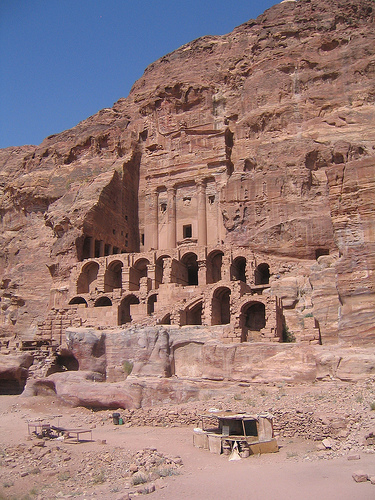
The Urn Tomb is one of the most imposing and well-preserved rock-cut monuments in Petra, Jordan, a UNESCO World Heritage Site renowned for its Nabataean architecture and historical significance as a trade hub. Located in the Royal Tombs complex along the eastern cliff face of Petra’s main valley, the Urn Tomb stands out for its grand facade, intricate interior, and later adaptation as a Byzantine church. Its scale, architectural sophistication, and historical layers make it a key monument for understanding Nabataean funerary practices, cultural influences, and Petra’s evolution over centuries.
The Urn Tomb is situated in the Royal Tombs group, a series of
monumental rock-cut tombs carved into the eastern cliff of Petra’s
central valley, facing the Colonnaded Street and the Great Temple. It is
the southernmost and most prominent of the four main Royal Tombs, which
also include the Corinthian Tomb, Palace Tomb, and Silk Tomb. Positioned
high on the cliff face, the tomb is accessible via a steep staircase
from the valley floor, offering commanding views of Petra’s urban core.
Its elevated location and grand facade suggest it was designed to convey
power and prestige, likely reserved for Nabataean royalty or
high-ranking elites.
Petra, the capital of the Nabataean Kingdom
from the 4th century BC to the 2nd century AD, thrived as a crossroads
for incense and spice trade routes connecting Arabia, Egypt, and the
Mediterranean. The Urn Tomb, dated to the mid-1st century AD, reflects
the peak of Nabataean architectural achievement, just before the Roman
annexation of Petra in 106 AD. Its later conversion into a church in the
5th century AD highlights Petra’s enduring significance in the Byzantine
era.
The Urn Tomb is a masterpiece of Nabataean rock-cut architecture,
characterized by its massive facade, complex interior, and evidence of
adaptive reuse. Carved directly into the reddish sandstone cliff, the
tomb’s design combines Hellenistic, Nabataean, and Roman influences,
showcasing the kingdom’s cosmopolitan culture.
Facade
Dimensions and Design: The facade is approximately 26 meters wide and 27
meters high, making it one of Petra’s largest. Its symmetrical design
draws heavily on Hellenistic architecture, resembling a classical temple
or palace. The lower level features six engaged columns (four central
and two flanking) with Nabataean-style capitals, which are simpler and
more geometric than Corinthian capitals. Above the columns, a triangular
pediment with a central niche contains a prominent urn, giving the tomb
its name. The urn, a common Nabataean motif, likely symbolizes the
deceased or their soul (nefesh).
Upper Level: The facade’s upper
section includes a row of 18 smaller engaged columns or pilasters,
creating a double-story effect. This tiered design, also seen in the
Treasury, enhances the tomb’s monumental appearance. The facade is
relatively well-preserved, though erosion has softened some details,
particularly around the urn and upper columns.
Arches and Niches: Two
arched niches or recesses flank the central doorway, possibly for
statues or decorative elements, though none remain. These arches reflect
Roman architectural influences, increasingly prominent in Petra during
the 1st century AD.
Interior
Main Chamber: The tomb’s interior
is a single, vast rectangular chamber, approximately 18 meters wide, 20
meters deep, and 10 meters high—one of the largest in Petra. The walls
are plain but precisely cut, with a smooth finish that highlights the
Nabataeans’ stone-working expertise. The chamber’s scale suggests it
housed multiple burials, likely for a royal family or elite group.
Loculi and Arcosolia: The back wall features five deep loculi (burial
niches), some with arched tops (arcosolia), designed to hold sarcophagi
or bodies. These niches indicate the tomb’s primary funerary purpose,
though no remains or grave goods have been found, likely due to looting
or reuse.
Side Chambers: Two smaller lateral chambers, accessible via
doorways on either side of the main chamber, may have served as
additional burial spaces or storage for offerings. These rooms are less
finished, suggesting they were secondary to the main chamber.
Courtyard and Substructures
Courtyard: In front of the facade, a
large courtyard (about 20 meters wide) is enclosed by two-story
colonnades on three sides, with the cliff forming the fourth. The
colonnades, partially rock-cut and partially built, feature arches and
columns, creating a grand entrance plaza. This courtyard likely served
as a space for funerary rituals or gatherings, enhancing the tomb’s
ceremonial function.
Cisterns and Channels: The courtyard includes
rock-cut cisterns and water channels, reflecting the Nabataeans’
advanced hydraulic engineering. These may have supplied water for
rituals or practical use during gatherings.
Substructures: Below the
courtyard, a series of vaulted rooms or crypts, possibly for additional
burials or storage, were carved into the cliff base. These are less
accessible and less studied but add to the tomb’s complexity.
Byzantine Modifications
In the 5th century AD (circa 447, based on an
inscription), the Urn Tomb was converted into a Byzantine church, likely
a cathedral, reflecting Petra’s Christianization under Byzantine rule.
Modifications include:
Christian Elements: The interior was
adapted for worship, with the addition of a bishop’s seat (cathedra)
carved into the back wall, suggesting the tomb served as a significant
ecclesiastical site. Crosses and other Christian symbols may have been
added, though few survive.
Structural Changes: The loculi were likely
sealed or repurposed, and the chamber was cleared for liturgical use.
The courtyard colonnades were repaired or rebuilt to accommodate larger
congregations.
Inscription: A Greek inscription from 447 AD, found in
the tomb, confirms its consecration as a church, naming a Bishop Jason
and indicating its role as a memorial or martyrium. This inscription is
a rare written record of Petra’s Byzantine period.
The Urn Tomb is dated to the mid-1st century AD (circa 40–70 AD),
based on its architectural style and comparisons with dated Nabataean
monuments like the Treasury (early 1st century AD). This places it
during the reign of King Malichus II (40–70 AD) or Aretas IV (9 BC–40
AD), a period of prosperity and Roman influence in Petra. Its historical
significance spans both Nabataean and Byzantine eras.
Nabataean
Funerary Practices
The Urn Tomb’s scale and design indicate it was a
royal or elite burial site, likely for a king, queen, or noble family.
The loculi suggest multiple burials, possibly spanning generations,
while the courtyard and colonnades imply large-scale funerary rituals,
such as feasts or commemorative ceremonies. The urn atop the pediment, a
common Nabataean symbol, may represent the nefesh (soul) of the
deceased, linking the tomb to spiritual beliefs about the afterlife. The
tomb’s prominence in the Royal Tombs complex underscores its role as a
status symbol, proclaiming the wealth and power of its patrons.
Architectural Innovation
The Urn Tomb exemplifies Nabataean
architectural mastery, blending local traditions with Hellenistic and
Roman elements:
Hellenistic Influence: The classical columns,
pediment, and tiered facade draw from Greek temple designs, reflecting
Petra’s engagement with the Hellenistic world through trade and
diplomacy.
Roman Influence: The arched niches and robust colonnades
suggest Roman architectural trends, which became prominent in Petra as
the Nabataeans aligned with Rome in the 1st century AD.
Nabataean
Style: The simplified capitals, urn motif, and rock-cut technique are
distinctly Nabataean, showcasing the kingdom’s ability to adapt foreign
styles to its desert environment.
The tomb’s construction required
advanced engineering, including precise carving of the cliff face,
leveling of the courtyard, and integration of water systems. The
Nabataeans likely used chisels, scaffolding, and skilled labor to
achieve this, working from the top down to minimize debris damage.
Byzantine Transformation
The conversion of the Urn Tomb into a
church in 447 AD reflects Petra’s transition from a Nabataean capital to
a Christian center under Byzantine rule. The choice of a royal tomb for
a cathedral suggests its continued prestige, possibly due to its size
and location. The bishop’s seat and inscription indicate it was a major
religious site, perhaps dedicated to a martyr or saint. This adaptation
preserved the tomb’s structure while repurposing it for a new cultural
and spiritual context, highlighting Petra’s resilience after the decline
of Nabataean power.
Urban Role
The Urn Tomb’s placement in the
Royal Tombs complex, overlooking Petra’s civic center, made it a focal
point of the city’s sacred and political landscape. The Royal Tombs
collectively served as a monumental backdrop to the Colonnaded Street,
reinforcing the authority of the Nabataean elite. The tomb’s elevated
position and grand courtyard ensured it was visible from much of the
valley, enhancing its symbolic impact.
The Urn Tomb’s grandeur has sparked ongoing scholarly discussion,
though limited inscriptions and looting hinder definitive conclusions.
Key points include:
Patronage: No inscription identifies the
tomb’s original occupants, but its size and location suggest a royal
figure, possibly Aretas IV, Malichus II, or a queen like Shaqilat. Some
propose it was a dynastic tomb for multiple rulers.
Urn Symbolism:
The urn is interpreted as a nefesh, but some scholars suggest it could
represent a divine symbol, such as Dushara, the Nabataean god, or a
treasury for offerings.
Byzantine Role: The tomb’s use as a cathedral
raises questions about its Christian significance. Was it chosen for its
size, prestige, or association with a specific martyr? The 447 AD
inscription provides a rare clue but leaves much unanswered.
Dating:
The mid-1st century AD date is widely accepted, but some argue for a
slightly earlier construction (late 1st century BC) based on stylistic
similarities to the Treasury.
Recent studies, such as those in The
Nabataeans: Their History, Culture and Archaeology (2017), emphasize the
tomb’s role in Petra’s urban and religious evolution. Archaeological
surveys continue to explore its substructures and Byzantine
modifications.
For modern visitors, the Urn Tomb is a highlight of a Petra tour,
often visited as part of the Royal Tombs trail. Its steep ascent (via
stairs or a ramp) rewards visitors with stunning views and a sense of
the tomb’s grandeur. The interior’s vastness and the courtyard’s
colonnades impress, while guides highlight its dual history as a
Nabataean tomb and Byzantine church.
Tourism: The tomb is
accessible but requires moderate effort to reach, making it less crowded
than the Treasury or Monastery. Signage and guides provide context,
though the Byzantine inscription is not always visible or emphasized.
Sunset visits are popular, as the facade glows in the evening light.
Cultural Practices: Local Bedouin vendors near the tomb sell crafts and
share stories, sometimes linking the urn to myths of hidden treasure, a
common Petra legend. These tales, while not factual, enhance the site’s
mystique.
Visitor Feedback: Tripadvisor reviews praise the tomb’s
scale and views but note the climb’s challenge for some. Visitors often
appreciate its historical layers, though it may be overshadowed by more
iconic monuments.
The Urn Tomb’s sandstone construction is vulnerable to erosion from wind, rain, and temperature fluctuations, which have worn down the facade’s finer details. The courtyard colonnades are particularly fragile, with some arches partially collapsed. Petra’s UNESCO status has spurred conservation efforts, including stabilization of the cliff face and monitoring of tourist impact. The tomb’s interior, exposed to the elements, faces ongoing risks, but its solid construction has ensured remarkable preservation. Continued archaeological work aims to protect the monument while uncovering more about its Byzantine phase.