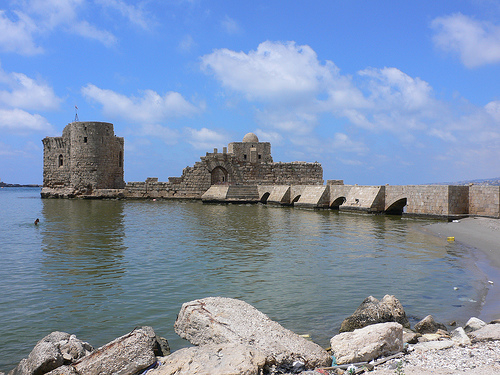
Location: Sidon, South Governorate Map
Constructed: 1228 by Crusaders
Sidon Sea Castle is a medieval fortress situated on a island and connected to the mainland via a 80 meter causeway. It is located in the city of Sidon of the South Governorate in Lebanon. Sidon Sea Castle was constructed in 1228 by the Crusaders on ruins of Phoenician temple devoted to Melkart. This mythical hero distinguished himself with numerous feats of bravery and chivalry. After his death he was proclaimed a deity and several shrines were devoted to him in the Eastern Mediterranean. Romans established their own fortification here, but it was largely in ruins by the time Christian armies of Western Europe showed up here. The castle protected local harbor from attacks of the pirates. After Crusaders lost control of the region the walls of the their former stronghold was largely destroyed by the Mamluks. In the following centuries Muslims did rebuild several of the towers to keep an eye over the watery frontier, but it did not reach the same level of sophistication as it did in the Medieval times.
Ancient Phoenician Foundations (Pre-1228)
Sidon ranks among
the oldest continuously inhabited cities in the world, with roots
dating to around 4000 BC as a major Phoenician port city known for
its maritime trade, purple dye, and cultural influence. The small
island where the castle now stands was not originally empty; it
likely hosted a temple dedicated to Melqart, the Phoenician god
equated with the Greek Heracles (Hercules). Some sources suggest it
may have been the site of a Phoenician king's palace or other
monuments.
These early structures were largely destroyed by the
Assyrian king Esarhaddon in the 7th century BC and further damaged
by natural earthquakes. Assyrian records from Sennacherib also
reference Sidon's fortifications, cisterns, and palaces. Today,
underwater archaeological evidence around the castle—including
walls, columns, stairways, statues, and cisterns—reveals submerged
remnants of the ancient Phoenician (and possibly Roman) city.
Roman-era granite columns were later reused as spolia in the
castle's walls, a common medieval practice for reinforcement (acting
like horizontal "rebar").
The island's natural rocky reef was
reinforced over time with sea walls to protect against waves,
setting the stage for its later military role.
Crusader
Construction (1227–1228)
By the early 12th century, Crusaders had
captured Sidon (in 1110), incorporating it into the Kingdom of
Jerusalem. The Sea Castle itself was built much later, in the winter
of 1227–1228, during the waning years of the Crusader states as a
defensive fortress for the Holy Land. It was constructed by Crusader
forces (possibly involving the Knights Hospitaller of St. John) on
the former Phoenician temple site, likely under the control of the
House of Grenier.
The design featured two main towers (the
rectangular West Tower better preserved) connected by a wall, with
pointed arches and cross-vaults typical of Crusader military
architecture. Roman columns were embedded horizontally in the outer
walls for structural strength. The castle overlooked and protected
Sidon's double harbor, serving as a key coastal stronghold amid
declining Crusader power. An initial narrow roadway linked it to the
mainland.
Old illustrations depict its former grandeur, but
surviving elements today include a large vaulted room inside filled
with carved capitals and rusting cannonballs (from later conflicts).
Mamluk Conquest, Destruction, and Rebuild (1291 onward)
The
castle's Crusader phase ended dramatically in 1291. After the fall
of Acre (the last major Crusader stronghold), Mamluk forces under
Sultan Al-Ashraf Khalil captured Sidon. The Mamluks partially
destroyed the fortress in a scorched-earth policy to prevent
Crusader return, but they soon recognized its strategic value and
rebuilt it. They added the iconic 80-meter (262-foot) fortified
causeway on nine arches—the narrow, arched bridge visitors cross
today. The East Tower's upper levels also date to this Mamluk phase,
while the lower parts remain Crusader.
This rebuild transformed
the site into a more accessible and defensible structure. The
Mamluks (and later Arabs) contributed heavily to its current form,
blending military functionality with the existing Crusader base.
Decline, 17th-Century Restoration by Emir Fakhr al-Din II, and
Ottoman Era
After the Mamluk period, the castle gradually fell
into disuse. In the 17th century, under Ottoman rule, the powerful
Druze Emir Fakhr al-Din II (Fakhreddine II, a Lebanese national hero
and modernizer) restored and expanded it around the 1630s. He
reportedly used it as part of his efforts to fortify and develop the
region, possibly even as a residence or palace at times. His
restoration helped preserve the structure amid Ottoman control.
During the Ottoman period, a small domed mosque—Masjed Qalaat el
Bahr (Sea Castle Mosque)—was added atop the West Tower. This simple
cubic Ottoman-era structure features a central dome with a
cantilevered mihrab (prayer niche) indicating the qibla direction.
The castle saw use as a prison in some accounts and endured further
damage from naval bombardments (notably in 1840 during conflicts
involving European powers) and earthquakes.
A 19th-century
engraving captures the castle's romantic, harbor-side silhouette
with fishing boats and the causeway.
Modern Era and Current
State
The castle has survived additional conflicts, including
damage during the Lebanese Civil War (1975–1990) and later events.
It was designated a national heritage site in 1935, with
restorations in the 1990s and ongoing efforts (sometimes using
modern materials, which have sparked debate). Today, it stands as a
half-ruined yet evocative monument, open to the public for a small
fee. Visitors explore the inner courtyard, towers, vaulted chambers,
and rooftop for panoramic views of Sidon's old city, fishing harbor,
and Mediterranean.
Its architecture embodies
"superpositions"—layered history visible in Crusader/Mamluk towers,
Roman spolia, Phoenician foundations, and the Ottoman mosque—all
coexisting on a single strategic islet. The castle symbolizes
Sidon's enduring maritime identity, from ancient Phoenician trade to
medieval warfare and beyond.
Historical Construction and Phases
The castle was erected in 1228
AD by Crusader forces (likely under the influence of the Knights
Hospitaller or local lords like the House of Grenier) on a small rocky
islet in Sidon's ancient harbor. The site overlay an earlier Phoenician
temple to Melqart (the Phoenician equivalent of Heracles) and possibly a
Phoenician king's palace, with surrounding submerged ruins—including
walls, columns, stairways, statues, and cisterns—still visible in calm
waters.
Crusader construction formed the core: two towers linked by a
fortified wall. It was partially destroyed in 1291 when the Mamluks
conquered Sidon from the Crusaders. The Mamluks then rebuilt and
expanded it, adding the iconic 80-meter (approx. 262-foot) causeway on
nine arches for mainland access and completing the upper section of the
eastern tower.
Further modifications occurred in the 17th century
under Emir Fakhr al-Din II (Fakhreddine), who restored damaged sections.
An Ottoman-era addition—a small domed mosque—appeared on the western
tower's roof. Earthquakes, wars, and time have left it as a picturesque
ruin, but its surviving elements reveal a palimpsest of architectural
layering.
Overall Layout and Setting
The fortress occupies a
small, low-lying island (roughly 75m east-west by 50m north-south) at
the eastern end of Sidon's port, strategically guarding the harbor
against naval threats. It features a compact plan typical of Crusader
coastal defenses: two primary towers (western/sea tower and eastern/land
tower) connected by a curtain wall that encloses a central courtyard
area. Defensive outer walls protect the eastern and southern flanks,
with the entire complex oriented to monitor sea approaches.
Access is
via the narrow, fortified Mamluk causeway (about 80m long, built on nine
arches), which crosses shallow waters and includes steps and a gateway.
Natural rocky reefs were reinforced with stone walls to buffer against
waves. The layout is pragmatic rather than ornate—focused on
functionality, with thick walls, limited openings, and elevated
positions for surveillance.
Materials and Construction Techniques
Builders used locally quarried limestone (or sandstone) blocks in ashlar
masonry for thick, durable walls suited to the coastal climate. A
distinctive Crusader technique—common in Levantine fortifications on
ancient sites—involves reusing Roman spolia: rose-granite or stone
columns embedded horizontally into the outer walls as structural ties or
reinforcements, functioning like modern rebar to bind the masonry
against lateral forces.
Vaulted ceilings (barrel or groin vaults)
provide strength and spacious interiors without excessive wood.
Foundations incorporate the islet's natural rock and earlier
Phoenician/Roman remnants. The result is a rugged, imposing structure
that blends seamlessly with its marine environment.
Key
Architectural Components
Causeway and Entrance: The Mamluk causeway
serves as the primary approach, fortified and arched for stability and
defense. It leads to a porch/gateway area flanked by walls.
Western
(Sea) Tower: The better-preserved rectangular tower stands to the left
of the entrance. Its ground floor features a large, elongated vaulted
hall/chamber with high arched ceilings, scattered carved stone capitals
(from earlier periods), and remnants like rusting cannonballs from later
conflicts. A winding/spiral staircase ascends to the roof. This tower's
robust masonry and minimal openings emphasize defense.
Eastern (Land)
Tower: Less intact, this tower shows phased construction: the lower
levels are Crusader-era, while the upper sections are Mamluk additions.
It is more fragmented but contributes to the overall defensive
enclosure.
Connecting Walls and Curtains: Robust curtain walls link
the towers, enclosing the courtyard. They incorporate arrow-slit-like
openings for archers and the horizontal Roman column reinforcements.
Walls rise significantly (historically estimated around 12m in parts)
with thicknesses supporting siege resistance.
Roof and Ottoman
Mosque: The western tower's roof offers panoramic views of the old city,
fishing harbor, and sea. Here stands the small "Masjed Qalaat el Bahr"
(Sea Castle Mosque), a simple cubic Ottoman structure topped by a
central dome. A notable feature is the cantilevered projection (likely
indicating the mihrab/qibla direction toward Mecca), adapting the
military platform for religious use.
Defensive and Functional
Features
As a harbor fortress, the design emphasizes perimeter
defense: thick walls, strategic tower placement for crossfire, and the
island's natural moat-like isolation (sometimes enhanced by seawater).
Interiors included storage (vaulted halls), water cisterns, and living
quarters suited for garrisons. It served as a refuge during internal
city threats and a base for controlling maritime traffic. Later
cannonballs reflect its use into the gunpowder era.
Architectural
Significance and Layers
Sidon Sea Castle is not a grand palatial
structure but a quintessential example of Crusader military pragmatism
in the Levant—efficient, spolia-rich, and resilient. Its "archaeology of
superpositions" is evident: Phoenician foundations, Roman recycled
elements, Crusader vaults and towers, Mamluk expansions, and Ottoman
religious overlay coexist without fully erasing prior layers. This
stratigraphic quality makes it a living historical document, visible in
the mismatched masonry, embedded columns, and phased tower heights.
Today, as a preserved ruin and tourist site, it retains its evocative
power, with the causeway, towers, and dome visible against the
Mediterranean backdrop. While no complete original floor plans survive
publicly, 3D laser scans and photogrammetry studies (recent academic
work) confirm the compact, functional layout described above.
Brief History and What to Expect
The castle was constructed in
1228 by Crusaders (Knights of St. John) on the site of an earlier
Phoenician temple to Melqart (a sea and commerce god, akin to Heracles).
It served as a coastal fortress during the Crusades. The Mamluks
partially destroyed it in 1291 but later rebuilt parts, including the
prominent 80-meter (262-foot) causeway with nine arches. Emir
Fakhreddine II restored it further in the 17th century, adding an
Ottoman mosque on the west tower.
Today, it consists of two main
towers linked by a wall:
West Tower (better preserved): Features a
large vaulted ground-floor chamber with carved capitals and old
cannonballs. A winding staircase leads to the rooftop with a small domed
Ottoman-era mosque.
East Tower: Shows clearer construction
phases—rough Crusader stones below, finer Mamluk/Ottoman work above.
Roman columns are embedded horizontally in the walls as reinforcements
(spolia from ancient Sidon).
Submerged ruins visible in calm, clear
water (especially early morning) include Phoenician/Roman walls and
column drums from earthquakes or ancient conquests.
The site
feels authentic and rugged rather than polished—expect uneven stones,
minimal signage or facilities, some litter in the harbor, and occasional
odors in darker corners. Visits typically last 45–60 minutes. The
highlight is the rooftop views over the Mediterranean, fishing boats,
and Old Sidon.
Visiting Tips
Hours: Open daily 9 AM–6 PM
(including weekends/holidays). Best windows: before 10 AM (cooler, fewer
people, better light for submerged ruins) or the hour before closing
(golden hour for photos).
Entrance Fee: Around $3 USD (or equivalent
in Lebanese lira) for foreigners—fluctuates with exchange rates. Small
USD bills are widely accepted and preferred. No advance tickets needed;
buy on-site. Children/students may get discounts.
What to Wear/Bring:
Comfortable grippy walking shoes (stairs are uneven and can be
slippery). Hat, sunscreen, and water—there's little shade. Modest
clothing is respectful in this conservative area. Avoid flip-flops.
Accessibility: Not wheelchair-friendly due to the causeway, stairs, and
rough terrain. External views from the Corniche are possible.
Photography: Excellent from the Corniche (pre-causeway for wide shots of
the castle), on the bridge, and rooftop. Golden hour or early morning
enhances the sandstone glow against the sea. Look down for underwater
ruins.
Facilities: Basic/minimal toilets (use a nearby café
beforehand). No café or shop inside. Nearby souks and restaurants offer
refreshments.
Crowds and Time: Relatively quiet outside peak times.
Combine with nearby sites for a half-day (see below).
Pro Tips:
Hire a local guide for deeper historical context (no official audio
tours or panels on-site).
Check the water for submerged ruins on calm
days.
The causeway walk is atmospheric—enjoy the sea breeze and
boats.
Getting There
Sidon is about 45 km (28 miles) south of
Beirut, a 45–90 minute trip depending on transport and traffic.
From
Beirut: Private taxi (~$55–70 one-way, 35–45 min, most comfortable);
minibus from Cola intersection (~$3–4, 60–90 min); service/shared taxi
or express bus options. Ask to be dropped near “Qala’a” (castle).
Within Sidon: Easily walkable from the Corniche or old souks (5–15 min).
Parking nearby on the seafront.
Day Tours: Many from Beirut combine
Sidon with Tyre (Sour) ruins—convenient with a driver/guide who knows
local conditions.
Self-driving is possible but not recommended
due to chaotic traffic, signage, and checkpoints.
Safety and
Practical Considerations (Important)
As of 2026, major governments
(US, UK, Canada, Australia) advise against all or most travel to Lebanon
due to ongoing armed conflict risks, volatility, terrorism, unrest, and
other concerns. Sidon itself is in the south, and areas further south
carry heightened warnings. The castle area is in the northern
waterfront/old city, relatively separated from flashpoints like the Ain
al-Hilweh refugee camp, but the broader situation can change rapidly.
Strong Recommendations:
Check official travel advisories (e.g.,
US State Dept, UK FCDO) immediately before any plans.
Use a local
licensed driver/guide familiar with real-time conditions.
Stay in the
waterfront/old souk area; avoid wandering inland or south.
Monitor
local news; have an exit plan and travel insurance that covers the
region.
Petty theft is the main on-site risk; keep valuables secure.
Direct incidents at the castle are rare, but regional stability is key.
Travel here is at your own risk—many sources emphasize going
informed and with local support.
Nearby Attractions for a Full
Experience
Make it a half-day:
Old Souks: Vibrant market streets
right by the castle.
Khan el-Franj: Beautiful 17th-century
caravanserai (free, peaceful courtyard).
Soap Museum: Restored
traditional soap factory with demos and shop (~$3, interesting and
family-friendly).
Fresh seafood restaurants along the Corniche or in
the souks.
Optionally, Debbané Palace or further south to Tyre (if
conditions allow).
Best Time Overall: Spring or autumn for milder
weather. Avoid peak summer heat.