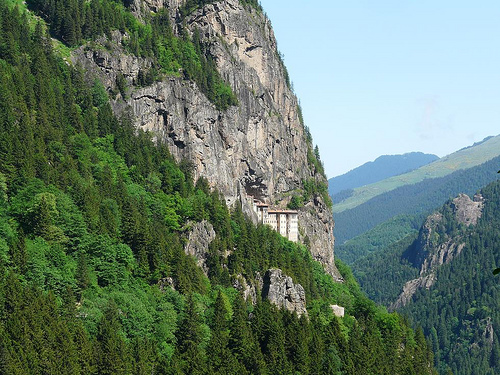
Location: 55 km (34 mi) Southeast of Trabson, Trabzon Province Map
Tel. (0462)230 19 66
Open: May- Oct: 8am- 6pm daily
Nov- Apr: 9am- 3pm daily
Sumela Monastery (Turkish: Sümela Manastırı; Greek: Moní Panagías
Soumelá or Panagia Soumela), also known as the Monastery of the
Virgin Mary (Meryem Ana), is one of the most dramatic and
historically significant Greek Orthodox monastic complexes in the
world. It clings precariously to a sheer cliff face at about 1,200
meters (3,900 ft) elevation in the Pontic Mountains, overlooking the
lush Altındere Valley in Maçka district, Trabzon Province,
northeastern Turkey. The site is now a museum and major tourist
attraction within Altındere National Park, but for over 1,500 years
it served as a vital center of Orthodox Christian worship,
pilgrimage, learning, and art in the Black Sea region (Pontus).
The name "Sumela" (or Soumela) likely derives from the Greek
"melas" (black), referring either to the dark, shadowed Karadağ
(Black Mountain) cliffs or the dark-hued icon of the Virgin Mary
housed there. An alternative theory links it to the Laz word for the
Trinity. The monastery is renowned for its gravity-defying
architecture—built organically into a natural cave—and its
miraculous icon of the Theotokos (Virgin Mary), traditionally said
to have been painted by the Apostle Luke himself. This icon, known
as the Panagia Gorgoepekoos ("She Who is Quick to Hear") or Panagia
Soumela, drew pilgrims for centuries.
Founding Legend and Early Byzantine Period (4th–6th Centuries)
The
exact founding date is uncertain and largely legendary, but Turkish
authorities and tradition place it around 386 CE during the reign of
Eastern Roman Emperor Theodosius I (r. 379–395). According to the widely
accepted legend, two Athenian monks—Barnabas and Sophronios (sometimes
described as uncle and nephew)—experienced visions or dreams in which
the Virgin Mary directed them to locate a sacred icon painted by St.
Luke. The icon had reportedly been supernaturally transported to a cave
high in the Pontic Mountains near a holy spring in the Altındere Valley.
The monks independently traveled there, met, recognized the shared
divine sign, and constructed the initial Rock Church inside the cave
along with two simple monastic cells. This cave-church remains the
spiritual and architectural core of the complex.
In the 6th century,
during the reign of Emperor Justinian I (r. 527–565), the monastery was
repaired and significantly enlarged by his famous general Belisarius.
Like many early Christian sites, it fell into ruin multiple times due to
invasions, natural disasters, or neglect, only to be restored by
successive Byzantine emperors. These early phases established Sumela as
a dedicated shrine to the Theotokos, blending ascetic monastic life with
pilgrimage.
Rise to Prominence: The Empire of Trebizond
(13th–15th Centuries)
Sumela reached its architectural and cultural
zenith under the Empire of Trebizond (1204–1461), a Byzantine successor
state founded by the Komnenos dynasty after the Fourth Crusade sacked
Constantinople. The Komnenoi positioned themselves as the true heirs of
Byzantium, and Trabzon became their capital. The monastery, already
ancient, was lavishly endowed and expanded.
The most transformative
period came during the reign of Emperor Alexios III Komnenos (r.
1349–1390). Legend claims that as a young man, Alexios was caught in a
violent storm at sea and saved by the intervention of the Theotokos, who
instructed him to restore and enlarge the monastery. He replaced earlier
wooden structures with stone, funded annual imperial support, and issued
a golden bull (chrysobull) in 1365. This imperial edict granted the
monastery extraordinary privileges: full autonomy, exemption from most
taxes and tributes, hereditary lands and dependents (including 40 named
serfs), and protection from local dukes and military obligations. His
son Manuel III continued the patronage, donating a relic of the True
Cross. By this era, Sumela included a library, chapels, kitchens,
guesthouses, and monastic cells, functioning as a wealthy,
semi-independent institution.
Frescoes in the Rock Church depicting
biblical scenes of Christ and the Virgin Mary date in part to this
Komnenian period, though many visible layers were overpainted later. The
complex now took on much of its present form, with buildings adapting
ingeniously to the uneven cliff ledge.
Ottoman Period (1461–Early
20th Century)
When Sultan Mehmed II conquered Trabzon in 1461, ending
the Empire of Trebizond, he issued orders protecting Sumela and granting
it special rights. Successive Ottoman sultans (including Bayezid II,
Selim I, and Selim II) renewed these privileges through firmans
(imperial decrees), allowing the monastery to thrive under Ottoman rule
as a center for the local Rum (Pontic Greek) Orthodox community. It
received support from distant patrons, such as the Voivodes (princes) of
Wallachia in the late 18th century.
Sumela expanded further in the
18th and 19th centuries. Most surviving frescoes on the inner and outer
walls of the Rock Church and adjacent chapels date to the 17th–18th
centuries (with major campaigns around 1710, 1732, and 1749 under
Archbishop Ignatios), featuring vivid biblical scenes, saints, and
symbolic depictions of heaven, hell, life, and death. Additional
structures were added, including a large 1840 building for monk cells
and pilgrims with a dramatic balcony overlooking the valley—showing some
Ottoman architectural influences. From 1682 until 1902, it even housed
the Phrontisterion of Trapezous, a prestigious Greek educational
institution that helped preserve Pontic Greek language, culture, and
Orthodox identity.
The site drew pilgrims—both Christian and
Muslim—who sought healing from the sacred spring. It remained active and
prosperous until the upheavals of the early 20th century, including the
Russian occupation of Trabzon (1916–1918).
Abandonment, Damage,
and Modern Revival (1923–Present)
Following the collapse of the
Ottoman Empire, the Turkish War of Independence, and the 1923 Treaty of
Lausanne, a massive population exchange occurred between Greece and
Turkey. The Greek Orthodox monks and community of Sumela were forced to
abandon the monastery. Before leaving, they hid the precious icon,
manuscripts, relics (including the True Cross), and other
treasures—reportedly in a nearby chapel dedicated to St. Barbara. A
devastating fire in 1930 destroyed the wooden elements, while treasure
hunters, vandals, and looters further damaged frescoes (through
graffiti, smoke, and physical destruction) and structures in subsequent
decades.
The hidden treasures were later recovered (around 1931) and
transferred to Greece with official approval. The icon eventually found
a home in a new Panagia Soumela Monastery built by refugees on Mount
Vermion near Kastania (Veria), Greece, where it remains venerated today.
In 1952 it was formally enshrined there.
The ruins came under Turkish
state protection in 1972 as a first-degree archaeological site and were
later placed on UNESCO’s tentative World Heritage list. Systematic
restorations began in the 1980s and intensified in the 2010s, funded by
the Turkish Ministry of Culture and Tourism. A major project (2015–2019)
addressed rockfall risks with netting and anchors, conserved frescoes
through cleaning and partial reintegration (without repainting),
repaired the aqueduct, and uncovered a secret tunnel leading to an older
hidden chapel with earlier murals. The monastery reopened to visitors in
2019 (partially in spring, fully later that year) and now serves
primarily as a museum, though occasional Orthodox liturgies are
permitted—most notably on the Feast of the Dormition (August 15).
Today, Sumela stands as a powerful symbol of Pontic Greek heritage,
Byzantine resilience, and cross-cultural endurance. Its breathtaking
setting, layered history spanning late antiquity to the modern era, and
restored frescoes continue to attract hundreds of thousands of tourists,
pilgrims, and scholars annually. While no longer a functioning monastery
in the traditional sense, it remains a living testament to the enduring
legacy of Orthodox Christianity in Anatolia.
Overall Layout and Engineering Adaptation to the Cliff
The
monastery is not a freestanding structure but an organic, multi-level
complex that exploits the irregular, steeply sloping cliff (with
sections at 70–90° angles). Buildings are carved into natural cavities
or constructed on narrow ledges, creating a labyrinthine, “palimpsest”
architecture that evolved over centuries. The core revolves around a
large natural cave converted into the central Rock Church (Katholikon).
Surrounding it are monks’ cells, chapels, kitchens, student rooms, a
guesthouse, a library, and a revered sacred spring. A prominent
multi-story residential block (often called the “barracks-like” or “new
building”) dominates the facade visible from the valley.
Access is
via a long, narrow external stairway ascending the cliffside, leading to
a guardroom at the entrance. From there, internal stairs descend to an
inner courtyard that serves as the heart of the complex. To the left of
the courtyard, in front of the cave, lie the primary monastery
buildings. Water is supplied by a large, multi-arched aqueduct built
against the cliff at the entrance (mostly restored in modern times). The
entire layout prioritizes defense, seclusion, and harmony with the
terrain—stone and brick masonry supports wooden roofs, balconies, and
galleries where the rock alone was insufficient.
Entrance,
Aqueduct, and Approach
The approach emphasizes drama and security.
Visitors climb a steep, narrow path and stairway that hugs the cliff.
The aqueduct—with its series of robust arches—stands out as a functional
and visual landmark, channeling mountain spring water into the complex.
A guardroom flanks the main entrance gate. This defensive layering
reflects the monastery’s history as a pilgrimage site that also needed
protection from raiders.
Rock Church (Katholikon) – The
Architectural and Spiritual Core
The Rock Church is the oldest and
most sacred element: a natural cave hollowed out and transformed into
the main church, with its apse partially constructed in brickwork that
projects outward. The cave forms the rear wall, while the front and
sides combine rock-cut surfaces with built masonry. Both interior and
exterior walls (along with those of an adjacent chapel) are covered in
frescoes. The church faces the courtyard, making it the visual and
functional focal point. Its design is intimate yet monumental, wedged
into the mountain’s corner.
Monks’ Cells, Residential Buildings,
and Supporting Structures
Monastic living quarters are among the most
striking features. The earliest cells occupy cavities on the north side
of the cave temple, forming a labyrinth of interconnected rooms,
chapels, and a bell tower. These are typically small (roughly 3m × 4m)
and stacked in 3–4 stories directly on the sloping rock. Later
expansions created a large, multi-story residential block (dated to
around 1840–1860, sometimes described as having up to 7 storeys
including cellars and a set-back top floor). This “barracks-like”
structure features rows of windows, balconies, galleries, and arches
under the eaves, housing monks’ cells, guest rooms, and communal
spaces—accounts mention up to 72 rooms total across the complex.
Kitchens, storage, student rooms, and a library occupy additional spaces
around the courtyard. The sacred spring is collected in a fountain with
distinctive pointed arches showing Ottoman influence.
Interior
details in the living quarters reveal practical adaptations: built-in
cupboards, wall niches, shelves, and fireplaces. Some later rooms show
Turkish architectural motifs.
Frescoes – Layers of Byzantine Art
The frescoes are the monastery’s artistic masterpiece and a key
architectural element, painted directly onto rock walls and plaster.
They cover the Rock Church’s inner and outer surfaces and adjacent
chapels in multiple layers from different periods:
Earliest
surviving layers date to the era of Alexios III of Trebizond (14th
century) on the inner wall facing the courtyard.
The adjacent chapel
has three distinct painting phases, with the uppermost (most visible)
from the early 18th century (inscriptions reference 1710–1732 and work
by Archbishop Ignatios in 1749).
A hidden chapel discovered during
2015–2017 restorations contains older, vibrant murals depicting
heaven/hell and life/death scenes.
Subjects are didactic and
devotional: scenes from the life of Christ (Annunciation, Nativity,
Baptism, Crucifixion, Resurrection), the Virgin Mary (including
Hodegetria and Dormition icons), apostles, Archangels Michael and
Gabriel, saints, and apocalyptic motifs. Styles blend Byzantine
iconographic traditions with vibrant colors and narrative cycles. While
some have suffered from vandalism, smoke, and weathering, recent
conservation has revealed previously hidden sections.
Architectural Influences and Evolution Over Time
Sumela’s
architecture is a Byzantine core with later accretions:
4th–6th
centuries: Founded c. 386 CE (legendarily by Athenian monks Barnabas and
Sophronios) as a simple cave church; restored under Justinian.
13th–14th centuries: Major expansion under the Empire of Trebizond
(Komnenos dynasty), reaching its essential form; Alexios III provided
endowments and autonomy.
Post-1461 Ottoman era: Protected by sultans
(Mehmed II onward); Turkish influences appear in details like
fireplaces, niches, cupboards, pointed arches on the fountain, and some
red-painted wall motifs resembling brickwork.
19th century:
Significant rebuilding after fires; addition of the large residential
block.
Modern era: 2015–2017 restorations stabilized the rock,
conserved frescoes, and repaired structures using traditional materials
(local stone, wood) while distinguishing new interventions. A secret
tunnel leading to an earlier chapel was uncovered.
Best Time to Visit
Ideal periods: Spring (May–June) or autumn
(September–October) for mild weather, lush greenery or golden foliage,
fewer crowds, and comfortable hiking.
Summer (June–August): Longest
hours and peak greenery, but busiest with crowds and higher prices.
Winter: Possible but colder, potentially slippery or partially closed
trails/areas; misty and atmospheric with fewer visitors, though access
can be limited by snow or fog.
Visit early morning (opens around 8–9
AM) to beat crowds and enjoy better light/photography. Allow 2–3 hours
on-site plus travel time.
How to Get There
Sumela lies ~45 km
(28 miles) south of Trabzon, about a 1-hour drive.
By car/taxi
(easiest and most flexible): Drive via D885/E97 through Maçka to
Altındere National Park parking. Private cars stop at the lower lot; an
official shuttle takes you closer (short ride, separate small fee). From
the shuttle drop-off, walk a scenic forest path with steps and handrails
(15–30 minutes, not too strenuous but uphill with some stairs).
Public transport: Trabzon to Maçka by dolmuş/minibus (frequent, ~30–40
min). Then taxi or local minibus to the park entrance (more limited in
winter/off-season). Summer has occasional direct dolmuş from Trabzon.
Guided tour: Most convenient from Trabzon—includes transport, often
other stops (e.g., Hamsiköy for rice pudding, Karaca Cave, Zigana Pass),
and a guide. Great for context on history/frescoes.
Pro tip:
Negotiate round-trip taxi fares from Maçka if needed. Roads wind through
beautiful forested valleys with waterfalls.
Tickets, Hours, and
Practicalities (as of 2026)
Opening hours: Typically 8/9 AM–5/7 PM
(longer in summer; ticket office closes ~30–60 min earlier). Confirm
locally as they vary seasonally or with restorations.
Entrance fee:
Around 50–450 TL per person for foreigners (varies by source; often
~70–125 TL or equivalent to ~20 EUR in older reports—check on-site or
official channels). Turkish citizens may use MüzeKart. Cash preferred;
shuttle extra.
No direct online booking for tickets in many cases—buy
at the entrance or park.
The Visit: What to Expect and Tips
From the shuttle, a pleasant forest trail (boardwalks, stone steps,
handrails) leads to the monastery. The approach reveals the dramatic
cliffside setting.
Inside/out:
Rock-cut main church with
frescoes (biblical scenes, Virgin Mary, angels—some well-preserved,
lower sections damaged by historical graffiti).
Inner courtyard, monk
cells, kitchen/bakery, terraces with epic valley views.
Narrow
passages and stairs—some areas may have restrictions due to ongoing work
or rockfall netting.
Visiting tips:
Footwear and fitness: Wear
sturdy, non-slip comfortable shoes. The path involves stairs and can be
wet/slippery (rain common in Black Sea region). Not extremely difficult,
but avoid if you have severe mobility issues or fear of heights.
Handrails help; take breaks on benches.
Weather and gear: Bring a
light jacket (cooler at altitude), rain jacket (frequent rain), water,
and snacks (limited facilities at top). Overcast/foggy days create
moody, photogenic conditions—soft light on frescoes and dramatic clouds.
Photography: No flash inside for fresco preservation. Best shots from
viewpoints, terraces, and the approach trail. Drones likely restricted.
Respect: Modest dress (cover shoulders/knees). It's a former religious
site—stay quiet in chapels.
Crowds and safety: Can get busy; early
arrival helps. Rockfall protections in place—follow signs. Limited
capacity in some inner areas.
Time and combining: Half-day trip easy;
pair with nearby sites for a full day. Fresh spring water available near
the base.
Health: Altitude is moderate; stay hydrated. No cafes at
the top—eat at the base restaurant if needed.
Additional Advice
Base in Trabzon (hotels, airport, restaurants). It's a great hub for
Black Sea exploration (e.g., Uzungöl Lake).
For deeper insight, hire
a local guide or join a tour—fresco details and history enrich the
experience.
Check current conditions (weather, openings) via official
tourism sites or your hotel before heading out, especially off-season.