Location: Burggasse 1, Feldkirch Map
Constructed: 1190 by Count of Montfort
Open: May- Oct: 9-
12am, 1:30- 6pm
Jan- Apr: 1-4pm
Entrance Fee: € 6,
children €4.50
Tel. +43(5522)71982
Website: www.schattenburg.at
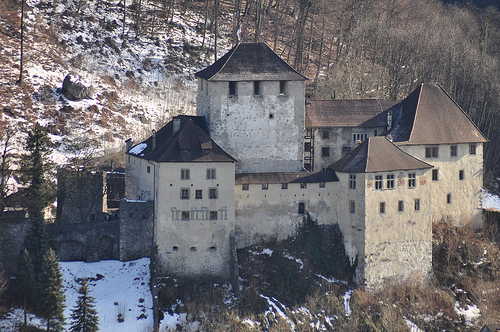
Schattenburg Castle is a medieval fortress perched on a side of a
mountain overlooking a town of Feldkirch below. Schattenburg Castle
was constructed in 1190 by Count Hugo I Montfort who also found a
town of Feldkirch below. Count used it an official seat of his
family as well as to control strategic and quiet lucrative trading
routes to the South and to the East of the castle. During Medieval
Period Schattenburg Castle was unsuccessfully besieged twice. Small
garrison managed to beat back all armies including the one sent by
Emperor Ludwig the Bavarian in 1345. Only with the break out of
Appenzell War (1401- 29) new military technologies finally broke
through the defenses of Schattenburg Castle. Count Friedrich von
Toggenburg brought heavy trebuchets that howled huge boulders
against thick walls, finally breaking them down. After 18 weeks of
constant bombardment Heinrich Walter of Ramschwag along with a
garrison of 38 men had to capitulate on 29 January 1406.
Subsequently Schattenburg Castle was burned down.
Schattenburg Castle was left untouched and without any major
renovations since the early 16th century. Today Schattenburg Castle
houses a and a museum devoted to its history with a collection of
medieval weaponry, religious art and costumes from the time period.
Early History and Construction (12th–13th Centuries)
The area
around Feldkirch had earlier fortifications. A castle called Muntifurt
(mentioned in the first half of the 12th century) may have existed as a
vassal seat under the Counts of Bregenz. Chronicles by monks Ortlieb and
Berthold reference Schattenburg as early as 1138.
The current
Schattenburg was constructed around 1200 by Count Hugo I of Montfort
(also known as Hugo von Montfort-Feldkirch). Hugo, grandson of the last
Count of Bregenz, strategically relocated his residence to control key
trade and mountain routes through the region. He is also credited with
founding the town of Feldkirch itself (first documented as a city in
1218).
The castle served as the primary seat and power base for the
Counts (later Dukes) of Montfort, who rose to become the dominant
aristocratic family in what is now Vorarlberg. It combined residential
quarters with strong defensive features: mighty walls, an impressive
keep (bergfried), romantic courtyards, and strategic positioning
connected to the town's fortifications.
Montfort Era and
Transition to Habsburg Rule (13th–14th Centuries)
For nearly 200
years, the castle was the ancestral home and administrative center of
the Montfort family. They expanded and fortified it, making it the heart
of their rule over Feldkirch and surrounding territories.
In 1375,
the last Montfort ruler of the Feldkirch line, Rudolf IV, sold the
lordship of Feldkirch (administered from Schattenburg) to Duke Leopold
III of Habsburg. Rudolf died in 1390, marking the end of direct Montfort
ownership.
The Habsburgs then used the castle as a fortress and
residence for their bailiffs (Vögte), who governed the region on behalf
of the Austrian dukes and later emperors. This period solidified its
role in regional administration and defense along the Rhine and Alpine
passes.
Later Medieval and Early Modern Periods (15th–18th
Centuries)
The castle saw various conflicts and changes in
overlordship:
From 1416 to 1436, rule was briefly interrupted when it
passed to the Counts of Toggenburg. During this time (around 1427 under
Count Friedrich von Toggenburg), Gothic additions like projecting
structures were made.
It endured wars and sieges, suffering damage
but undergoing repeated renovations.
By the 18th century, its
military importance declined. Habsburg bailiffs resided there until
around 1773.
19th Century: Decline and Municipal Ownership
After the Napoleonic era and shifts in Austrian administration, the
castle fell into disrepair. In 1825, the city of Feldkirch purchased it
from the state for 833 guilders (roughly the value of eight good
tournament horses). It was subsequently used as barracks and later as a
poorhouse or workhouse.
20th Century Restoration and Museum Era
In the early 20th century, local heritage efforts saved the castle. The
Feldkirch and District’s Museum and Folklore Preservation Society
(founded 1912) played a key role in restoring it to its former glory.
Extensive renovations preserved its medieval character, making it one of
the best-preserved medieval castle complexes in Central Europe.
Today, the castle is owned by the city of Feldkirch. It houses:
The
Schattenburg Museum (opened in its modern form through preservation
efforts).
A restaurant on the ground floor.
The museum features 18
rooms across three floors, each dedicated to aspects of Feldkirch and
Vorarlberg history. Exhibits include:
Medieval to WWII weapons
(one of Austria’s notable collections).
Period furniture, armor,
religious artifacts, traditional costumes (with a focus on women’s
headgear), engravings, paintings, and bourgeois interiors.
Rooms
highlighting Gothic architecture, bailiff’s offices, and local crafts.
It offers family-friendly experiences like quizzes and audio guides,
plus occasional guided tours.
Overall Layout and Defensive Architecture
The castle exemplifies
early medieval fortress design with later additions. Core early elements
include:
Mighty curtain walls, thick defensive structures, moats,
and drawbridges (original features).
The Bergfried (Keep): A
prominent, tall defensive tower (roughly 21 meters high in battlements).
It features a slightly trapezoidal or robust floor plan typical of
12th-13th century Romanesque military architecture, with thick walls for
strength. Today, it houses a weapons collection across four floors and
offers panoramic views from its upper gallery.
Inner Courtyard: A
romantic, enclosed space with restored wooden battlements, half-timbered
additions from later centuries, wooden stairs, galleries, and a
fountain. It blends stone fortifications with later domestic
architecture, creating a picturesque medieval atmosphere.
Architectural Styles
Schattenburg shows an evolution from Romanesque
military roots (solid, functional, thick-walled structures for defense)
to Gothic refinements (verticality, pointed arches, more light and
decoration) and some later Renaissance/Baroque influences in interiors
and fittings.
Exterior views reveal whitewashed or light stone walls,
brown/red tiled roofs, small functional windows (some with later
decorative elements like flower boxes), and projecting structures added
over time. It sits dramatically against a forested hillside with rocky
cliffs.
Key Interior Features and Rooms
The museum spans 18
rooms over three floors, each illustrating aspects of local history.
Many rooms retain original or reconstructed medieval/Gothic
architectural elements:
Gothic Room (High Gothic Interior): Features
a notable High Gothic ceiling. Projecting structures were added in 1427
under Count Friedrich von Toggenburg. It includes wood-paneled walls,
carved furniture, and religious sculptures.
Old Castle Chapel (Alte
Burgkapelle): Served as the chapel until 1614. Contains a significant
1507 fresco as its artistic highlight, exemplifying late Gothic
religious art.
Bailiff’s Office (Vogtei): High Gothic ceiling with
epitaphs (memorial plaques).
Palas (Small Hall): Reception or
administrative space tied to later lords (e.g., Counts of Hohenems from
1567).
Ladies’ Bower (Gräfinnenzimmer): Furnished to evoke a
countess’s quarters, with a canopy bed and cradle.
Other Rooms:
Include a bourgeoisie/music room, traditional costume room, Veduta
cabinet (baroque-style picture display of engravings and views of
Feldkirch), and spaces with period furniture, weapons, and artifacts.
Interiors often feature wooden floors, beamed or vaulted ceilings,
leaded windows, heraldic paintings (e.g., Montfort arms in the
Rittersaal/Knights’ Room, now part of the restaurant), and half-timbered
elements.
Later Modifications and Preservation
The castle
endured sieges, wars, and periods of neglect but was repeatedly
renovated. In the 18th–19th centuries, it declined and was used as
barracks or a workhouse before the city purchased it in 1825.
Restoration efforts by local societies in the early 20th century
preserved its medieval character while adapting it for public use.
It
combines the solidity of a 13th-century defensive residence with more
livable residential additions, making it an excellent example of how
noble seats evolved from pure fortifications to administrative and
domestic centers.
Getting There
Location: Burggasse 1, 6800 Feldkirch, Austria. It
towers above the old town and is connected to the historic city center
via the former city wall.
By foot (recommended): From Feldkirch train
station, it's an easy 10–15 minute uphill walk through the picturesque
old town. The climb adds to the medieval atmosphere.
By car: Parking
is available nearby (limited near the castle itself). Follow signs for
the castle or use GPS.
Public transport: Feldkirch is well-connected
by train (e.g., from Vienna, Innsbruck, Zurich, or Munich). Local buses
stop in the town center.
Pro tip: Combine your visit with a stroll
through Feldkirch’s old town (Marktgasse, etc.) for a full medieval
experience.
Opening Hours (as of 2026)
Summer (29 March – 31
October):
Daily 10:00 AM – 5:00 PM (last admission often earlier on
special evenings). Some Thursdays have extended hours until 7:30 PM.
Winter (November – March):
Monday: Closed
Tuesday – Saturday: 1:30
PM – 4:00 PM
Sunday & public holidays: 11:00 AM – 4:00 PM
Closed on 1 Nov, 24/25 Dec, and 1 Jan. Always check the official site
(schattenburg.at) for special closures or events.
Recommended visit
duration: 1.5–3 hours (museum + views + possible meal).
Ticket
Prices (2026)
Standard prices (includes all 18 museum rooms, chapel,
and keep):
Adults: €9
Seniors (65+): €8
Teenagers (12–17) /
Students (up to 26): €6.50
Pupils (6–11): €4.50
Children under 6:
Free
People with disabilities: €8 (or reduced)
Group rates
(10+ people) are slightly lower. Guided tours cost a flat fee (around
€95 during opening hours).
Discounts: Bodensee Card PLUS offers free
entry. Families and multi-attraction tickets may provide savings.
What to Expect During Your Visit
The self-guided tour takes you
through three floors of well-preserved rooms, each themed around
Feldkirch’s history, medieval daily life, crafts, weapons, furniture,
and folk culture. Information cards are available in German, English,
French, and Russian.
Highlights:
Extensive collection of weapons
and armor.
Original medieval interiors and artifacts.
The castle
chapel.
Climb the keep (tower) for panoramic views over Feldkirch,
the Rhine Valley, and the Alps — this is a major draw.
Rooftop
gallery and ramparts for photos.
The castle is atmospheric with
many stairs and uneven surfaces — wear sturdy, comfortable shoes and
prepare for some physical effort. It is not ideal for wheelchair users
or those with severe mobility issues.
Practical Visiting Tips
Best time to visit: Weekday mornings in shoulder seasons (spring/fall)
for fewer crowds. Afternoons can be busier, especially weekends. Aim to
arrive before 4 PM in summer to fully explore.
Weather: The hilltop
location can be windy or cooler. Bring layers. Rain makes cobblestones
slippery.
Photography: Allowed in most areas (check rules inside).
Sunset views from the ramparts are spectacular.
Guided tours: Highly
recommended for deeper insights. Available in multiple languages; book
ahead for groups. Public tours and family programs occur periodically.
Accessibility: Limited due to stairs and historic structure. Contact the
museum in advance if you need assistance.
With kids: Engaging for
history buffs; quizzes or family tours make it fun. The climb and views
appeal to children.
Dining and Amenities
The on-site
restaurant (in the castle) serves traditional Austrian cuisine with
great views. Many visitors praise the hot chocolate, full meals, and
medieval ambiance. It’s a nice spot for lunch or a break, though some
note it can feel touristy.
Nearby Attractions & Itinerary Ideas
Explore Feldkirch’s charming old town, cathedral, and river walks.
Day trip to Liechtenstein (Vaduz is ~20–30 minutes away).
Hike in the
surrounding Alps or visit other Vorarlberg highlights.
A full-day
plan: Train to Feldkirch → Old town → Schattenburg (2–3 hours) → Lunch →
More town exploration.