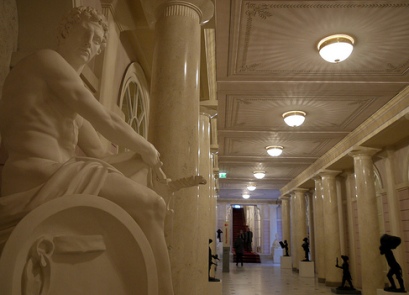
Michaelerkuppel- Feststiege
Tel. 01- 533 7570
Open: 9am- 5pm
The State Apartments (Staatsgemächer or Kaiserappartements) of the Hofburg Palace in Vienna, Austria, are a collection of opulent rooms within the former imperial winter residence of the Habsburg dynasty. Located in the Reichskanzleitrakt (Imperial Chancellery Wing) and the Amalienburg, these apartments served as the private and official living quarters of Emperor Franz Joseph I (r. 1848–1916) and Empress Elisabeth (“Sisi”) from the mid-19th century. Today, they form part of the Kaiserappartements museum, offering visitors a glimpse into Habsburg court life, imperial history, and the personal lives of Franz Joseph and Elisabeth. The apartments are complemented by the Sisi Museum and the Silver Collection, creating a comprehensive historical experience within the Hofburg complex at Michaelerplatz, 1010 Vienna.
Origins of the Hofburg and State Apartments
The Hofburg Palace,
constructed in the 13th century, evolved over centuries into the
sprawling imperial residence of the Habsburgs, serving as their winter
palace (Schönbrunn was the summer residence). The State Apartments, as
they exist today, were primarily shaped during the reign of Emperor
Franz Joseph I, who modernized and restructured parts of the
Reichskanzleitrakt and Amalienburg to suit the needs of the imperial
family in the 19th century. These rooms were designed for both private
residence and official duties, reflecting the Habsburgs’ dual role as
private individuals and public rulers.
Franz Joseph and Elisabeth
occupied these apartments from their marriage in 1854 until their deaths
(Elisabeth in 1898, Franz Joseph in 1916). The apartments were also used
by other Habsburgs, including Empress Maria Theresa in the 18th century,
whose influence is seen in the Amalienburg’s earlier decor. After the
fall of the Austro-Hungarian Empire in 1918, the Hofburg ceased to be a
royal residence, and the State Apartments were preserved as a historical
site.
Key Historical Context
Franz Joseph’s Reign: Known for
his disciplined lifestyle, Franz Joseph used the apartments for both
governance and daily life, conducting state affairs from his study while
maintaining a modest personal routine.
Elisabeth’s Legacy: Empress
Elisabeth, or “Sisi,” is a central figure in the apartments’ narrative,
with her rooms reflecting her beauty regimen, love of travel, and
complex relationship with court life.
Post-1918: The apartments were
opened to the public as a museum in the 20th century, with careful
preservation to maintain their 19th-century appearance.
The State Apartments are spread across the Reichskanzleitrakt (built
in the 18th century under Maria Theresa) and the Amalienburg (a
16th-century wing named after Amalia of Saxony). The architectural style
is predominantly Rococo and Biedermeier, with later 19th-century
modifications reflecting Franz Joseph’s preference for functionality
over extravagance. The rooms are richly decorated with gilded stucco,
chandeliers, tapestries, and period furniture, but they are less
ostentatious than other European palaces like Versailles, emphasizing
Habsburg restraint.
The apartments consist of 19 rooms, divided
into:
Franz Joseph’s Apartments: Official and private rooms used for
governance and daily life.
Elisabeth’s Apartments: Private quarters
reflecting her personal tastes and lifestyle.
Shared and Guest Rooms:
Spaces for court functions, family gatherings, and visiting dignitaries.
The rooms are accessed via a grand staircase in the Reichskanzleitrakt,
leading to a sequence of interconnected chambers designed for both
ceremonial and intimate purposes.
Notable Rooms
The State Apartments are organized to showcase the lives of Franz Joseph and Elisabeth, with each room meticulously restored to its 19th-century state. Below are the key rooms, grouped by their primary occupant or function:
Franz Joseph’s Apartments
Audience Chamber (Audienzzimmer):
Purpose: Where Franz Joseph
received subjects, including commoners, for petitions and official
audiences (up to 12 per day).
Features: A large portrait of the
emperor, gilded stucco ceilings, and a desk with his personal items. The
room reflects his accessibility as a ruler.
Historical Note: Franz
Joseph’s commitment to hearing petitions personally underscores his
bureaucratic diligence.
Conference Room (Konferenzzimmer):
Purpose: Used for meetings with ministers and advisors.
Features: A
long table, portraits of Habsburg rulers, and maps of the empire,
emphasizing governance.
Historical Note: This room hosted discussions
on key policies, including the 1867 Austro-Hungarian Compromise.
Study (Arbeitszimmer):
Purpose: Franz Joseph’s private workspace,
where he began work at 5 a.m. daily.
Features: A simple desk, family
photographs, and military memorabilia. The room’s austerity reflects his
disciplined lifestyle.
Historical Note: The emperor’s spartan
routine—rising early and working long hours—is evident here.
Bedroom (Schlafzimmer):
Purpose: Franz Joseph’s private sleeping
quarters.
Features: A modest iron bed, religious icons, and a
washstand, highlighting his asceticism despite his imperial status.
Historical Note: The emperor died in this room on November 21, 1916,
during World War I.
Valet’s Room (Kammerdienerzimmer):
Purpose: Quarters for Franz Joseph’s personal staff.
Features: Basic
furnishings, illustrating the proximity of servants to the emperor.
Elisabeth’s Apartments
Elisabeth’s Dressing and Exercise Room (Ankleide- und Turnzimmer):
Purpose: Where Sisi spent hours on her legendary beauty regimen,
including hairdressing and exercise.
Features: A wooden exercise
frame (rings and bars), mirrors, and hairdressing tools. The room
showcases her obsession with physical fitness and her ankle-length hair,
which took hours to maintain.
Historical Note: Sisi’s beauty routine
was both a personal passion and a public image strategy.
Elisabeth’s Bedroom (Schlafzimmer):
Purpose: Her private sleeping
quarters, used when she resided in Vienna.
Features: A canopied bed,
delicate Rococo decor, and personal items like her prayer book. The room
contrasts with Franz Joseph’s austerity.
Historical Note: Sisi spent
little time here, preferring to travel or stay at Schönbrunn.
Elisabeth’s Salon (Großer Salon):
Purpose: A private sitting room for
relaxation and receiving close family or friends.
Features: Elegant
Biedermeier furniture, portraits of her children (especially Crown
Prince Rudolf), and a bust of Sisi by Franz Xaver Messerschmidt.
Historical Note: The room reflects Sisi’s emotional distance from court
life and her focus on family.
Marie Valerie Apartment:
Purpose: Rooms for Sisi’s youngest daughter, Archduchess Marie Valerie,
who was particularly close to her mother.
Features: Delicate decor,
family portraits, and personal mementos.
Historical Note: Sisi’s
favoritism toward Marie Valerie is evident in the room’s prominence.
Shared and Ceremonial Rooms
Large Salon (Großer Salon):
Purpose: A formal reception room for
court events and family gatherings.
Features: Crystal chandeliers,
silk wall coverings, and large mirrors, creating a grand atmosphere.
Historical Note: Used for imperial birthdays and other celebrations.
Small Salon (Kleiner Salon):
Purpose: A more intimate space for
private family moments.
Features: Cozy furnishings and personal
touches, such as Sisi’s watercolors.
Dining Room (Speisezimmer):
Purpose: Where the imperial family dined, often in formal settings.
Features: A long dining table, silverware from the Silver Collection,
and portraits of Habsburg ancestors.
Historical Note: Franz Joseph
preferred simple meals, contrasting with the room’s opulence.
Alexander Apartment:
Purpose: Guest rooms named after Emperor
Alexander I of Russia, who stayed here during the 1815 Congress of
Vienna.
Features: Rococo decor, including frescoed ceilings and
gilded moldings, reflecting 18th-century splendor.
Historical Note:
These rooms highlight the Hofburg’s role in European diplomacy.
Cultural and Historical Significance
Habsburg Legacy
The State Apartments are a tangible link to the
Habsburg dynasty, which ruled much of Europe for centuries. They
illustrate the personal and political lives of Franz Joseph and
Elisabeth, whose reigns shaped the Austro-Hungarian Empire’s final
decades. The contrast between Franz Joseph’s disciplined simplicity and
Sisi’s elusive, glamorous persona is a central narrative, offering
insights into the monarchy’s internal dynamics.
Sisi Mythology
The apartments, particularly through the Sisi Museum, contribute to the
enduring fascination with Empress Elisabeth. The museum, located in the
adjacent Stephansturm, displays personal items like her gowns, jewelry,
and exercise equipment, debunking myths while highlighting her complex
personality—her beauty, her aversion to court protocol, and her tragic
assassination in 1898.
Silver Collection
The Silver
Collection, included in the Kaiserappartements ticket, showcases the
imperial household’s dining culture. Housed in the Reichskanzleitrakt,
it features thousands of items, including Meissen porcelain, Sèvres
tableware, and gold-plated cutlery, used for state banquets. Highlights
include the 30-meter-long Milanese centrepiece and the vermeil
tableware, reflecting Habsburg wealth and diplomatic grandeur.
Architectural and Artistic Value
The apartments’ Rococo and
Biedermeier decor, combined with portraits by artists like Franz Xaver
Winterhalter and sculptures by Messerschmidt, make them a treasure trove
of 18th- and 19th-century art. The preservation of original furnishings
and personal items enhances their authenticity.
Visitor Information
Location and Access
Address: Hofburg, Michaelerkuppel, 1010
Vienna, Austria.
Public Transport:
Subway: U3 to Herrengasse or
U1/U3 to Stephansplatz.
Tram: 1, 2, D, 71 to Burgring.
Bus: 1A, 2A
to Michaelerplatz.
Hours: Daily, 9 a.m.–5:30 p.m. (July–August until
6 p.m.; closed on select holidays like December 24–25).
Admission
(2025 prices, subject to change):
Adults: €18 (includes Sisi Museum,
State Apartments, Silver Collection).
Students/Seniors: €17.
Children (6–18): €11.
Audio Guide: Included in ticket price
(available in multiple languages).
Guided Tours: Private tours
available via advance booking (office@kaiserappartements.at).
Website: www.kaiserappartements.at
Visiting Tips
Duration:
Allow 1.5–2 hours to explore the Sisi Museum, State Apartments, and
Silver Collection.
Route: The visit begins with the Sisi Museum,
followed by the State Apartments, and concludes with the Silver
Collection. The audio guide provides detailed commentary.
Photography: Non-flash photography is permitted, but tripods and video
recording are prohibited.
Accessibility: The apartments are partially
accessible for wheelchair users (elevators available; contact staff for
assistance). The Sisi Museum and Silver Collection are fully accessible.
Best Time: Visit early morning or late afternoon to avoid crowds,
especially in peak tourist seasons (summer, December).
Combined
Tickets: Consider the Sisi Ticket (€44 adults, 2025) for access to the
Kaiserappartements, Schönbrunn Palace, and the Imperial Furniture
Collection.
Nearby Attractions
Hofburg Complex: Includes the
Imperial Treasury, National Library, and Spanish Riding School.
Augustinian Church: Adjacent, known for Habsburg weddings and the
Herzgruft.
Albertina Museum: A short walk, housing a world-class art
collection.
St. Stephen’s Cathedral: Vienna’s Gothic landmark, 10
minutes away.
Cultural and Historical Context
The State Apartments encapsulate the twilight of the Habsburg
monarchy, a period marked by political challenges (e.g., the 1848
revolutions, World War I) and cultural flourishing (Vienna’s music, art,
and coffeehouse culture). They contrast with Schönbrunn’s grandeur,
offering a more intimate perspective on imperial life. The preservation
of Franz Joseph’s spartan quarters alongside Sisi’s elegant rooms
highlights the monarchy’s duality—duty versus individuality.
The
apartments also reflect Vienna’s role as a European cultural capital.
The Hofburg’s proximity to institutions like the Vienna State Opera and
Kunsthistorisches Museum underscores its centrality to the city’s
heritage. The Sisi Museum, in particular, engages with modern historical
scholarship, presenting Elisabeth as a multifaceted figure rather than a
romanticized icon.